San Giovanni a Mare: A Medieval Romanesque and Byzantine Church in Gaeta
Site at a Glance
- Rating
- 4.4
- Popularity
- Very Low
- Country
- Italy
- Primary era
- Medieval
- Eras represented
- Classical, Medieval, Early Modern
- Civilizations
- Kingdom of Naples, Roman
- Site type
- Religious
- Remains
- Church
On this page9 sections
History
San Giovanni a Mare is a Roman Catholic church in Gaeta, Italy, dedicated to Saint John the Evangelist. Built by the medieval community of Gaeta between the late eleventh and early twelfth centuries, it combines Romanesque architecture, a medieval style known for substantial masonry and rounded forms, with Byzantine influences. The church belongs to the parish of the Cathedral of Saints Erasmus and Marcian and Saint Mary of the Assumption, within the Archdiocese of Gaeta, the Catholic territorial jurisdiction headed by the archbishop.
Medieval foundation and rebuilding
The present church occupies the site of an older place of worship, probably built in the tenth century by John IV, a medieval duke of Gaeta. Reused architectural elements, likely taken partly from that earlier building, were incorporated into the later structure. Construction began between the late eleventh and early twelfth centuries, while the building history continued through the thirteenth century.
An earthquake in 1213 led to repairs and alterations. The church originally stood outside Gaeta’s city walls, occupying a position associated with the settlement’s medieval expansion. During the fourteenth and fifteenth centuries, its walls received fresco decoration that contributed to the church’s religious and artistic character.
Guild support and early modern changes
For many years, the carpenters’ guild supported the church, which became popularly known as San Giuseppe. The guild’s confraternity of Saint Joseph had been documented before 1626 and was formally founded at San Giovanni a Mare in 1628. This association shaped the church’s later identity alongside its dedication to Saint John the Evangelist.
Several side altars were added during the Baroque period, a seventeenth- and eighteenth-century style associated with elaborate architectural and decorative effects. A new main altar followed in the eighteenth century, when the facade also acquired its principal later form.
Restoration, damage, and renewed use
A major restoration promoted in 1928 by Pietro Fedele, Minister of Public Education, and directed by Gino Chierici, superintendent for medieval and modern art in Campania, aimed to bring the church closer to its earlier appearance. The internal Baroque decorative scheme was removed, and the main altar was transferred to Santa Maria della Catena.
San Giovanni a Mare suffered severe damage during the Second World War. It continued to serve as a church and concert venue until approximately 1975–1980. Restoration campaigns took place during the 1970s and again between 1998 and 2000. After closing in 2005, the church underwent comprehensive internal and external restoration between 2014 and 2015. It reopened for worship and was consecrated by Fabio Bernardo D’Onorio, Archbishop of Gaeta, on 24 October 2015.
Remains
Exterior and dome
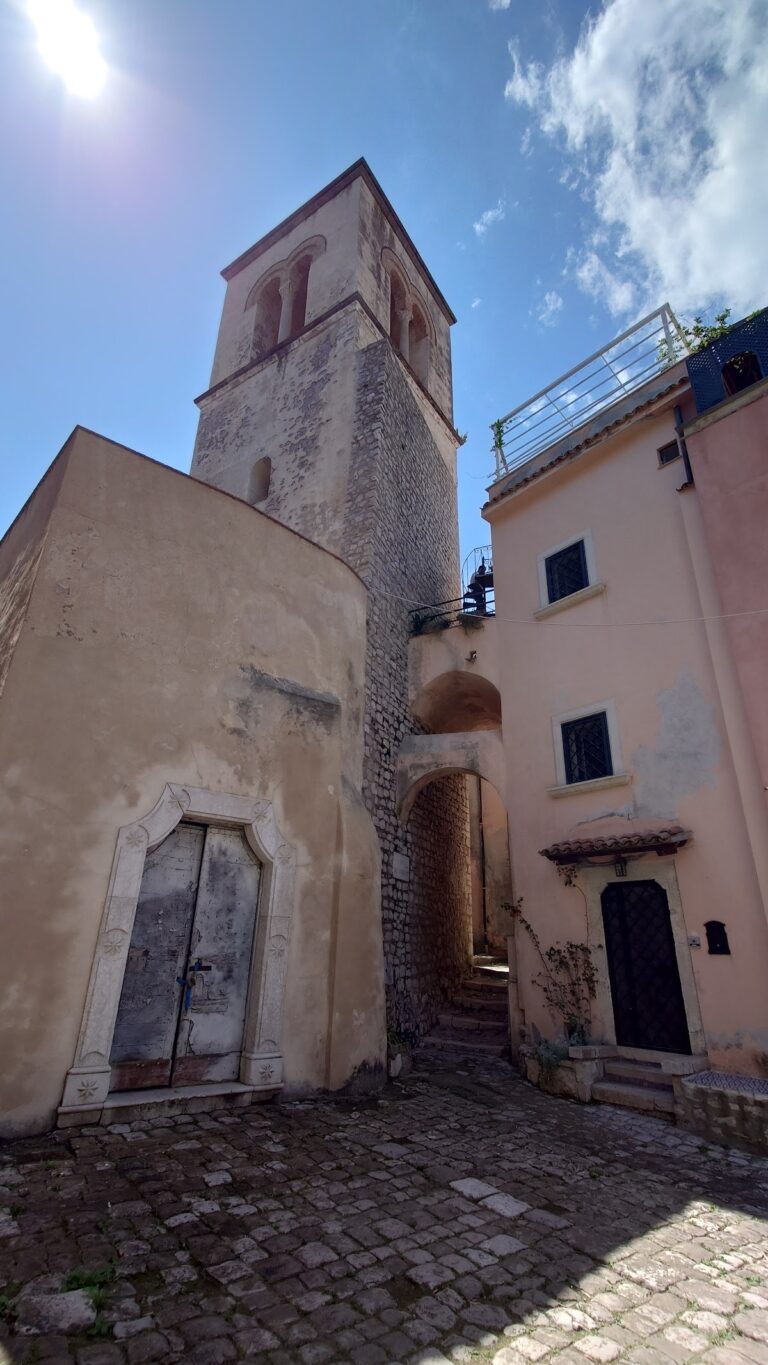
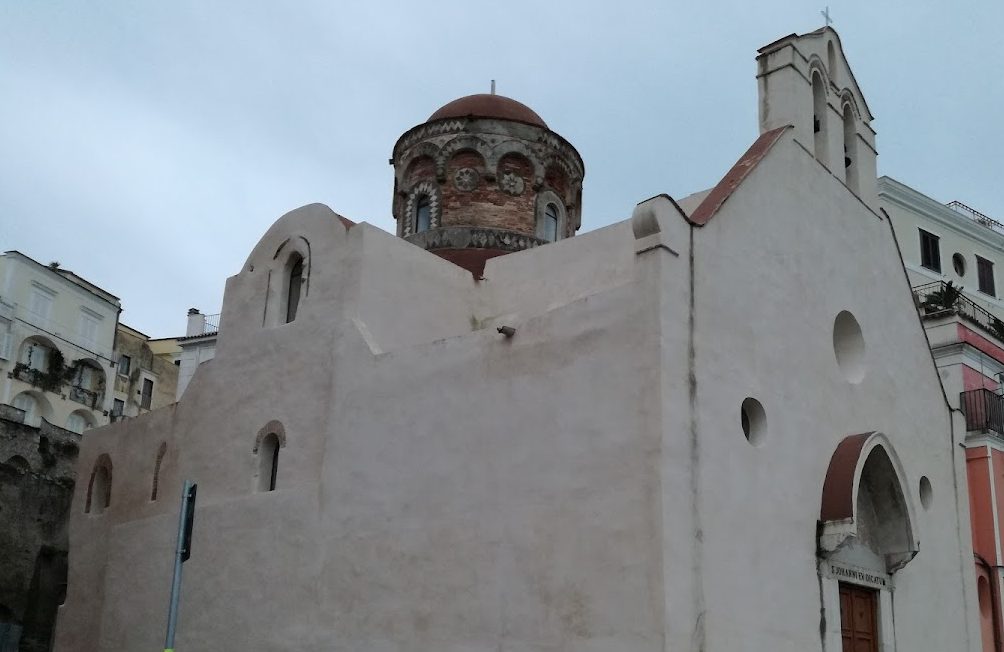
The exterior remains readable as a unified Romanesque and Byzantine structure and is attached to neighboring buildings on its right side. The gabled facade rises to a double-pitched summit whose sides end in faint volutes. Above it stands a bell gable with three pointed-arch openings and brick cornices. Two bells occupy the openings, corresponding to the notes D4 and G4.
The central portal is topped by a suspended porch and a lunette containing a deteriorated fresco, probably depicting Saint John the Evangelist. At the crossing of the central nave and transept rises a dome dated to the late eleventh or early twelfth century. Its tall drum, the supporting structure beneath a dome, is decorated with Byzantine-style geometric inlay in two colors of marble. The dome was probably originally covered with polychrome roof tiles.
Interior layout and presbytery
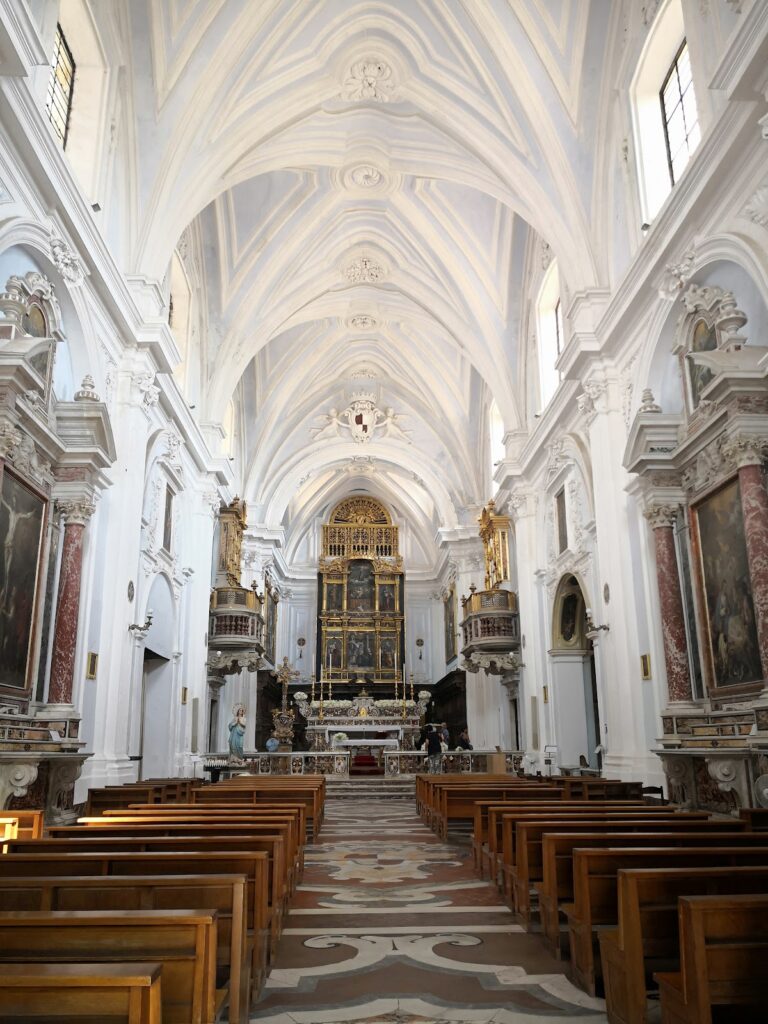
The interior is arranged in three aisles, each divided into four bays. A transept that does not project beyond the side walls lies between the second and third bays, while the bays are covered by groin vaults, formed by the intersection of two barrel vaults. Eight reused columns of different styles and dimensions separate the aisles, reflecting the incorporation of earlier architectural material.
Each aisle ends in a semicircular apse. The central apse is occupied by the presbytery, the area reserved for the altar and clergy, which rises several steps above the rest of the church. Its altar front is made from the front section of a second- or third-century sarcophagus. The panel bears a cross, geometric motifs, and rosettes between two hippogriffs, mythical creatures with the foreparts of eagles and the hindquarters of horses, each holding a lighted candelabrum.
A small section of the original medieval floor survives near the presbytery. The floor slopes toward the entrance, a design that strengthened the interior perspective and allowed seawater to drain during flooding.
Medieval frescoes
The left apsidal chapel is covered by a fresco of the Virgin and Child accompanied by Saint John the Evangelist, the Archangels Gabriel and Michael, and an unidentified figure. In the first bay of the left aisle, a Coronation of the Virgin survives with a small portion of an underlying Crucifixion and part of the vault decoration.
The fourth bay of the left aisle contains a probable Deesis, a devotional image centered on Christ and accompanied by figures praying or interceding. It is represented by a seated figure on a throne and another figure below in a posture of prayer. The fourth bay of the right aisle preserves a fragment of a saint holding a book, probably the Archangel Gabriel from a larger Annunciation.
Other medieval frescoes, including the Visitation, the Virgin and Child with Saint Lawrence, and Saint Agatha, were detached and transferred to the Gaeta Diocesan Museum. The Virgin and Child with Saint Lawrence has been attributed to Pietro Cavallini, a major Italian painter and mosaicist of the late thirteenth and early fourteenth centuries.
Former organ
A late-nineteenth-century pipe organ of the Neapolitan school, the artistic tradition associated with Naples, once stood on the floor in the apse behind the main altar. Restoration work during the 1970s led to its removal and disposal.