Santissima Annunziata: Gaeta’s Medieval Church and Baroque Sanctuary


Site at a Glance
- Rating
- 4.8
- Popularity
- Very Low
- Country
- Italy
- Primary era
- Early Modern
- Eras represented
- Medieval, Early Modern
- Civilizations
- Kingdom of Naples, Spanish
- Site type
- Religious
- Remains
- Church
On this page13 sections
History
Santissima Annunziata is a medieval church and sanctuary in Gaeta, Italy, founded in 1320 outside the city walls as a church associated with a hospital. Its original fabric was Gothic, while its present appearance is predominantly Neapolitan Baroque. The bishop of Gaeta, Francesco Bruno, authorized the construction of the hospital complex and its church-ward on 2 May 1321. The church was consecrated on 11 May 1354, and hospital activity began in the following year.
Church and Hospital
The hospital expanded repeatedly over the following centuries. A large ward with a barrel-vaulted roof was added in the sixteenth century, and the complex also included an orphanage. Its seventeenth-century pharmacy was regarded as one of the most important in the Kingdom of Naples. During the sixteenth century, the wealthy Gaetan Giuliano Colojna gave the church Andrea Sabatini’s large multi-panel altarpiece, while the Chapel of the Immaculate Conception received a cycle of paintings.
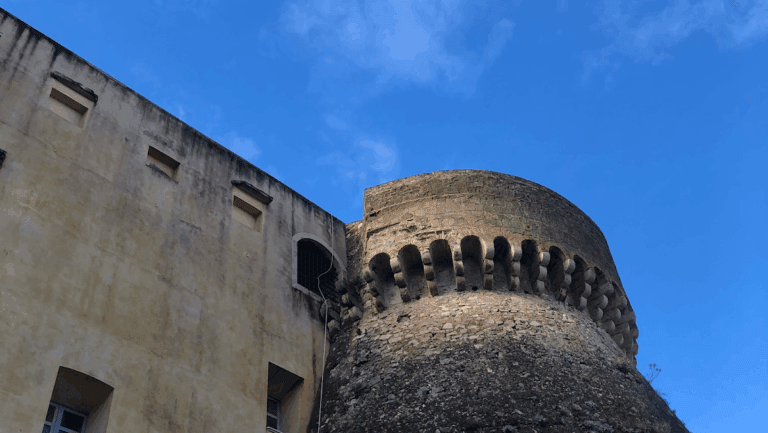
In 1536, part of the church was demolished and altered to make room for bastions constructed for Gaeta under Charles V, Holy Roman Emperor. Those defensive works no longer survive. The church’s hospital function eventually ended after its Baroque renewal, and the building became solely a church dedicated to the Virgin Mary.
Baroque Renewal
A comprehensive Baroque transformation began in 1621 and continued until 1677. The work involved the Neapolitan architect and marble worker Andrea Lazzari, his son Jacopo, and their relative Dionisio. Andrea designed the facade, Jacopo created the Chapel of the Holy Sacrament, and Dionisio organized much of the interior. During the seventeenth century, Colangelo Vinaccia of Massa produced the wooden choir stalls, and the two side altars were installed.
Giuseppe de Martino built the organ for the left choir gallery between 1685 and 1689. A second organ was acquired from the cathedral because the Annunziata institution could not afford another new instrument. The church and its artworks later faced danger during both World Wars. In 1927, the principal organ was moved into the screened Orfanelle choir above and behind the main altar, where concealment protected it from lead thieves. It returned to the church in 1980, was placed below the left gallery, and was restored and returned to its original position in December 2009.
Sanctuary and Pro-Cathedral
The sanctuary belongs to the Archdiocese of Gaeta and to the parish associated with the Cathedral of Saints Erasmus and Marcian and Saint Mary of the Assumption. While the cathedral underwent restoration, Santissima Annunziata temporarily served as a pro-cathedral from 2008 until 27 September 2014. A pro-cathedral is a church that temporarily performs the functions normally associated with a cathedral. Santissima Annunziata was elevated to sanctuary status in 2009 and was twinned with the sanctuary at Lourdes.
The church also preserves an important music library containing dozens of handwritten codices with miniatures. Its artistic and musical holdings reflect the long development of the institution from hospital church to Marian sanctuary.
Remains
Exterior and Medieval Fabric
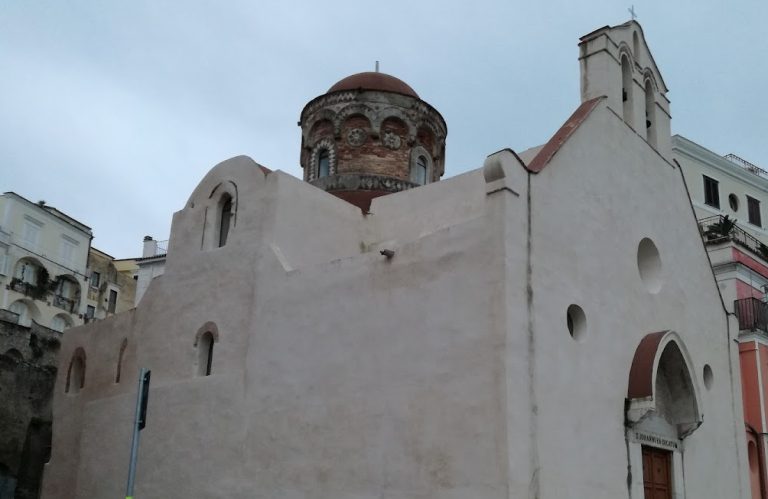
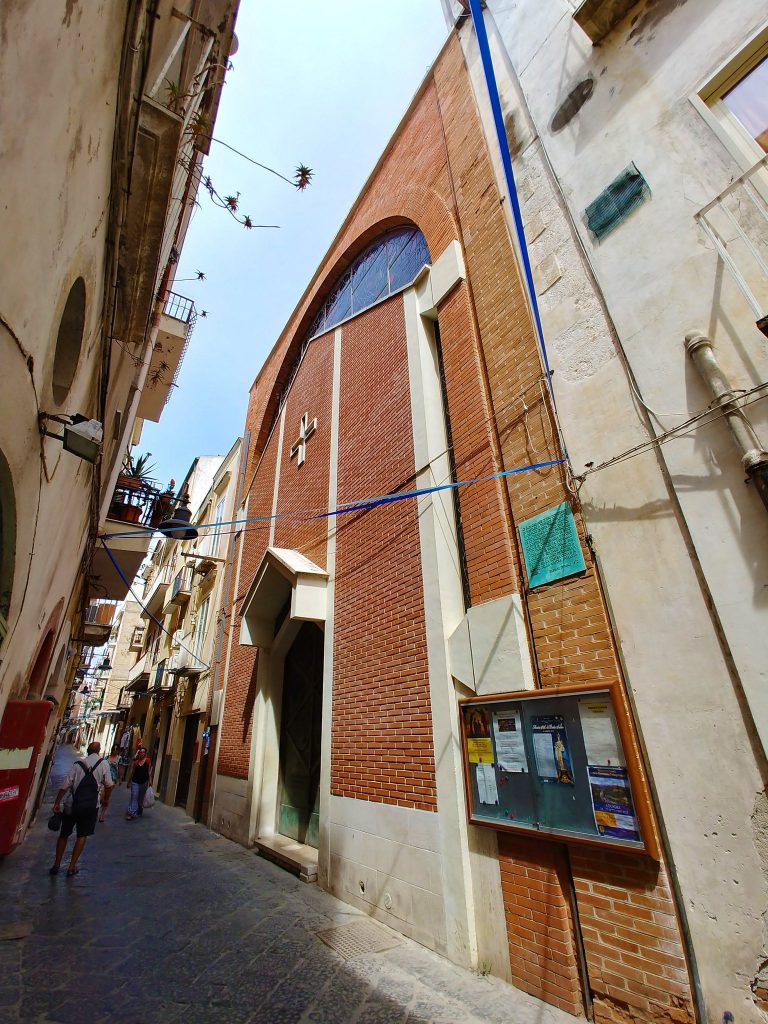
Santissima Annunziata stands in Gaeta’s historic center between Via Annunziata and the Giovanni Caboto waterfront. Andrea Lazzari’s tall facade faces the small square linking Via Annunziata with the waterfront. Large cornices divide it into three orders. The lowest has the main portal, the middle contains a large window, and the upper order ends in a sail-shaped bell gable, a wall-like structure with openings for bells, fitted with a glazed ceramic clock made by Matteo De Vivo of Naples. Two rectangular niches flank the lower and middle orders and were intended for statues of saints that were never made.
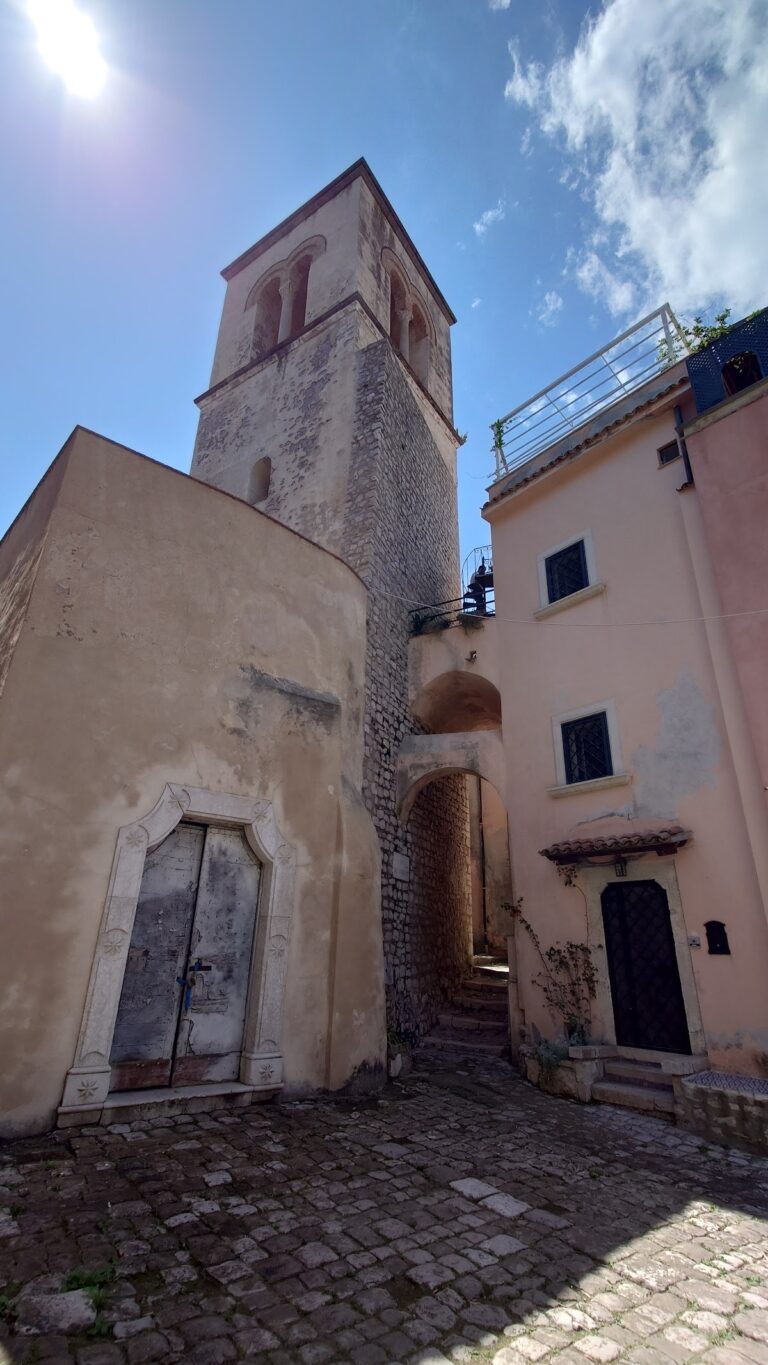
The waterfront side exposes the internal arrangement of the church, with a single nave covered by cross vaults. A cross vault is formed by the intersection of two barrel vaults. Pointed lateral arches remain visible, each corresponding to a rectangular window. Above the right side of the apse rises a medieval sail-shaped bell tower decorated with black-and-white marble and containing three Renaissance bells. The side facing Via Annunziata retains the ancient Gothic portal. Its architrave carries a dedication plaque naming the dedication and the year construction began, while a fresco above it depicts the Annunciation, the Christian account of the angel Gabriel’s announcement to Mary that she would conceive Jesus.
Nave and Altars
Entrance Bay
The narrow, high interior is arranged as a single nave divided into four bays and covered by cross vaults. Its pavement bears the coats of arms of Gaeta. In the first bay are two mid-seventeenth-century holy-water basins made of polychrome marble, the large coat of arms of Gaeta on the counterfacade below the window, and the Gattola Crucifix in a niche on the left wall. The counterfacade is the interior wall opposite the main altar. Two nineteenth-century confessionals stand in the same bay, together with paintings of Saint Apollonia and Saint Lucy. The painting of Saint Apollonia may be an early work by Giovanni Filippo Criscuolo, while the Saint Lucy is attributed to the school of Sebastiano Conca.
Side Altars
The second bay contains two side altars designed by Dionisio Lazzari. Luca Giordano’s large canvases occupy them, with the Crucifixion on the left and the Adoration of the Shepherds on the right. Smaller paintings above the altars show the Glory of Saint Dominic with Saint Peter Martyr and Saint Francis of Paola, together with Saint Anne and Saint Joachim. These works are also by Giordano.
Holy Sacrament Chapel
The third bay contains the Gothic side portal and a small painting of the Annunciation on the left. On the right is the Chapel of the Holy Sacrament, built by Jacopo Lazzari. Its small balustrade and altar are accompanied by a painted vault by Andrea Scapuzzi, a tabernacle by Lazzari, and Giacinto Brandi’s altarpiece of the Madonna and Child. Two paintings by Jusepe de Ribera, the Mater Dolorosa and the Deposition, formerly stood beside the altar but were stolen during the Second World War.
Choir Galleries and Presbytery
The fourth bay contains two choir galleries designed by Dionisio Lazzari. They were originally intended to be built in stone, but financial constraints led to their construction in wood painted to imitate marble. The presbytery occupies the apse and the final bay of the nave and is enclosed by a polychrome-marble balustrade by Lazzari. Beneath the apse arch stands his large main altar, decorated with floral motifs. Its tabernacle bears a white Carrara-marble cherub and is surmounted by a Lazzari Crucifix.
The apse contains large carved wooden choir stalls. Beneath the rectangular side windows are two paintings by Sebastiano Conca dated 1720, depicting the Presentation of Jesus in the Temple and the Adoration of the Magi. The rear wall is dominated by Andrea Sabatini of Salerno’s 1521 polyptych, a multi-panel altarpiece arranged in horizontal tiers. Its central panel depicts the Annunciation. The lower tier shows the Nativity, Saint Sebastian, the Holy Face of Jesus, Saint Augustine, and the Adoration of the Magi. The middle tier presents the Descent of the Holy Spirit, the Annunciation between Saints John the Baptist and Peter, and the Ascension. The upper tier shows Saint Ambrose, the Death and Assumption of Mary, and Saint Jerome. Above it, a grille encloses the Orfanelle choir, a screened choir associated with orphan girls, with Gaeta’s coat of arms at its center supported by cherubs.
Historic Organ
Giuseppe de Martino’s pipe organ occupies the left choir gallery. Built between 1685 and 1689, it has a gilded wooden case designed by Dionisio Lazzari. The instrument operates through its original suspended mechanical action and has one 48-key keyboard and a straight 11-note pedalboard. Both keyboards have a chromatic first octave lacking C-sharp. The Contrabassi 16-foot stop was added in the nineteenth century and remains permanently engaged.
The richly decorated Baroque case contains carved sculptures and reliefs inspired by the facade of Santa Maria del Faro in Naples. Its front is divided into three sections, with the central section crowned by a round arch. Each division contains non-original display pipes from the Principal 8-foot stop, whose mouths are arranged in horizontal mitre shapes.
Golden Chapel
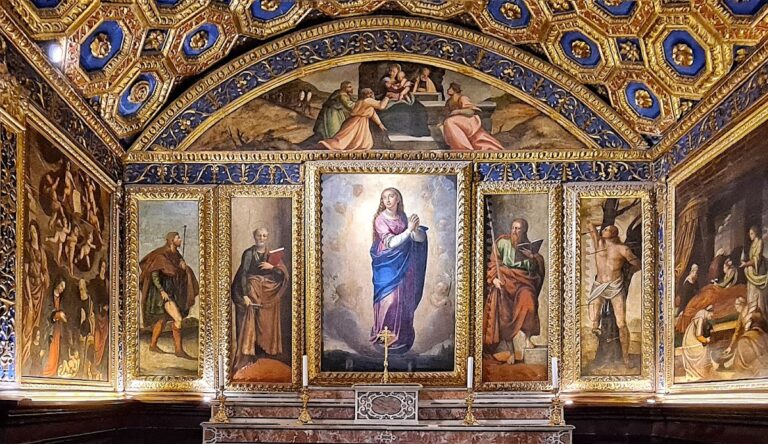
Behind the apse stands the Chapel of the Immaculate Conception, also called the Golden Chapel or Golden Grotto. It has an independent entrance on Via Annunziata, with a Baroque portal attributed to Dionisio Lazzari and surmounted by Gaeta’s coat of arms. The chapel dates from the fourteenth century, or more broadly from the fourteenth to fifteenth centuries. Originally covered entirely with frescoes, it was remodeled in the Baroque style during the sixteenth century.
Giovanni Filippo Criscuolo and possibly his pupils decorated the chapel with an eighteen-part cycle showing episodes from the lives of Jesus and Mary, together with scenes from the Old Testament. The altar polyptych has Scipione Pulzone’s central Immaculate Conception of 1582, four paintings by Criscuolo depicting Saints Roch and Peter on the left and Saints Paul and Sebastian on the right, and a Criscuolo lunette showing the Adoration of the Magi. The chapel’s name derives from its gilded ceiling and frames. Its ceiling is a richly gilded, coffered wooden vault with floral decoration on a blue ground.
Pope Pius IX regularly prayed in the Golden Chapel during his stay in Gaeta in 1848 and 1849. A prayer before Pulzone’s Immaculate Conception on 8 December 1848 is traditionally associated with his decision to pursue the dogmatic proclamation of the Immaculate Conception in 1854. This Catholic doctrine holds that Mary was preserved from original sin from the first moment of her conception. During his time in Gaeta, Pius IX also wrote the encyclical Ubi primum, seeking episcopal responses concerning the proposed dogma.