Santa Maria della Mercede: A Mercedarian Church in Palermo
Site at a Glance
- Popularity
- Medium
- Country
- Italy
- Primary era
- Medieval
- Eras represented
- Medieval, Modern
- Civilizations
- Italian, Kingdom of Sicily, Spanish
- Site type
- Religious
- Remains
- Church
On this page13 sections
History
Santa Maria della Mercede, also known as Santa Maria della Mercede al Capo, is a Mercedarian church in Palermo, Italy. The Mercedarians built it nearby after leaving Sant’Anna di Porto Salvo in 1482.
Origins and arrival in Sicily
Tradition holds that the Virgin Mary appeared to Peter Nolasco on the night of August 1–2, 1218, prompting the foundation of the Order of Santa Maria della Mercede in Barcelona under King James I of Aragon. The Roman Catholic order sought to free Christians held in slavery, and its members vowed chastity, poverty, and obedience. Pope Gregory IX recognized it in 1230.
In 1463, King John II of Aragon allowed the Mercedarians to settle in Sicily and gave them Sant’Anna di Porto Salvo in Palermo’s Capo district. This Norman-period church, known by that name by 1088, stood above the old port near the Papireto River, which extended the port as a canal. A confraternity of embroiderers and makers of fringes and trimmings was active there by 1482. Following disputes with the confraternity, the Mercedarians left Sant’Anna and built their church nearby.
Confraternities and devotion
A lay devotional association called the Company of Santa Maria la Mercè was founded on November 19, 1590, to promote devotion to the Virgin as Mary of Mercy. Its statutes entered the public record on June 1, 1683. In 1622, the Mercedarians in Sicily divided into shod and barefoot branches, distinguished by whether their members wore shoes. The Company acquired land in Capo in 1635 for a convent and associated church. A confraternity dedicated to Mary Most Holy of Mercy, popularly called the Wednesday confraternity, began on June 16, 1694.
In 1813, the Company commissioned sculptor Girolamo Bagnasco to make a Madonna statue, stipulating that it should surpass an earlier statue in beauty. Professor G. Correnti restored it in 1997.
Suppression and survival
Suppressive legislation led to the Mercedarians’ expulsion from Palermo in 1866. The church returned to worship in 1882, and women joined its confraternity in 1885 to care for the building and the Madonna statue. The Confraternity of the Mercede al Capo was established in 1914.
In the early twentieth century, commercial redevelopment brought the demolition of the convent buildings, including construction associated with the Cassa di Risparmio, later the Banco di Sicilia. The church remained as the surviving part of the complex. Processions bearing a Madonna statue take place on the last Sunday of September, continuing the Company’s devotion.
Remains
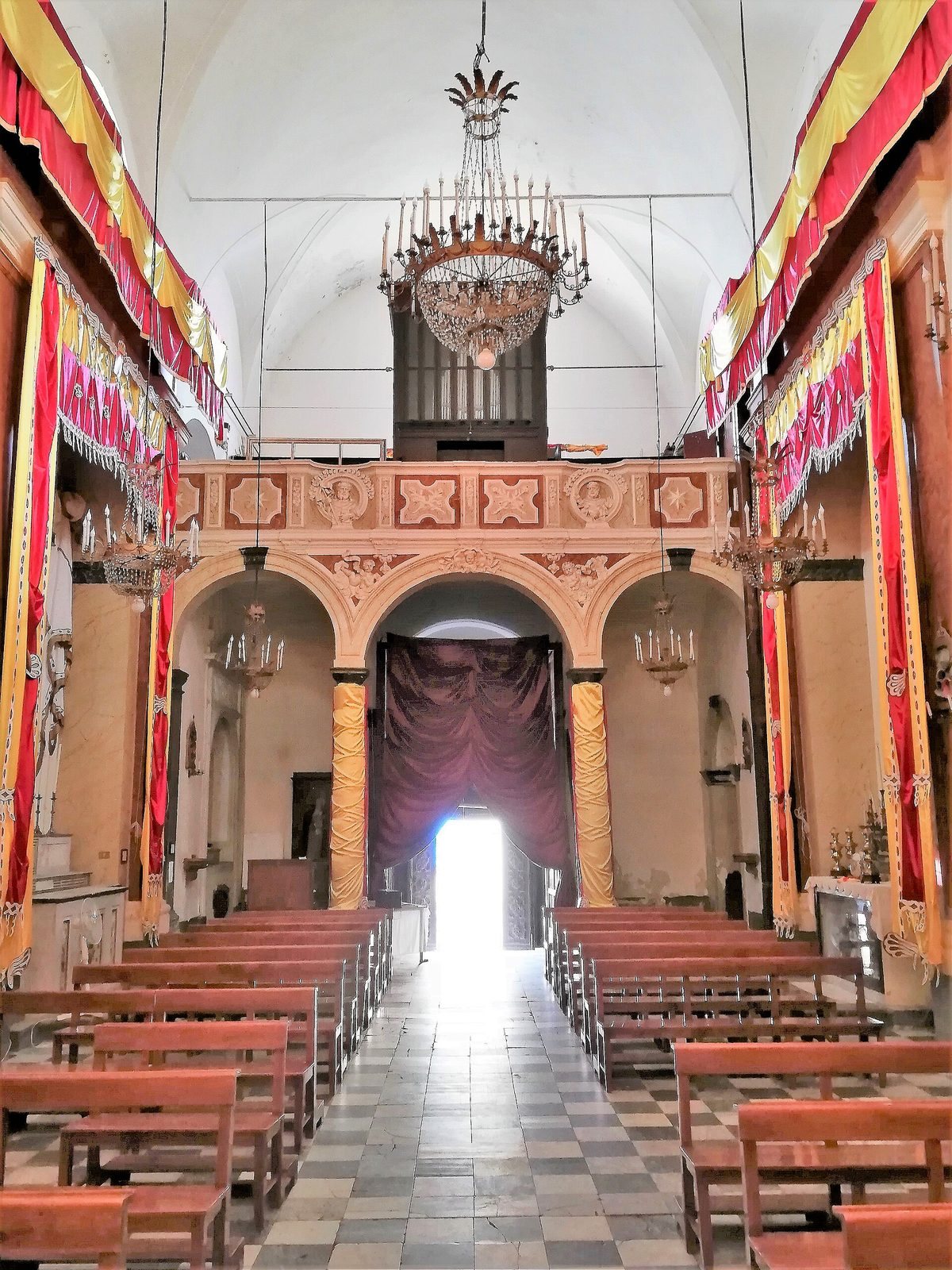
The church is arranged around a single nave, the main central space, with chapels along both sides. Pilasters, shallow columns attached to the walls, separate the chapels. Reddish-brown stucco highlights the pillars and pilasters, as well as a narrow horizontal band near the ceiling.
Exterior and setting
Terrace and approach
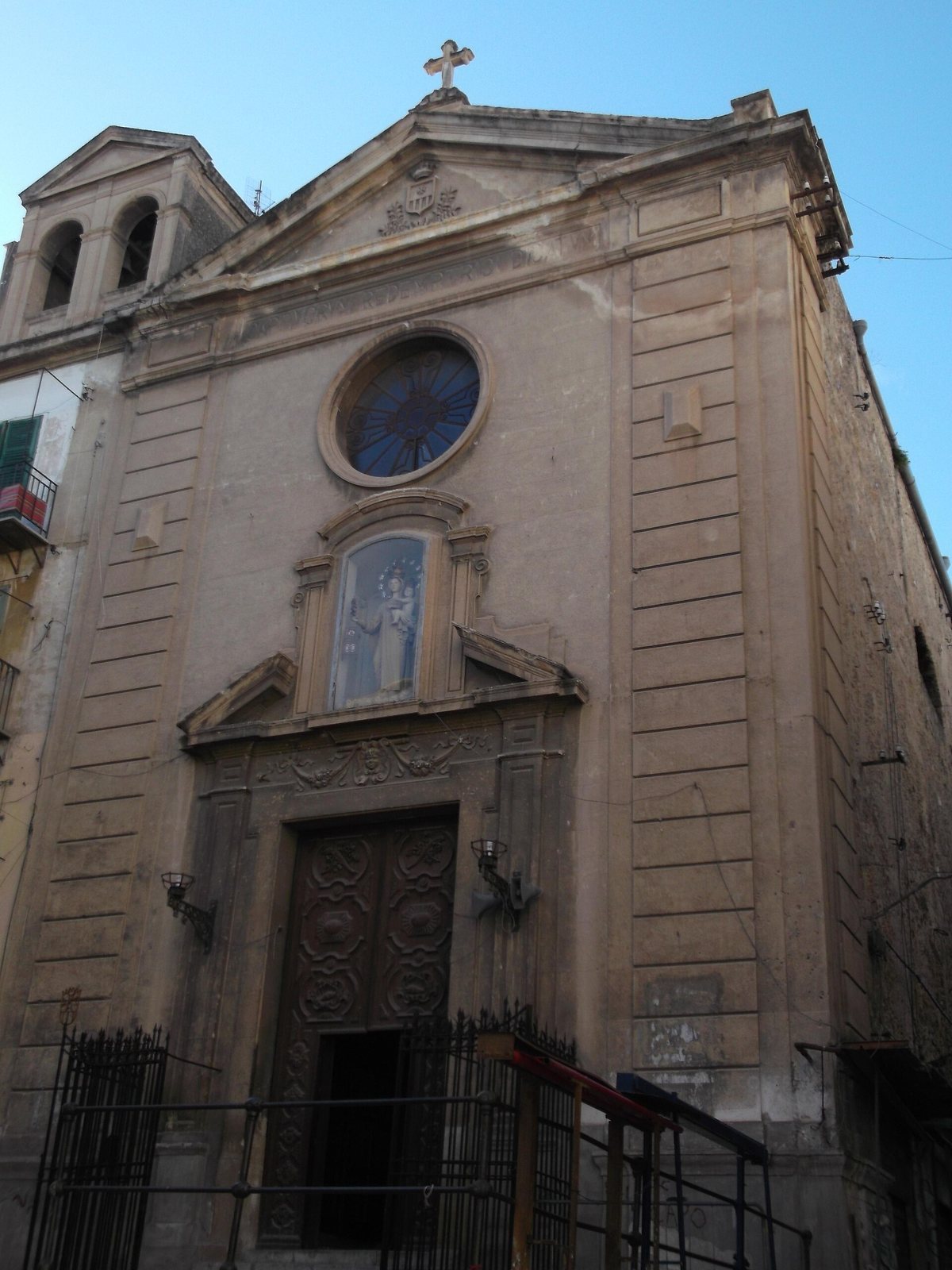
Santa Maria della Mercede stands on a broad terrace in the Seracaldio area of Palermo’s historic center, on Via Cappuccinelle near its junction with Via Porta Carini. Steps rise to the terrace from a narrow lane in the Capo Market.
Facade and bell tower
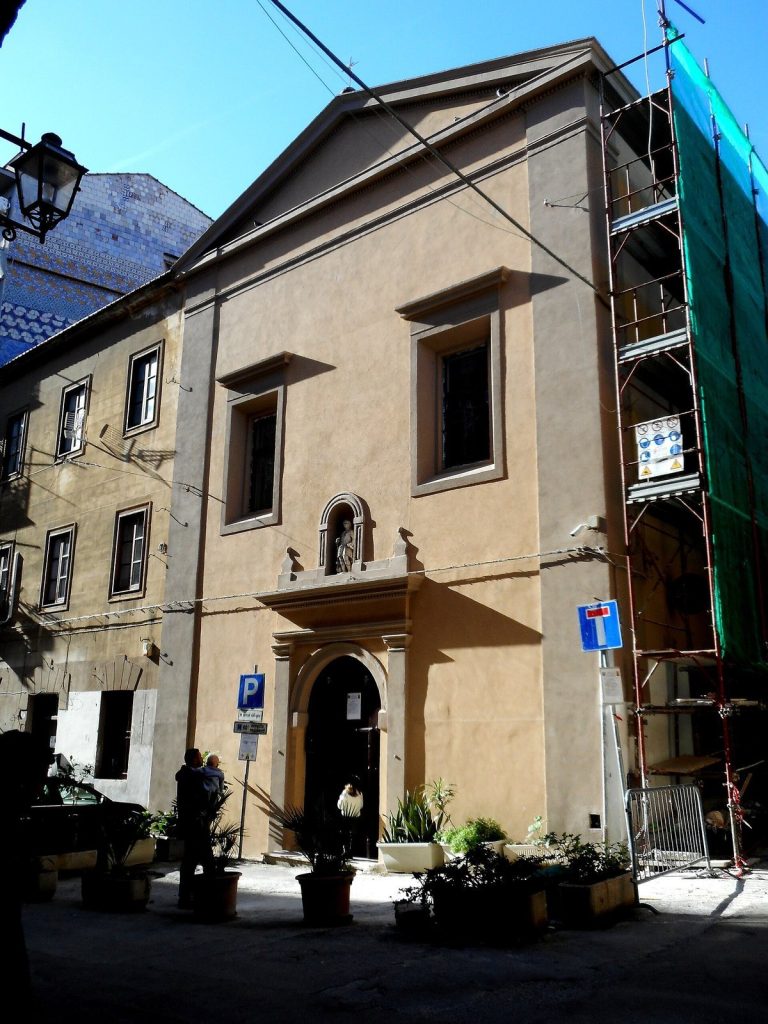
The otherwise plain facade centers on a tall stone doorway sized to accommodate processions carrying the Madonna statue, which is more than two metres high. Plant forms decorate the horizontal stone above the entrance. An interrupted triangular pediment frames a niche containing a statue of the Madonna of Mercy; two pilasters with rough-cut stonework flank the doorway. A projecting cornice and triangular pediment complete the facade, while a round window above lights the interior. An open gallery with two pairs of arched windows on the adjoining building to the left serves as the bell tower.
Interior and chapels
Choir and entrance end
At the entrance end, a choir loft rests on marble columns and carries an organ at its center. Carved child figures and ornamental details decorate the gallery. A wooden display case in a niche beneath it holds an Ecce Homo, an image of Christ presented during the Passion. Wooden choir stalls in a Neo-Baroque style, a later revival of Baroque design, date to 1910; further stalls line the right side.
Right-side chapels
The first chapel on the right is dedicated to the Crucifix, set beneath a stucco canopy within an arch in the wall. In the second, a statue of Saint Joseph with the child Jesus stands on the altar. The third chapel is dedicated to the Sacred Heart, a devotional image of Jesus’ heart as a sign of his love. Its altar holds a statue of the Sacred Heart, while a figure of the dead Christ lies in a case beneath the altar table.
Left-side chapels
The first chapel on the left contains a statue of Saint Peter Nolasco on the altar and a figure representing the Dormition, or death, of the Virgin in a case below. In the third bay, the Chapel of the Madonna of Mercy has an altar framed by floral stucco pilasters and a niche with an icon of the Madonna. A wooden pulpit is also on this side.
Sanctuary and high altar
Statues of Peter Nolasco and Raymond Nonnatus stand at the arch between the nave and sanctuary; other statues flank the sanctuary. A processional Madonna statue occupies a niche to the left of the altar. The high altar incorporates multicoloured marble and deep-blue lapis lazuli from the demolished Church of Santa Maria del Cancelliere, also called Chiesa Gran Cancelliere. Two Ionic columns, with scroll-shaped capitals, support a full triangular pediment with an elaborately decorated inner band. A small shrine-like frame holds the altarpiece, and a round window above illuminates the sanctuary. The altarpiece depicts the Eternal Father and the Holy Family, alongside Saint Anne, Saint Joachim, Saint Rosalia, Saint Raymond Nonnatus, Saint Joseph, and other figures. It is attributed to Antonio Manno, although its authorship remains uncertain.