Santa Maria della Concezione dei Cappuccini: A Capuchin Church in Rome
Site at a Glance
- Popularity
- Very High
- Country
- Italy
- Primary era
- Early Modern
- Eras represented
- Early Modern, Modern
- Civilizations
- Papal States
- Site type
- Religious
- Remains
- Church
On this page15 sections
History
Construction and dedication
Santa Maria della Concezione dei Cappuccini is a Roman Catholic church in Rome, Italy, built between 1626 and 1631. It belongs to the Latin Church, the Western branch of Catholicism, and the Diocese of Rome. The church was the first in Rome dedicated to the Immaculate Conception, the Catholic teaching that Mary was preserved from original sin from the moment of her conception. Pope Pius IX formally defined this teaching as dogma in 1854, more than two centuries after the church’s dedication.
Pope Urban VIII blessed the first stone on 4 October 1626. His brother, Capuchin cardinal Antonio Marcello Barberini, then initiated construction. The first Mass took place on 8 September 1630, and the work was finished the following year.
Burials and seventeenth-century associations
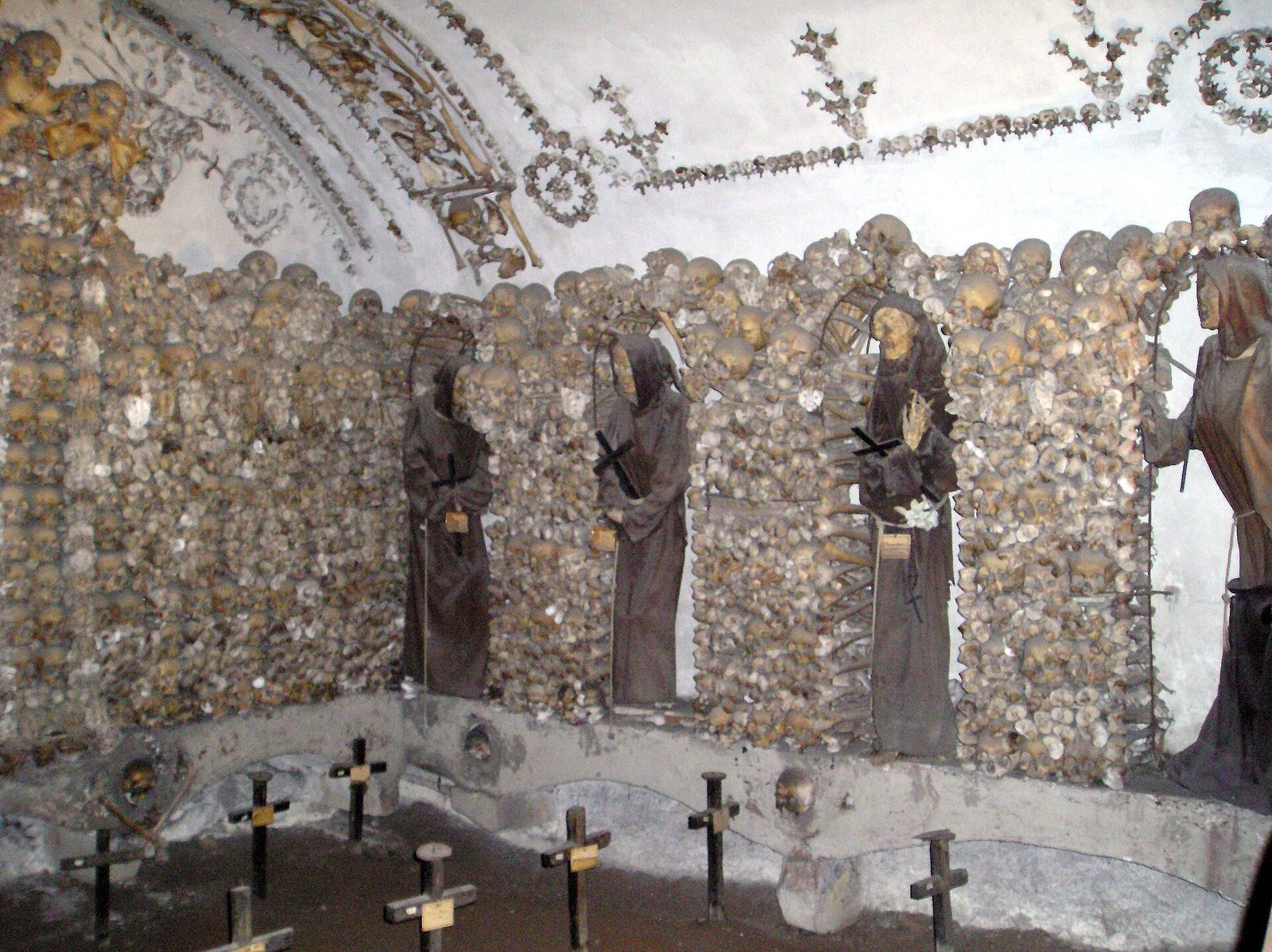
In 1631, Cardinal Barberini ordered the remains of thousands of Capuchin friars moved from the order’s former burial ground near the Trevi Fountain to the church crypt. The bone decoration there reflected a belief that the body is a temporary vessel for the soul and served as a meditation on human mortality. Capuchin spiritual teachers also meditated and preached with a skull in hand. The crypt is said to have inspired the Sedlec Ossuary in the Czech Republic and the Skull Chapel in Poland.
A legend connected to rivalry between the Barberini and Pamphilj families concerns Guido Reni’s painting of Saint Michael defeating Satan. It holds that Reni gave Satan the features of Cardinal Giovanni Battista Pamphilj after hearing that Pamphilj had insulted his reputation. Pamphilj later became Pope Innocent X.
Later history and artistic reception
Aleksander Benedykt Sobieski, son of Poland’s King John III Sobieski, died in 1714 and was buried in the church. His father was remembered for defeating Ottoman forces at Vienna. In 1821, the French painter F. M. Granet gave one of nine versions of his painting of the church choir to Russia’s Emperor Alexander I, who placed it in the Imperial Hermitage gallery. The Russian painter A. G. Venetsianov studied the work there and drew on its linear perspective for The Threshing Floor (1823–1824); he also wrote an essay on perspective.
After Italian unification, much of the monastery complex, including its bell tower, was demolished in the late nineteenth century to make way for Via Veneto and other buildings. The church was spared, in part because of Sobieski’s tomb.
Remains
The church
Exterior and layout
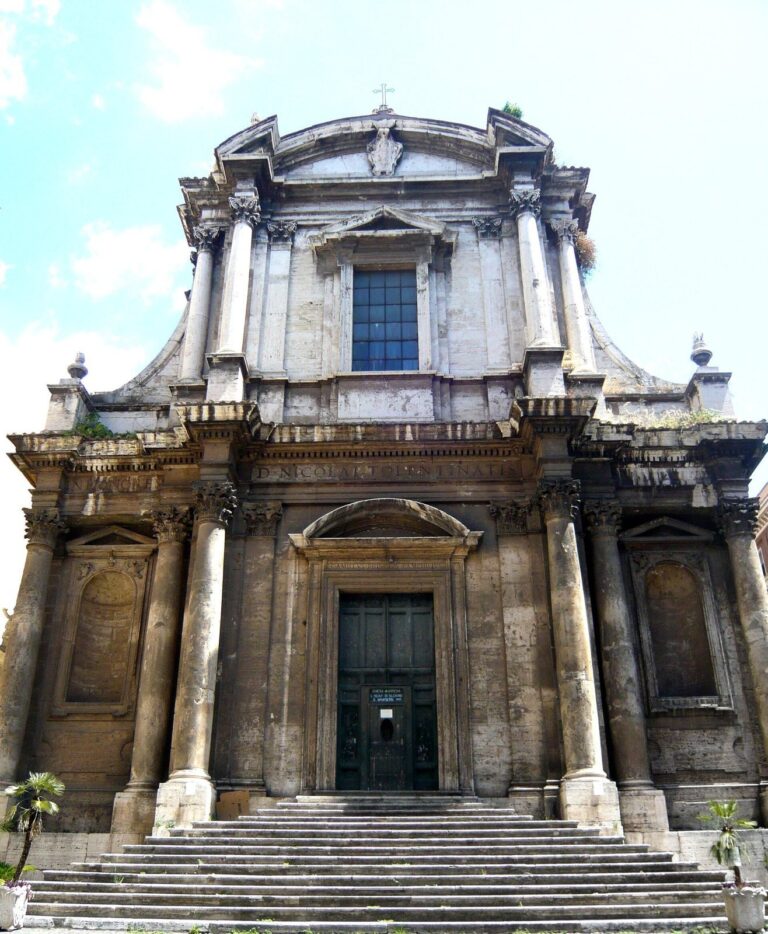
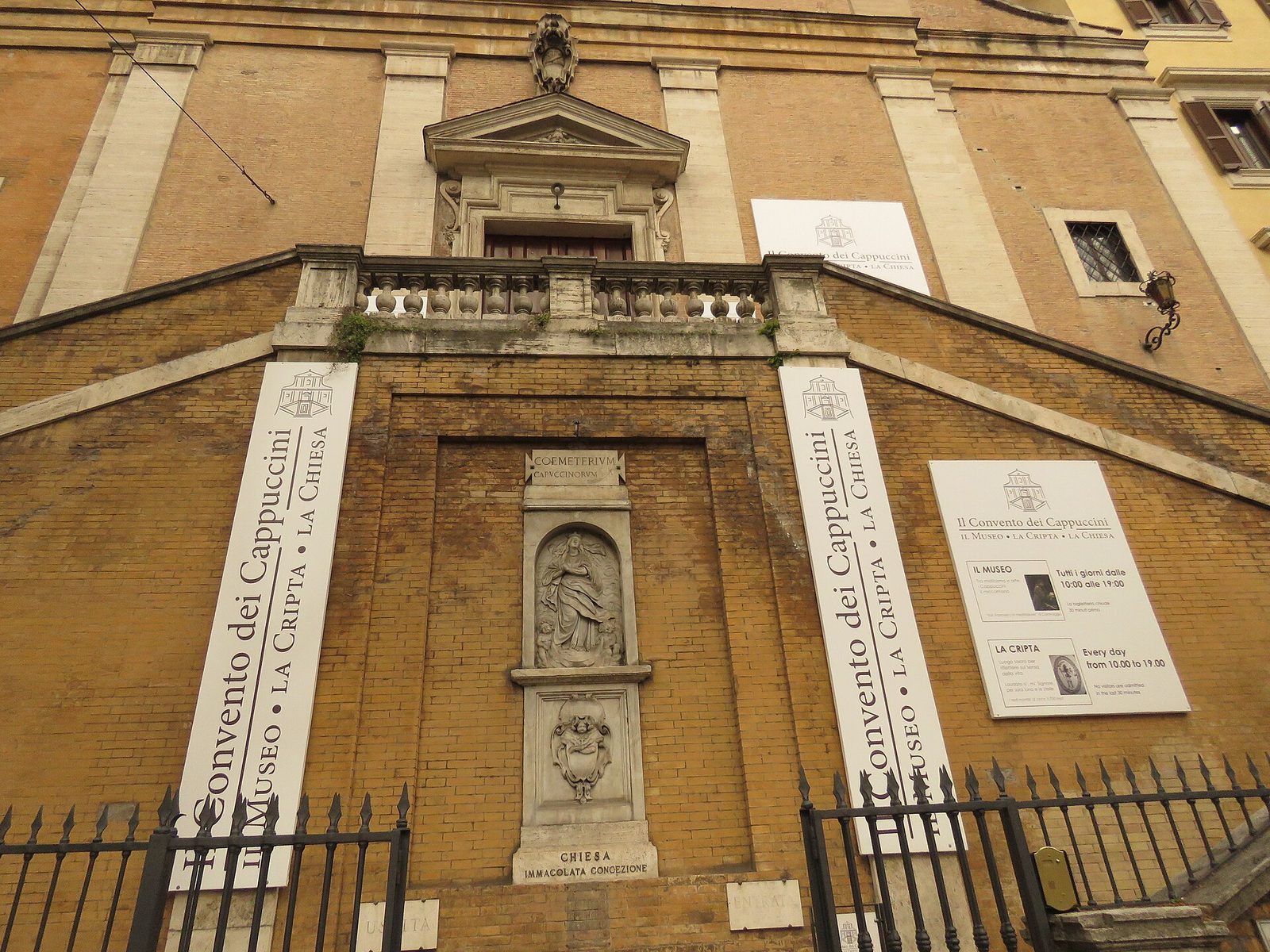
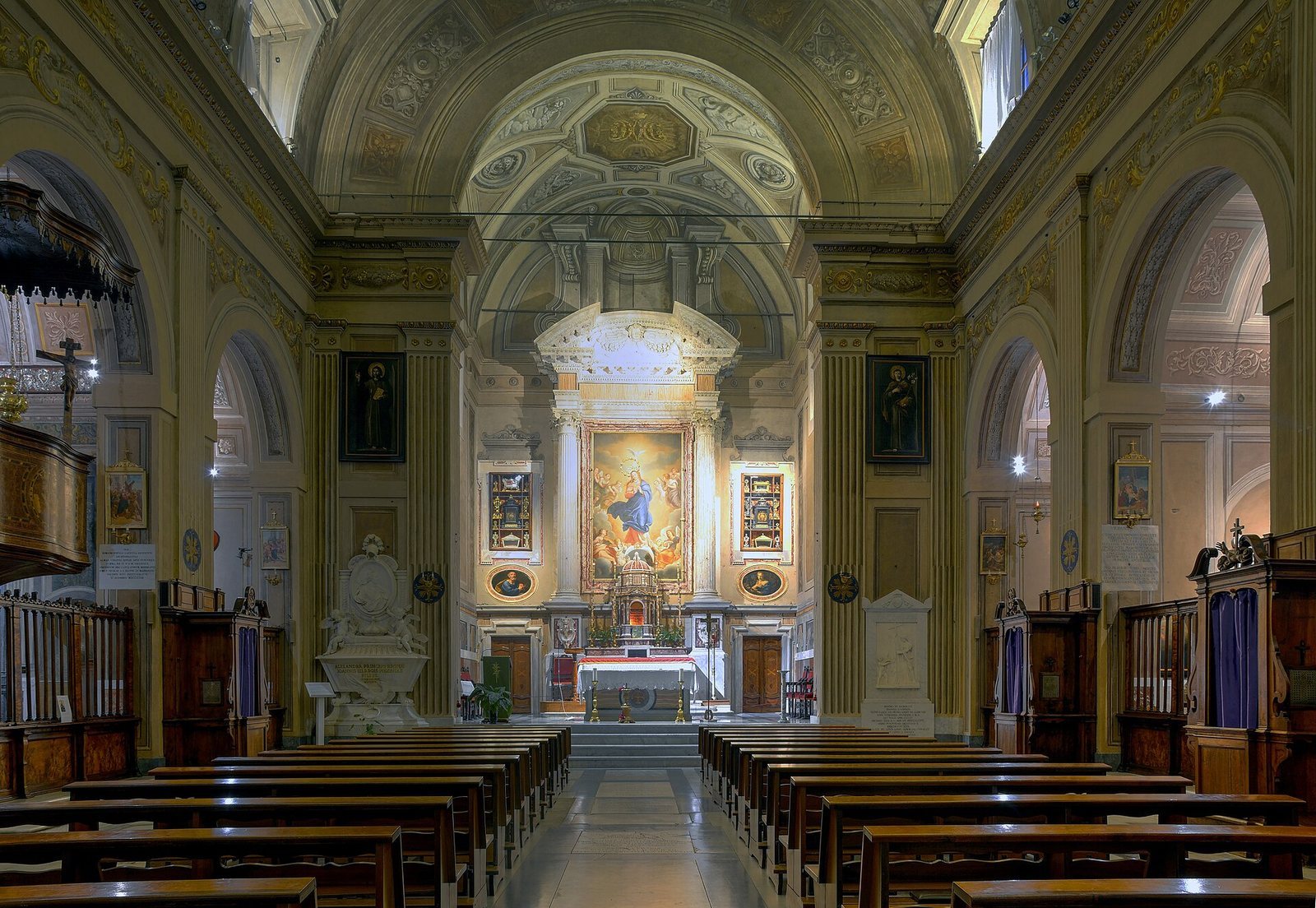
On Via Vittorio Veneto, north of Piazza Barberini and near Palazzo Barberini and the Triton Fountain, the church has a small, single nave, the main hall for worship, with five side chapels on each side. A double staircase rises to the brick façade, whose white-stone pilasters are flat vertical supports.
Altar and ceiling
The marble high altar was made on Urban VIII’s order, and his coat of arms appears at the bases of its two columns. Fire destroyed Giovanni Lanfranco’s original altarpiece of the Immaculate Conception; Gioacchino Bombelli’s 1814 painting copies it. Above, Liborio Coccetti’s 1796 fresco of the Assumption of the Virgin covers the barrel-vaulted ceiling, a curved ceiling shaped like a continuous arch.
Right-hand chapels
The first chapel on the right is associated with Gerard van Honthorst’s seventeenth-century Christ Mocked and Guido Reni’s Saint Michael the Archangel Defeating Satan, commissioned by Antonio Barberini in 1630 and completed in 1636, though dated to about 1635. The second chapel’s works include Mario Balassi’s Transfiguration, commissioned by Taddeo Barberini, and Lanfranco’s Nativity, dated to about 1632. The third has a Stigmatization of Saint Francis attributed to Domenichino, with an alternative attribution to Caravaggio. Baccio Ciarpi’s Prayer in Gethsemane, dated to about 1632, is associated with the fourth chapel, and Andrea Sacchi’s Saint Anthony with the fifth.
Paintings by Reni, Lanfranco, Balassi, and Domenichino associated with the side chapels are now displayed in the museum in the former monastery buildings.
Left-hand chapels
The first chapel on the left has Pietro da Cortona’s Ananias Heals Paul’s Blindness, dated to about 1631. Alessandro Turchi’s Santa Felice da Cantalice is associated with the second. In the third are Andrea Camassei’s Deposition, also called La Pietà, and Girolamo Muziano’s Stigmatization of Saint Francis, dated to about 1570. Andrea Sacchi’s Apparition of the Virgin to Saint Bonaventure, from 1645, is in the fifth chapel.
Tombs and relics
Cardinal Antonio Barberini’s grave lies before the high altar. Its tombstone bears an inscription meaning “Here lies dust and ashes and nothing.” To the altar’s left stands the marble tomb of Aleksander Benedykt Sobieski, sculpted by Camillo Rusconi. The church also contains the body of Felix of Cantalice, a tomb of Crispin of Viterbo, a tombstone for Cardinal Agapito Mosca (1678–1760), and relics associated with Justin Martyr.
Former monastery buildings
The surviving convent buildings house the Museum of the Capuchin Friars Minor of the Province of Rome. Its eight rooms contain artworks, books, documents, liturgical objects, and items used by Capuchin friars.
Underground crypt
Bone decoration
Directly beneath the church, a corridor links five small chapels. Their walls are ornamented with skulls and bones arranged in patterns that include rosettes, pilasters, stars, and garlands. Other bone arrangements form symbols associated with death, including hourglasses, lamps, and crosses. Cracks admit dim natural light, supplemented by small fluorescent lamps. The decoration incorporates the remains of about 4,000 Capuchin friars who died between 1528 and 1870. Each chapel is associated with a type of human remains, and tradition holds that each contains sacred earth brought from Palestine or Jerusalem.
Burial remains and inscriptions
The crypt also contains mummified friars dressed in Capuchin clothing. A child’s skeleton is attached to the ceiling with scales and a scythe. In the fifth chamber is the skeleton of a Barberini princess who died in childhood and was a niece of Pope Sixtus V. A plaque in one chapel gives this warning in three languages: “What you are now, we once were; what we are now, you shall be.”