San Nicola da Tolentino agli Orti Sallustiani: A Baroque Armenian Catholic Church in Rome
Site at a Glance
- Popularity
- Medium
- Country
- Italy
- Primary era
- Early Modern
- Eras represented
- Early Modern, Modern
- Civilizations
- Armenian, Italian, Papal States
- Site type
- Religious
- Remains
- Church
On this page21 sections
History
Foundation and construction
San Nicola da Tolentino agli Orti Sallustiani is a Baroque church in Rome, Italy, founded in 1599 alongside a monastery for novices of the Discalced Augustinians, a branch of the Augustinian order that followed stricter religious observance. Dedicated to Nicholas of Tolentino, a thirteenth-century Augustinian friar, the church takes its name from the nearby Gardens of Sallust. These gardens were associated with the Roman historian and politician Gaius Sallustius Crispus, and were established in the first century BC before being abandoned in the sixth century AD.
Work proceeded slowly because the community lacked funds. Interior work between 1614 and 1620 involved the architect Martino Longhi and the redesign by Francesco Buzio. Around 1620, Carlo Buti directed a campaign to rebuild and enlarge the church. In the mid-seventeenth century, Camillo Pamphilj financed its completion and commissioned Alessandro Algardi to oversee the project. Pamphilj’s support followed a vow connected with the recovery of his wife, Olimpia Aldobrandini. After Algardi left for Spain in 1650, Martino Longhi the Younger contributed to the sacristy and choir.
A further rebuilding campaign began in 1654 under Giovanni Maria Baratta, a pupil of Algardi. Baratta had designed the façade in 1651, and it was erected in 1670. The church was consecrated in 1685.
Armenian Catholic church
In 1883, Pope Leo XIII transferred the church and monastery to the Pontifical Armenian College, which educates Armenian Catholic clergy. The former monastery, then used by the Augustinian women’s community known as the Romite of St John the Baptist, became the college’s home and included a seminary for training priests.
The church follows the Armenian Rite as part of the Armenian Catholic Church, an Eastern Catholic church in communion with Rome. It is one of two Armenian national churches in Rome, meaning churches associated with a particular national community; the other is San Biagio della Pagnotta. San Nicola belongs to the parish of San Camillo de Lellis and the Diocese of Rome, and serves as an active rectorial church, overseen by a rector.
Devotions and later dedications
Since 1921, a chapel once dedicated to Philip Neri has been devoted to the Holy Sepulchre, the Jerusalem shrine traditionally associated with Jesus’s burial and resurrection. Its dedication followed the transfer of a replica from Santa Maria Egiziaca at the Forum Boarium. The church’s main altar also recalls a tradition about Nicholas of Tolentino. When he was gravely ill, the Virgin Mary was said to have appeared with the Christ Child, Augustine, and Monica, and offered him blessed bread. Augustinians distributed blessed rolls known as panini di S. Nicola, or “little breads of St Nicholas,” which people believed could cure illness.
The Gavotti Chapel commemorates a tradition dating to 1536. It tells that the Virgin Mary appeared to the shepherd Antonio Botta at Savona while the city was at war with Genoa, and called on both sides to act with mercy. Another dedication reflects the church’s Armenian ties: a chapel formerly dedicated to St Joseph is now devoted to Gregory the Illuminator, an early Christian leader associated with Armenia’s conversion. Two Armenian cardinals, Andon Bedros IX Hassoun (1809-1884) and Krikor Bedros XV Agagianian (1895-1971), are buried there. The left transept chapel, once dedicated to St Agnes, is now dedicated to the Armenian priest Gomidas Keumurjian, who was martyred in 1707.
Remains
The brick church has a cross-shaped plan, with a single nave, the main body of the church, crossed by a transept that forms its arms. A dome rises above the point where they meet. The nave has a long arched ceiling, or barrel vault, decorated with gilded stucco. Chapels line both sides of the nave and occupy the transept.
Exterior
Façade
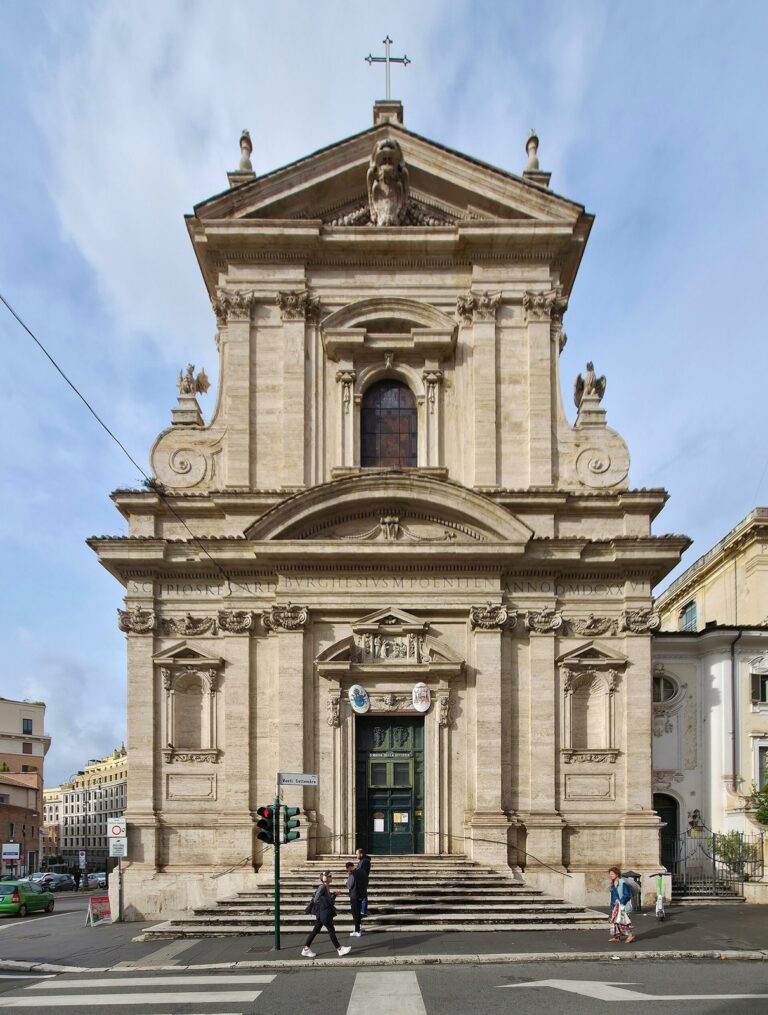
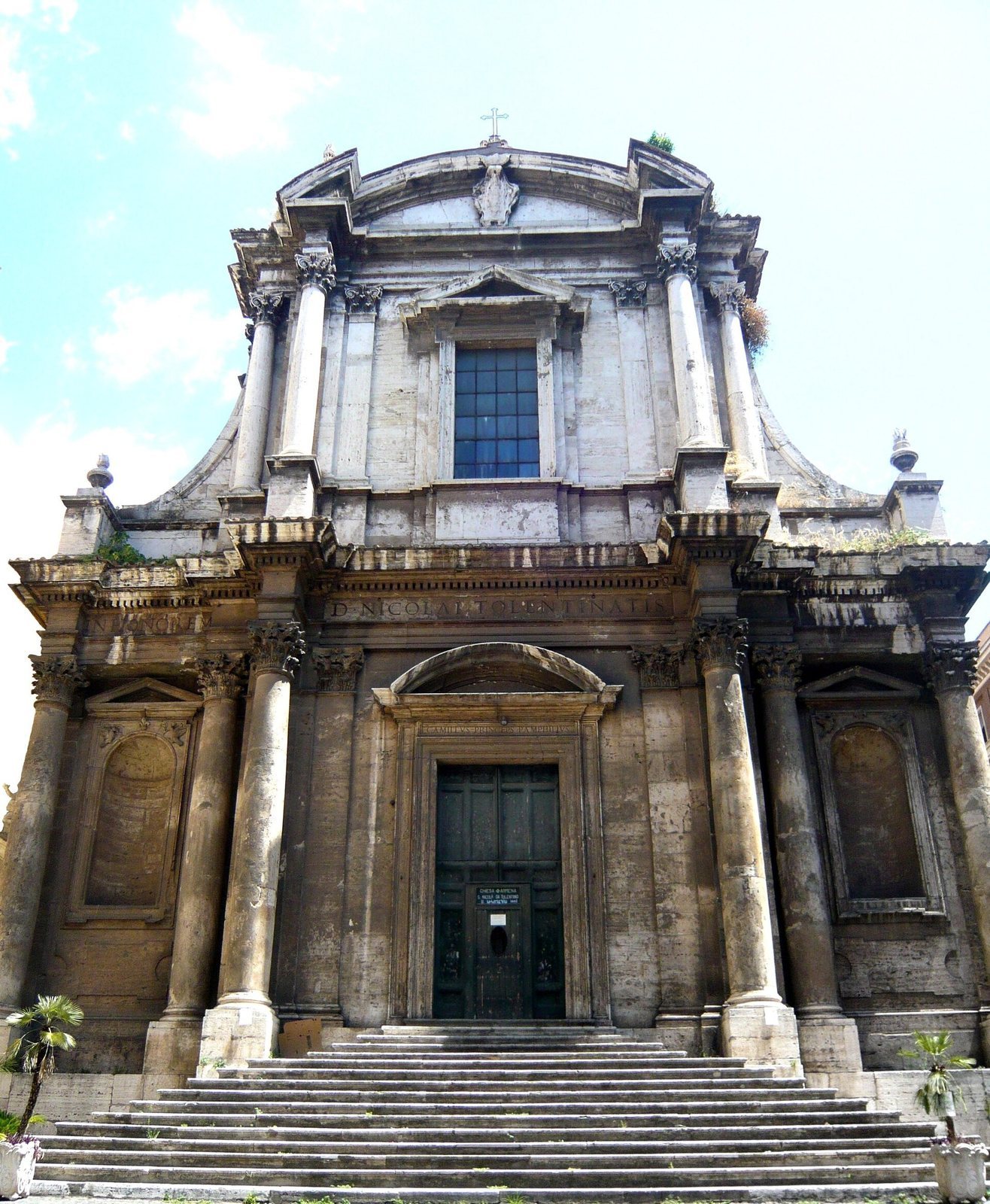
Steps lead to the two-storey façade. On the lower level, Corinthian columns, whose capitals are decorated with acanthus leaves, and flat wall-attached supports divide the front into three parts. The central entrance is topped by a semicircular pediment, a gable-like feature, inscribed with the words "Camillus Princeps Pamphilius." On either side, a niche with a triangular pediment is decorated with a dove carrying an olive branch, an emblem of the Pamphilj family. An inscription honoring St Nicholas of Tolentino separates the lower and upper levels. The narrower upper storey has a central window with a triangular pediment, flanked by scroll-shaped forms called volutes. A semicircular pediment crowns the façade, bearing the Pamphilj arms and a cross.
Armenian memorial stone
A khachkar, a carved Armenian stone monument typically marked with a cross, stands to the left of the façade. It commemorates the Armenian genocide, the mass deportation and killing of Armenians in the Ottoman Empire during World War I.
Interior and principal altar
Nave and dome
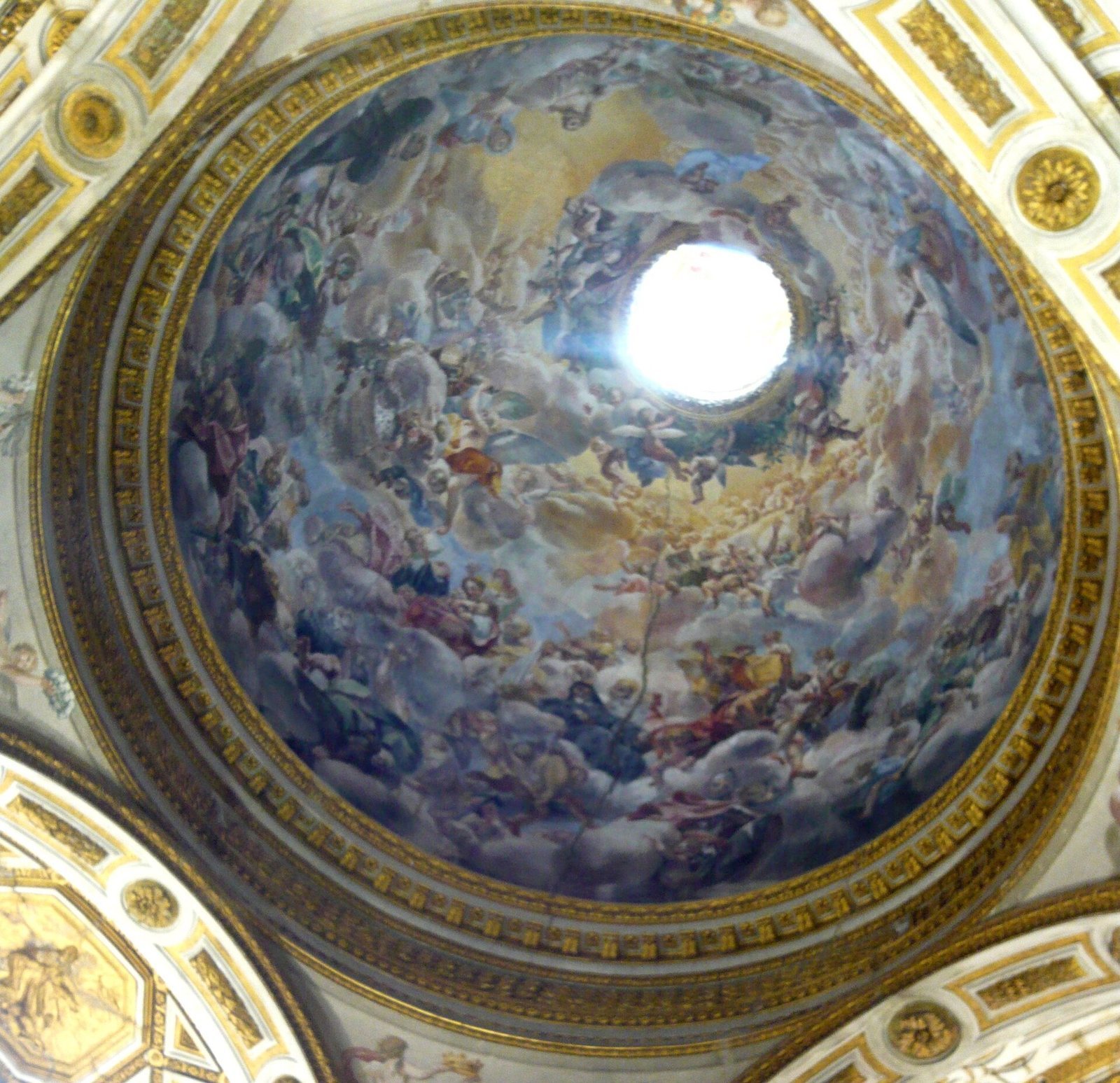
The dome has an octagonal form, eight windows, and no supporting drum. Giovanni Coli and Filippo Gherardi painted its fresco of the Glory of St Nicholas of Tolentino in 1670-1671. Curved triangular surfaces, called pendentives, support the dome above the crossing. Pietro Paolo Ubaldini painted these areas in 1643 with images of humility, chastity, obedience, and poverty, ideals associated with the Augustinian order rather than formal religious vows.
High altar
Designed by Algardi, the high altar is framed by four grooved Corinthian columns of grey marble. Ercole Ferrata and Domenico Guidi sculpted the group of the Virgin and Child with Augustine and Monica appearing to Nicholas of Tolentino. Above it, Ferrata’s relief of God the Father occupies an interrupted, curved pediment, with angels by Francesco Baratta on either side.
Chapels
First chapel on the right
Filippo Laurenzi’s 1710 altar painting shows St Nicholas of Bari bringing a boy back to life. Giovanni Ventura Borghesi’s paintings of the Birth of the Virgin and the Coronation of the Virgin, dated 1680, decorate the sides. An Annunciation attributed to Pughelli is also associated with the chapel.
Chapel of Gregory the Illuminator
The chapel’s paintings include Giovanni Gagliardi’s scene of Pope Sylvester I meeting Gregory in Rome, with the Roman emperor Constantine the Great and the Armenian king Tiridates I in the background. An altar painting by Lazzaro Baldi is also associated with the chapel. A memorial to Gregory stands there, and a cardinal’s hat hangs from the church ceiling.
Chapel of Lucretia of Mérida and Gertrude of Helfta
Completed in 1648, this chapel has marble decoration in several colors. Two Corinthian columns of red, grey, and white Camposanto marble frame an altar painting of the two saints, copied from a work by Guercino. Ubaldini painted scenes from their lives on the side walls and inside the dome. On the left wall, a tomb monument commemorates Cardinal Federico Lante della Rovere; Virginio Bracci made it in the 1770s.
Right transept chapel
Dedicated to John the Baptist, this chapel contains Baciccio’s painting of the saint in the desert, completed in 1670.
Chapel of the Holy Sepulchre
A replica of the Holy Sepulchre is kept in the chapel. A painting of Philip Neri by Cristoforo Creo, formerly associated with it, is now in the Armenian College refectory.
Gavotti Chapel
Pietro da Cortona designed the chapel, which was furnished in 1668. Ciro Ferri completed its decoration in 1674, including the dome painting begun by Cortona. Cosimo Fancelli sculpted the altar relief of the Virgin’s appearance to Antonio Botta. The chapel also contains statues of Joseph by Ercole Ferrata and John the Baptist by Antonio Raggi, as well as Raffaele Minossi’s Annunciation. A copy of a miraculous icon venerated at Genazzano is incorporated into the altar. Carlo Gavotti and Giovanni Battista Gavotti are buried in the chapel.
Left transept chapel
Mario Barberis’s altar painting shows Gomidas Keumurjian preaching. A copy after Guercino depicting the martyrdom of St Agnes, formerly the chapel’s altar painting, is now in the sacristy.
Buratti Chapel
Also called the chapel of Cecilia and the Evangelist Matthew, this space lies to the left of the high altar and is attributed to Giovanni Battista Mola. Ubaldini’s altar painting depicts the Virgin appearing to the two saints. Other frescoes portray episodes from their lives, including Cecilia’s death and Matthew’s martyrdom.
Other chapels on the left
A chapel on the left contains Cristoforo Unterberger’s altar painting of the Madonna of Good Counsel. Giuseppe Cades’s Holy Family, dated 1790, hangs on a side wall in another chapel on that side.