Casino di Villa Boncompagni Ludovisi: The Surviving Villa Aurora in Rome


Site at a Glance
- Rating
- 4.2
- Popularity
- Very Low
- Country
- Italy
- Primary era
- Early Modern
- External website
- Open
- Eras represented
- Early Modern
- Civilizations
- Papal States
- Site type
- Domestic
- Remains
- Elite Residence
On this page11 sections
History
Casino di Villa Boncompagni Ludovisi is a historic building in Rome, Italy, and the only surviving part of a much larger suburban retreat established in the sixteenth century by Cardinal Francesco Maria Del Monte. Here, the word casino means a relatively small country house or pleasure pavilion, not a gambling establishment. The building belonged to a world of aristocratic collecting, artistic patronage, and intellectual experimentation that later became associated with the Ludovisi and Boncompagni families.
Del Monte and the first villa
Francesco Maria Del Monte was a diplomat, intellectual, art connoisseur, collector, and patron of Galileo Galilei and Caravaggio. His interest in alchemy, a premodern set of experimental and philosophical practices concerned with transforming matter, shaped the decoration of the retreat. That interest is especially clear in Caravaggio’s ceiling painting Jupiter, Neptune and Pluto, where classical gods express symbolic relationships among substances and elements.
In 1621, Del Monte sold the villa and its extensive grounds to Cardinal Ludovico Ludovisi. Earlier that year, Ludovico’s uncle Alessandro Ludovisi had become Pope Gregory XV, the papal name he used from 1621 to 1623. Shortly after his coronation, Gregory XV made his nephew a cardinal. Ludovico then expanded the property into a park of approximately 30 hectares between Porta Pinciana, Porta Salaria, and the convent of Sant’Isidoro, historic gates and a religious complex in Rome.
The Ludovisi estate
The expanded estate included buildings designed by Domenichino, the Bolognese painter Domenico Zampieri, while the gardens were attributed, though not definitively, to André Le Nôtre, a French designer associated with formal garden planning. The grounds later attracted the admiration of Henry James, who praised them in Portrait of Places in 1883. In the late seventeenth century, the estate passed by inheritance to the Boncompagni family, creating the double family name Boncompagni-Ludovisi.
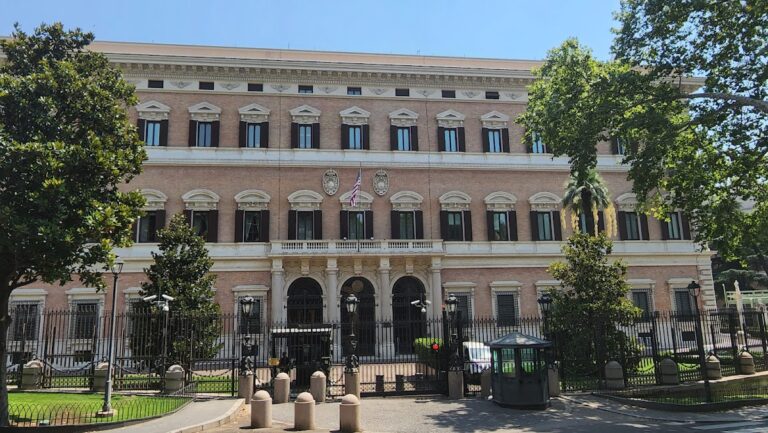
In 1883, the Boncompagni-Ludovisi princes subdivided and sold the estate. The surrounding park was developed as Rome’s Ludovisi district, with hotels, expensive residences, and palaces. Of the villa’s historic buildings, only the Casino and the façade and staircase of the former Palazzo Grande remained. The Palazzo Grande was later concealed behind the nineteenth-century Palazzo Margherita, acquired by the Italian state as a residence for Queen Margherita of Savoy. Palazzo Margherita now houses the Embassy of the United States in Italy.
Collections and the twentieth-century legacy
The Boncompagni-Ludovisi art collections passed into the possession of the Italian state during the twentieth century. They are now viewable at Palazzo Altemps in central Rome, a historic palace forming part of the National Roman Museum. The surviving Casino, also known as Villa Aurora or Casino dell’Aurora, remained connected to the family’s property, while Villa Aurora and a small parcel of land continued with the Ludovisi family.
After Prince Nicolò Boncompagni Ludovisi died in 2018, an inheritance dispute arose between his widow, Princess Rita Boncompagni Ludovisi, and his three sons. The property was offered at auction in 2022 and several more times through January 2023 without attracting a bid. Its opening price was eventually reduced from 471 million euros to 145 million euros. After a wall collapsed, a judge ruled that the property was not being properly maintained and ordered Princess Rita to leave. She refused and was evicted on 20 April 2023.
Remains
The surviving Casino covers approximately 2,200 square metres and retains a small parcel of land enclosed by high walls. Its surviving form belongs to the historic villa complex, although the larger park was subdivided and developed into the modern Ludovisi district. The building preserves painted decoration, works associated with major Italian artists, and a collection of ancient Roman and Greek artefacts.
Painted interiors
Guercino’s Aurora
The building takes its name from Guercino’s ceiling fresco Aurora in the principal reception hall. Guercino was the Bolognese painter Giovanni Francesco Barbieri. The fresco depicts Aurora, the ancient Roman goddess of dawn, and gives the building its alternative name, Casino dell’Aurora. Other works associated with the Casino include Guercino’s Glory, Honour and Virtue and Night, both executed in tempera in 1621.
Caravaggio’s mythological ceiling
One of the smaller rooms contains Caravaggio’s Jupiter, Neptune and Pluto, created around 1597 using oil applied to plaster. It is described as the only ceiling painting ever executed by Caravaggio. The composition presents Jupiter, Neptune, and Pluto as an alchemical triad associated with Paracelsus, a sixteenth-century physician and alchemist. Jupiter corresponds to sulfur and air, Neptune to mercury and water, and Pluto to salt and earth. An eagle identifies Jupiter, a hippocamp identifies Neptune, and Pluto appears with the three-headed dog Cerberus.
Collections and surviving buildings
Art and ancient artefacts
The Casino contains works attributed to Pomarancio and Michelangelo, together with ancient Roman and Greek artefacts. Pomarancio is a name associated with Italian painters of the Renaissance and early modern period, while Michelangelo was a leading Italian Renaissance artist, sculptor, painter, and architect. These works form part of the artistic and archaeological contents associated with the surviving house.
Palazzo Grande remnants
The façade and staircase of the former Palazzo Grande are separate surviving remnants of the historic villa complex. The façade is now hidden behind Palazzo Margherita, so the remains of the former palace are physically distinct from the Casino and its painted interiors.
Nearby sites