Santa Maria del Sasso: A Renaissance Marian Sanctuary near Bibbiena
Site at a Glance
- Rating
- 4.6
- Popularity
- Very Low
- Country
- Italy
- Primary era
- Early Modern
- Eras represented
- Medieval, Early Modern
- Civilizations
- Republic of Florence
- Site type
- Religious
- Remains
- Sanctuary
On this page16 sections
History
Santa Maria del Sasso is a Roman Catholic sanctuary in Italy near Bibbiena, whose present Renaissance church was begun in 1486 under the patronage of Lorenzo de’ Medici. The sanctuary belongs to the Diocese of Arezzo-Cortona-Sansepolcro and was granted the status of a minor basilica by Pope Pius XII in August 1942. Its history combines a local Marian apparition tradition with centuries of religious use, pilgrimage, artistic patronage, and Dominican administration.
Foundation and Marian tradition
The sanctuary’s foundation tradition centres on a boulder near Bibbiena. In 1347, a dove was said to have remained there for a month, allowing itself to be approached only by children and Blessed Martino da Poppi, a Camaldolese monk and hermit. The Camaldolese are a contemplative branch of the Benedictine tradition founded by Saint Romuald.
On 23 June, the Virgin Mary reportedly appeared on the boulder to seven-year-old Caterina. She gave the child some beans before disappearing. When Caterina’s mother prepared them, they were found to be full of blood. The event was interpreted as a warning of the plague that struck Europe the following year but spared Bibbiena.
A small oratory was built at the site in 1348, and Blessed Martino became its first custodian. Further celestial phenomena were reported around the sanctuary in 1444. These traditions established the boulder and the associated image of the Madonna del Sasso as the centre of the site’s devotional identity.
Dominican administration and rebuilding
In 1468, responsibility for the sanctuary was entrusted to the Dominicans of the Convent of San Marco in Florence. The Dominicans are a Catholic mendicant order founded by Saint Dominic, with a particular commitment to preaching and theological study. As the number of pilgrims increased, the friars planned a larger church. An earlier chapel was destroyed by fire during this period, although the image of the Madonna del Sasso was believed to have survived.
Construction of the present church began in 1486 to a design by Giuliano da Maiano, an Italian Renaissance architect and sculptor, and was commissioned by Lorenzo de’ Medici, the fifteenth-century ruler and principal patron of Florence. After the Dominican preacher and reformer Girolamo Savonarola visited in 1495, the project was expanded to include the convent and sanctuary. Cosimo de’ Pazzi, Bishop of Arezzo, consecrated the church in 1501.
Sixteenth-century expansion and continuing devotion
A further enlargement began in 1513, when a choir was added behind the church. Its interior was completed in 1525, and the nuns’ choir created during the sixteenth century was designed by Stefano Lunetti. The sanctuary continued to preserve the Marian image associated with the apparition, together with a cycle of miracle scenes in the church and convent.
The cloister’s eighteenth-century frescoes were restored in 1999. The intervention preserved scenes of the Miracles of the Madonna del Sasso, including details of contemporary life. Together with the surviving artworks and devotional images, they maintain the connection between the sanctuary’s physical fabric and its long-standing Marian cult.
Remains
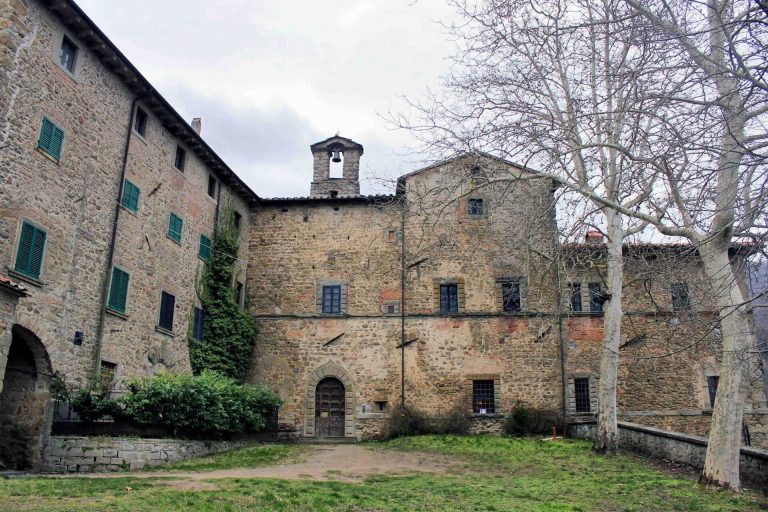
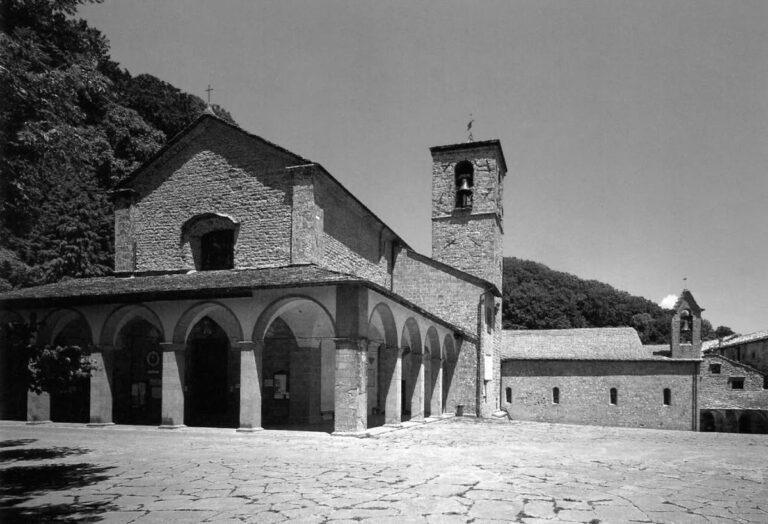
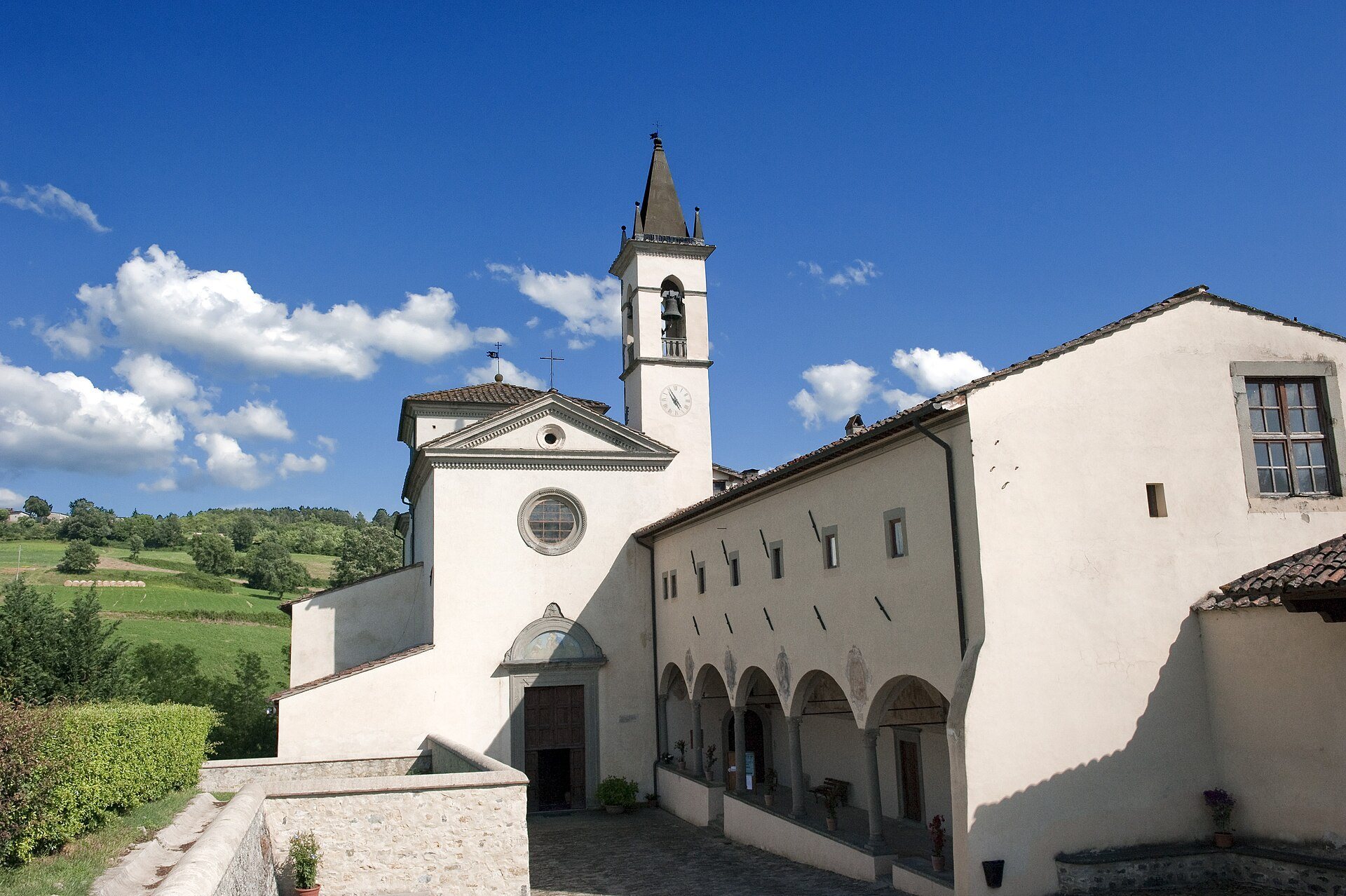
Santa Maria del Sasso is a Renaissance complex centred on a single-nave church with a transept and a deep choir. A columned portico stands to the right of the facade and once sheltered pilgrims. The convent is arranged around a large cloister with four arcaded sides, while the crypt lies beside the boulder associated with the apparition.
Church exterior and central shrine
Facade and portico
The church has a simply plastered facade with a portal crowned by a semicircular pediment and an oculus. A triangular pediment completes the upper front. In the portal lunette, Gherardino del Fora’s 1486 fresco shows the Madonna and Child between Saints Dominic and Peter Martyr. The lunette paintings beneath the portico depict miracles associated with the Madonna del Sasso and date from the eighteenth century.
Tempietto and Madonna del Sasso
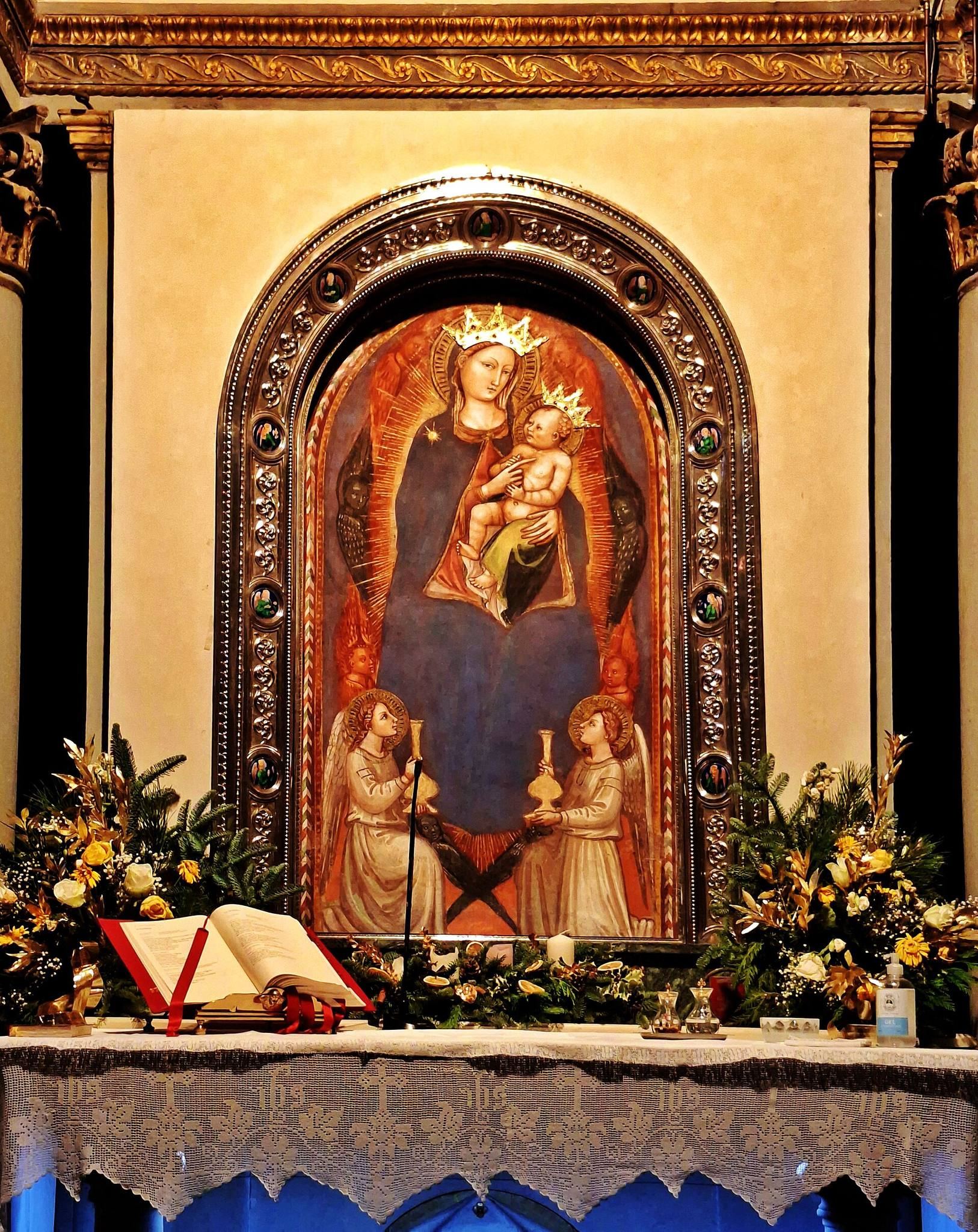
At the crossing of the transept, beneath a small dome, stands a free-standing tempietto, a small temple-like shrine. Four Corinthian columns support the structure, which houses the Madonna del Sasso fresco by Bicci di Lorenzo, dated approximately to 1430–1440. Bicci di Lorenzo was a Florentine painter of the early Renaissance.
Bartolomeo Bozzolini of Fiesole designed the tempietto. Its exterior bears a glazed terracotta frieze attributed to Ambrogio and Mattia della Robbia and made around 1501. The della Robbia family was renowned for glazed terracotta sculpture and architectural decoration. Four stone-framed roundels of the Evangelists belong to the same period and artists, although the roundel of Matthew was reconstructed in 1586.
The shrine’s lunette-shaped pediments contain frescoes of the Savior and decorative motifs framing inscriptions by Giovanni Brina. Brina also painted the Annunciation on the rear wall. The signed and dated work was completed in 1567 and includes a painted predella, the horizontal lower section of an altarpiece that commonly carries small narrative scenes.
Nave, transept, and choir
Nave furnishings
The nave contains a stained-glass Assumption dating to approximately 1490. It also holds Santi Buglioni’s glazed polychrome terracotta altarpiece of the Ecce Agnus Dei, showing Saint John the Baptist and the Redeemer. Scenes from the Baptist’s life appear on its predella. The altarpiece was transferred from the lower church and dates to the period between construction of the chapel dedicated to the Forerunner in 1513 and the death of its Sestini-family patron in 1529.
On the left wall hangs Fra Paolino da Pistoia’s painting of the Madonna and Child with saints. Signed and dated 1525, it derives from models by Fra Bartolomeo.
Transept altars
The two arms of the transept contain side altars. The right altar holds Jacopo Ligozzi’s signed and dated Nativity of the Virgin with Saints Sebastian and Raymond of Peñafort, painted in 1607 for the Poltri family of Bibbiena. Its complex composition was developed through extensive graphic study and uses perspectival and tactile illusionism, together with carefully handled painted surfaces.
The left transept altar contains Ludovico Buti’s Apparition of the Virgin to Saint Hyacinth. The work is dated 1601 by the inscription on the vase of lilies in the foreground.
Nuns’ choir
The nuns’ choir contains Fra Paolino’s monumental Assumption, made in 1532–1533 and possibly based on a cartoon by Fra Bartolomeo. The space also preserves a seventeenth-century papier-mâché Crucifix and wooden choir stalls made by Salvatore and Michele of Impruneta in 1525.
Crypt and devotional works
The crypt stands beside the boulder linked with the apparition. Its altar contains the Madonna del Buio, an early fifteenth-century wooden statue from the Florentine school, probably by Andrea Cavalcanti, known as Buggiano. The statue combines stylistic features associated with Donatello and the della Robbia tradition. Earlier attributions included the young Luca della Robbia, and the image is associated with several reported miracles.
Also in the crypt is Giovanni Antonio Lappoli’s signed painting of the Madonna and Child enthroned between Saints Bartholomew and Matthew, dated approximately to 1530. Its composition reflects Lappoli’s use of models by Rosso Fiorentino. The monumental figures and vivid clothing draw on the style associated with Michelangelo’s Sistine Chapel.
Convent and cloister
Cloister frescoes
The convent surrounds a large cloister with four arcaded sides. Its lunettes contain eighteenth-century frescoes of the Miracles of the Madonna del Sasso, with an inscription giving the date 1713. The badly deteriorated paintings were restored in 1999 and retain details of contemporary life.
Refectory buildings
The vestibule leading to the refectory contains two frescoes by Giovanni Brina, dating approximately to 1567–1568. One depicts the Samaritan Woman at the Well with a modern landscape, while the other shows the Face of Christ. The refectory itself contains Raffaellino del Colle’s fresco of the Last Supper.