Romena Castle: A Medieval Fortress in Tuscany
Site at a Glance
- Rating
- 4.5
- Popularity
- Medium
- Country
- Italy
- Primary era
- Medieval
- External website
- Open
- Eras represented
- Medieval
- Civilizations
- Unclassified
- Site type
- Military
- Remains
- Castle
On this page16 sections
History
Romena Castle is a medieval fortress in Italy overlooking Pratovecchio in the Casentino. Its first documented evidence dates to 1088, when it was the residence of Guido Alberto, a count of the Marquises of Spoleto, a medieval noble lineage associated with central Italy. From Romena, Guido Alberto expanded his control over the Casentino during the eleventh century.
The Guidi Counts
During the twelfth century, Romena became the property of the Guidi, a medieval comital dynasty that controlled territories in the Casentino and nearby parts of central Italy. After Count Guido Guerra III died in 1213, his lands were divided among his sons. Romena passed to Aghinolfo, whose descendants formed the branch known as the Guidi counts of Romena.
The castle entered literary history in 1281, when Mastro Adamo da Brescia lived there and falsified the gold florins of the Republic of Florence on behalf of the Guidi counts of Romena. He was captured, condemned to death, and executed near the castle at a place later called Omomorto. Dante Alighieri referred to the episode in Canto XXX of the Inferno.
Dante also stayed at Romena during part of his exile, which began in 1301 and lasted until his death in 1321. The Guidi counts, with whom he maintained friendly relations, offered him hospitality and protection, although he lived mainly at the nearby Castle of Porciano.
Florentine Rule and Destruction
The Guidi retained Romena until 1357, when the municipality of Florence purchased the castle. Its later political history followed that of Florence and then the Grand Duchy of Tuscany, an early-modern state centered in Tuscany.
Romena was probably partly destroyed in 1440, when troops recruited by the Visconti rulers of Milan and commanded by Niccolò Piccinino captured it. Piccinino was a professional military commander, or condottiero, who led troops under contract in medieval and Renaissance Italy. The castle returned to Florentine control a few years later.
A devastating earthquake reduced Romena to a ruin in 1579. In 1768, the property passed by public auction to the Counts Goretti de Flamini, who remain identified as its owners. By 1889, vineyards and olive trees were cultivated within the walls, while farmworkers’ houses stood against the second defensive circuit.
Restoration and Literary Associations
Count Ottaviano Goretti de Flamini promoted conservation restoration that saved the castle from further deterioration. Gabriele D’Annunzio, an Italian poet and writer of the late nineteenth and early twentieth centuries, stayed at Romena in 1901 and wrote much of Alcyone there.
During the Second World War, Allied forces heavily bombed the castle to dislodge German troops who had fortified themselves inside it. Major restoration work later led to its reopening to the public in 2007. Romena Castle is designated Italian national heritage.
Remains
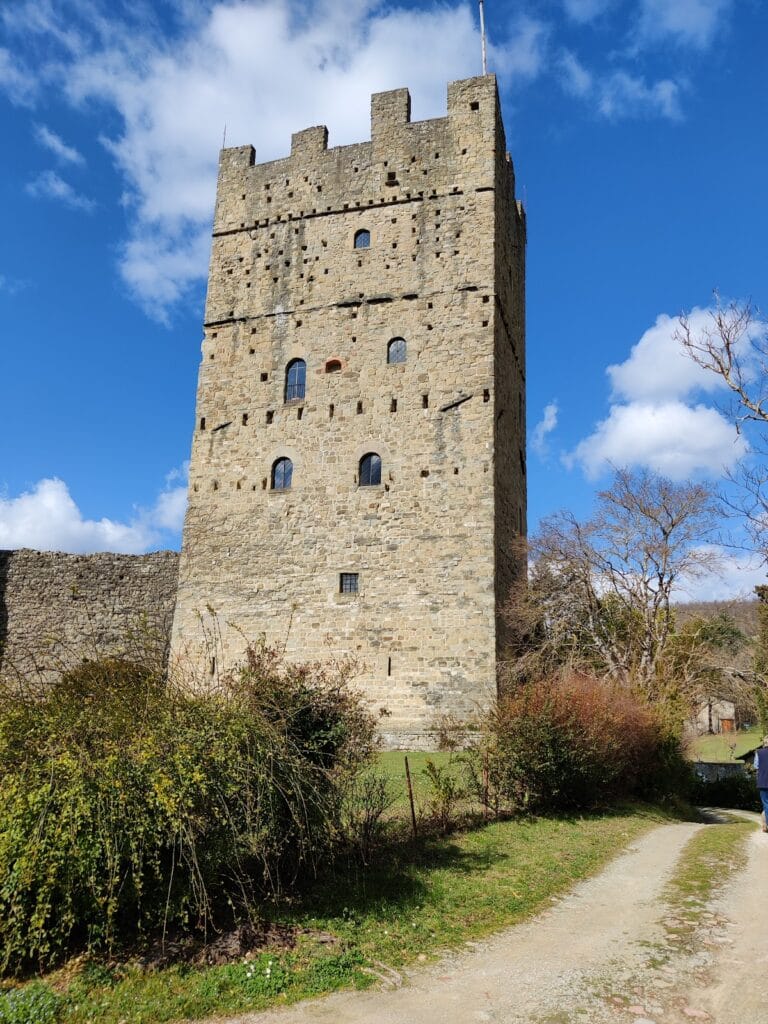
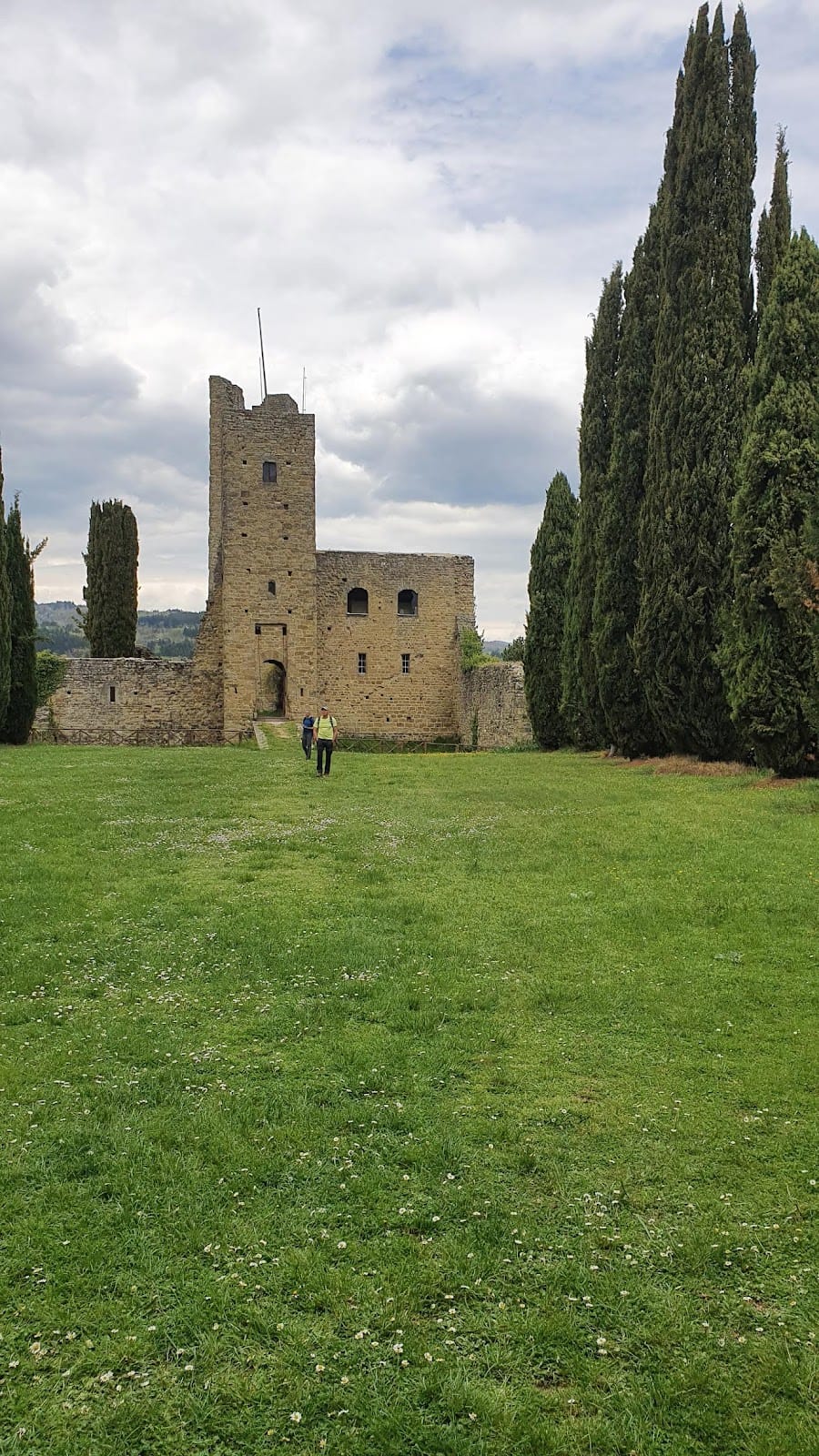
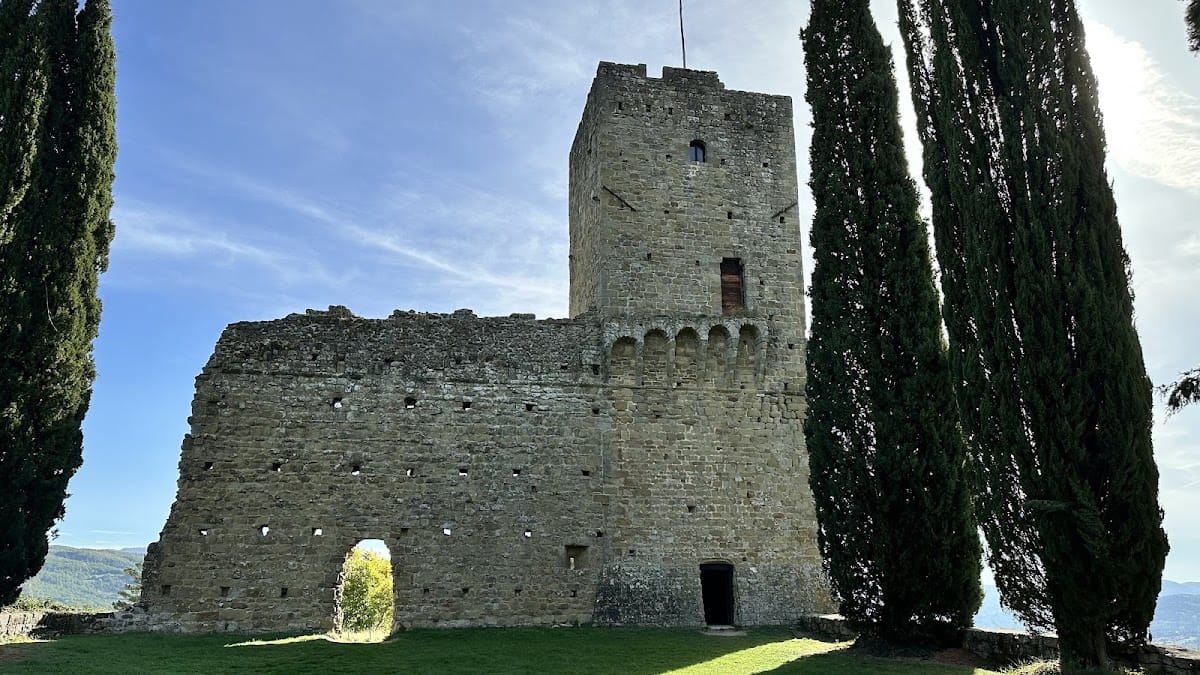
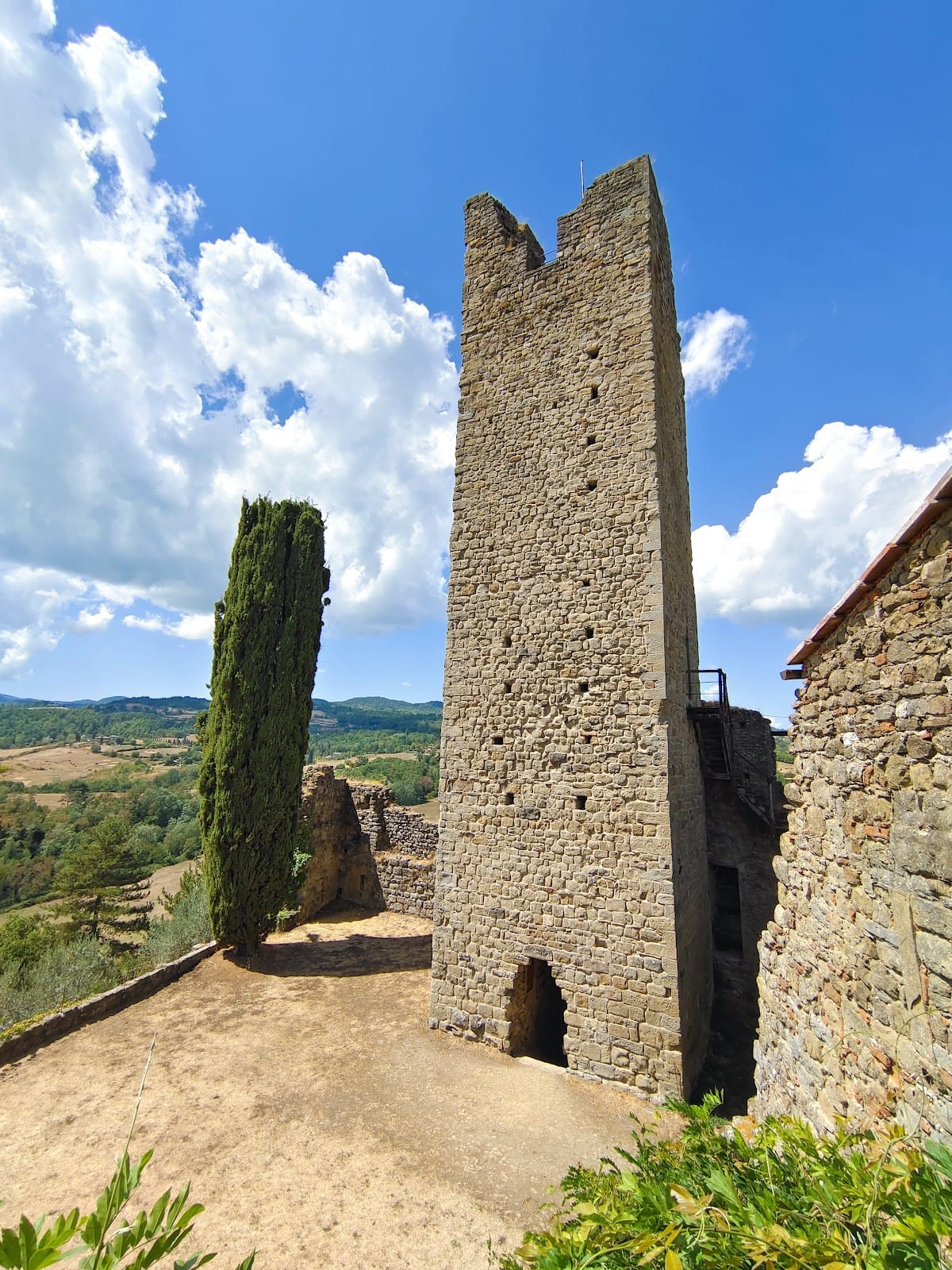
Romena Castle stands on a hilltop at an elevation of 621 metres, overlooking the Casentino and the town of Pratovecchio. The surviving complex includes the inner keep, three towers, and parts of all three defensive wall circuits. Its present appearance reflects restorations promoted by Count Ottaviano Goretti de Flamini. Excavations in the castle area recovered fragments of vessels and various domestic utensils.
Outer Defences and Entrances
Gioiosa and Bacia Gates
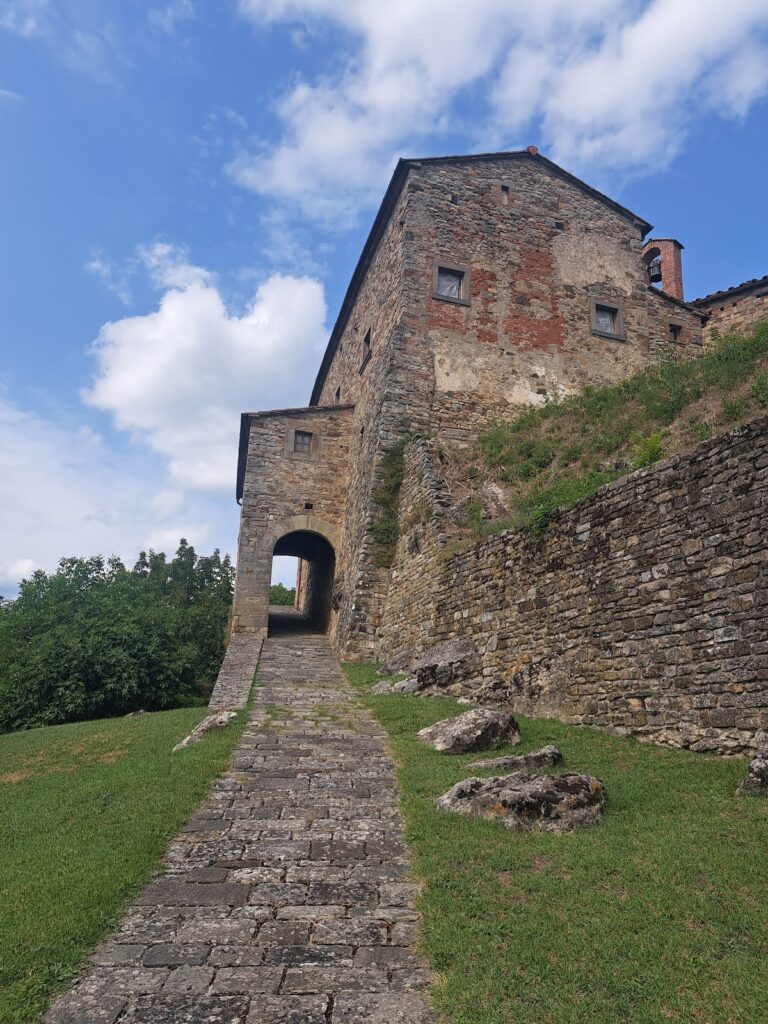
The northern entrance is formed by two structures known as the Gioiosa Gate and the Bacia Gate. They belong to the castle’s surviving defensive arrangement, which preserves portions of the three wall circuits that once enclosed the stronghold.
Defensive Walls and Wall-Walk
The walls retain corbels, projecting supports designed to carry a wooden defensive wall-walk. The wall-walk visible today is a nineteenth-century reconstruction. The complex originally contained fourteen towers, but this number was later reduced to five.
Inner Keep and Interior Features
Keep Entrance
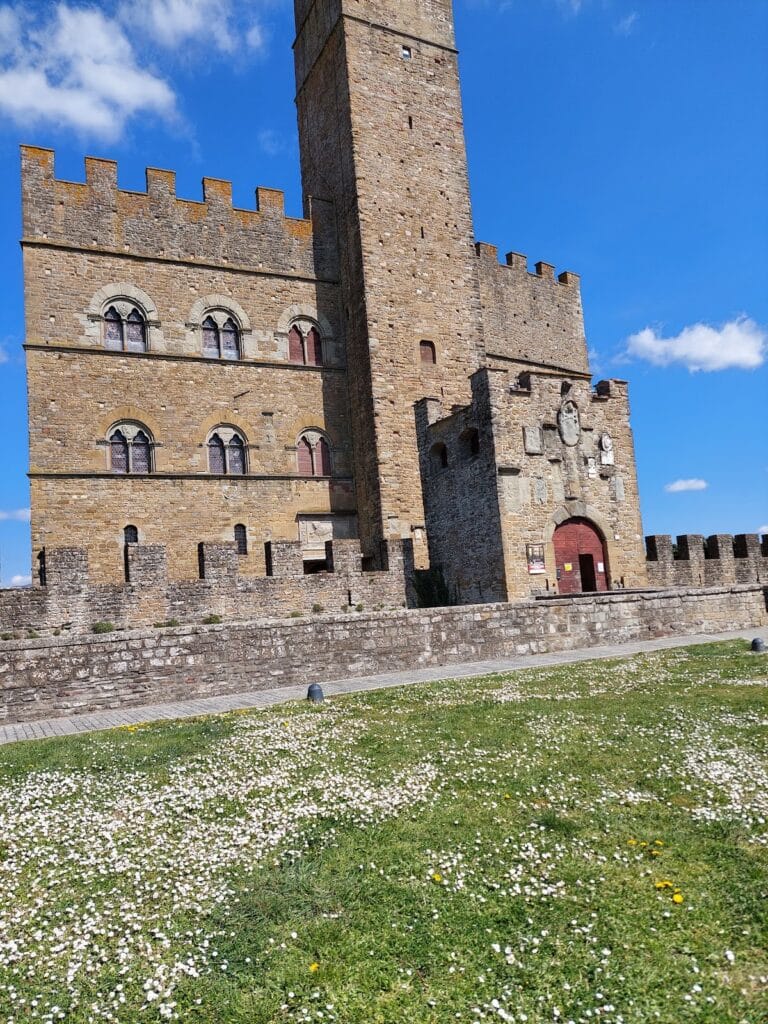
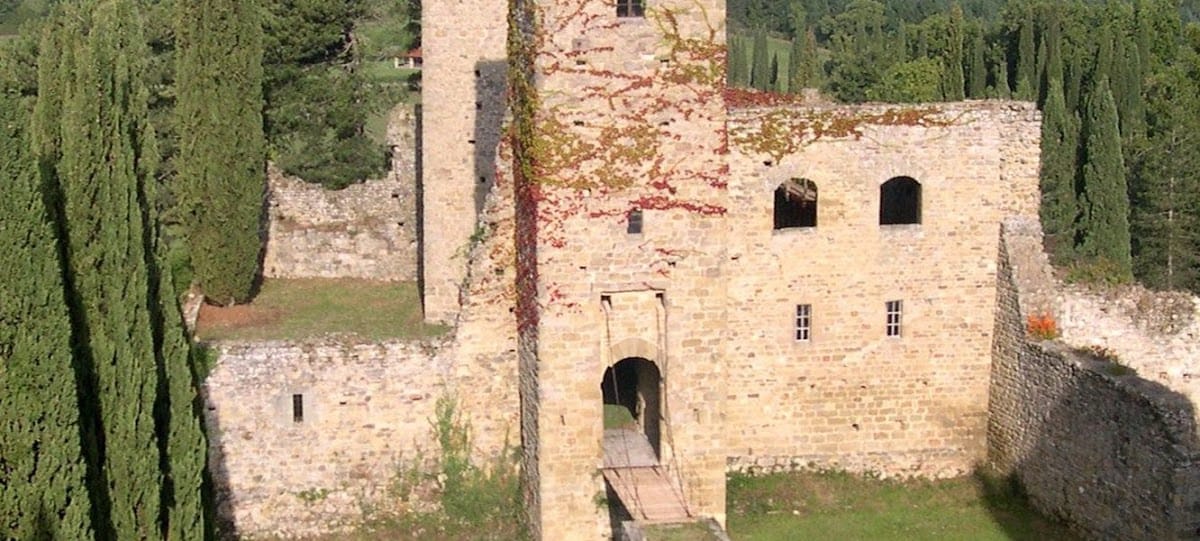
Access to the inner keep passes through a tower equipped with a drawbridge and a moat. This strongly protected inner section is organized around two principal parts, the so-called Podestà’s House and the keep tower.
Podestà’s House
Podestà’s House was the residential palace of the Guidi counts of Romena. It contains a scale reconstruction showing the castle as it appeared in the thirteenth century, providing a representation of the earlier fortified complex.
Keep Tower
The keep tower, also called the mastio, is the highest and most strongly protected tower in the complex. A mastio is the principal or highest tower of a medieval castle.
Cistern and Underground Passage
The castle contains a cistern for collecting rainwater and an underground passage leading outside. These features formed part of the practical infrastructure within the fortified enclosure.
Open Ground and Surviving Towers
Parade Ground
A broad parade ground lies between the inner keep and the third surviving tower. Gabriele D’Annunzio pitched his tent there during his 1901 stay at the castle.
Prison Tower
The last of the surviving towers is known as the Prison Tower. Together with the other remaining towers, the inner keep, and the sections of defensive wall, it forms part of the restored remains of Romena Castle.