Castello di Gressa: A Medieval Castle in Bibbiena, Italy


Site at a Glance
- Rating
- 4
- Popularity
- Very Low
- Country
- Italy
- Primary era
- Medieval
- Eras represented
- Medieval
- Civilizations
- Holy Roman Empire
- Site type
- Military
- Remains
- Castle
On this page14 sections
History
Castello di Gressa is a medieval castle in Italy, located at Gressa in Bibbiena, Tuscany. It was built between the tenth century and the beginning of the eleventh century at the initiative of Elemperto, Bishop of Arezzo from 986 to 1010, during a period when bishops could exercise political, judicial, and feudal authority over castles and surrounding lands.
Episcopal foundation and feudal tenure
Elemperto, who also rebuilt Arezzo Cathedral and founded the monastery of Badia Prataglia, granted Gressa around 990 as a feudal benefice to Tedalascio, a wealthy member of the Casentino elite. A feudal benefice consisted of property or rights granted by a superior in return for allegiance and service, while ultimate ownership remained with the grantor.
After Tedalascio died in 1009, the castle passed to his four children, Farolfo, Ranieri, Suppo, and Sibilla. Farolfo and Ranieri died around 1045. In May 1078, Sibilla and Suppo’s two sons, Rodolfino and Suppolino, transferred their feudal rights in Gressa to Rodolfo, prior of the monastery of Camaldoli, a major monastic center and the historic seat of the Camaldolese Benedictine congregation. These rights were held from the Bishop of Arezzo and administered by a steward named Leone.
Bishops, documents, and political conflict
In 1249, Bishop Guglielmino Umbertini issued an indulgence brief from Gressa for people who contributed alms toward building the Hospital of Saint Mary of the Bridges in Arezzo. An indulgence was a formal remission of ecclesiastical penalties associated with sin, often linked to charitable contributions or religious works. Gressa may also have been a place where coins were minted, since the bishop possessed the authority required for minting.
In 1257, Guglielmino pledged the castle to the Florentines as security for his debts. Two years later, after Arezzo attacked Cortona and Florence became suspicious of the bishop, the Florentines took retaliatory action against him, although the precise nature of that action is not specified.
Guglielmino’s successor, Bishop Ildebrandino of the Guidi counts of Romena, returned to reside at Gressa. In 1299, he issued a formal bull from the castle authorizing his paternal aunt Sofia, abbess of Pratovecchio, to transfer the relics of Saint Hilary from the Church of Pagliola to a monastery in Arezzo.
Seizure, siege, and incorporation into Florence
After the deaths of Ildebrandino and his successor, Guido Tarlati of Pietramala, Pier Saccone Tarlati, lord of Arezzo, seized Gressa. Following the Treaty of Sarzana, he returned it to Boso Ubertini, although he intended to recapture it. Pier Saccone measured the walls and ordered his son Marco to scale them at night, but the attempt failed because the castle was well defended. Pier Saccone died after learning of the failure.
Florentine forces besieged Gressa in 1356. Apart from a brief period, the castle remained under episcopal control and was the last castle in Casentino to remain in the possession of the Bishop of Arezzo.
On 24 February 1366, the inhabitants of Gressa and its surrounding jurisdiction appointed Francesco di Lippo Catenacci of Arezzo and Maggio di Peruzzo of Marena as representatives to acknowledge their incorporation into the territory of Arezzo. The act was transcribed in Arezzo’s communal palace on 24 March 1366.
Arezzo was officially compelled to accept Florentine rule in 1384. On 21 August 1386, Stefano di Paoluccio of Querceto, representing Gressa and the associated localities of Poggiolo, Catarsina, Giona, and Querceto, formally submitted them to Florence. Florence promised protection, an eight-year exemption from land and other taxes, remission of earlier Florentine and Arezzo sentences or bans, and permission to establish local statutes provided they did not conflict with Florentine law. In return, the inhabitants had to provide military service, receive Florentine officials, and present an annual offering of wax to the Baptistery of Florence on 24 June.
Later ownership and wartime use
In 1500, Castello di Gressa became the property of the Martellini counts, a noble family of Bibbiena. Ownership later passed to the Nati counts, the Nati Poltri counts, the Marcucci Poltri counts, and the Crisoliti Malatesta marquises. The castle is now owned by the Pentasuglia di Cuia d’Aragona princes, who also own the nearby Castle of Vicorati. During the Second World War, German forces used Gressa as a military outpost.
Remains
Defensive layout
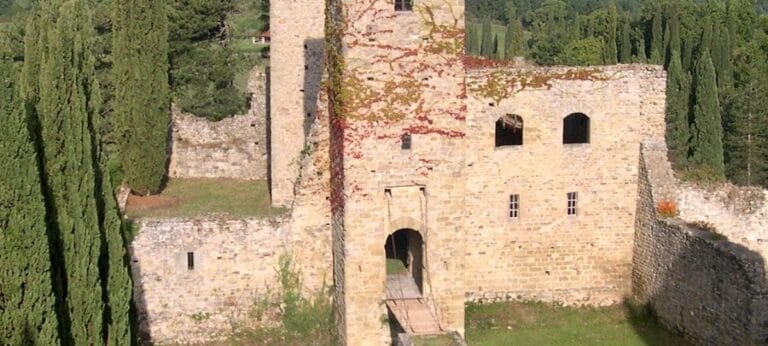
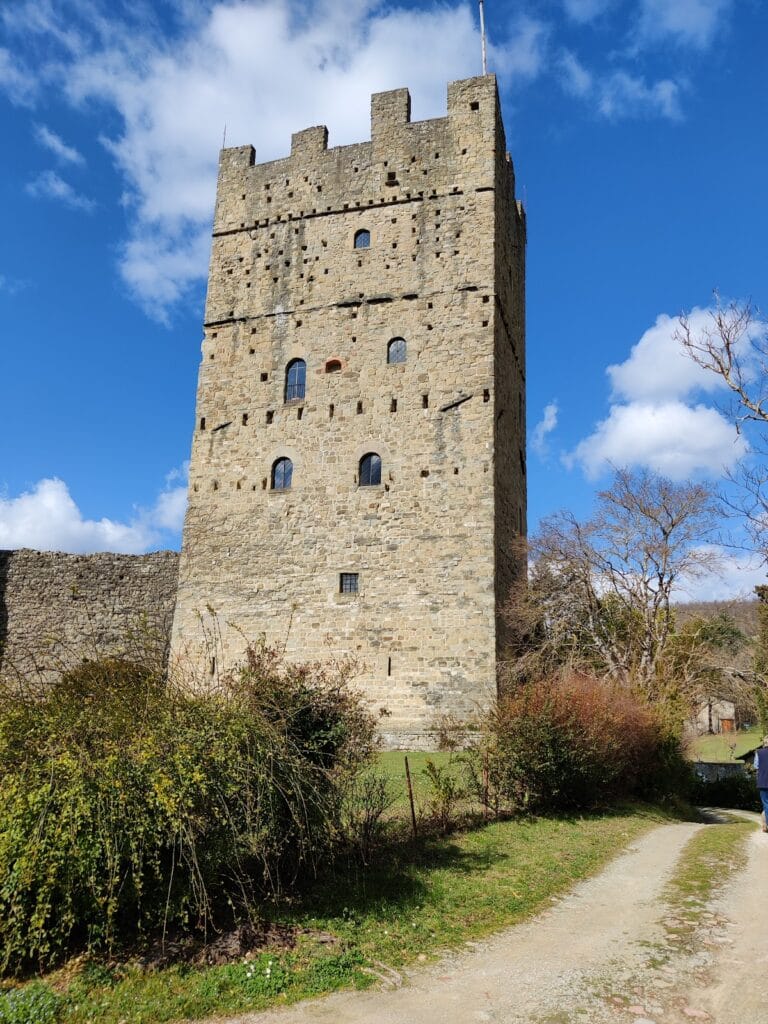
Castello di Gressa stands at about 585 metres above the valley of the Archiano stream. Its defenses follow the contours of the terrain and comprise an outer wall circuit with an irregular polygonal plan and a smaller inner circuit with an irregular octagonal plan. The walls are built of rough sandstone and limestone, with some sections reaching approximately five metres in height. The outer curtain retains a notable portal, while a central building occupies the highest point of the site.
Inner stronghold and central tower
The central tower
A strong quadrangular tower rises in the central area. It has three storeys and served both as a seigneurial residence and as a military structure. Its position at the highest point formed the principal focus of the castle’s defenses.
The Cassero
Within the inner enclosure is the Cassero, a fortified inner stronghold. Its central tower is entered through a small doorway positioned halfway up the tower, an arrangement that forms part of the surviving defensive design.
Buildings between the circuits
Residential and water-storage buildings
Houses and two water cisterns lined with plaster occupy the space between the outer and inner wall circuits. These structures form part of the inhabited area enclosed by the castle’s defenses.
Church of San Jacopo
The Church of San Jacopo stands between the two wall circuits, within the area shared by the castle’s domestic and ecclesiastical buildings.
Former episcopal residence
The former episcopal residence is also located between the circuits. Its position reflects the period when Gressa served as a residence and administrative center for the Bishops of Arezzo. The castle is partially restored.