San Silvestro, Venice: A Historic Parish Church near Rialto


Site at a Glance
- Rating
- 4.6
- Popularity
- Low
- Country
- Italy
- Primary era
- Modern
- External website
- Open
- Eras represented
- Medieval, Modern
- Civilizations
- Habsburg, Italian, Venetian
- Site type
- Religious
- Remains
- Church
On this page14 sections
History
San Silvestro is a Roman Catholic parish church in Venice, Italy, dedicated to Pope Sylvester I, who was Bishop of Rome from 314 to 335 and is traditionally associated with the Christianization of the Roman Empire under Constantine. Probably founded in the second half of the ninth century during Venice’s urban growth and the organization of its island parishes, the church became an important religious institution in the Rialto area and remains an active parish of the Patriarchate of Venice.
Foundation and patriarchal administration
An older tradition places the foundation in 884. Wealthy merchant families who settled in Rialto supported the building, especially the Caloprini family, although other traditions assign the foundation to different families or to several families together. When the Caloprini line and its patronage came to an end, the church and its revenues were assigned in 989 to the Patriarchate of Grado, a major ecclesiastical jurisdiction in the Venetian lagoon. San Silvestro already exercised parish rights at that time, and in 1069 the Patriarch of Grado appointed Vital Morario as its parish priest and prior.
The permanent residence of the Patriarch of Grado was transferred to Rialto probably before the middle of the twelfth century, and the move is documented by 1105. San Silvestro then became the patriarchal residence as well as the seat of the patriarchal chancery and curial courts. Its elevation to a mother church, meaning a parish church with supervisory authority over dependent churches, strengthened its position. In 1182, part of the parish tithe was assigned to it.
Patriarch Enrico Dandolo oversaw the construction of a patriarchal palace in the parish in 1156. Because the patriarchate possessed no independent territory, Pope Innocent III assigned four nearby churches to San Silvestro in 1200 to provide income for the patriarchate. These were San Matteo, San Giacomo dall’Orio, San Canzian, and San Martino. The extension of patriarchal jurisdiction produced prolonged disputes with the Bishop of Castello, including conflicts over spiritual authority between 1216 and 1231 and further disputes in 1305. In 1342, San Bartolomeo became a filial church of San Silvestro.
Rebuilding and ecclesiastical change
The jurisdictional conflicts ended in 1451, when Pope Nicholas V abolished the Patriarchate of Grado and transferred its titles, jurisdiction, and property rights to the newly established Patriarchate of Venice. San Silvestro was incorporated into the new patriarchate. The church itself was rebuilt during the first half of the fifteenth century, in work dated between 1422 and 1485. It was consecrated in 1422 together with the adjacent Ognissanti oratory, also called the Oratory of Santa Maria dei Patriarchi and Ognissanti. That oratory had been consecrated by Pope Alexander III in 1177 and was later incorporated into the church.
Further alterations took place during the seventeenth century. Until 1807, San Silvestro retained collegiate status and was administered by a chapter of three titular priests, a deacon, and a subdeacon. The Napoleonic reorganization of Venetian parishes preserved its parish status while adding the territories of the suppressed parishes of San Matteo, San Giovanni Elemosinario, and Sant’Apollinare. From 1807, a parish priest appointed by the patriarch administered the church.
Serious structural problems led to another near-total rebuilding. The altar of Saint Joseph collapsed before Easter in 1820, and the condition of the building threatened the church as a whole. Reconstruction took place from 1837 to 1843, beginning with plans by Sebastiano Santi and continuing under Giovanni Battista Meduna after Santi’s death. The rebuilt church was reconsecrated in 1850. Giuseppe Sicher completed the present facade in 1909. Between 1932 and 1934, the ceiling was changed from a half-vault to a flat ceiling with painted coffers.
In 2010, falling fragments from the ceiling led to the closure of the church. Worship was suspended for approximately two years while restoration was prepared and carried out, and the work was completed in May 2016. San Silvestro continues to serve as a parish church within the Patriarchate of Venice.
Remains
Exterior and structural elements
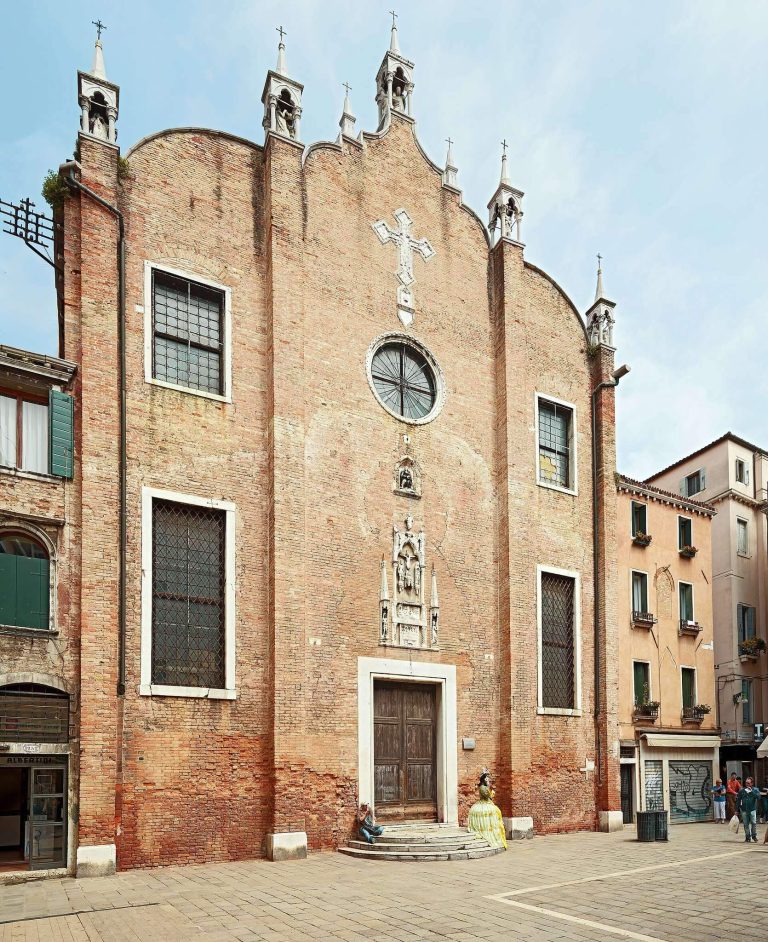
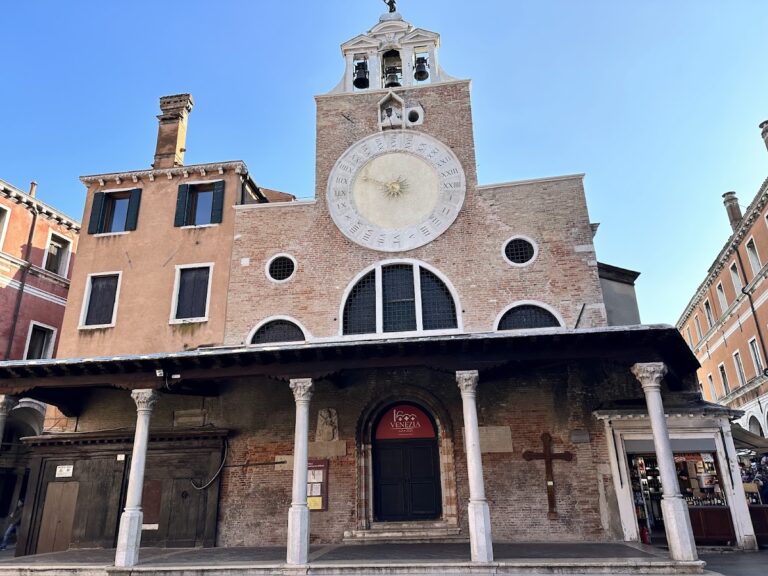
San Silvestro stands beside the similarly named campo in eastern San Polo, near the Rialto area and the Grand Canal. Its present principal facade faces northwest toward Rio Terra San Silvestro. The church once faced in the opposite direction, with its main facade turned toward the Grand Canal. The name Rio terra refers to a filled-in canal. The filling of the Rio del Fontico, which flowed around the houses immediately north of the church until the nineteenth century, changed the surrounding infrastructure.
Neoclassical facade
The present church is a Neoclassical brick building associated principally with Sebastiano Santi and Giovanni Battista Meduna. Its northwest facade is arranged in three sections. Ionic pilasters define the ground floor, while Corinthian pilasters articulate the upper level, with the outer pilasters doubled. A large, undecorated pediment crowns the composition. Above the portal, an aedicule contains a seventeenth-century statue of the blessing Saint Sylvester, flanked by large heraldic panels.
Campanile
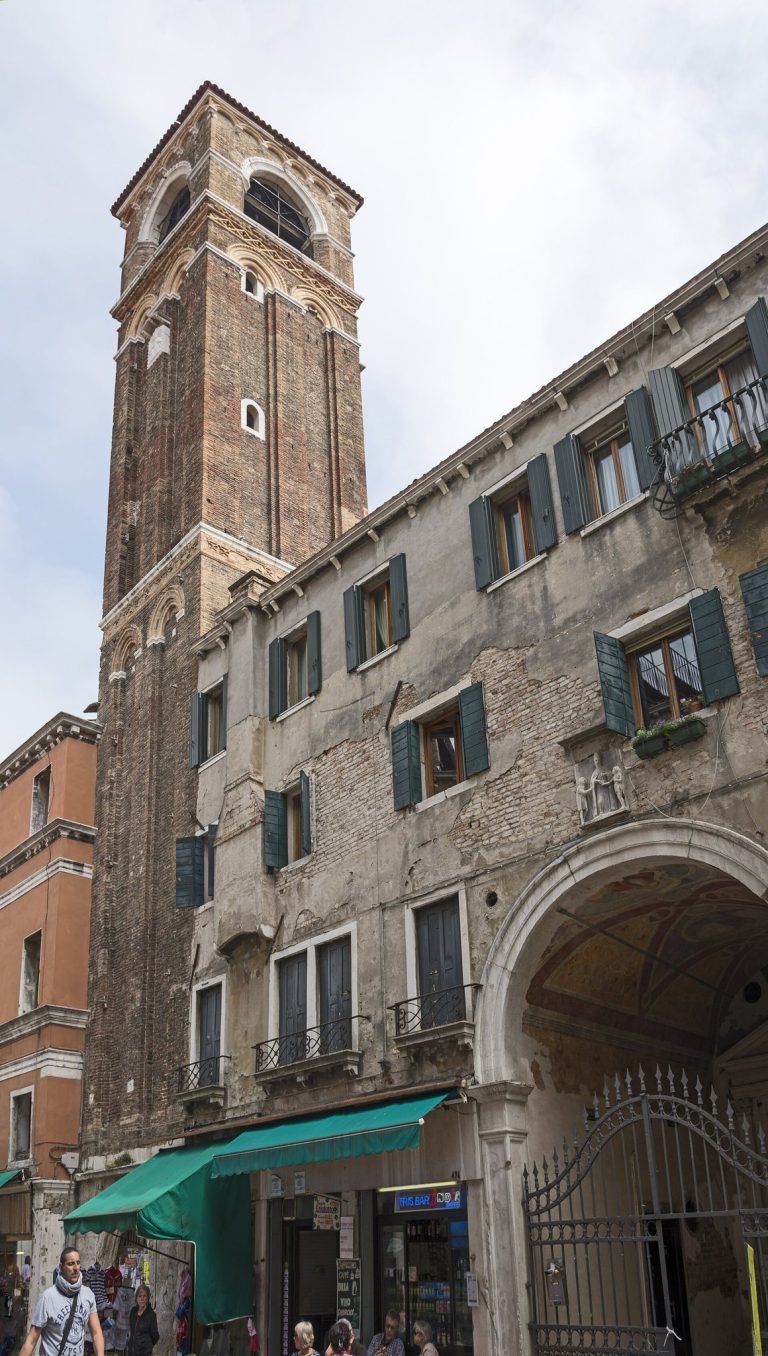
The church’s campanile, or bell tower, was destroyed by the earthquake of 25 January 1347. It was rebuilt in 1422, restored in 1840, and raised to 47 meters during the nineteenth-century rebuilding. Its bells are operated manually, and a clock mechanism was installed in 1880.
Earlier fabric
Earlier buildings survive visibly in a limited form through a fragment of a column with a Venetian-Byzantine capital incorporated into the wall facing Rio Terra San Silvestro. This fragment is distinct from the present nineteenth-century structure and provides a surviving element of the church’s earlier fabric.
Interior and artistic works
The church has a single nave, a semicircular apse, a main altar, and four side altars, arranged as two on each side. The interior walls are organized by Corinthian pilasters supporting a projecting cornice on consoles and an egg-and-dart molding. Above them is a very low gallery with fan-shaped windows and transverse arches. Three arches span the space between each set of pilasters, while low-relief friezes with grotesque ornament appear at capital level. The pilasters and round columns are made of light red marble.
Ceiling and entrance porch
The flat ceiling is painted to imitate coffering. It replaced an earlier ceiling made in 1683 by Louis Dorigny. The triumphal arch between the nave and presbytery is echoed at the entrance, where it forms a pronaos, an entrance porch open to the church interior.
Left side altars
The first altar on the left contains Sebastiano Santi’s nineteenth-century painting Saint Sylvester Baptizes Constantine. The second holds Saint Thomas Becket Enthroned among Angels and Saints, painted by Girolamo da Santacroce in 1520, together with a nineteenth-century reworking of Saints John the Baptist and Francis by Leonardo Gavagnin. Thomas Becket, Archbishop of Canterbury from 1162 to 1170, was later venerated as a martyr.
Right side altars
The first altar on the right contains Jacopo Tintoretto’s Baptism of Christ, painted around 1580 to 1582 in oil on wood. The work measures 283 by 162 centimeters. It was altered over the centuries, restored in 2004, and brought closer to its original state during later restoration. The second right altar contains Johann Carl Loth’s Holy Family: The Virgin and Saint Joseph Present Jesus to God the Father, painted in 1681 and later modified by Ludovico David.
Main altar and entrance wall
The main altar is decorated with two nineteenth-century sculptures by Luigi Ferrari depicting adoring angels. A fourteenth-century polyptych, a painted altarpiece made of several panels, stands on the entrance wall. It depicts the Virgin, saints, and sacred episodes. The work originally belonged to the nearby Scuola dei Mercanti da Vin, a Venetian lay confraternity associated with wine merchants. It was later moved to the church sacristy and altered in its present location in 1756.
Former Veronese altarpiece and funerary urn
San Silvestro formerly contained Paolo Veronese’s Adoration of the Magi, a large oil painting on canvas commissioned in 1573 by the devotional confraternity of Saint Joseph. It stood beside the Saint Joseph altar and was sold by the church in 1855, probably to help finance the rebuilding. The painting has been in the National Gallery in London since then. Above the principal door is the early sixteenth-century Lombard-style funerary urn of the procurator Filippo Morosini.