Santuario della Verna: A Franciscan Sanctuary in Italy


Site at a Glance
- Rating
- 4.8
- Popularity
- High
- Country
- Italy
- Primary era
- Medieval
- External website
- Open
- Eras represented
- Medieval, Early Modern, Modern
- Civilizations
- Grand Duchy of Tuscany, Italian, Republic of Florence
- Site type
- Religious
- Remains
- Monastery
On this page22 sections
History
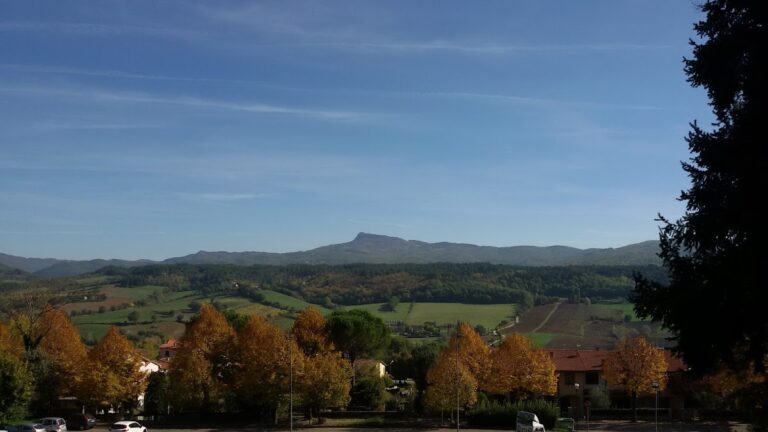
Santuario della Verna is a Roman Catholic Franciscan sanctuary in Italy, near Chiusi della Verna in Tuscany. It stands on the southern slope of Monte Penna at about 1,128 metres, in the Casentinesi Forests, Monte Falterona and Campigna National Park. The sanctuary grew from Francis of Assisi’s retreat on the mountain and became one of the major sites of Franciscan history and pilgrimage.
Foundation and Francis of Assisi
In 1213, Count Orlando Catani of Chiusi donated the mountain to Francis after meeting him at San Leo in Montefeltro. Francis considered the rocky height suitable for an ascetic retreat, and the first religious settlement took shape through simple huts and cells. Francis of Assisi was the Italian religious founder whose preaching and austere life gave rise to the Franciscan movement, a Catholic mendicant order centred on poverty, preaching, communal religious life, and devotion to Francis.
Between 1216 and 1218, a chapel dedicated to Santa Maria degli Angeli was built. Its location and dimensions were traditionally associated with a vision in which the Virgin indicated where it should stand. The name La Verna was also connected in a seventeenth-century Franciscan account with the ancient cult of Laverna, a deity associated with refuges, hiding places, ravines, and caves.
Francis undertook a forty-day retreat and fast on the mountain in August 1224 as he prepared for the feast of Saint Michael. On 17 September, while praying in a secluded wooden cell near the cliff, he was traditionally believed to have received the stigmata, the marks or wounds corresponding to those of Christ’s crucifixion. This event transformed La Verna into a major sacred site and shaped the devotional organization of the sanctuary.
Thirteenth-century expansion
Pope Alexander IV placed La Verna under papal protection in 1255. The church of Santa Maria degli Angeli was enlarged from about 1250 and consecrated in 1260 in the presence of Saint Bonaventure, numerous bishops, and many religious. Count Simone Guidi of Battifolle financed further construction. The Chapel of the Stigmata was built in 1263, the Oratory of Saint Anthony of Padua followed in 1264, and a five-cell convent was established around 1267 for the priests serving the chapel.
These works formed two principal centres at La Verna. One was the original basilica and convent near the Beccia entrance. The other consisted of chapels gathered around the place traditionally associated with Francis’s stigmata. A chapel was also built over the site of Francis’s first cell and later dedicated to Mary Magdalene. A chapel above it became associated with Cardinal Galeotto di Pietramala and was later dedicated to Saint Peter of Alcantara. The deteriorating five-cell hermitage near the Chapel of the Stigmata was demolished in the fifteenth century.
Growth of the pilgrimage sanctuary
As pilgrimage increased, construction began on the larger church of the Assumption in 1348. Count Tarlato of Pietramala and Giovanna of Santa Fiora supported the project. The presbytery was completed in 1457, the roof in 1459, and the church in 1509 with assistance from Florence’s Arte della Lana, the city’s wool guild and a powerful civic corporation involved in charitable and religious works. The church was consecrated in 1568 and altered several times afterward.
In 1432, Pope Eugene IV entrusted the sanctuary’s religious administration to the Observant Franciscans, a reform branch that emphasized stricter religious discipline and poverty. He also granted its patronage to the Signoria of Florence, which exercised it through the Arte della Lana. A solemn daily procession to the Chapel of the Stigmata was established during this period and remains a central devotional practice.
The primitive convent was almost destroyed in 1472 and rebuilt two years later. The reconstruction included buildings around the Cistern Cloister and a large refectory, the communal dining hall of the religious community. The later fifteenth and early sixteenth centuries brought further chapels, the completion of the church, and decoration throughout the convent corridors.
Reformed administration and later building
The Friars Minor Reformed administered the sanctuary from 1625. This reform branch of the Franciscan order also stressed stricter observance, but life at a heavily visited mountain sanctuary required practical adaptations. A forge was established in 1628, and a wool mill operated from 1646.
Construction continued during the seventeenth and eighteenth centuries. The internal guesthouse was enlarged between 1705 and 1709, a large library was built between 1710 and 1712, and a new marble high altar was installed in 1721. Sculpture for the altar was completed in 1731.
The friars were temporarily expelled in 1810 and again in 1866 during suppressions of religious orders. In August 1921, Pope Benedict XV raised the church of Santa Maria Assunta to the rank of minor basilica. This is a special papal designation for a church recognized for its religious and historical importance, distinct from the architectural use of the word basilica.
Museum and continuing devotion
The sanctuary museum closed in 1978 after a theft and reopened in new premises in 2002. It occupies seven fifteenth-century rooms and presents objects connected with former monastic life, including illuminated choir books, liturgical furnishings, vestments, paintings, and material from the former pharmacy and laboratory.
La Verna remains associated with pilgrimage and Franciscan devotion. The annual observance of the stigmata on 17 September brings surrounding parish communities and other worshippers to the sanctuary. In 2013, an 110-kilometre spiritual and historical route from Rimini to La Verna was inaugurated as a five-stage journey and incorporated into Italy’s catalogue of religious routes.
Remains
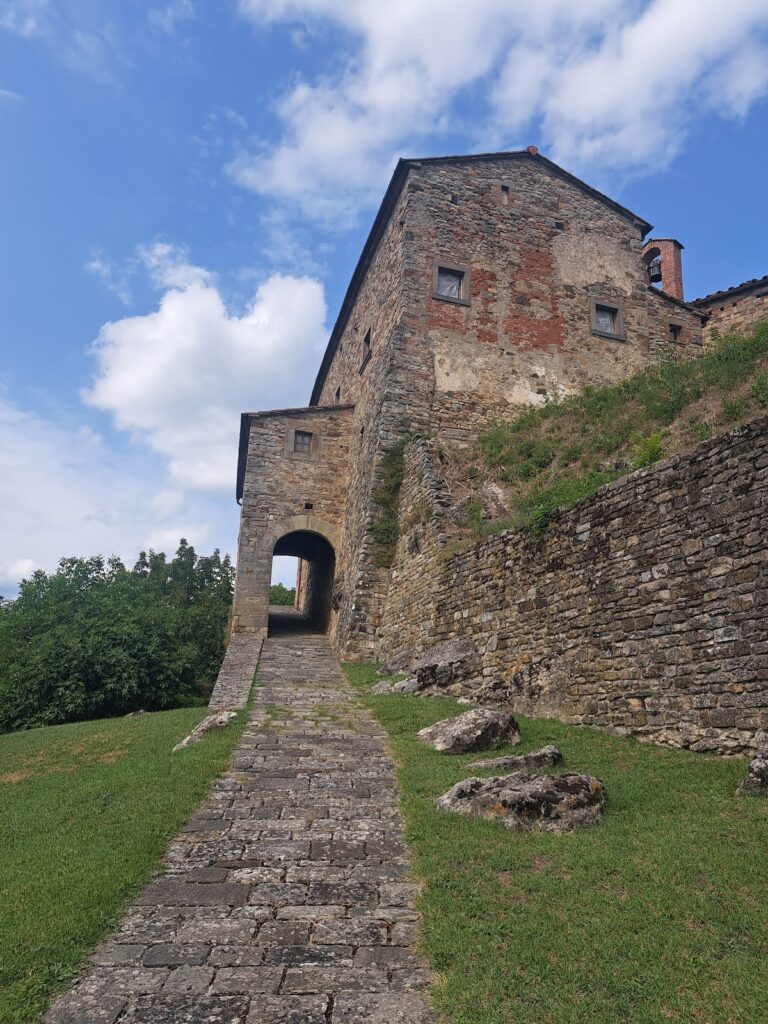
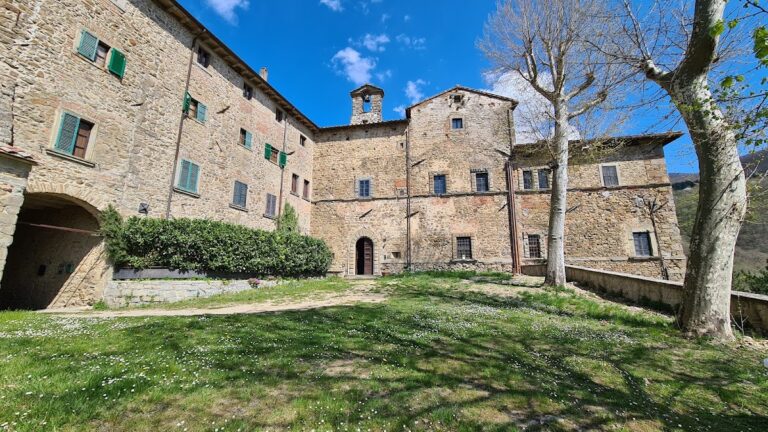
The sanctuary occupies a rocky mountain site at approximately 1,128 metres. Its buildings and devotional spaces are arranged in two principal zones: the convent and Basilica of Santa Maria Assunta near the Beccia entrance, and the chapels surrounding the Chapel of the Stigmata. Numerous chapels, prayer spaces, cloisters, guest facilities, and covered passages connect the complex. The surrounding forest, historically cared for by the Franciscans, is dominated by fir and beech trees, some reaching about 50 metres in height with trunks up to 180 centimetres in diameter. A pure beechwood lies northwest of the sanctuary, within a landscape that also supports deer, fallow deer, roe deer, wild boar, wolves, eagle owls, and peregrine falcons.
Early chapel and basilica entrance
Santa Maria degli Angeli
The Chapel of Santa Maria degli Angeli is the earliest surviving nucleus of the sanctuary. A low portico precedes its single nave, which is divided into two parts by a screen. The choir is the oldest part of the present building. The earlier structure is also represented by a bell dated 1257, suspended in a small bell gable.
Two paintings by Ferdinando Folchi, made in 1877, depict the meeting of Francis and Count Orlando and the dedication of the chapel. The screen is flanked by glazed terracotta reliefs of the Nativity and the Pieta, made around 1490 to 1493 by Andrea della Robbia with Luca the Younger and Giovanni della Robbia. In the choir, Andrea della Robbia’s 1488 glazed-terracotta altarpiece shows the Virgin giving her girdle to Saint Thomas, accompanied by Saints Gregory, Francis, and Bonaventure. Its lunette shows the Eternal amid adoring angels, while the predella contains an Eucharistic tabernacle, angels, and the arms of the Bartoli and Rucellai families.
Quadrante and Renaissance portico
The Quadrante is a paved forecourt and belvedere enclosed by a stone wall. Its name derives from the sundial engraved on the basilica bell tower. A large wooden cross is fixed in the rock, and a sixteenth-century cistern known as the guesthouse well stands to one side.
The Renaissance portico of the Basilica maggiore faces the Quadrante and continues along the building’s right side toward the bell tower. The right-hand loggia was completed in 1536 and reconstructed after the Second World War. It contains Vincenzo Rosignoli’s bronze Crucifix embracing Saint Francis, donated by Pope Leo XIII in 1888. At the entrance to the wider complex stands Rosignoli’s 1903 bronze statue of Francis with a child.
Basilica of Santa Maria Assunta
Interior and chapels
The Basilica maggiore has a Latin-cross plan and a single nave covered by broad groin vaults. Sixteenth- and seventeenth-century altars stand beside several lateral chapels. The Chapel of the Relics, established in 1635, contains the habit of Saint Francis, a remnant of his blood, and other relics in reliquaries. The habit was transferred to La Verna in 2001 after being kept at the castle of Montauto and later in Franciscan institutions in Florence.
Near the middle of the basilica, the Niccolini Chapel and the adjoining Brizi Chapel have a neo-Brunelleschian form. The Niccolini Chapel contains Andrea della Robbia’s 1475 Annunciation, the first of the sanctuary’s major glazed-terracotta works. The Brizi Chapel contains his Nativity, dated 1479.
Other works by Andrea della Robbia and his workshop include glazed-terracotta reliefs of Saint Francis and Saint Anthony the Abbot from about 1475 to 1480. The Ascension, made in the 1480s with Luca the Younger, was transferred to the Ridolfi Chapel in 1601. A relief of the Madonna of Refuge, made by Andrea’s workshop in the early sixteenth century, was transferred from the hermitage of Sant’Onofrio in 1874. The della Robbia family was a Florentine artistic dynasty known for brightly glazed, weather-resistant terracotta sculpture and reliefs.
High altar, choir, and organ
The marble high altar was installed in 1721. It is accompanied by painted stone statues of Saint Francis and Saint Anthony of Padua and two angels by Gaetano Masoni, completed in 1731. Behind the altar is a walnut choir made in 1495, with two rows of stalls. The central inlays depicting the Assumption, Saint Lawrence, and Blessed Giovanni are twentieth-century additions by Fra Leonardo Galiberti. The central lectern is an intarsia work by Piero di Zanobi dated 1509. Intarsia is a decorative technique in which pieces of wood or other material are fitted together to form a pattern or image.
The basilica’s organ includes a Tamburini instrument from 1926, restored and enlarged in 1951 and 1967. It has two consoles, four keyboards of 61 notes each, a 32-note pedalboard, approximately 90 stops, and about 5,700 pipes. The older carved wooden organ case contains the Echo division.
Chapel of Saint Michael
The Chapel of Saint Michael is symmetrical with the Chapel of the Relics and contains the remains of Blessed Giovanni della Verna, also known as Giovanni da Fermo, a thirteenth-century Franciscan friar associated with La Verna. Its altar painting, made by Emanuele da Como around 1670 to 1671, depicts Saints Michael, Gabriel, and Raphael with other saints. Another painting by the same artist, dated 1670, shows Saint Anthony of Padua with the Christ Child.
Processional corridor and chapels of the stigmata
Corridor of the Stigmata
The covered Corridoio delle Stimmate links the basilica with the Chapel of the Stigmata. Built between 1578 and 1582, it sheltered the daily procession from severe weather and is approximately 78 metres long. At its beginning is a chapel dedicated to Count Checco di Montedoglio, containing a painted and glazed maiolica relief of the Pieta with saints by Santi Buglioni and his assistants, made around 1525 to 1532. Maiolica is tin-glazed pottery.
The corridor retains a lunette of the Madonna della Scala from the work of Emanuele da Como. Later frescoes by Luigi and Giovanni Ademollo date from 1840, while eighteen twentieth-century panels by Baccio Maria Bacci, painted between 1929 and 1962, depict episodes from the life of Saint Francis. A side door leads to the so-called bed of Saint Francis, a small damp grotto where he was said to rest on bare earth. A metal grille protects the exposed soil.
Chapel of the Cross and associated spaces
The corridor gives access to the former hermitage, the Chapel of the Cross, the chapels of Saint Anthony, Saint Bonaventure, Saint Sebastian, the Madonna della Scala, and the Loddi Chapel. The Chapel of the Cross is identified with Francis’s second cell, where he stayed in 1224 before receiving the stigmata. It contains a terracotta statue of Francis by Johannes Collina-Graziani dated 1886.
Chapel of the Stigmata
The Chapel of the Stigmata was erected around 1263 at the place traditionally associated with Francis’s stigmatization. It has a single nave and a groin vault, with a plaque marking the alleged location of the event. Above the entrance is a workshop relief of the Madonna and blessing Child from about 1480 to 1485. The end wall contains Andrea della Robbia’s monumental glazed-terracotta Crucifixion of 1481. The scene includes the grieving Virgin, Saint John, Saint Francis, Saint Jerome, and groups of angels, and bears the arms of the Alessandri family.
Cliff chapels
The Chapel of Saint Sebastian was built on the Stigmata cliff in 1480. The Chapel of the Blessed John, also called the Chapel of the Beech, was built in 1519 and 1520 at the site of a beech tree beneath which the friar was said to pray. The Chapel of the Penna and the Loddi Chapel were built around 1580 and 1581. The Chapel of the Birds followed in 1602 at the site of an oak associated with a Franciscan devotional tradition.
Monastic buildings and museum
Cloisters and refectory
The monastery includes a fourteenth-century cloister with a draw well and a cloister dedicated to Saint Clare. The latter contains a wooden relief made by Hildegard Hendrichs in 1955. The refectory was eight metres wide when built in 1518 and was extended in 1717 to a length of 39 metres. Its entrance bears a terracotta Madonna with a goldfinch attributed to Andrea della Robbia, while Ferdinando Folchi painted the Last Supper on the rear wall in 1873.
Museum rooms and former pharmacy
The museum occupies historic fifteenth-century rooms. Its collections include illuminated fifteenth-century choir books, liturgical furnishings, vestments, paintings, a polychrome wooden crucifix attributed to Giovanni Angelo Montorsoli, and a ceramic bust attributed to Andrea della Robbia. The former pharmacy and apothecary laboratory retain shelves, maiolica vessels, albarelli, and alembics. An albarello is a pottery jar traditionally used by apothecaries, while an alembic is a distillation apparatus.
A restored eighteenth-century column clock signed by Francesco Nuzzi of Rincine remains functional. Scientific instruments in the rooms include quadrants, hourglasses, and a perpetual calendar, preserving material evidence of the practical and intellectual life connected with the monastery.