Scuola Grande di San Marco: A Venetian Lay Confraternity Complex in Italy


Site at a Glance
- Rating
- 4.7
- Popularity
- Low
- Country
- Italy
- Primary era
- Medieval
- External website
- Open
- Eras represented
- Medieval, Early Modern
- Civilizations
- Venetian
- Site type
- Religious
On this page11 sections
History
Scuola Grande di San Marco is a historic confraternity complex in Venice, Italy, founded in 1260 by the lay Confraternity of San Marco. The institution developed from the late-thirteenth-century flagellant movement, a penitential movement whose participants publicly practiced corporal penance as an expression of devotion and repentance. Its rebuilt form belongs chiefly to the Renaissance, and the building became one of Venice’s most important scuole grandi, major lay confraternities that combined religious observance with charitable, social, and institutional work.
Foundation and fifteenth-century development
The confraternity first met at the former church of Santa Croce, on land now occupied by the Papadopoli Gardens. In 1437, the Dominican friars of the nearby Basilica of Santi Giovanni e Paolo granted it a new site in Campo Santi Giovanni e Paolo. The building established there served several aspects of the confraternity’s work, including a hospital, a shelter, and spaces for education. During the fifteenth century, the organization grew into one of the city’s leading scuole. A scuola grande was not a modern school, but a formally organized religious association of laypeople devoted to worship, mutual support, and charitable activity.
The first building on the new site was constructed in a Gothic manner under Matteo and Stefano di Nicola Bon of Cremona. A major fire destroyed it on 30 March 1485, along with paintings commissioned from Jacopo Bellini and Bartolomeo Vivarini in 1466. Reconstruction began soon afterward. Members of the confraternity provided funds, and the Council of Pregadi, the principal governing council of the Venetian Republic, also supported the work.
Renaissance rebuilding
Gregorio di Antonio da Padova received responsibility for the structural work in 1487. Pietro Lombardo, Giovanni Buora, and Bartolomeo di Domenico Duca directed the design and decoration. Around 1490, Mauro Codussi and Antonio Rizzo replaced Lombardo and Buora, completing the remaining work, including the upper facade, the interiors, and the original internal staircase. The reconstructed complex was substantially finished by the middle of the 1490s, although its interior decoration continued through the sixteenth and seventeenth centuries.
The confraternity’s members included the fifteenth-century Venetian explorers Ambrogio Contarini, Giosafat Barbaro, and Alvise da Mosto. The institution continued to support religious and charitable activities while its building developed into a major setting for assemblies, smaller meetings, the preservation of valuables and relics, and the display of paintings devoted to Saint Mark.
Suppression and hospital use
The confraternity was suppressed in 1797 during the Napoleonic period. In the early nineteenth century, the building was converted into a military hospital, and in 1819 it became Venice’s civil hospital. These changes substantially altered the interiors and led to the destruction of Codussi’s original staircase. During the First World War, the Saint Mark Hall was destroyed.
The building now serves as the principal entrance to the Ospedale Civile SS. Giovanni e Paolo. From 1950, its rooms also accommodated the historical library of the medical-scientific institution, while the upper floors housed a medical library and a museum of the history of medicine. The facade underwent conservation between 2000 and 2005. Since 2013, the complex has formed part of the Polo Museale della Scuola Grande di San Marco.
Remains
Facade and external organization
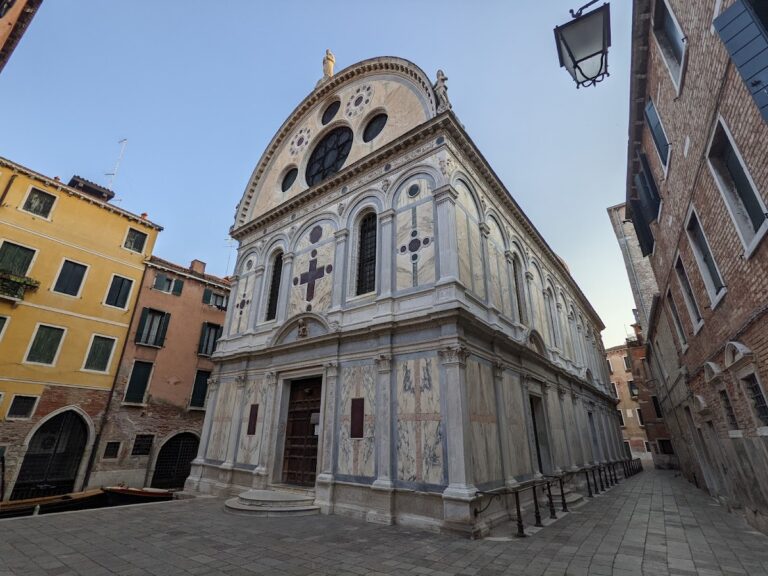
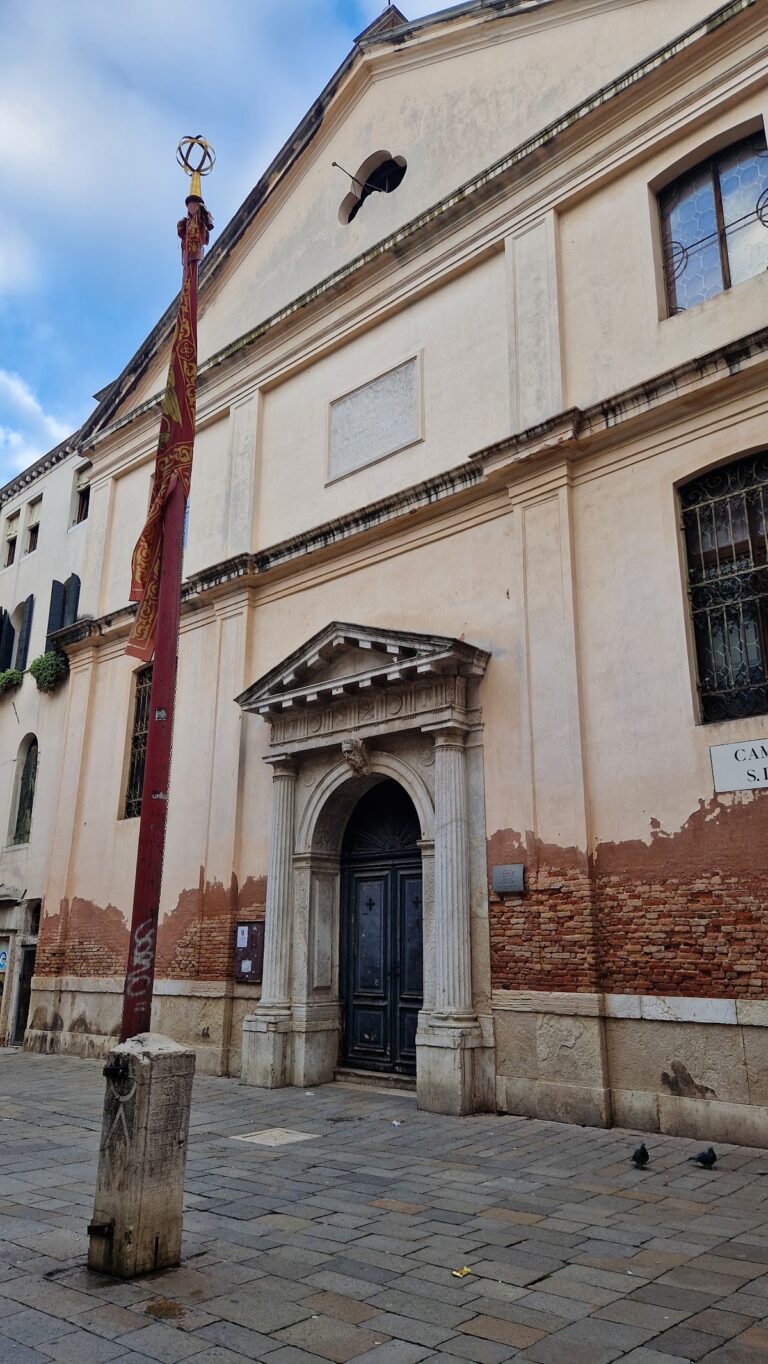
The building stands beside the Dominican Basilica of Santi Giovanni e Paolo in Venice’s Castello district. Its two-part arrangement reflects the principal rooms inside: the Portego delle Colonne, or entrance hall, with the Sala Capitolare, the chapter or assembly hall of the institution, above it on one side; and the former Cappella della Pace with the Sala dell’Albergo, a confraternity reception and meeting hall, above it on the other. The facade is clad in white and polychrome marble and divided into two wings with separate entrances. Renaissance classicism is combined with arches, niches, and forms associated with conservative Venetian and Byzantine-influenced design.
Marble reliefs and central entrance
The lower facade contains paired perspectival trompe-l’oeil reliefs. This technique creates the illusion of three-dimensional depth, and here shallow marble carvings imitate architectural portals receding into space. The reliefs include winged lions of Saint Mark and scenes from the saint’s life. The work is associated with Pietro Lombardo’s workshop, with individual reliefs attributed to Pietro Lombardo and others to Tullio Lombardo.
The principal entrance projects forward as a portico supported by columns on square pedestals decorated with putti, small childlike figures in Renaissance art. Its form recalls the Arch of Constantine in Rome. The lunette contains Saint Mark Venerated by the Confraternity, probably by Bartolomeo Bon, while statues of Saints Peter Martyr and Dominic stand beside it. The former entrance to the Cappella della Pace has corresponding perspectival reliefs attributed to Tullio Lombardo. That area is now associated with a historic pharmacy and a museum of pathological anatomy.
Friezes and upper facade
Above the main entablature is a frieze of griffins alternating with vases filled with fruit. A second, taller frieze between the capitals shows confronted griffins separated by porphyry roundels. Both friezes are attributed to Pietro Lombardo.
The upper right wing has fluted pilasters with Corinthian capitals and two pedimented windows lighting the Sala dell’Albergo. Between them is a roundel showing Saint Mark’s winged lion standing on waves. Guglielmo da Carona made the relief, which is surrounded by four porphyry inserts. Three arches terminate the wing, decorated with porphyry ovals and five vases of Istrian stone. These are placed alternately above acroteria, architectural ornaments set at the corners or apex of a pediment, and winged sphinxes.
The upper left wing is divided by fluted pilasters into three sections. The two outer sections contain windows with arched pediments opening onto the Sala Capitolare. The central section, behind the statue of Charity, is faced with twelve marble slabs. Its high, semicircular-gabled front carries putti, cornucopias, and the figures of Capricorn and Sagittarius, together with two smaller semicircular gables at lower levels.
The upper left gable supports a Saint Mark’s lion with an open book by Luigi Ferrari. The sculpture stands on a podium carried by five small columns. Two niches contain armored Roman-style warriors, probably by Tullio Lombardo and possibly representing the martyr saints John and Paul. Four statues on the gable represent the cardinal virtues Temperance and Prudence and the theological virtues Faith and Hope. Two angels and the Evangelist complete the summit decoration.
Entrance hall and staircase
The Portego delle Colonne is a large tripartite entrance hall divided by two rows of Corinthian columns set on high bases of Istrian stone. Gregorio di Antonio da Padova began the column foundations after the fire, while Pietro Lombardo and Giovanni Buora worked on the columns and their carved bases. Giovanni di Mafio, under Mauro Codussi’s supervision, laid a black-and-red checkerboard pavement.
Ten round-arched windows on the west wall illuminate the hall and the marble slabs commemorating benefactors. On the exterior, the windows alternate with pilasters decorated with discs showing members of the confraternity. Two portals at the ends of the right-hand wall lead to the monumental staircase. Its two flights meet at a central landing and connect the entrance hall with the Sala Capitolare. The present staircase is a twentieth-century reconstruction, replacing Codussi’s original, which was demolished during the conversion to hospital use.
Assembly halls and ceilings
The upper floor contained the Sala Capitolare, used for general assemblies, and the Sala dell’Albergo, used for smaller meetings and for keeping the confraternity’s valuables and relics. The Sala Capitolare also included an elevated chapel enclosed by a balustrade, providing the room’s principal liturgical focus.
Niccolò di Marco made the benches with columns and capitals arranged along the walls of the Sala Capitolare. Its wooden ceiling, produced by Vettore Scienza di Battista da Feltre and Lorenzo di Vincenzo da Trento, contains 147 octagonal coffers. Their red grounds carry gilded floral ornament, alternating with 60 lions of Saint Mark and concentric floral designs ending in rosettes. The center originally held a Saint Mark’s lion on a red field within a gilded circular frame on a blue ground. Four smaller coffers around it bore the emblems of the other Great Schools, Venice’s principal large lay confraternities.
The entrance to the Sala dell’Albergo has a stone frame possibly made by Codussi. Biagio and Pietro da Faenza produced its coffered ceiling, formed by a dense network of round coffers with gilded garland frames and smaller rosettes at their intersections. The coffers have red grounds, gilded floral decoration on ultramarine-blue fields, and raised central rosettes. At the center, a gilded Saint Mark’s lion on an ultramarine ground is enclosed within a double octagonal floral frame.
Painted decoration
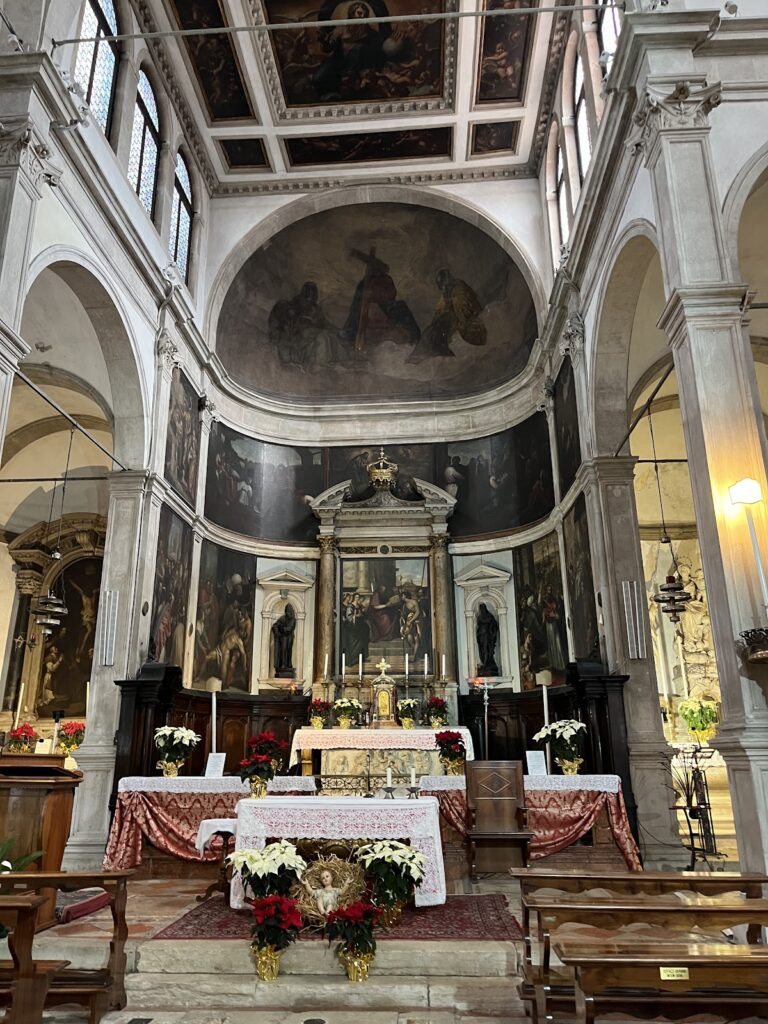
The interiors originally carried an extensive painted cycle. Works by Jacopo Palma the Younger, Domenico Tintoretto, Padovanino, and Alvise Donato remain in their original locations. Other paintings by Jacopo Tintoretto, Jacopo Palma the Elder, Paris Bordone, Gentile and Giovanni Bellini, Giovanni Mansueti, and Vittore Belliniano were lost or transferred to the Gallerie dell’Accademia in Venice and the Pinacoteca di Brera in Milan.
Jacopo Tintoretto painted Miracle of the Slave, also called The Miracle of Saint Mark, in 1548. His Saint Mark’s Body Brought to Venice and Finding of the Body of Saint Mark date from 1562 to 1566. The first two paintings are now in the Gallerie dell’Accademia, while the third is in the Pinacoteca di Brera. Palma the Elder also contributed Storm at Sea to the decorative cycle.
The former Sala dell’Albergo cycle presented scenes of Saint Mark preaching and suffering martyrdom, healing and baptizing the shoemaker Anianus, and a fisherman presenting a ring to Doge Gradenigo. It also showed Saint Mark, Saint George, and Saint Nicholas protecting Venice from a storm. The Sala Capitolare later received Palma the Younger’s Christ in Glory with Saints Mark, Peter, and Paul, dated 1614 to 1616, together with four scenes from the life of Saint Mark by Domenico Tintoretto.
Paintings commissioned from Jacopo Tintoretto by Tommaso Gianotti, known as Rangone or Ravenna, were installed in the Sala Capitolare after prolonged discussion. Following the suppression of the confraternity, they were dispersed. Reproductions now occupy their places in the building.