Santa Maria Assunta Church: A Roman Catholic Parish Church in Italy
Site at a Glance
- Popularity
- Very Low
- Country
- Italy
- Primary era
- Early Modern
- Eras represented
- Early Modern, Modern
- Civilizations
- Unclassified
- Site type
- Religious
- Remains
- Church
On this page15 sections
History
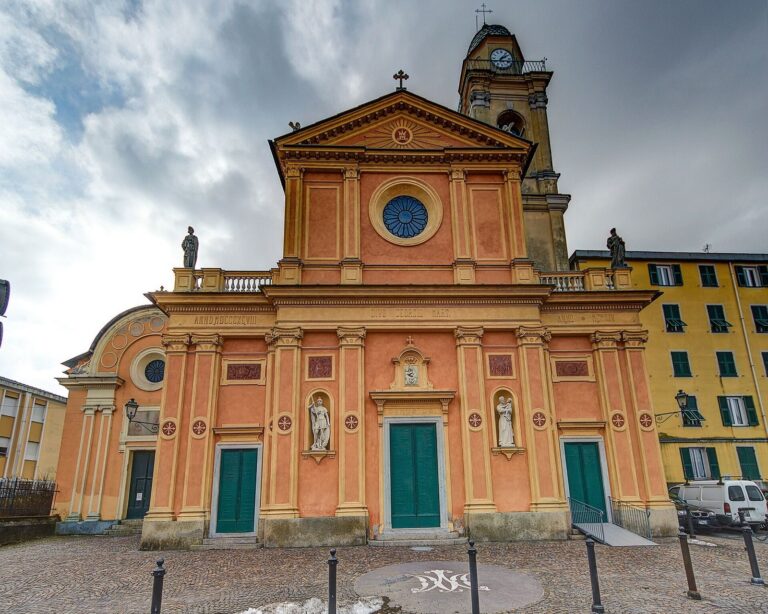
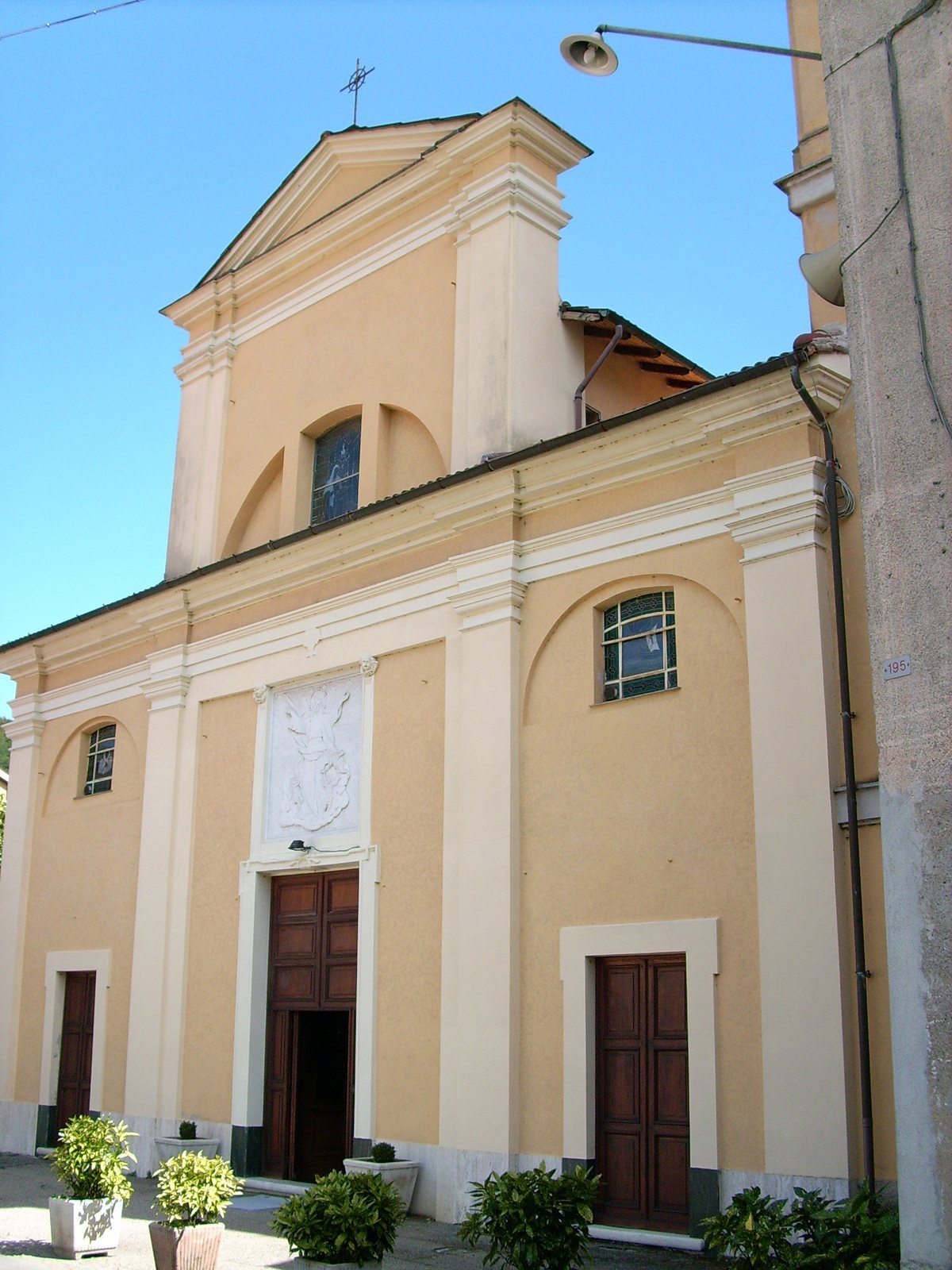
Santa Maria Assunta Church is a Roman Catholic parish church in Italy, dedicated to the Assumption of Mary, the Catholic belief that Mary was taken body and soul into heaven. The present church was completed and consecrated in 1666. Its current appearance reflects later changes and a light form of Piedmontese Baroque, a regional style associated with northwestern Italy.
Early parish and changing jurisdiction
The old parish church was known as Santa Maria di Ceta. Its name appears in a document from 1127, and the church is first listed in 1198. A record dated June 13, 1208, gives the abbot of Rivalta Scrivia permission from the bishop of Tortona to build a church and monastery within the parish territory. A proposed fourth-to-sixth-century date for the church was later rejected.
Until the mid-thirteenth century, the parish and its dependent churches at Busalla, Ronco Scrivia, Isola del Cantone, and Fraconalto belonged to the Diocese of Tortona. A decree of Pope Innocent IV transferred them to the Archdiocese of Genoa. The decree is dated June 3, 1248, although historian Arturo Ferretto placed its date at January 10, 1250.
Parish life and rebuilding
Archpriest Giorgio Morando began the parish registers in 1580; the first baptism entered in them took place on October 1. During a 1582 inspection, Bishop Francesco Bossi of Novara found the church in very poor condition. It then had a high altar and four others dedicated to Saint Michael, Saint Martin, Saint Mary, and Saint John the Baptist.
The church was badly damaged in 1625 during the war between the Republic of Genoa and the Duchy of Savoy, neighboring powers whose conflict affected the building. The old church was demolished in 1650, and its replacement was completed and consecrated in 1666. Austrian forces set fire to the church in the eighteenth century, prompting another remodeling. By the early nineteenth century it had fallen into ruin, and it was rebuilt.
By 1889 the church had seven altars, with several dedications altered over time. An altar near the entrance on the right, dedicated to Saint Lucy before 1771, was then dedicated to Saint Joseph. On the left, an altar once dedicated to Saint Charles Borromeo had been rededicated to Saint Francis of Assisi in 1838. An altar to Saint Michael at the end of the nave was replaced in 1876 by one dedicated to Our Lady of the Assumption.
Twentieth-century changes
Archpriest Giovanni Roggerone directed a complete remodeling in 1913. Later conservation included work on the bell tower in 1983 and repairs to the church in 1984–85, focused on strengthening its supporting structure and conserving the building. Painters Angelo Petrucci and Mauro Repetto directed and carried out work on the stucco and frescoed surfaces.
The church is the seat of its namesake parish in the Valle Scrivia vicariate, an administrative subdivision of the Archdiocese of Genoa.
Remains
Building and site features
Church and interior
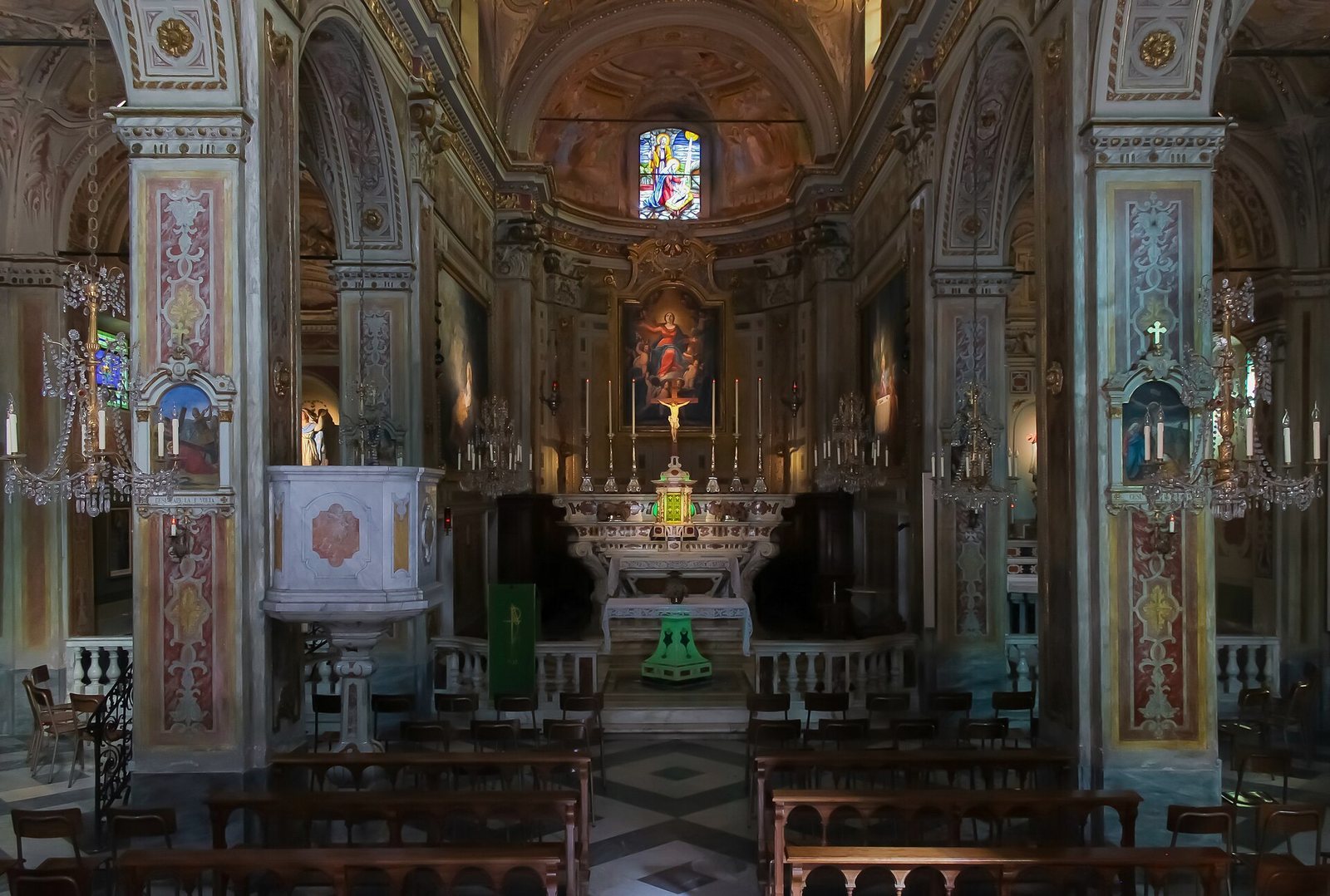
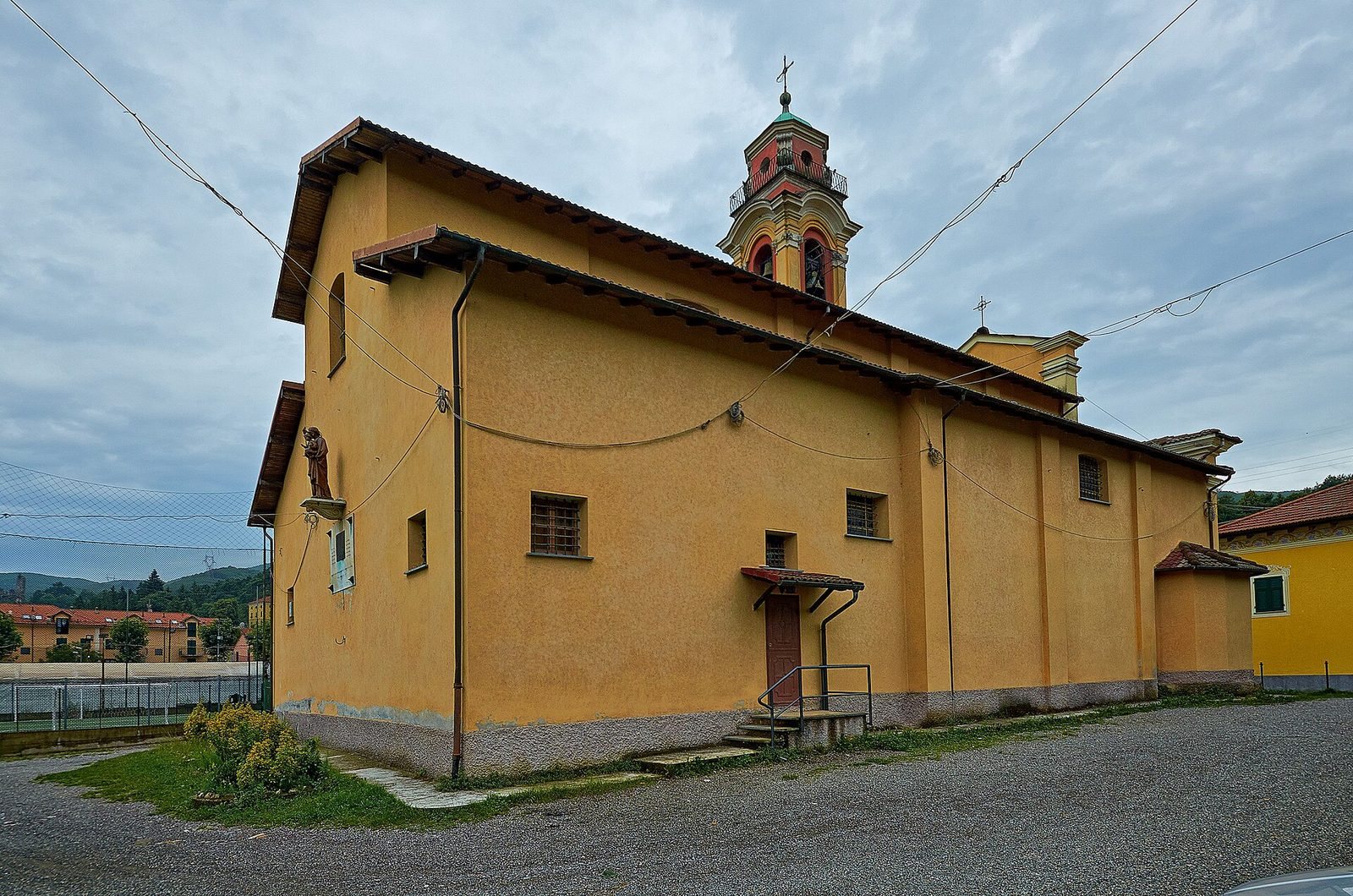
The church stands somewhat apart from the town. The older name Santa Maria di Ceta derived from a nearby mountain, now called Rivà. The interior is divided into three aisles, with gilded ornament, stucco, and painted decoration. Its present appearance retains the light Piedmontese Baroque character.
Bell tower
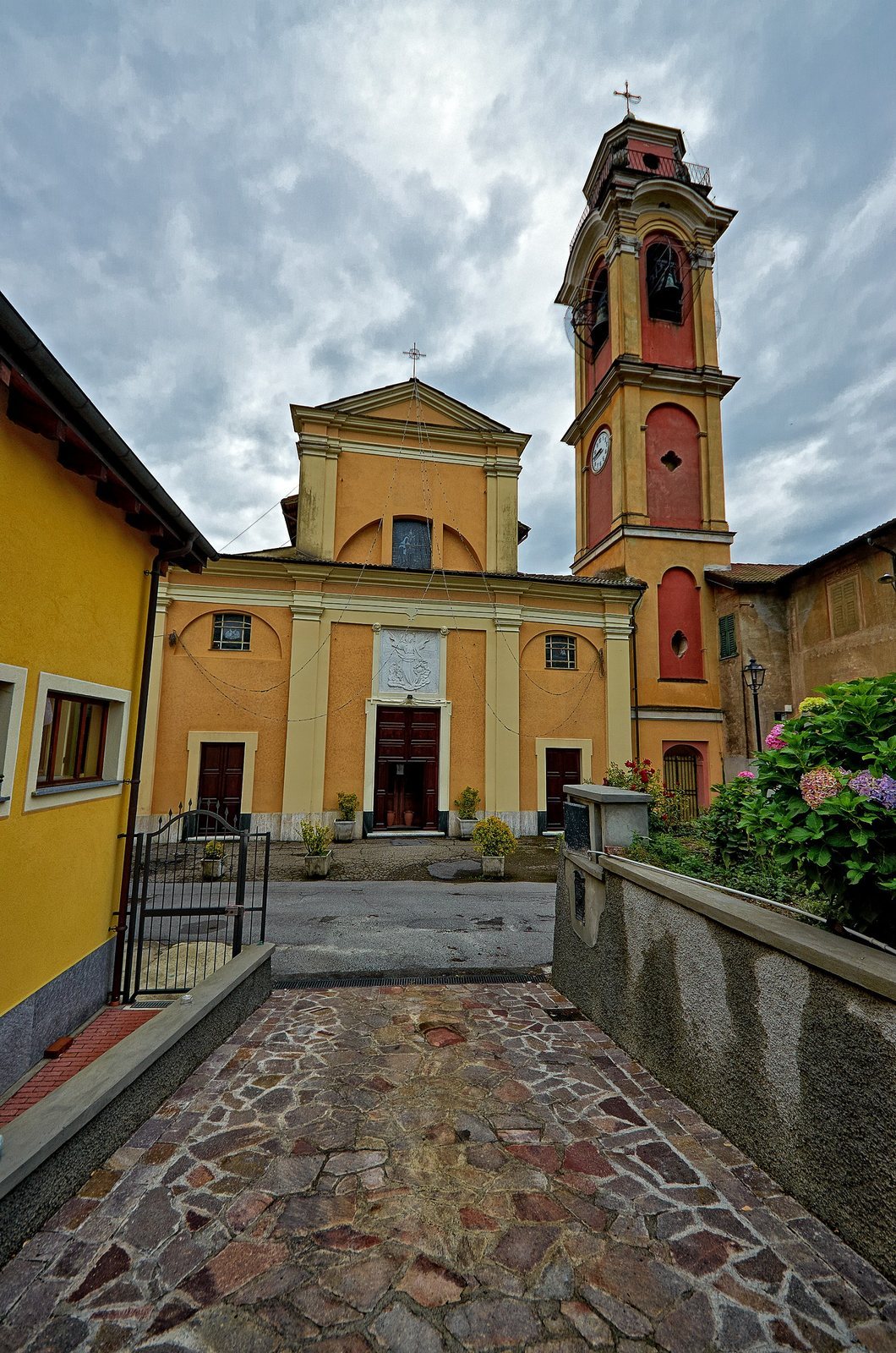
The bell tower stands beside the façade. A topographic map from 1645 places the earlier tower to the left of the choir. That tower held two bells cast in 1374 by Carlo Lanxarotto. The tower was rebuilt beside the façade in 1752. Its present five-bell ensemble was cast in 1886 by the Pasquale Mazzola foundry of Valduggia and sounds in D-flat major, with D-flat 3 as its lowest note. The largest bell weighs about 1,500 kilograms. The tower was fully restored in 1983.
Sanctuary and altars
Main altar and chapels
The presbytery, the area around the main altar, contains a monumental seventeenth-century marble altar bearing the Spinola family coat of arms. The Spinola were a prominent Genoese family. Two chapels flank the altar. On the left, the Assumption chapel has an altar donated by Nicoletta and Rina Carpaneto and a statue dated 1878 by Genoese sculptor Paolo Olivari. The chapel on the right, now dedicated to the Sacred Heart, was formerly dedicated to Our Lady of the Rosary. Its statue, by Antonio Canepa, dates to 1916.
Other marble altars
Two further marble altars are dedicated to Saint Joseph and to Our Lady Immaculate and the Holy Virgins. Geo Davidson paid for the Saint Joseph altar, while Vincenzo and Gigetta Borzone financed the other. The Borzones also funded the Sacred Heart statue and construction of the parish recreation hall in 1937.
Paintings and furnishings
Frescoes and painted decoration
Rodolfo Gambini painted the church’s frescoes, including the Stations of the Cross. In the presbytery, a scene of Jesus in the Garden of Gethsemane is on the Gospel side, one traditional side of the sanctuary; the appearance of Jesus to the disciples at Emmaus is on the Epistle side, the other traditional side. The choir contains an eighteenth-century painting of the Assumption. Paintings on the curved ceilings depict the Coronation of the Virgin, the Madonna of the Rosary, Saint Anne, and Blessed Maria Vittoria Fornari Strata, who founded the Celestial Annunciades, a women’s religious order.
Paintings and stained glass
The church’s paintings include The Flagellation by Giovanni Raffaele Badaracco, associated with Genoese painting, and Saint John the Baptist in the Desert by Giovanni Andrea De Ferrari, dating to the third decade of the seventeenth century. Some of the stained-glass windows were made by Luigi Costa, a glass artist from Alessandria.
Pulpit and organ
Giovanni Roggerone donated the pulpit, which dates to 1913. A pipe organ has stood on the wall opposite the entrance since 1822.