Sant Bartomeu i Santa Tecla de Sitges: A Baroque Parish Church
Site at a Glance
- Popularity
- Medium
- Country
- Spain
- Primary era
- Early Modern
- Eras represented
- Medieval, Early Modern, Modern
- Civilizations
- Crown of Aragon, Habsburg, Habsburg Spain, Spanish
- Site type
- Religious
- Remains
- Church
On this page19 sections
History
Sant Bartomeu i Santa Tecla de Sitges is a Roman Catholic parish church in Spain, dedicated to Saints Bartholomew and Thecla. The present Baroque building was begun in 1665 and blessed on 18 July 1672, following earlier churches on the site.
Medieval foundations and the Gothic church
A Romanesque church stood here around 1135. Giuslabert founded it and dedicated it to Saint Thecla. A Gothic church was completed in 1322 under the promotion of Bernat de Fonollar, a medieval Catalan nobleman.
In 1324, Fonollar paid 300 Barcelona sous for Gothic altarpieces for the chapels of Saint Michael and Saint Peter Martyr. A Renaissance altarpiece made in 1499 later took their place. Two years later, Fonollar endowed a benefit, a church fund requiring a daily Mass at Saint Peter’s altar in memory of him and his family. Its income came from revenues attached to Campdàsens Castle.
The Baroque church
Work on the present church began in 1665. One tower was built in 1672, the year the church was blessed; the second, called the Communidor, followed in 1674. A Communidor is a church tower associated with rites intended to bless or protect the surrounding area.
In the late seventeenth century, religious associations and the Sitges civic corporation, the town’s municipal governing body, commissioned new devotional furnishings. The Rosary Confraternity, a religious association supporting this devotion, dedicated an altarpiece to the Rosary in 1684. The civic corporation commissioned an altarpiece in 1699, with part of its cost met through the salt duty and a contribution from Joan Llopis, a priest and parish priest of El Vendrell. Llopis stipulated that part of the work also honor Saint Francis of Paola.
Later changes and conservation
The Blessed Sacrament Chapel was built between 1854 and 1856. In 1868, the church’s other bell tower was remodelled, and its bells and the town clock were placed in the Communidor after the old Clock Tower on Carrer Major was demolished. During the Spanish Civil War, the Rosary altarpiece’s earlier image of the Virgin was thrown into the sea. The image of Our Lady of Sorrows was destroyed on 21 July 1936, and the Holy Sepulchre was also thrown into the sea. A new Sepulchre was commissioned in 1946 using the recovered original head of Christ; in 1948, a Pietà by Sitges sculptor Pere Jou replaced the destroyed image of Our Lady of Sorrows.
The central surviving section of the 1499 altarpiece was moved to the Sanctuary of Our Lady of Vinyet during construction of the Baroque church. It returned in 1939 and was installed behind the altar. Architect Francesc Folguera worked on the dome and high altar in 1950 and 1951. Since 1985, the Association of Friends of the Sitges Organ, founded by musician Josep Pagès i Busom, has overseen the instrument’s conservation. The church is included in Catalonia’s cultural heritage.
Remains
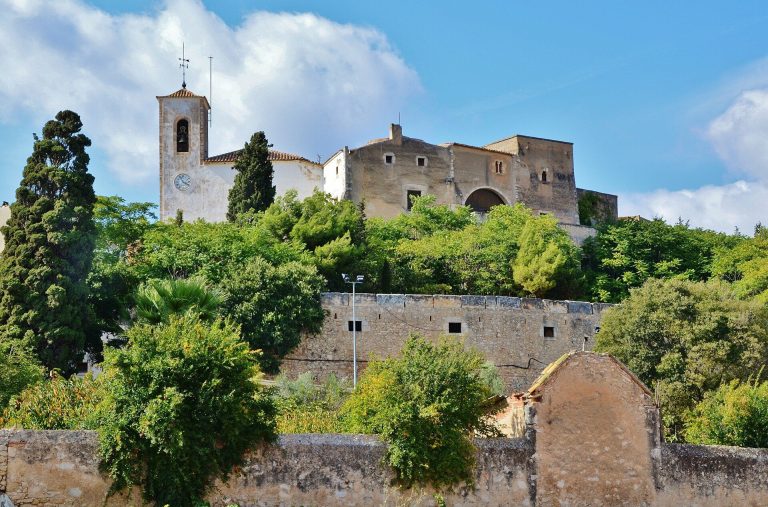
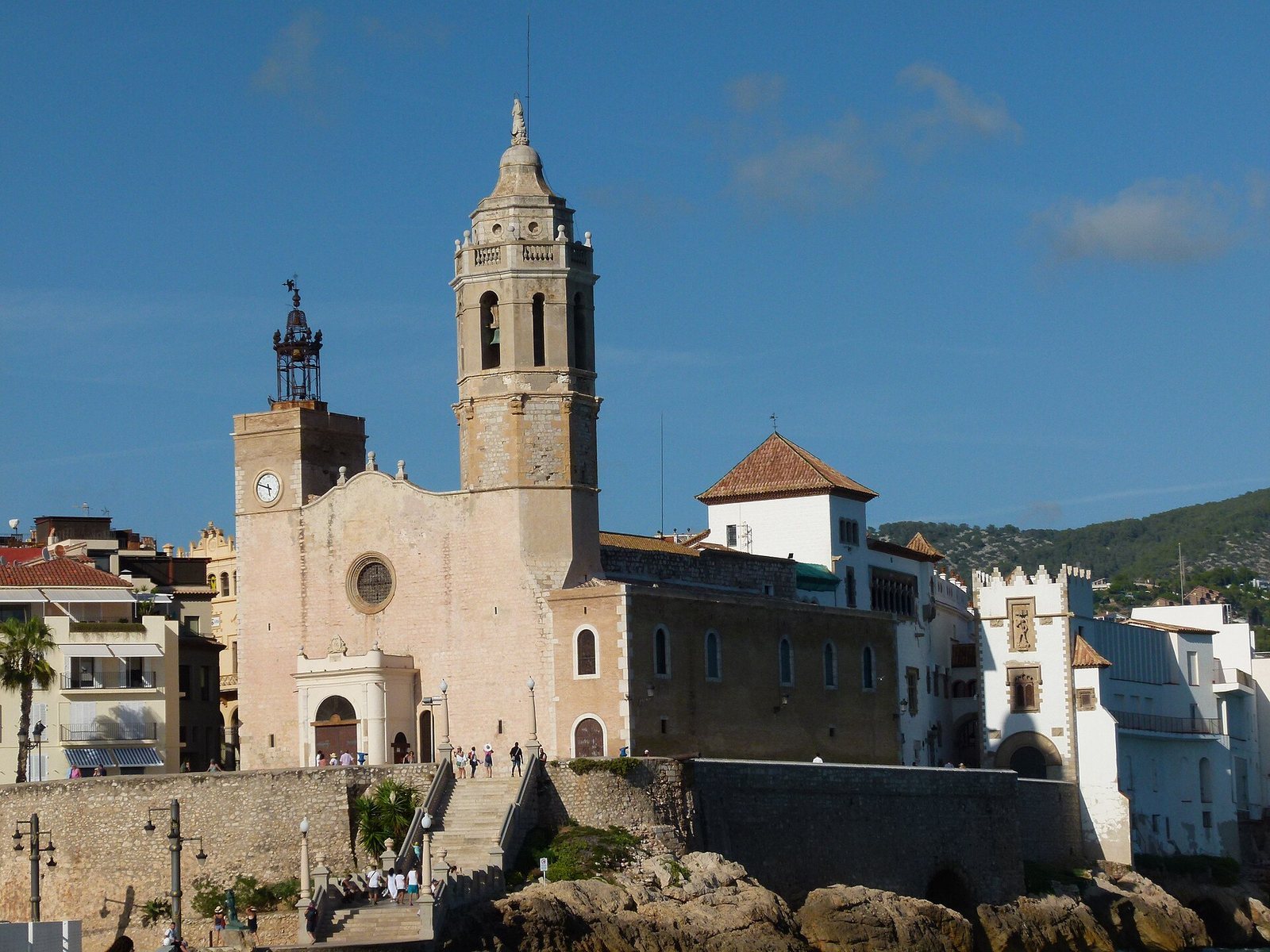
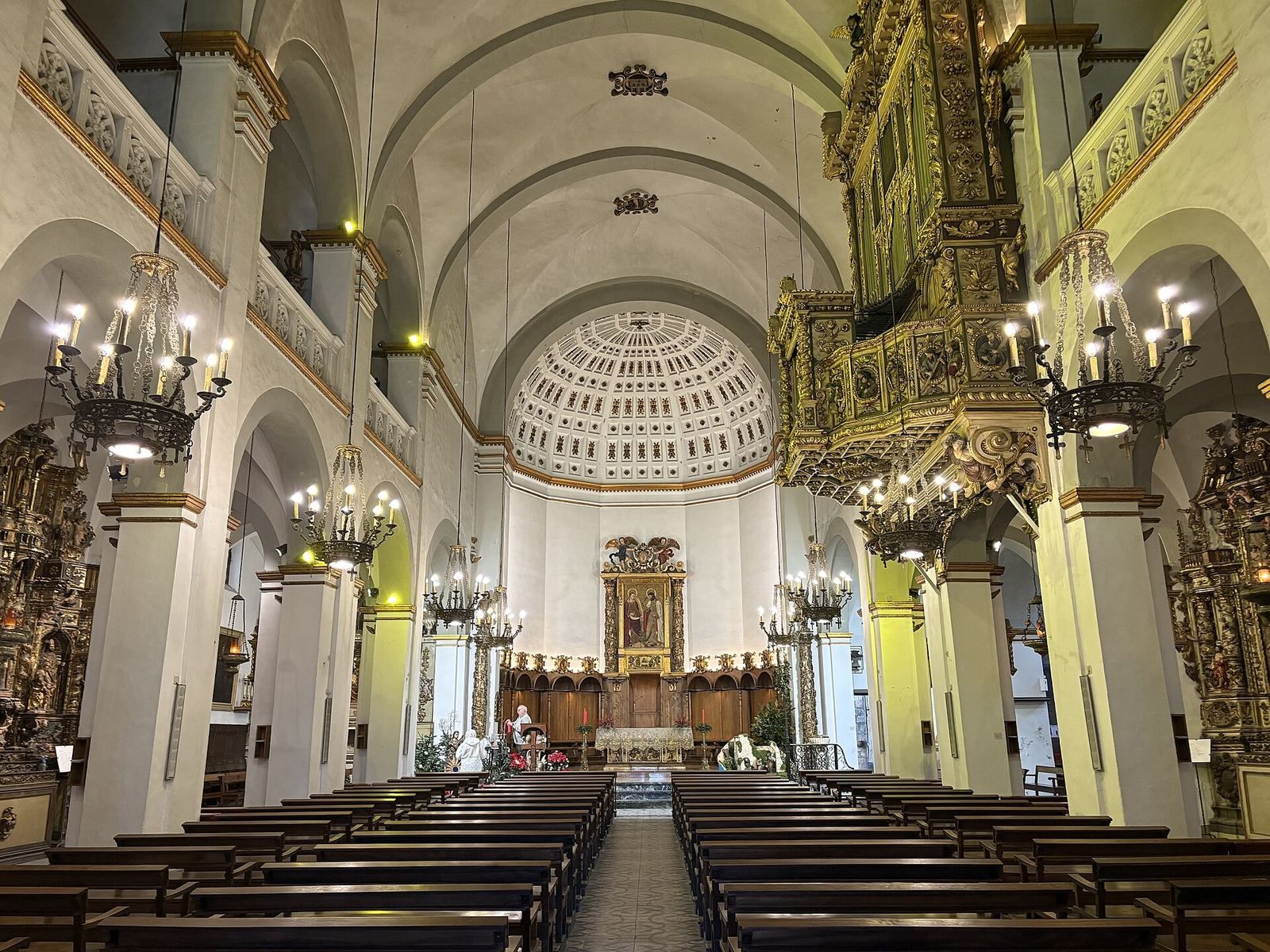
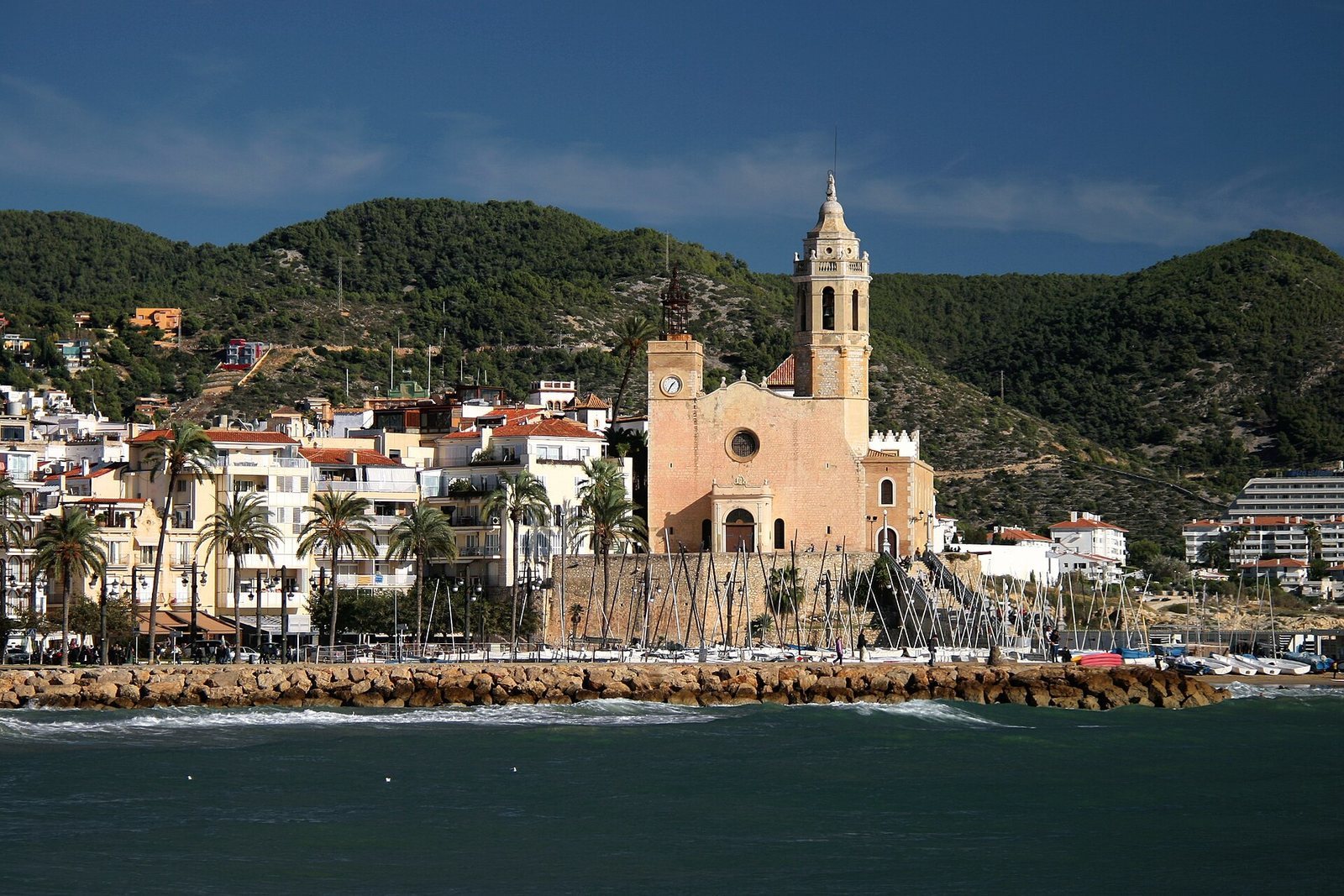
Set on a hill overlooking the beach, the church has an asymmetrical outline. Its Baroque interior is arranged in three naves, with the central nave higher than the side aisles. The building ends in a polygonal apse, the sanctuary end of the church, and has a choir at the entrance end. Ribs strengthen the vaulting, which rests on semicircular arches.
Façade and towers
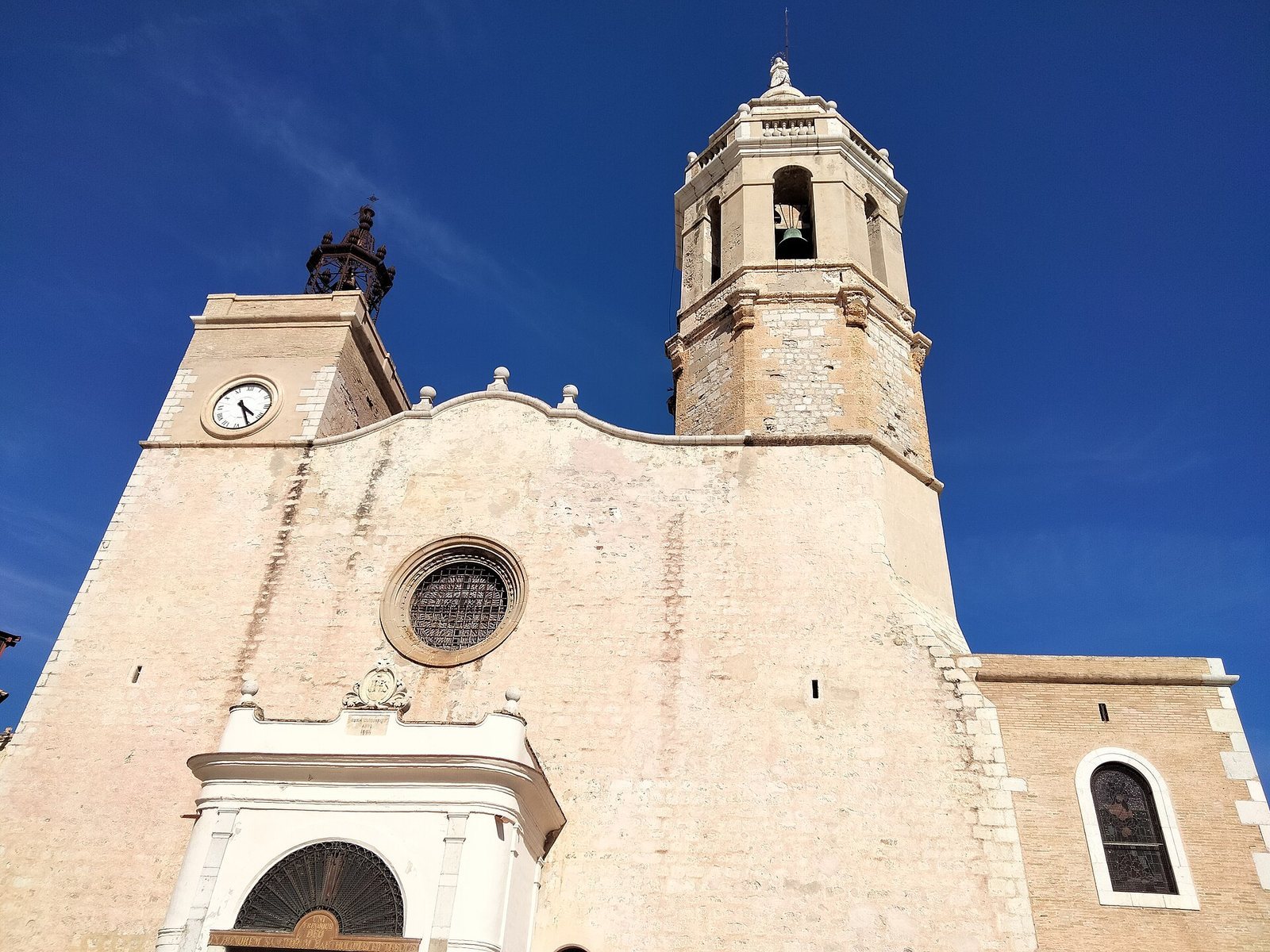
The main façade projects beyond the body of the church. Three round-arched doorways open at ground level, with a circular window above and a curving upper outline finished with a cornice and stone spheres. To the façade’s right rises an octagonal bell tower, arranged in three tiers and topped by an image of the Immaculate Conception. The square Communidor stands to the left.
Interior and chapels
Nave and side chapels
Chapels line the side aisles, which also have upper galleries. Facing the altar, the chapels on the left are dedicated to Our Lady of the Remedies, Saint Elmo, and Saint Peter; those on the right honor the Immaculate Conception and the Rosary. Two nineteenth-century chapels are attached to the church, Ecce Homo and the Blessed Sacrament. The Blessed Sacrament Chapel is on the church’s right side. Its Corinthian capitals, ornate column tops decorated with leaves, have abundant floral ornament and softly modelled angels.
Paintings and tombs
The Blessed Sacrament Chapel contains a twentieth-century mural of the Last Supper by Darius Vilàs, who also painted the presbytery. Both commissions were made for American philanthropist Charles Deering. Paintings by Pere Pruna are in the baptistery and a side chapel dedicated to Our Lady of Montserrat; paintings by Ocerans are also associated with the baptistery chapel. The Chapel of Our Lady of Sorrows is reached through the sacristy. Beneath the choir are two Gothic tombs, dated 1317 and 1322, containing the remains of Bernat de Fonollar, Galceran de Ribes, and Galceran de Pacs.
Altarpieces
Saints Bartholomew and Thecla
The surviving central panel of the Renaissance altarpiece made in 1499 by Neapolitan painter Nicolau de Credença depicts Sitges’s patron saints, Bartholomew and Thecla.
Our Lady of the Rosary
Made in 1684, this is the oldest preserved altarpiece in the parish. Its overall design is Renaissance in character, with five groups of images separated by twisting Solomonic columns decorated with birds and vine leaves. The predella, the altarpiece’s lower section, shows the Sorrowful Mysteries of the Rosary, except for an Adoration of the Magi at the centre. Above it, the first tier has a modern central image of the Virgin, flanked by four scenes from the Joyful Mysteries. Medallions above show Gregory, Jerome, Augustine, and Ambrose of Milan, influential early Christian theologians whose writings helped shape doctrine. The second tier places the Coronation of Mary between scenes of the Glorious Mysteries. At the top, a Calvary scene is flanked by the Virgin and the Archangel Gabriel, representing the Annunciation. Master sculptors planned the ensemble and carved its more demanding figures, while workshop staff made secondary figures and ornaments.
Saint Elmo
Built in 1688 and attributed to Barcelona sculptor Jaume Tremulles, this altarpiece honors Saint Elmo, another name for Erasmus of Formia, an early Christian bishop and martyr venerated as a protector of sailors. Its maritime decoration includes fish, angels riding sea monsters, and forms of marine plants. The predella depicts the saint’s episcopal consecration, a ship in a storm, and a shipwreck. Gilder Francesc Cervera carried out the altarpiece’s painted finish under a 1691 contract with the Saint Elmo Confraternity. Its present Saint Elmo image is modern.
Our Lady of Sorrows
Commissioned by the Sitges civic corporation in 1699 and dated 1702, this altarpiece was made by sculptor Joan Roig i Gurri. Its cost of 500 pounds came from the salt duty and a contribution by Joan Llopis, who required that part of the work also honor Saint Francis of Paola, an Italian religious founder. Joan Muxí carried out its patterned, textile-like painted decoration and gilding. The Virgin occupies the central position above the Holy Sepulchre, which rests on the altar. Four high-relief scenes beside her depict episodes from her life: Simeon’s announcement, Jesus lost and found among the teachers, the Flight into Egypt, and Jesus on the way to Calvary. Two further reliefs flank the upper image of Saint Francis and depict episodes from his life.
Immaculate Conception
Dated 1694, this altarpiece has a grid-like arrangement and a central image more than half its total width. The image of the Immaculate Conception and the angels forming its base were added after the Spanish Civil War. The Immaculate Conception is the Catholic belief that Mary was conceived without original sin.
Our Lady of the Remedies
Dated 1695, this altarpiece may have come from the same workshop as the Saint Elmo work. Its gilding continued for at least seventeen years, and its arrangement has since been substantially altered. Our Lady of the Remedies now occupies the upper central niche, with Saint Joseph in the lower place of honor. Saint Maginus, a Catalan saint traditionally associated with Tarragona, is placed to one side among figures of Saints Elizabeth, Teresa, John the Baptist, Isidore, and Sebastian.
Saint Peter
This altarpiece combines seventeenth-century elements with a broader arrangement added in 1839. Its earlier parts include two side niches in the middle tier and a predella with three reliefs depicting episodes from the saint’s life.
Saint Raymond of Penyafort
Assembled as a distinct altarpiece in the 1980s, it combines seventeenth-century pieces with much later elements. Saint Raymond of Penyafort was a medieval Catalan Dominican friar and canon lawyer.
Organ
The Baroque organ stands halfway along the nave on the right when facing the altar, attached to the gallery running alongside it. Built during the 1690s, it was considered complete in May 1699. Trinitarian Bartomeu Triay, a member of the Catholic Order of the Most Holy Trinity, was engaged to build the instrument. The Sitges civic corporation contracted Joan Roig i Gurri to make its case in 1695, and Sebastian Font was commissioned to paint its doors in 1697. The doors are dedicated to Saints Bartholomew and Thecla.
A smaller instrument sits beneath the main one. Images of the Apostles decorate the two railings, their faces turned downward, while four sculpted angel musicians flank the case. Above it, a frieze and cornice support two angels holding a medallion with Sitges’s coat of arms; an image of the Immaculate Conception stands above them. The lower part of the base resembles a panelled ceiling with a star at its centre.