Corpus Domini, Bologna: A Clarissan Monastic Complex and Sanctuary


Site at a Glance
- Rating
- 4.8
- Popularity
- Very Low
- Country
- Italy
- Primary era
- Medieval
- External website
- Open
- Eras represented
- Medieval, Early Modern
- Civilizations
- Papal States
- Site type
- Religious
- Remains
- Monastery
On this page8 sections
History
Corpus Domini is a Roman Catholic monastic complex in Bologna, Italy, founded in 1456 by Caterina de’ Vigri, later known as Saint Catherine of Bologna. It became the city’s first monastery of the Poor Clares, the contemplative Second Order of Saint Francis, and its sanctuary was constructed between 1477 and 1480.
Foundation and construction
Caterina de’ Vigri founded the monastery on 22 July 1456. The new establishment replaced the Monastery of San Cristoforo delle Muratelle, which dated from around 1300 and had been donated by Cardinal Bessarion, a Byzantine-born churchman and Catholic cardinal, to Caterina and her fellow nuns. The complex developed under the titular dedications of Saint Catherine of Siena and Corpus Domini, the Christian feast centred on the Eucharist, or consecrated bread understood in Catholic theology as the body of Christ.
The sanctuary was built from 1477 to 1480 by Nicolò Marchionne of Florence and Francesco Fucci of Dozza. Its religious community followed the Rule of Saint Clare, with vows of chastity, poverty, obedience, and enclosure.
Baroque enlargement and suppression
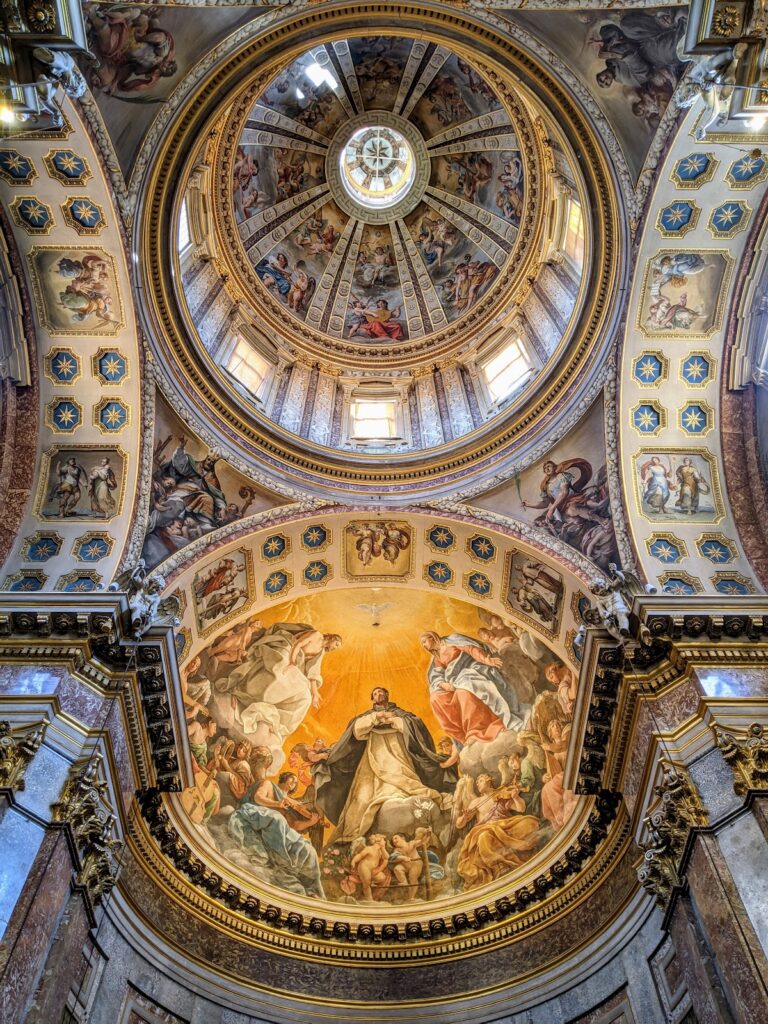
In 1687 Giovanni Giacomo Monti enlarged the church and raised its vaults. The interior was then redecorated in the Baroque style. Marcantonio Franceschini and Francesco Monti supplied paintings, Giuseppe Maria Mazza created stucco work, Enrico Haffner added floral decoration, and Luigi Quaini produced architectural illusionism.
French troops accompanying Napoleon suppressed the Clarissan order, desacralized the church, and confiscated the monastery. After the Restoration, the nuns returned in 1816. Part of the monastery was later converted into a barracks by General Enrico Cialdini, an Italian general and political figure.
Restoration, war damage, and the museum
Alfonso Rubbiani and the Committee for Historic-Artistic Bologna led the restoration of the church facade in 1905. On 5 October 1943, Allied bombing struck the church and monastery because the nearby Cialdini barracks was regarded as a military target. The nave vaults and sections of the supporting walls collapsed, severely damaging the frescoes and Baroque decoration, while the terracotta portal was shattered. The Monuments Superintendency carried out a prompt restoration in 1949, creating the sanctuary’s present appearance.
Cardinal Giorgio Gusmini conceived the museum, which opened on 8 March 1919. It preserves the body and works associated with Saint Catherine of Bologna. Since 2023, the monastery has suspended its function, and the last cloistered nuns were transferred to another structure.
Remains
Corpus Domini is a cloistered monastic establishment on Via Tagliapietre, adjoining its sanctuary. The church has a Latin-cross plan, meaning a long central nave crossed by a shorter transept, with a single nave and several important side chapels. Its Renaissance facade includes a terracotta portal attributed to Sperandio of Mantua. After the wartime destruction, sculptor Giovanni Vicini reassembled the portal during a sixteen-month restoration, while the rest of the building was reconstructed.
Sanctuary and memorials
An urn containing the remains of Blessed Giovanna Lambertini, a fellow nun of Saint Catherine of Bologna, stands on the entrance door. At the entrance to the adjoining room is an urn containing the relics of the Poor Clare Paola Mezzavacchi. A memorial slab in the centre of the nave marks the burial of Laura Bassi, an eighteenth-century physicist and one of the first women in Europe to receive a university professorship.
Saint Catherine’s museum
The second chapel on the left gives access to the museum. It contains the seated, incorrupt body of Saint Catherine of Bologna, a body believed to have resisted normal decomposition, together with manuscripts of her works, including Seven Necessary Weapons for Spiritual Combat, The Twelve Gardens, The Rosarium, Sermons, Lauds, Treatises, and Letters.
A reliquary, a container made to preserve or display a religious relic, stands on the museum’s left wall and contains the painting Madonna del Pomo, attributed to Saint Catherine. A watercolor image of the Christ Child, also attributed to her, was carried devotionally to the sick. The museum occupies a cell dating from 1680. Its decoration includes Franceschini’s Glory of Angels in the semi-dome and his Evangelists in medallions, floral work by Giovanni Haffner, architectural framing by Luigi Quaini, and stucco putti by Mazza. A giga, a historical bowed string instrument, is displayed on the wall opposite the Madonna del Pomo.
Galvani Chapel
The Galvani Chapel on the left side of the nave contains the burials of Luigi Galvani and Lucia Galeazzi Galvani. Luigi Galvani was an eighteenth-century physician and physicist whose experiments helped establish the study of bioelectricity. The chapel’s principal feature is a large stucco crucifix made by Alfonso Bortolotti in 1957. Sculptures by Angelo Piò were lost during the Second World War. Franceschini’s painting of Prudence is positioned above, while a representation of Wisdom occupies the wall.
Nearby sites