Sanctuary of Our Lady of Polsi: A Marian Pilgrimage Centre in Calabria

Site at a Glance
- Rating
- 4.1
- Popularity
- Very Low
- Country
- Italy
- Primary era
- Early Modern
- Eras represented
- Early Modern
- Civilizations
- Kingdom of Naples
- Site type
- Religious
- Remains
- Monastery
On this page14 sections
History
The Sanctuary of Our Lady of Polsi is a Roman Catholic Marian sanctuary in San Luca, Italy, within the Aspromonte National Park. Its Christian history is associated with a Basilian monastic tradition, while its precise foundation date remains uncertain. Religious activity at Polsi began before the medieval period, and the sanctuary later became one of Calabria’s most important centres of devotion to the Virgin Mary.
Before the Christian sanctuary
Archaeological finds indicate that worship took place at Polsi before the rise of Christianity. Settlers from the Greek colony of Locri left small clay votive tablets, known as pinakes, which point to a female fertility cult associated with Persephone. Persephone was a Greek deity linked with the underworld and the seasonal cycle, while Demeter was associated with agriculture and fertility. Later pilgrimage customs involving grain and flowers have been interpreted as survivals of older rites connected with these deities, although the sanctuary itself became a Christian place of worship.
Christian origins and medieval traditions
Several traditions describe the beginning of the Christian sanctuary. Basilian monks, members of a monastic tradition associated with Basil of Caesarea, are traditionally said to have established a Greek-rite hermitage at Polsi in the seventh century. Another account places a small Byzantine monastic settlement and church there in the ninth century. A widely transmitted eleventh-century tradition tells of a shepherd named Italiano who discovered a Greek iron cross and saw a vision of the Virgin and Child. In the vision, the Virgin requested that a church be built at the site.
A further historical attribution dates the foundation to 1144, during the rule of Roger II of Sicily. Roger II was the Norman ruler who became the first king of Sicily, and this attribution places Polsi within the Norman consolidation of southern Italy. These different traditions do not establish a single foundation chronology, but together associate the sanctuary with the long survival of Eastern Christian practices in southern Calabria.
The eighteenth-century expansion
In the early eighteenth century, a community of monks was established at Polsi to pray, work, and spread devotion to the Madonna. Bishop Idelfonso Del Tufo of Gerace laid the first stone of the sanctuary in 1740. Twelve years later, Bishop Cesare Rossi appointed Francesco Larosa of Mammola as its first rector. Larosa had already served as superior and remained in charge until his death in 1782.
During Larosa’s tenure, the sanctuary was enlarged, a convent was built, and accommodation for pilgrims was added. Devotion to Our Lady of Polsi spread through Calabria and Sicily, while the site gained a reputation for sincere faith, aid to the needy, and hope for divine assistance. Traditions associated with Larosa attribute thirteen miracles and other supernatural events to the intercession of the Virgin of Polsi. They include the reported revival in 1771 of Giovan Battista, a dead child brought to the sanctuary by Vincenzo Maria and Livia Carafa, Princes of Roccella. Other traditions recount the extinguishing of a convent fire after Larosa threw part of a burning candle into the flames, the reported healing of the priest Girolamo Cognetti of Gerace after he was anointed with lamp oil, and the healing of Bishop Del Tufo’s severe eye disease.
Larosa died on 6 December 1782 and was regarded by devotees as a person of saintly reputation. His period as rector coincided with rising pilgrimage and offerings, establishing patterns of devotion that continued through later centuries.
Later priors and continuing pilgrimage
In the early nineteenth century, the Abbey of Polsi was assigned to Francesco Apa, who had served in the Sanfedist army in 1799. This counter-revolutionary force supported the Bourbon monarchy in the Kingdom of Naples, and Apa was rewarded for his loyalty to the Bourbon dynasty. Enrico Macrì became one of the sanctuary’s most important later priors. During his thirty-three-year government toward the end of the nineteenth century, the church was restored and enriched.
The recorded succession of rectors includes Francesco Larosa of Mammola, 1752–1782; Giovanni Palamara of Casalnuovo di Africo, 1783–1820; Domenico Fera of Platì, 1836–1856; Enrico Macrì of Cirella di Platì, 1874–1899; Antonio Macrì of Cirella di Platì, 1900–1903; Giosofatto Mittiga of Platì, 1905–1927; Francesco Pangallo of Platì, 1927–1939; Antonio Pelle of Antonimina, 1940–1974; Giosofatto Trimboli of Platì, 1974–1997; Giuseppe Strangio of San Luca, 1998–2017; and Tonino Saraco of Stignano from 2017.
Polsi became a major Marian pilgrimage destination for communities across Calabria, eastern Sicily, the Aspromonte, Reggio Calabria, and Messina. Many pilgrims traditionally regarded a visit as an important act of faith, sometimes one to be undertaken at least once in a lifetime. Pilgrimage activity extended from about June into autumn, traditionally continuing until October or November. Attendance rose sharply between 30 August and 2 September and has exceeded 50,000 people. The festival also became an important setting for Calabrian music and dance.
Feasts and changing devotional practices
The principal feast of Our Lady of Polsi takes place on 2 September. The traditional pilgrimage begins on 22 August with a walking caravan from San Luca and a novena, a period of nine days of prayer. The Feast of the Holy Cross of Polsi follows on 14 September. A ceremonial crowning of the Madonna and Child has been held every fifty years. The first reported crowning took place in 1860 under Domenico Fera, marking the stated three-hundredth anniversary of the statue’s arrival at the sanctuary in 1560. The most recent reported crowning occurred on 2 September 2022.
Older pilgrimages could last for hours or days on foot. Participants sometimes danced along the route in fulfillment of vows, scattered grain and flowers around the processional statue, sacrificed goats, cooked communally, danced the tarantella, sang, prayed, and gave thanks. Church authorities have substantially modified several of these practices in recent decades to regulate popular devotional expressions. Before the road to Polsi was built, pilgrims camped for several days in the valley. Modern participants generally travel by vehicle, especially trucks, and many return home after prayer and the procession rather than staying at the sanctuary.
The sanctuary and the ‘Ndrangheta
Polsi has also been associated with annual meetings of the ‘Ndrangheta, a Calabrian organized-crime network made up of local clans and wider coordinating bodies. These meetings are known as crimini, gatherings of senior representatives. Carabinieri captain Giuseppe Petella reported meetings between criminal groups at the shrine as early as 1903. In 1969, police raided the so-called Montalto summit near the sanctuary and arrested more than seventy ‘Ndrangheta members, while others escaped. Criminal leaders from outside Calabria, including Canada and Australia, also attended such meetings.
In 2010, Giuseppe Fiorini Morosini, Bishop of Locri-Gerace, publicly condemned the sanctuary’s association with criminal activity during the feast, stating that illegal actions had no connection with Christian faith. Attendance at the religious festival declined in 2007 because of fear and tension linked to the San Luca feud between two rival ‘Ndrangheta clans. It is also believed that the decision to assassinate Francesco Fortugno, vice-president of the Regional Council of Calabria when he was killed in 2005, was made at Polsi. The sanctuary was later used as a filming location for parts of Hedy Krissane’s film Aspromonte.
Remains
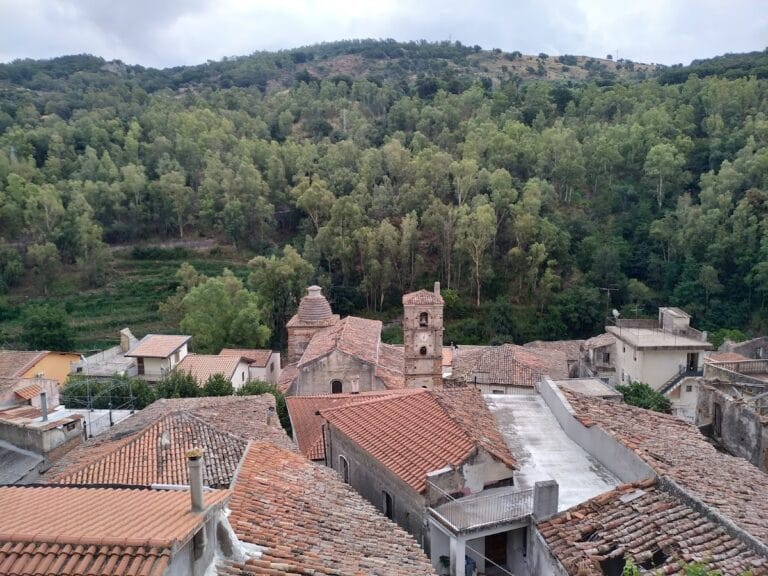
The sanctuary and convent stand at the bottom of a mountain valley or gorge in the heart of the Aspromonte, at approximately 862 to 865 metres above sea level. High mountains surround the complex on the eastern side of Montalto, the highest peak of the Aspromonte, whose elevation is given as 1,955 metres. The Bonamico torrent crosses the site, passing through San Luca before flowing into the Ionian Sea. The complex is a Basilian convent, one of the few surviving Basilian monastic establishments in Calabria, and includes the church, the convent, buildings for pilgrims, and additional rooms containing old objects.
Church and convent
Church interior
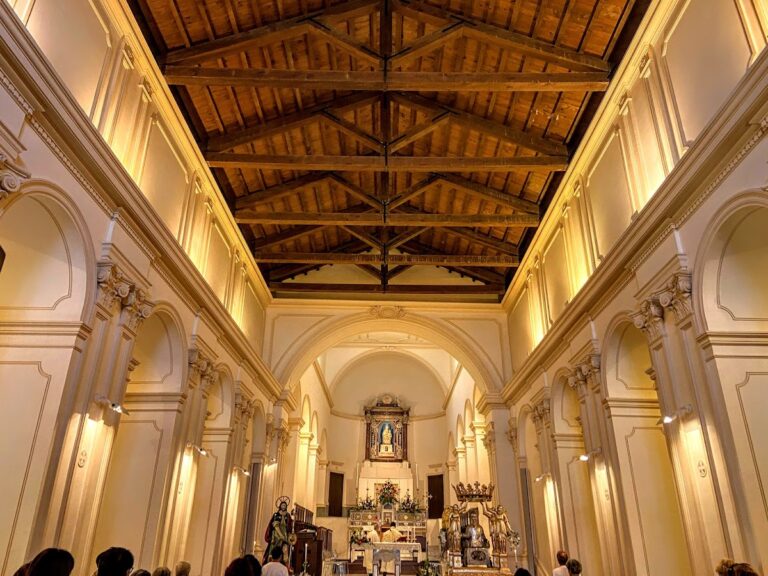
The church has three naves, the principal longitudinal sections of a church. Its central nave is covered by a classical honeycomb-patterned ceiling decorated with solid gold leaf. Arches rest on substantial pillars, whose surfaces are embellished with stucco made by local craftsmen. Wall paintings show episodes from the life and miracles of the Virgin Mary, reinforcing the church’s role as the centre of Marian worship at Polsi.
Convent rooms and preserved objects
The convent includes rooms containing old and valuable objects connected with the sanctuary’s history. Among the preserved items are the Holy Cross of Polsi, associated mementos, and the coffin of the young prince of Roccella. These objects remain part of the material heritage held within the monastic complex.
Images of the Madonna
Madonna of the Mountain
The principal statue, known as the Madonna of the Mountain, is a coloured sculpture carved from tufa, a porous volcanic stone commonly used for carving. A Sicilian artist made it in the sixteenth century. Its black-and-white eyes are designed to appear to follow the viewer.
Processional statue
A second wooden statue of the Madonna of Polsi stands in a white-marble niche. It is used during the annual procession and for the peregrinatio, a devotional journey in which the statue is taken to numerous parishes in the dioceses of Locri-Gerace and Oppido-Palmi, across the metropolitan area of Reggio Calabria, and among other Sicilian communities.