San Vittore, Ascoli Piceno: A Romanesque Church
Site at a Glance
- Country
- Italy
- Primary era
- Medieval
- Eras represented
- Medieval, Early Modern
- Civilizations
- Papal States
- Site type
- Religious
- Remains
- Church
On this page11 sections
History
San Vittore is a Roman Catholic church in the Diocese of Ascoli Piceno, in central Ascoli Piceno, Italy. It stands on the site of a first-century oratory. Its present layout and façade date to a Romanesque reconstruction begun in the mid-thirteenth century, and its design served as a model for other religious buildings in the city through that century. The church was also called a “Constantinian basilica,” a phrase recalling the early Christian basilicas associated with Emperor Constantine.
Early church and parish role
San Vittore first appears in written records in 966, when Bishop Adamo added it to Ascoli’s metropolitan chapter, a body of clergy associated with a major church. The same record names San Venanzio, Santa Maria Intervineas, and San Pietro di Adamo. The last had been built at Adamo’s initiative in the tenth century and no longer survives.
In the early Middle Ages, San Vittore was known as a pieve, a church responsible for pastoral care in a defined district, including administering baptism. The term appears in a diploma of Otto III, Holy Roman Emperor, preserved in Ascoli’s Chapter Archive. San Vittore served its assigned urban district and acted as a territorial point of reference.
Rebuilding in the thirteenth century
In 1242, troops of Frederick II, ruler of the Holy Roman Empire, caused extensive damage to Ascoli Piceno and prompted widespread rebuilding. In 1266, Pope Clement IV called the city’s renewal “New Ascoli.” San Vittore’s reconstruction formed part of this period of change.
Later damage and conservation
Lightning struck the church in 1502, damaging it and bringing down its bell tower, which was later rebuilt. Conservation work from 1924 to 1932 restored the interior to an appearance associated with 1695. The rose window was remade in 1924. After centuries of closure and use as an ossuary, a place for storing human bones, the crypt reopened in 1929.
Remains
Exterior
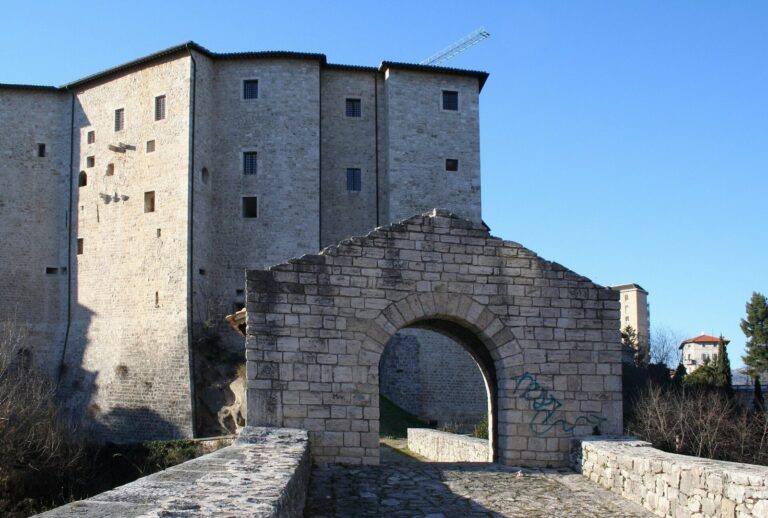
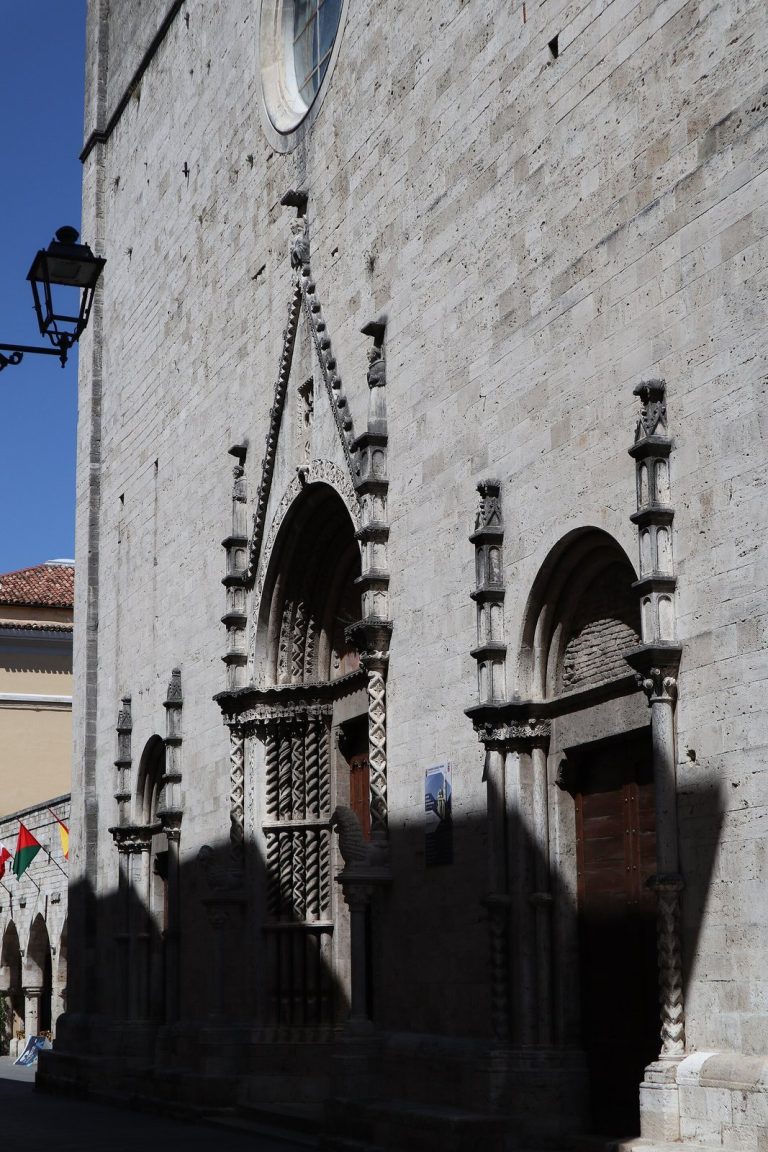
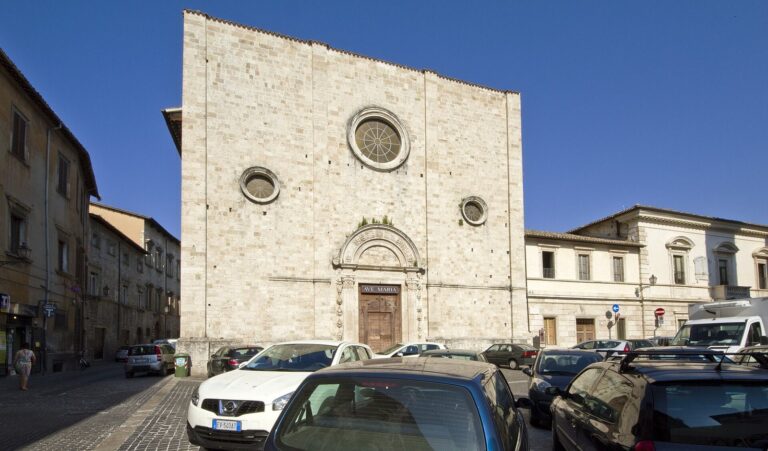
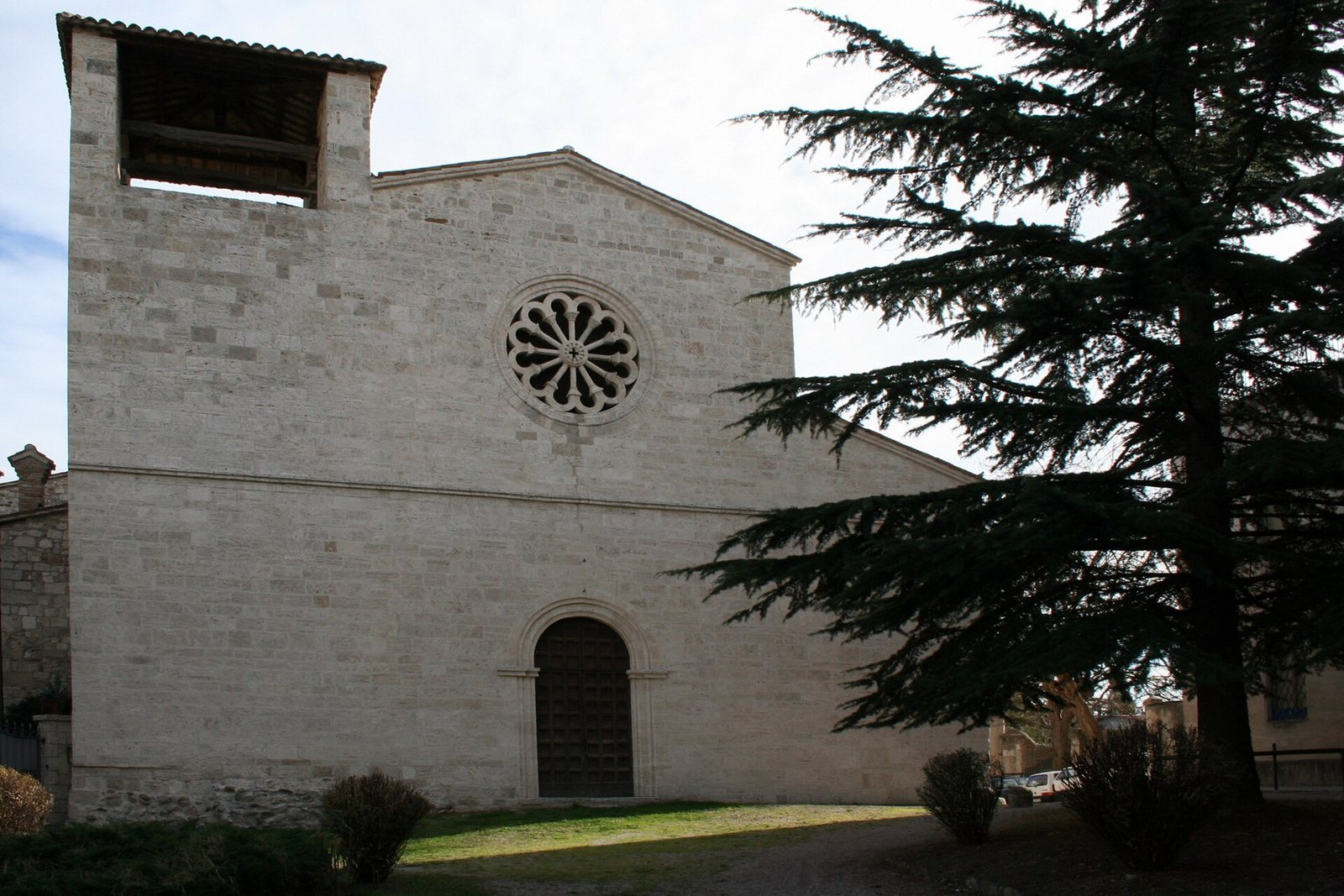
The church is built from squared travertine blocks. Its façade has a rose window formed by small columns radiating from the center, above a central arched portal with a paneled wooden door. A low, square bell tower stands on the left, with a small chapel at its base that probably held the baptismal font. The church is near Forte Malatesta. The ancient Roman Salaria road, which linked Rome with the Adriatic region, ran along its right side toward Ponte di Cecco.
Interior
Three broad naves, the church’s long main spaces, extend beneath a ceiling supported by trusses. A transept, the crosswise part of a church, rises by three steps and leads to a shallow, central, five-sided apse, the sanctuary end. Its Gothic windows are divided by vertical stone supports. A rear tribune, a raised space at the back, completes the arrangement. The sacristy, a room used to prepare for worship, has Gothic windows with single openings.
Painted decoration
Frescoes on the right wall
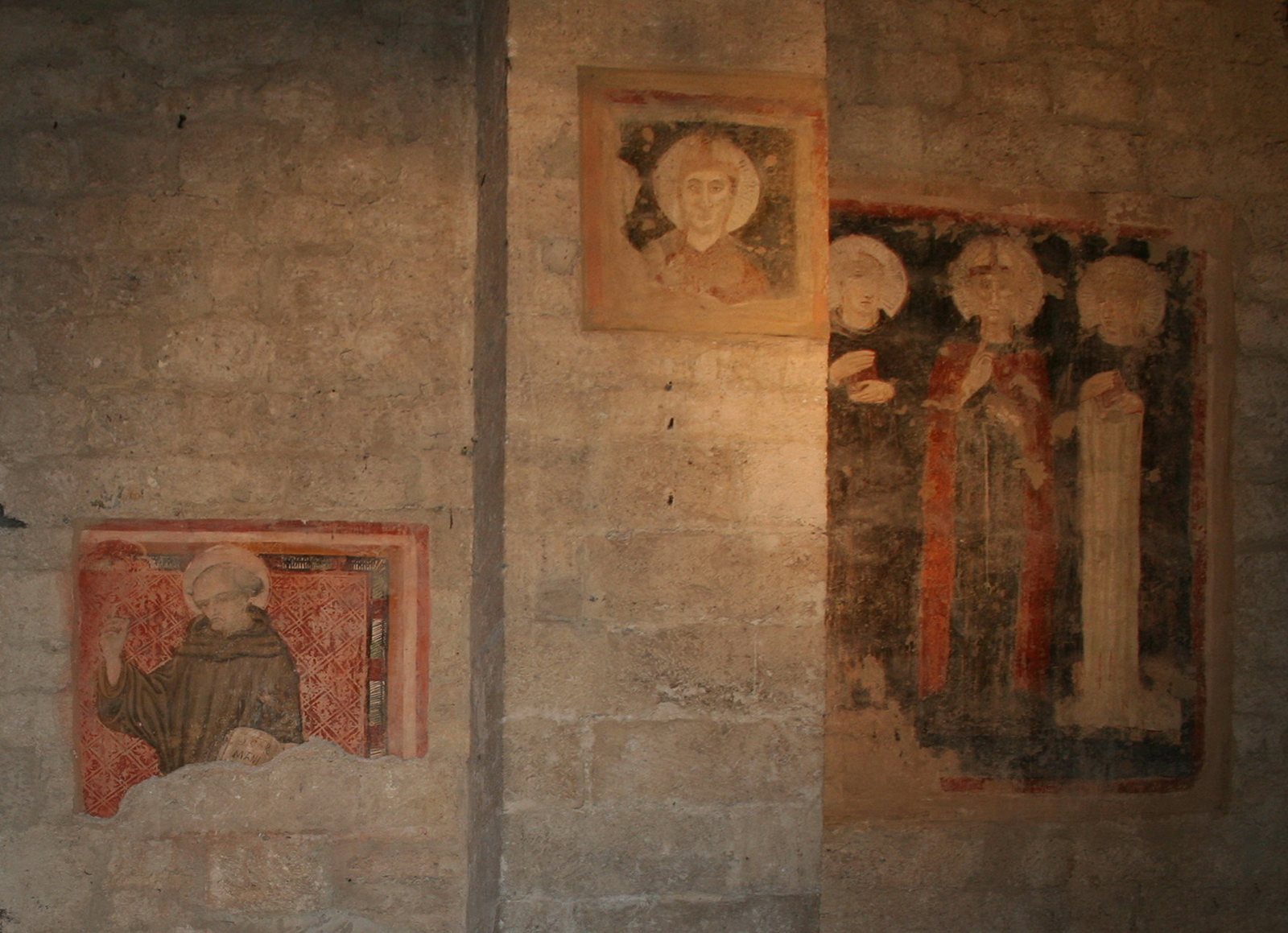
Faint traces of frescoes remain on the church’s right exterior wall. Probably painted around 1250–1270, they sit beneath a series of arches and show Christ and other saints. Saint John the Evangelist remains identifiable.
Church frescoes
Anonymous frescoes from the mid-to-late thirteenth century once decorated both the interior and exterior. Worshippers commissioned images of saints in hope of their help and of salvation for themselves and their families. The paintings were arranged in orderly horizontal bands, with a vivid range of colors; a recurring subject shows the Virgin Mary enthroned with the Child Jesus. Many frescoes from the right nave were detached and are preserved at the chapel of the Episcopal Palace and the Diocesan Museum. The paintings are difficult to attribute, though an image identified as Pope Saint Victor may be by Giacomo da Campli.
Crypt of St Eustachio
Beneath the sacristy, the irregularly polygonal Crypt of St Eustachio is entered from outside the church. Its medieval fresco cycle depicts the legend of Saint Eustachio, also known as Eustace. The paintings are attributed to the Master of Offida, a conventional name for an unidentified medieval painter.