San Tommaso, Ascoli Piceno: A Romanesque Church and Collegiate Foundation
Site at a Glance
- Rating
- 4.3
- Popularity
- Very Low
- Country
- Italy
- Primary era
- Medieval
- Eras represented
- Medieval, Early Modern, Modern
- Civilizations
- Papal States
- Site type
- Religious
- Remains
- Church
On this page11 sections
History
Foundation and religious community
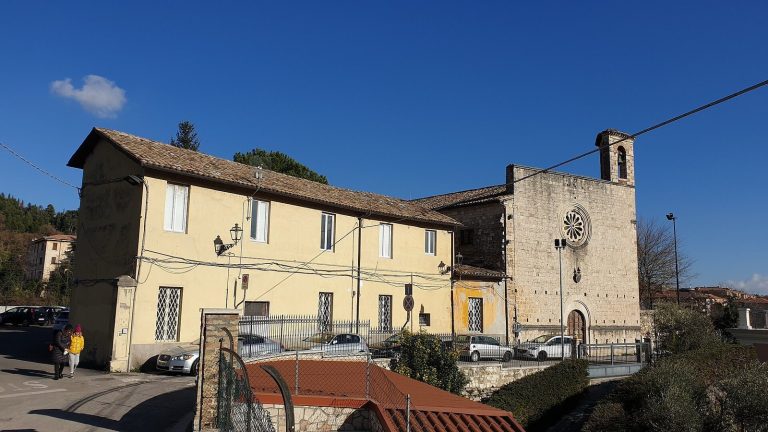
San Tommaso, Ascoli Piceno, is a Roman Catholic Romanesque church in Italy, built around 1064 through the initiative of Bishop Bernardo II. It was established together with a collegiate church served by Lateran Canons, members of a Catholic community following the rule of Saint Augustine. The foundation formed part of the medieval religious development of Ascoli Piceno.
The canons followed a simple communal life and rejected personal ownership. They lived in the building attached to the church, whose cloister is now used by the Museum of Ceramic Art. This arrangement joined worship, communal religious life, and the management of the adjoining complex.
Medieval transformation
The church acquired much of its present appearance through interventions carried out during the thirteenth century. Elements from earlier buildings were reused in the fabric, linking the medieval church to the older architectural history of Ascoli Piceno.
The square beside San Tommaso contains remains of the city’s Roman amphitheatre, built in the first century BC. The amphitheatre remains were reburied in 1974, while fragments from the ancient structure had already been reused in the church.
Later changes
The church continued to be altered and furnished in later centuries. A gilded wooden tabernacle was made for the high altar in the sixteenth century, and the major travertine altars in the transept date from the first half of the eighteenth century. Seventeenth-century sculpture and later paintings further shaped the interior’s appearance.
In 1872, Emidio Paci executed the stucco decoration on the central nave, the piers supporting the dome, and the curved vault of the apse. The façade’s five ceramic bowls were installed in 1930 in place of ancient bowls, and the rose window was reconstructed in 1948. A new baptismal font was added in 1960, accompanied by a statue of Saint John the Baptist by Aldo Sergiacomi.
Remains
Façade and bell tower
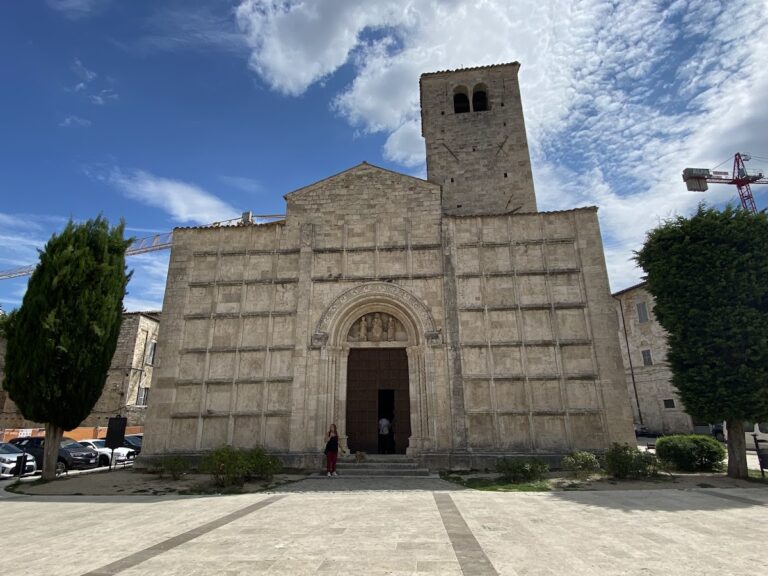
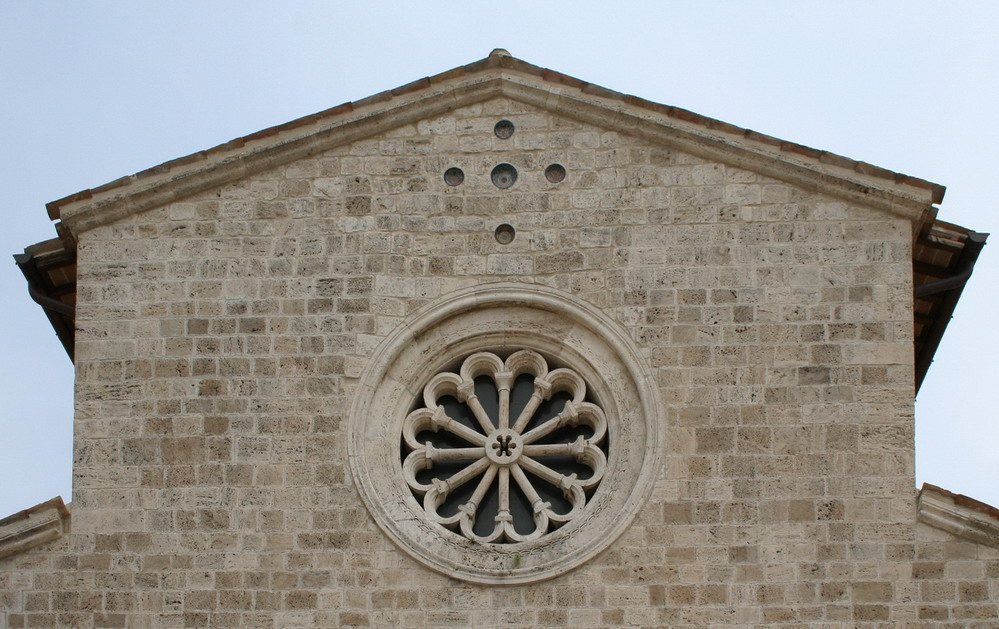
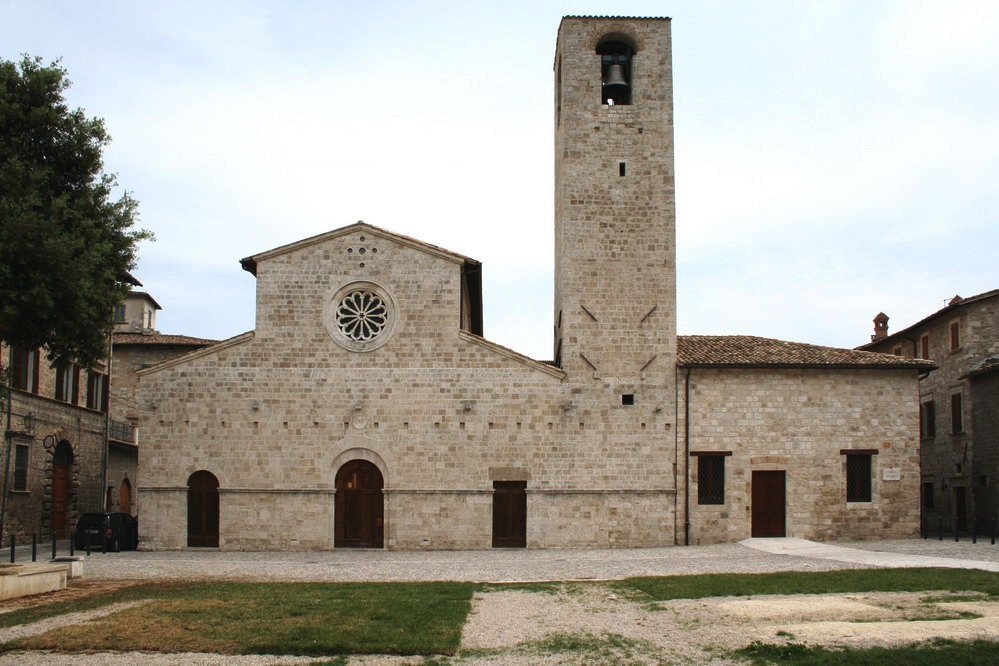
The broad façade is built entirely from squared travertine blocks and divided into three gabled sections beneath a cornice. Five ceramic bowls form a cross in the central tympanum, above the reconstructed rose window, a large circular opening with radiating divisions. A horizontal string course, or band of masonry, crosses the façade at the level of the portal arches.
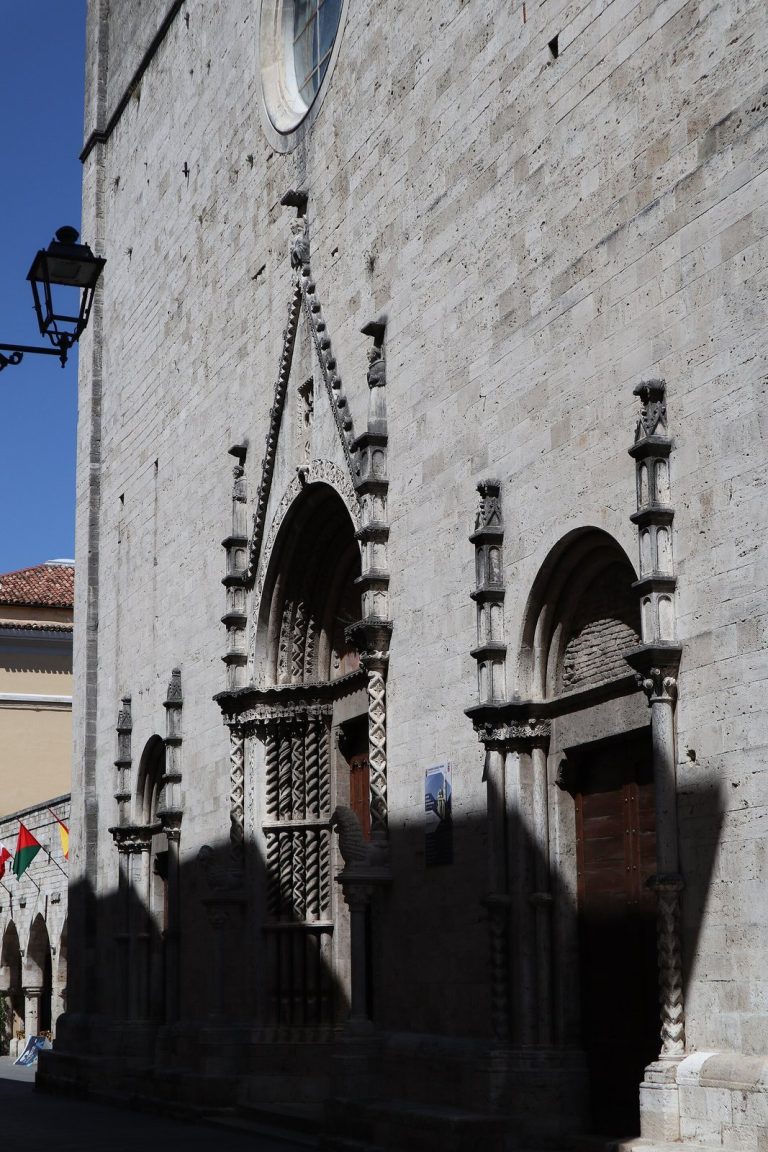
Three doorways open onto the front, while a separate arched portal is set in the church’s left side. Putlog holes, openings that supported temporary scaffolding, and travertine hooks remain visible on the façade. The hooks were used to install temporary structures during civic festivals. On the right, a square-based bell tower contains Ascoli Piceno’s oldest bell, dated 1283.
Plan and structural features
The interior follows a basilica plan, with a central nave flanked by two lower aisles. Alternating cross-shaped piers and columns divide the aisles. Their shafts are both fluted and smooth, and they include reused medieval column sections and Roman column drums. These reused elements are examples of architectural spolia, meaning components taken from earlier buildings and incorporated into a later structure. The supports carry round arches, while the roof is formed by a trussed framework of interconnected structural members.
A raised transept crosses the nave. It contains a blocked lancet window, a tall and narrow opening, and a bifora, or two-light window divided by a central support, on its sides. Six small single-lancet windows illuminate the left aisle, while four larger windows light the central nave. Two arched portals in the right side wall are blocked, and one is decorated with acanthus leaves.
Transept altars and paintings
A travertine altar from the first half of the eighteenth century stands in a lateral part of the transept. Its two tapered columns support Ionic capitals, and its marble frontal is inlaid. The altar displays Pietà, an oil painting on canvas by the Ascoli painter Biagio Miniera, measuring 1.90 by 2.95 metres. The grieving Virgin holds the dead Christ after his removal from the Cross, while Joseph of Arimathea, Mary Magdalene, Nicodemus, Saint John, and Saint Francis of Assisi appear at the sides. An image of Saint Barbara, measuring 0.89 by 0.62 metres, occupies the space between the sections of the broken pediment.
Two monumental travertine altars from the same period stand against the right side of the transept. The first is dedicated to Saint Ursula and carries Giuseppe Angelini’s oil painting of the Madonna and Child in glory with Saint Joseph, Saint Anthony of Padua, Saint Roch, and Saint Ursula. The painting measures 1.90 by 2.95 metres, while a smaller image of Saint Ursula, measuring 0.89 by 0.62 metres, fills the centre of the broken pediment.
The second right-transept altar bears Giulio Cantalamessa’s Patronage of Saint Joseph, an oil painting measuring 1.55 by 2.15 metres. It shows the Madonna and Child enthroned, with Saint Joseph prostrate on the steps in an attitude of supplication on behalf of humanity. Beside the altar are finely carved stone elements and two funerary slabs, one bearing the date 1383 and the other decorated with small heraldic coats of arms.
High altar and devotional furnishings
The high altar retains a sixteenth-century gilded wooden tabernacle, a receptacle for the consecrated Eucharistic elements. It takes the form of an octagonal small temple, or tempietto, with a dome and refined painted decoration.
Above the high altar stands a white Carrara-marble group made in the seventeenth century by Giuseppe and Lazzaro Giosafatti. Each statue is 2.10 metres high. Giuseppe made the figures of Saint Thomas the Apostle and the Madonna and Child, while Lazzaro made Saint John the Evangelist. Four holy-water stoups are formed from carved Roman capitals set on sections of fluted columns.
Frescoes and baptismal area
The church contains numerous frescoes and statues from different periods. A pier before the side door of the left aisle carries a 1293 fresco of the Madonna and Child measuring 0.77 by 2.21 metres. At the end of the same aisle, near the left side door, is the baptismal font installed in 1960, accompanied by Aldo Sergiacomi’s 70-centimetre-high statue of Saint John the Baptist.
The first pier of the right aisle bears a thirteenth-century fresco measuring 0.67 by 0.97 metres and showing four small saintly figures. The second column carries a Madonna of the Milk, a devotional image of the Virgin nursing the Christ Child, measuring 0.70 by 1.50 metres. Nearby is a fresco of Saint Lucy, measuring 0.32 by 1.80 metres. Both paintings date from between the thirteenth and fourteenth centuries. Saint Lucy holds her eyes on a plate in her right hand and a book in her left.
The third pier displays an image of a blessing saint measuring 0.77 by 1.54 metres and another of the Enthroned Madonna and Child measuring 0.77 by 1.46 metres. Both belong to the thirteenth or fourteenth century.
Attached cloister
The building adjoining the church contains a cloister now used as the Museum of Ceramic Art. Its presence preserves the connection between the church and the communal complex created for the Lateran Canons.