San Francesco d’Albaro Church: A Franciscan Parish Church in Genoa


Site at a Glance
- Rating
- 4.4
- Popularity
- Low
- Country
- Italy
- Primary era
- Medieval
- External website
- Open
- Eras represented
- Medieval, Early Modern, Modern
- Civilizations
- Genoese
- Site type
- Religious
- Remains
- Church
On this page13 sections
History
San Francesco d’Albaro Church is a Roman Catholic church in Genoa, Italy, whose present Baroque appearance developed from a thirteenth-century foundation beside the historic road between San Martino and the sea. The church and its attached convent stand at the junction with present-day Via Albaro in the Albaro district. The complex is dedicated to Francis of Assisi and remains entrusted to the Friars Minor Conventual, a branch of the Franciscan Order founded by Francis of Assisi.
Medieval Foundation
A church dedicated to the archangel Michael occupied the site by the thirteenth century. A notarial act from 1304 identifies it as belonging to the Friars Minor Conventual, who had previously been based at San Giuliano Abbey. After adjacent land was donated, the friars built their convent in 1316. A new church followed in 1323 and 1324, financed by the noble Cebà family. It was later rededicated to Francis of Assisi.
The complex underwent repeated work during the fifteenth century. In 1426, the Grimaldi-Cebà family sponsored restoration and conservation of the high altar and choir. The pulpit was altered and embellished in 1440. A much larger structural intervention took place in 1476 and may have amounted to a complete reconstruction of the church.
Parish Development and Later Transformation
In 1593 to 1595, another member of the Cebà family rebuilt the choir, while the Giustiniani family participated in further restoration in 1606. These interventions formed part of the continuing changes that shaped the church between the seventeenth and nineteenth centuries. In 1699, the convent became independent of San Francesco di Castelletto. During the eighteenth century, Giuseppe Galeotti added frescoes to the presbytery and choir, and in 1754 he decorated the transept, apse, and choir.
A papal bull, a formal document issued by the pope, transferred the parish title of the ancient Church of Saints Nazarius and Celsus to San Francesco d’Albaro. Issued on June 20, 1544, and effective August 27 of that year, the bull followed the earlier relinquishment of the parish by its rector in favor of the Franciscans in 1543. Saints Nazarius and Celsus had been known since the tenth century, but their church stood on seashore cliffs in the area still called San Nazaro and had been reduced to ruin by violent storms.
Suppression, Restoration, and Present Parish Role
During the Napoleonic period, the Ligurian Republic was incorporated into the French Empire and religious orders were suppressed. The friars were forced to leave San Francesco d’Albaro in 1810. They regained full possession in 1817, after Napoleon Bonaparte’s fall and Liguria’s transfer to the Kingdom of Sardinia.
By the middle of the nineteenth century, the convent housed fourteen Franciscan priests, including the parish priest and the guardian, together with four lay brothers and four servants. On November 26, 1862, the church was removed from the jurisdiction of the San Martino d’Albaro plebania, a territorial ecclesiastical jurisdiction headed by a senior parish church or plebanus. Its parish priest consequently entered the Collegio Urbano dei Parroci. Today the church is the seat of the parish of Saints Nazarius and Celsus and San Francesco d’Albaro within the Albaro vicariate of the Archdiocese of Genoa.
Remains
Church Structure and Medieval Fabric
Plan and Exterior Portal
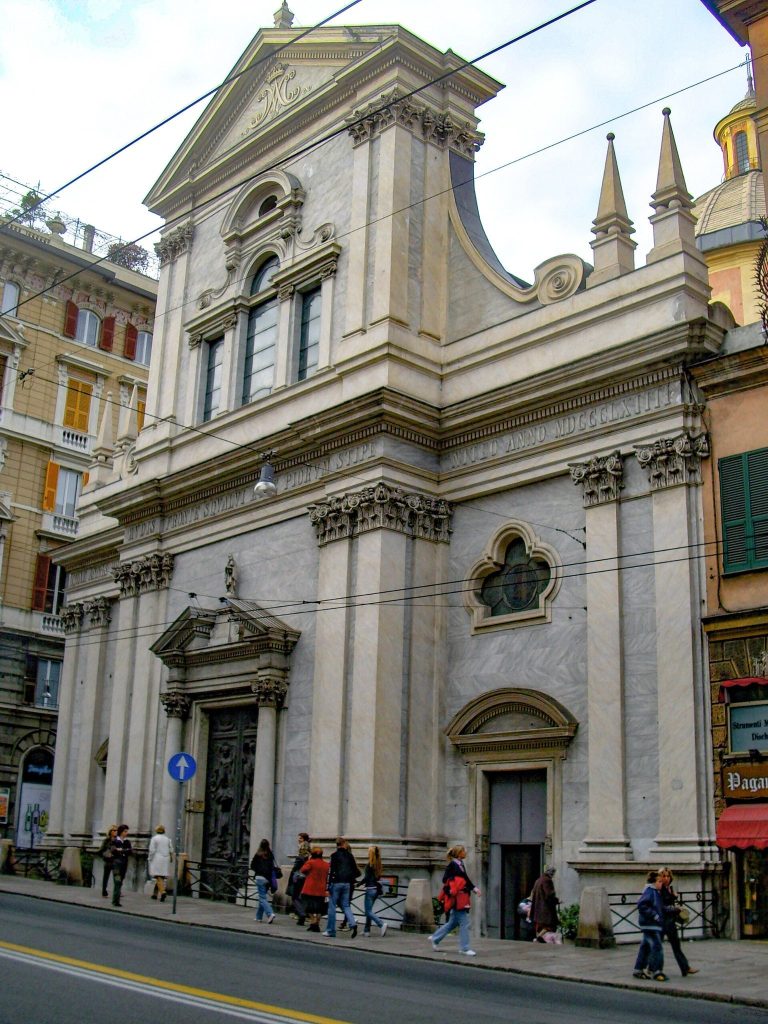
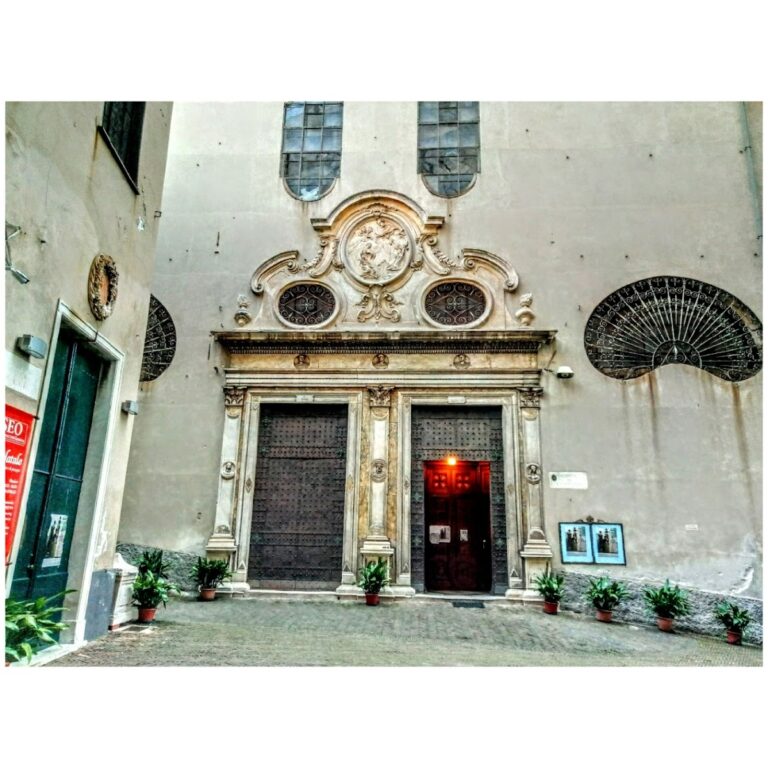
The church is arranged on a Latin-cross plan, with a long central axis crossed by a shorter transverse arm, and has three aisles. Its present architectural character is Baroque, reflecting the successive alterations and rebuilding campaigns that followed the medieval foundation. The external portal is the only visible surviving testimony of the original Gothic structure. The fifteenth-century rebuilding and later work established the form in which the medieval church is now encountered.
Vaults, Choir, and Presbytery
The vault of the central nave carries a seventeenth-century fresco by Giovanni Battista Carlone depicting Saint Francis in Glory. Giovanni Agostino Ratti later enlarged the work. The presbytery presents the patron saints of churches that disappeared during the nineteenth and twentieth centuries and had formerly stood within the territory of the present parish. Frescoes by Giuseppe Galeotti extend through the presbytery and choir, while the transept and apse also belong to his 1754 decorative campaign.
Paintings and Sculpture
Sculptural Groups and Altarpiece Painting
The church preserves a wooden group by Anton Maria Maragliano representing the Baptism of Christ. Antonio Brilla is represented by a sculptural group of the Crucifixion, and Domenico Fiasella by a painting of Saint Francis contemplating Jesus and Mary. Together these works form part of the church’s painted and sculpted furnishings, alongside the fresco decoration of the principal liturgical spaces.
Convent and Organ
Convent Paintings
The convent refectory contains Alessandro Magnasco’s Supper at Emmaus, described as a masterpiece of his mature period. Other convent rooms preserve Francesco Campora’s Rest During the Flight into Egypt and a sketch for the Last Supper by Luca Cambiaso. These works extend the artistic ensemble beyond the church into the spaces of the Franciscan community.
Organ
The current organ was built in 1857 by the Rasori brothers of Bologna for that city’s church of the Friars Minor Conventual. It was sold to San Francesco d’Albaro in 1891, when the Bolognese Franciscans considered it too small for their liturgical needs. Because it was larger than the earlier eighteenth-century instrument, its installation required modifications to the church. The organ later received alterations and improvements, most recently in 1969 from the Inzoli Cav. Pacifico organ-building firm of Crema.