San Sisto: A Romanesque Church in Pisa


Site at a Glance
- Rating
- 4.8
- Popularity
- Low
- Country
- Italy
- Primary era
- Medieval
- Eras represented
- Medieval, Early Modern
- Civilizations
- Unclassified
- Site type
- Religious
- Remains
- Church
On this page14 sections
History
San Sisto is a Romanesque church in Pisa, Italy, built between 1087 and 1133 during the city’s maritime expansion. It stands on the site of San Pietro in Corte Vecchia, an important center of power during the Lombard and Carolingian periods. The present church was begun after the Pisan fleet conquered the Tunisian emporium of Al-Mahdiya and was consecrated in 1133.
Foundation and civic role
The church was dedicated to San Sisto, meaning Pope Sixtus II, a third-century bishop of Rome who was martyred during the persecution of Emperor Valerian. The dedication expressed thanksgiving for Pisan victories associated with August 6, the saint’s feast day. Before the consecration, San Sisto was already used for the most important notarial acts of the Commune of Pisa, giving it a role in the city’s civic life as well as its religious life.
Military traditions and later history
San Sisto’s identity remained closely tied to Pisa’s military and naval traditions. After the conquest of the Balearic Islands in 1115, a tombstone belonging to the emir Al Murtada was brought to Pisa and placed in the church. Naval equipment inside the building likewise recalls the military history of the Pisan Republic.
August 6 was regarded as a favorable day for Pisan military victories, rather than being the city’s ancient patronal feast before the rise of San Ranieri, an eleventh-century Pisan hermit who became Pisa’s patron saint. This tradition ended after the Genoese fleet defeated Pisa at the Battle of Meloria on August 6, 1284.
San Sisto was altered and restored during the fifteenth, seventeenth, and nineteenth centuries. In the second decade of the twentieth century, Baroque decorations and stucco were removed to give the interior a more medieval appearance. Since 1959, the Association of the Friends of Pisa has organized an annual August 6 commemoration for Pisans who died in different battles. The ceremony includes a laurel wreath at the memorial plaque, a historical address, and Mass. From the 1970s onward, the association also arranged the installation of civic and military commemorative elements in the church.
A statue of Giovanni Pisano, the major Italian Gothic sculptor and architect, stood near San Sisto from 1926 until it was destroyed with explosives by unknown persons on the night of January 6, 1945.
Remains
San Sisto survives as a three-aisled basilica in roughly worked stone. Its Romanesque design follows the local Pisan tradition, which combines stone walls, blind arches, pilasters, and ceramic vessels set into the exterior. The interior is arranged in nine bays separated by round arches and columns that incorporate numerous reused ancient Roman capitals.
Facade and exterior walls
Tripartite facade
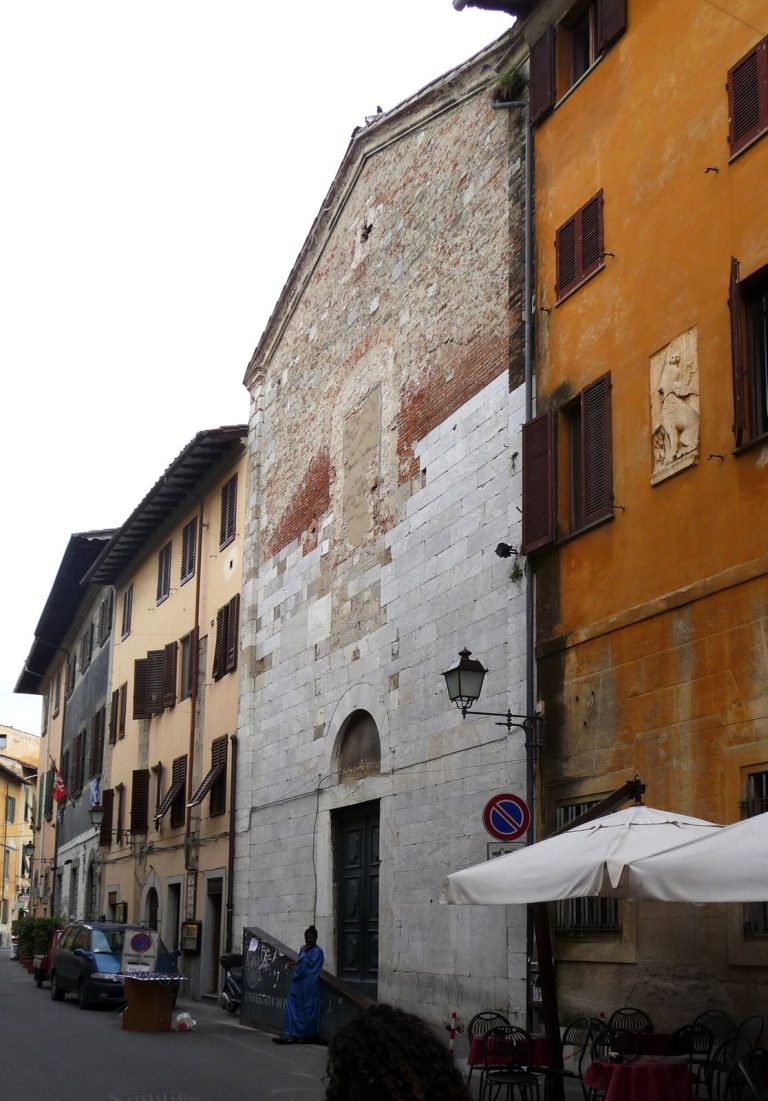
The facade is divided into three sections by pilaster strips and rises in a stepped profile. It includes a mullioned window and a line of blind arches beneath the roofline. The mullioned window belongs to a later phase than the principal construction of 1087 to 1133. The portal areas were entirely remade, and their squared, smoothly finished stones differ from the rougher earlier masonry.
Left flank and ceramic decoration
Blind arches continue along the facade and the left side wall, where Islamic ceramic bacini, or vessels and dishes incorporated into medieval facades, form part of the decoration. The surviving pieces are copies of tenth- and eleventh-century examples whose originals are preserved in the Museo Nazionale di San Matteo. The left flank also contains eight lower single-light windows and four upper ones.
Bell tower
The bell tower combines a lower section of stone with an upper section of brick. Single-light windows and blind arches appear beneath its roof, continuing the exterior vocabulary of the church.
Interior and furnishings
Roof and liturgical arrangement
The church has a double-pitched, hut-shaped roof, while the wooden ceiling has been rebuilt. The central nave terminates in an apse, a rounded or polygonal end of the main church space, and the side aisles have flat terminations. The polychrome-marble high altar was made by Giuseppe Vaccà in 1730. It is decorated with cherubs and allegories of Faith and Charity.
Paintings and devotional sculpture
At the end of the right aisle is the Madonna della Purità, a work of the Pisan school dated to 1290–1300. A monumental polychrome wooden crucifix dated to 1370 hangs on the right-aisle wall. It was made to emulate the celebrated Volto Santo, the venerated crucifix preserved in Lucca. The church also preserves a Madonna and Child with Saints by Giovan Battista Paggi and a Preaching of Saint John the Baptist attributed to Francesco Vanni.
Naval and civic memorials
Al Murtada’s funerary stone
The Arabic funerary stone of the emir Al Murtada is set into the counterfacade. Its presence recalls the transfer of the tombstone to Pisa after the city’s conquest of the Balearic Islands in 1115.
Ship equipment and civic symbols
At the corners of the church are the rudder and mast of a Pisan transport vessel dating from the fourteenth century. The interior also displays the flags of Pisa’s four historic quarters, Ponte, Mezzo, Foriporta, and Kinzica, together with the Pisan Eagle and Pisan Cross, the city’s principal symbols.