Palazzo della Carovana: Headquarters of the Knights of Saint Stephen in Pisa


Site at a Glance
- Rating
- 4.6
- Popularity
- Low
- Country
- Italy
- Primary era
- Early Modern
- External website
- Open
- Eras represented
- Medieval, Early Modern, Modern
- Civilizations
- Grand Duchy of Tuscany, Italian, Republic of Pisa
- Site type
- Civic
- Remains
- Palace
On this page6 sections
History
Palazzo della Carovana is a historic palace in Pisa, Italy, remodelled between 1562 and 1564 for the Order of the Knights of Saint Stephen. It occupies the site of Pisa’s medieval Palazzo degli Anziani, or Palace of the Elders, which had been occupied from 1286. The sixteenth-century transformation was commissioned by Cosimo I de’ Medici, the first grand duke of Tuscany, and made the building the order’s headquarters.
Medieval Palace and Medici Transformation
The earlier palace formed part of a medieval group of buildings that included adjacent tower houses. Elements of the old structure remain visible along the sides of the present building. Between 1562 and 1564, Giorgio Vasari radically remodelled the irregular medieval complex for Cosimo I and the Knights of Saint Stephen. Vasari was an Italian architect, painter, and writer whose work here brought the building’s architecture together with sculptural and painted decoration.
The Order of the Knights of Saint Stephen was a military-religious institution linked to the Grand Duchy of Tuscany. It had been established to protect Tuscan maritime activity from pirates and Ottoman Turks. The name Palazzo dei Cavalieri, meaning “Palace of the Knights,” reflects this institutional connection. Palazzo della Carovana refers to the recruits’ three-year novitiate, during which they trained in weapons handling before joining armed group voyages in the Mediterranean against corsairs.
Educational Use
Since 1846, the palace has served as the principal seat of the Scuola Normale Superiore di Pisa, an Italian institution of advanced higher education and research established during the Napoleonic period. Its rear section was added in 1928–1930 during a revival of the institution promoted by Giovanni Gentile. In 1977, a tunnel connected the palace with the institution’s library in the Palazzo dell’Orologio.
Remains
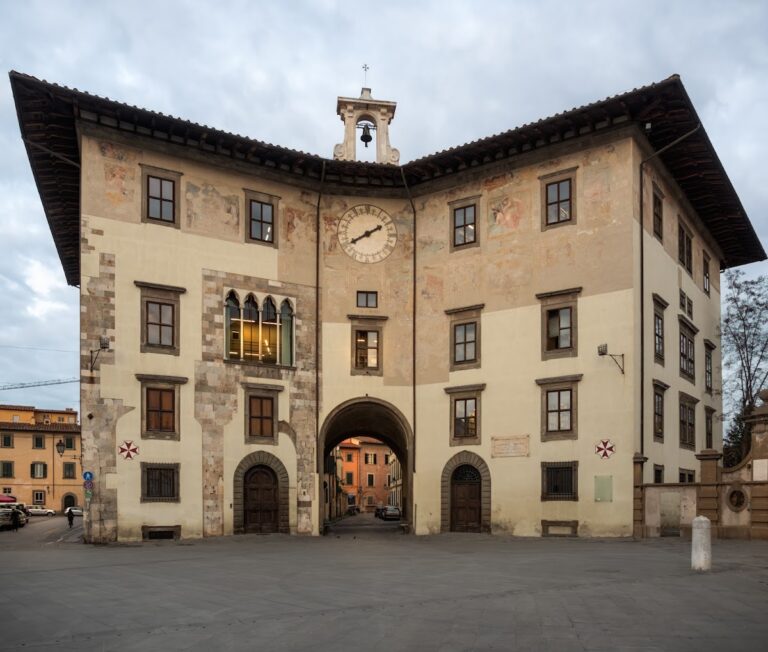
Palazzo della Carovana stands on Piazza dei Cavalieri and rises four floors above a frontage that reorganized the irregular medieval buildings behind it. The surviving palace combines architecture, sculpture, and painted surface decoration into a unified exterior. Parts of the medieval palace and neighboring tower houses can still be seen along the sides, while the church of Santo Stefano dei Cavalieri stands beside the building.
Facade and Monument
The facade is covered with sgraffito, a technique that exposes contrasting layers by scraping through applied surface material. Its compositions contain allegorical figures, zodiac signs, vegetal ornament, and grotesques. Vasari designed the schemes, which Tommaso Battista del Verrocchio and Alessandro Forzori executed between 1564 and 1566. Weathering, fading, and detachment affected the exterior paintings, so parts that now appear well preserved were repainted during the nineteenth and twentieth centuries.
Marble sculpture adds the Medici and Knights’ coats of arms, with Stoldo Lorenzi’s allegories of Religion and Justice, made in 1563. Giovanni Fancelli produced the coats of arms at the corners in 1564. A gallery of six marble busts of Medici grand dukes occupies the upper facade. Ridolfo Sirigatti made the busts of Cosimo I, Francesco I, and Ferdinando I between 1590 and 1596; Pietro Tacca created the bust of Cosimo II around 1633; and Giovan Battista Foggini made the busts of Ferdinando II in 1681 and Cosimo III in 1718. In front of the palace stands Pietro Francavilla’s monument to Cosimo I, created in 1596.
Staircase and Interior
The entrance is reached by a two-flight marble staircase reconstructed in 1821 by Giuseppe Marchelli. It replaced an original staircase of smaller dimensions. Inside, rooms contain nineteenth-century frescoes and stucco decoration, together with paintings by sixteenth-century artists and painters associated with the Vasarian school.