Palazzo dell’Orologio (Pisa): A Medieval Palace and Clock Arch


Site at a Glance
- Rating
- 4.5
- Popularity
- Low
- Country
- Italy
- Primary era
- Early Modern
- External website
- Open
- Eras represented
- Medieval, Early Modern, Modern
- Civilizations
- Grand Duchy of Tuscany, Italian, Republic of Pisa
- Site type
- Civic
- Remains
- Palace
On this page8 sections
History
Palazzo dell’Orologio (Pisa) is a medieval building in Italy with origins in the thirteenth century. It developed from properties associated with the Gualandi family and later became the residence of the Captain of the People, a civic official who represented and defended the wider urban population in relation to ruling elites, at least from 1357.
The medieval palace and the Torre della Muda
The palace incorporated the Torre della Muda, also known as the Tower of Hunger. In 1289, Count Ugolino della Gherardesca died there with his sons and grandsons. Ugolino was a Pisan nobleman, and the story of his imprisonment and death became one of the most memorable episodes in Dante Alighieri’s Divine Comedy, specifically Inferno XXXIII. This association gave the building a lasting place in both Pisan history and Italian literary memory.
The Knights of Saint Stephen and the palace’s transformation
From 1566, the complex housed the infirmary of the Order of the Knights of Saint Stephen, a Catholic military order established by the Medici in Tuscany. Its medical officer was known as the Bonomo, and this connection gave the palace the earlier names Palazzo del Bonomo and Palazzo del Buon Omo.
Between 1605 and 1608, two neighboring buildings were joined by a central arch carrying a clock. The work brought the complex to its present form and followed a project prepared in 1554 by Giorgio Vasari, the sixteenth-century Italian architect, painter, and art historian. Between 1607 and 1609, Giovanni Stefano Marucelli and Filippo Palladini decorated the facade and the inner vault of the arch with imagery celebrating the Medici family and the Order of the Knights of Saint Stephen. Their frescoes included panoplies, decorative arrangements of weapons and armor, grotesque ornament, and allegorical figures.
Later ownership and institutional use
The clock and bell chamber date from 1696. After the suppression of the Order, Count Alberto della Gherardesca acquired the building in 1919 and promoted a controversial neo-Gothic remodeling. This intervention included the opening of a four-light window in the facade.
The palace was restored during the 1970s. In 1982, it passed to the Scuola Normale Superiore of Pisa and was converted into a library. During the same period, an underground passage was created to connect it with the Palazzo della Carovana, the school’s seat. In 2003, the school commissioned extensive restoration and consolidation affecting the exterior facades, roof, and window and door frames. Since 2016, part of the building has housed a museum space devoted to the Torre della Muda and the history of Count Ugolino, with verses from Dante’s Divine Comedy.
Remains
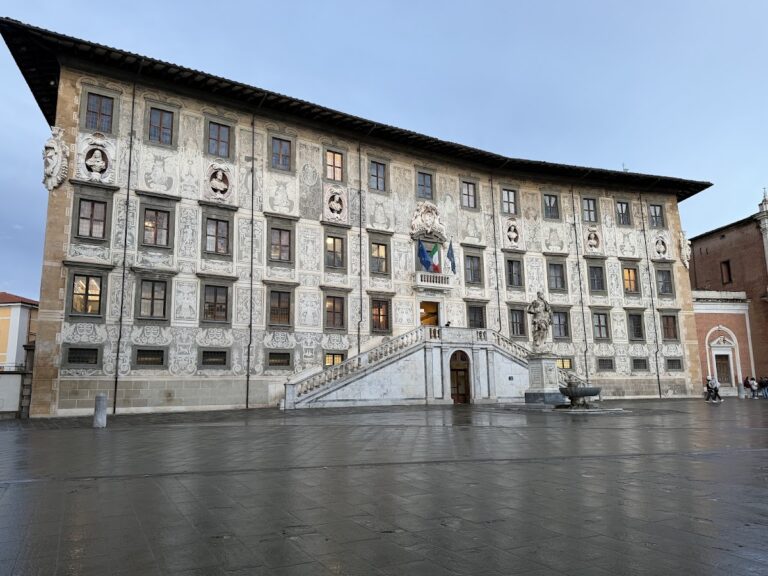
Palazzo dell’Orologio stands on Piazza dei Cavalieri as a four-story complex formed from two adjacent buildings joined by a central arch. The clock-bearing arch provides the building’s name and organizes the present facade, while medieval fabric, seventeenth-century additions, fresco decoration, the 1696 clock and bell chamber, and later alterations remain part of its physical history.
Facade and central arch
The facade and the inner vault of the central arch retain frescoes painted by Giovanni Stefano Marucelli and Filippo Palladini between 1607 and 1609. Panoplies, grotesque designs, and allegorical figures express the building’s association with the Medici and the Order of the Knights of Saint Stephen. The clock and bell chamber above the arch dates from 1696. The former Gualandi palace stood to the left of the arch, where a twentieth-century four-light window now forms part of the facade.
Torre della Muda
The remains of the Torre della Muda are incorporated into the right wing of the seventeenth-century building. They remain identifiable from inside the palace, and the surviving walls can be viewed from the museum space dedicated to the tower and Count Ugolino. Their position within the later complex preserves the physical connection between the medieval tower and the palace that grew around it.
Underground connection
An underground passage links Palazzo dell’Orologio with the Palazzo della Carovana. The passage was made during the period when the Scuola Normale Superiore adapted the palace for use as a library, adding a physical connection between the two buildings.