Saddell Abbey: A Cistercian Monastery on Kintyre


Site at a Glance
- Rating
- 4.6
- Popularity
- Low
- Country
- United Kingdom
- Primary era
- Medieval
- Eras represented
- Medieval
- Civilizations
- Unclassified
- Site type
- Religious
- Remains
- Monastery
On this page10 sections
History
Saddell Abbey is a former Cistercian monastery in the United Kingdom, dedicated to the Virgin Mary and associated with Mellifont Abbey in Ireland through the Clairvaux line of Cistercian houses. The Cistercians were a reform branch of Western Christian monasticism that stressed communal discipline, manual work, and relatively austere buildings. The foundation date is uncertain, with proposed dates of 1148, about 1160, and about 1163, but the community’s development at its present location began in 1207, when the monks moved from an earlier site somewhere on Kintyre.
Foundation and Irish connections
The abbey’s origins are linked with Somerled, the twelfth-century Norse-Gaelic ruler who controlled territories in western Scotland and is associated with the Lordship of the Isles. Another foundation tradition credits Malachy of Armagh, an Irish bishop and church reformer. A papal mandate issued in 1393 names Somerled’s son Ragnall as founder. Ragnall, who succeeded his father as Lord of Kintyre, completed or substantially enlarged the abbey and increased its lands.
Saddell’s connection with Mellifont, Ireland’s first Cistercian monastery, gave the community an unusual Irish affiliation within Scotland. Irish monks formed the religious community, and Irish architectural details are reflected in the surviving remains. The monastery remained relatively modest and founded no daughter abbeys. It controlled or was associated with the churches of Inchmarnock, Kilchattan, and Kilkivan.
Later medieval activity and dissolution
Few details survive about Saddell’s later medieval history. The last surviving reference to an abbot dates from 1470, while a document from 1498 shows that the abbey was still functioning and receiving donations. Its position weakened after the decline of Clan Donald’s power in 1493, an event that reduced the political importance of the institution.
In 1507, a royal letter stated that monastic fervour had disappeared and that the abbey was effectively occupied only by laypeople. On 26 November that year, with papal approval, the abbey and its lands were transferred to the bishopric of Argyll. Saddell is therefore conventionally regarded as dissolved in 1507.
Castle building and later dismantling
In the same year, Bishop David Hamilton, a natural son of James IV, received permission to build Saddell Castle beside the former abbey. The castle was completed in 1510. In 1512, James IV proposed moving the bishopric of Argyll from Lismore to Saddell and constructing a cathedral at the abbey, but the negotiations ended after the king’s death at the Battle of Flodden Field.
The abbey buildings were soon dismantled, and their materials were reused in Saddell Castle and elsewhere on the Saddell estate. A further phase of destruction began about 1770, when Saddell House was added to the castle. The surviving remains were designated a scheduled monument in 1975, a legal status used for archaeological and historic sites considered nationally important.
Remains
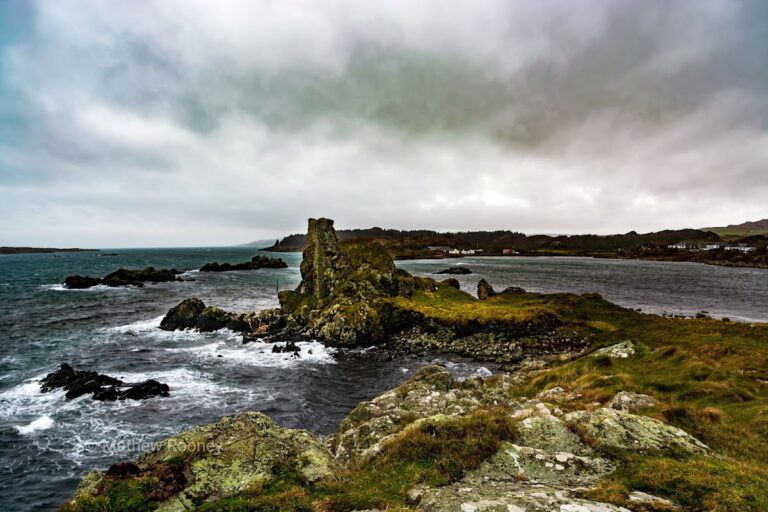
The ruins stand near Saddell village on the eastern coast of the Kintyre peninsula, on a bluff above the meeting point of Saddell Water and Allt nam Manach. The site faces the Kilbrannan Strait and the Isle of Arran. The medieval complex was arranged around an east to west cruciform church, with an aisleless nave, choir, and crosswise north and south transepts. The cloister and the monastery’s other communal buildings occupied the area south of the church.
Church and monastic buildings
Church remains
Parts of the choir, the northern transept, and the wall dividing the nave from the choir survive. The northern transept is generally associated with a thirteenth-century rebuilding phase. The choir contains masonry attributed to the twelfth century and was probably remodelled or partly rebuilt later. The walls are constructed from random rubble bonded with lime mortar and rise to about 4.6 metres in places. Later walls remain on the western and partly eastern sides of the choir, while the surviving church masonry is enclosed by a burial ground.
Cloister and refectory range
Three adjoining buildings once stood around the cloister. Most of these conventual buildings have been levelled and survive chiefly as low mounds. Part of the southern cloister range remains, probably representing the centre of the refectory, the monastery’s communal dining hall, together with its undercroft, a supported lower room beneath the main building. The refectory occupied the middle of the southern wing and may have survived because this area was reused for burials after the Reformation. Later masonry also survives at the eastern side of the refectory.
Monastic well
A well lies between the ruins and Allt nam Manach. Its stone drinking basin dates from the early nineteenth century and bears a Latin cross. Local tradition regards the well as a reconstruction of an earlier monastic well, linking the surviving feature with the abbey’s medieval water supply.
Medieval carvings and burial monuments
Saddell contains twelve richly decorated medieval stone carvings and burial monuments dating from the fourteenth century to the beginning of the sixteenth century. Six are attributed to the Kintyre school of sculptors, a regional group of medieval stone carvers probably based at Saddell. Their decoration includes swords and galleys, sometimes accompanied by otters hunting salmon or hounds hunting deer.
The collection also includes a cross, six grave slabs, and five life-sized recumbent effigies displayed beneath a shelter at the entrance to the archaeological site. A recumbent effigy is a carved representation of a deceased person lying horizontally on a tomb. The four largest effigies follow the style of the Iona school, another regional tradition of West Highland funerary sculpture. They are believed to have been carved on Iona and brought to Saddell, while the other carvings were made by skilled stoneworkers at the abbey. Additional slabs, including several late-seventeenth-century recumbent stones, lie outside the ruined church walls.
Nearby sites