Church of the Assumption in Radomierowice: An Eighteenth-Century Timber-Frame Church in Poland
Site at a Glance
- Rating
- 4.8
- Popularity
- Very Low
- Country
- Poland
- Primary era
- Early Modern
- Eras represented
- Early Modern, Modern
- Civilizations
- Holy Roman Empire, Kingdom of Prussia
- Site type
- Religious
- Remains
- Church
On this page10 sections
History
The Church of the Assumption in Radomierowice is a Roman Catholic church in Poland, built for Prussian colonists during the Frederician colonization of the second half of the eighteenth century. This settlement policy, associated particularly with Frederick the Great, established planned colonies and brought settlers into new communities. The church was constructed between 1786 and 1790 in the period of Prussian colonization, with the tower added in 1790.
Construction for the Evangelical community
The building was designed by the architect Christian Isemer, while the construction was carried out by the master carpenter Petzer. It served the local Evangelical community from its completion until the end of the Second World War. The church was first renovated in 1860, reflecting the continued use of the building before its later change of denomination.
Changes in ecclesiastical use
After the war, the church functioned as a parish church from 1946 to 1980. It then became a filial church, meaning a subsidiary church attached administratively to a parish, belonging to the parish of Saint Roch in Stare Budkowice. Since 1988, it has belonged to the parish of Our Lady of the Snows in Dąbrówka Dolna, within the Zagwiździe deanery of the Diocese of Opole. A deanery is a regional grouping of parishes, while a diocese is the territorial jurisdiction of a bishop.
The church is dedicated to the Assumption of the Blessed Virgin Mary, the Christian feast commemorating the belief that Mary was taken into heaven. Its liturgical feast is observed on 15 August. The building was entered in the register of monuments of Opole Voivodeship under number 760/64 on 1 April 1964.
Remains
Timber-frame structure and interior
Hall and galleries
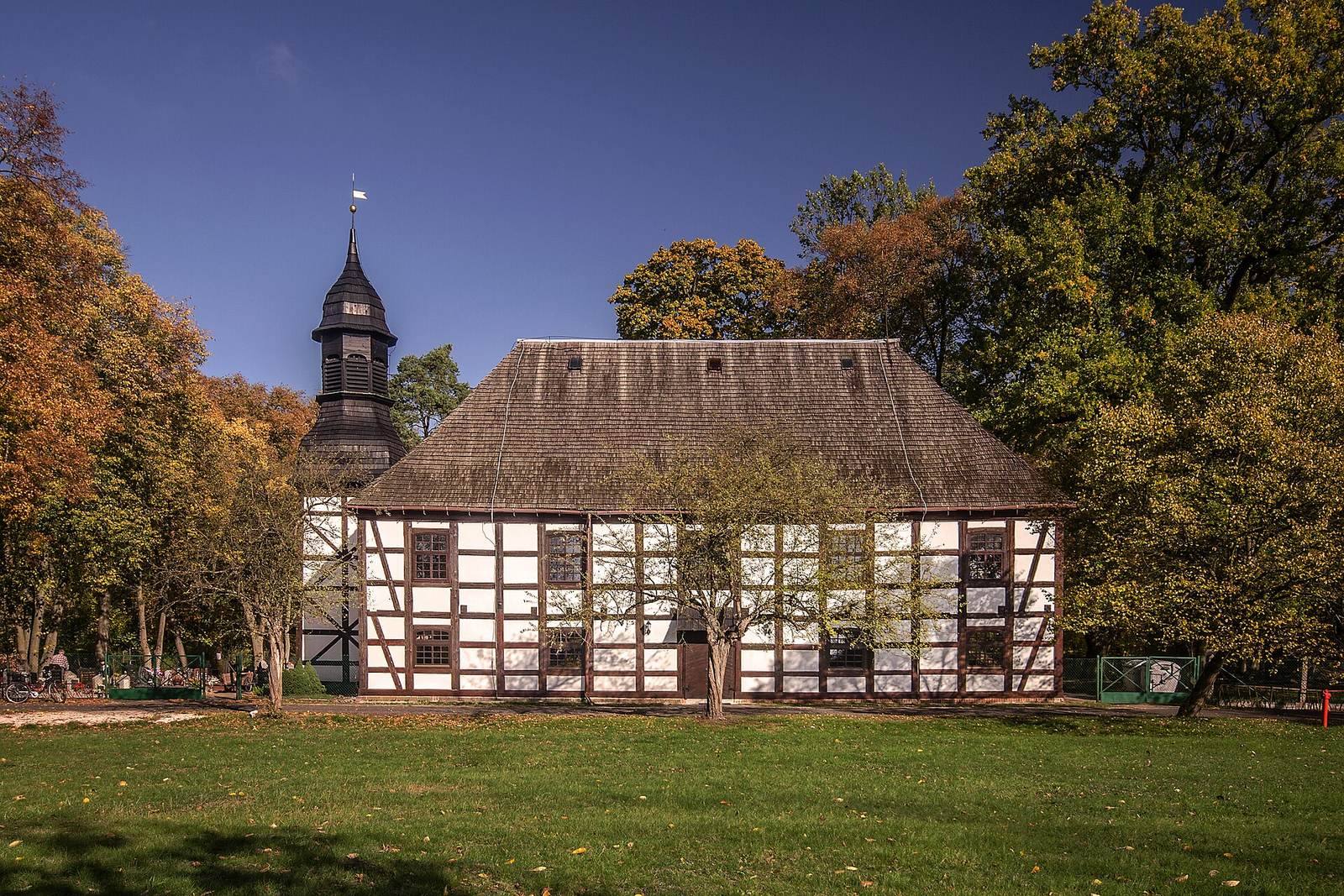
The oriented church has a timber-frame structure, with the spaces between the wooden members filled with brick. Both the exterior and interior are plastered. It is a five-bay hall church with a rectangular termination. A hall church has one unified interior space rather than clearly separated parallel naves. The building is enclosed by a profiled crowning cornice, and its windows are arranged in two levels.
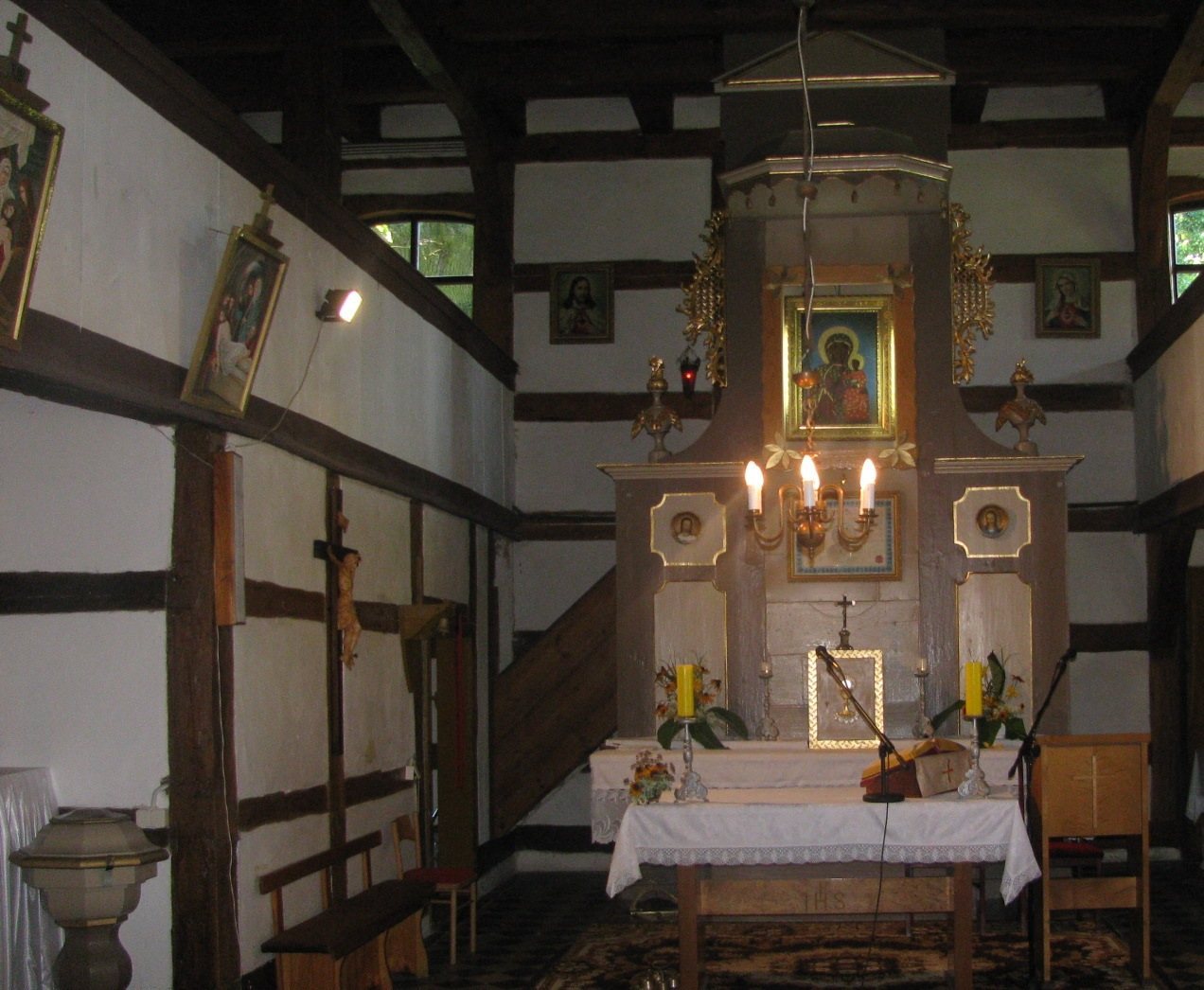
An unpainted beam ceiling covers the interior. Longitudinal supporting beams rest on eight posts with braces, and these supports carry galleries along three sides of the church while dividing the interior into three parts. The galleries contain three rows of benches. A sacristy is separated from the northern aisle.
Roof and tower
The church has a hipped, single-ridge roof covered entirely with wooden shingles. A timber-frame tower with half-timbered infill adjoins the west end. Its ground level forms a porch, while above it is a bell-shaped shingled roof set on an octagonal cylinder. A weather vane carries the date “1790.”
Historic furnishings
Choir loft and organ case
Between the galleries is a choir loft, a raised area for singers and instrumentalists. It contains an organ case dating from around 1790, made by Franciszek Majewski of Rychtal. The case forms the visible architectural housing of the pipe organ and belongs to the church’s original period of construction.
Altar and devotional furnishings
The main altar dates from around 1790 and originally incorporated a pulpit placed at its center. During the second half of the twentieth century, it was altered into a Catholic altar with an image of the Virgin Mary in the middle. The pulpit is now freestanding. The furnishings also include a baptismal font from the late eighteenth century and Stations of the Cross hung on the galleries. The original interior furnishings were modest and combined Rococo, an ornate eighteenth-century style, with Classicist forms based on the balanced language of classical antiquity.