Marienberg Abbey: A Benedictine Monastery in Northern Italy


Site at a Glance
- Rating
- 4.5
- Popularity
- Low
- Country
- Italy
- Primary era
- Medieval
- External website
- Open
- Eras represented
- Medieval, Early Modern, Modern
- Civilizations
- Habsburg, Holy Roman Empire
- Site type
- Religious
- Remains
- Monastery
On this page14 sections
History
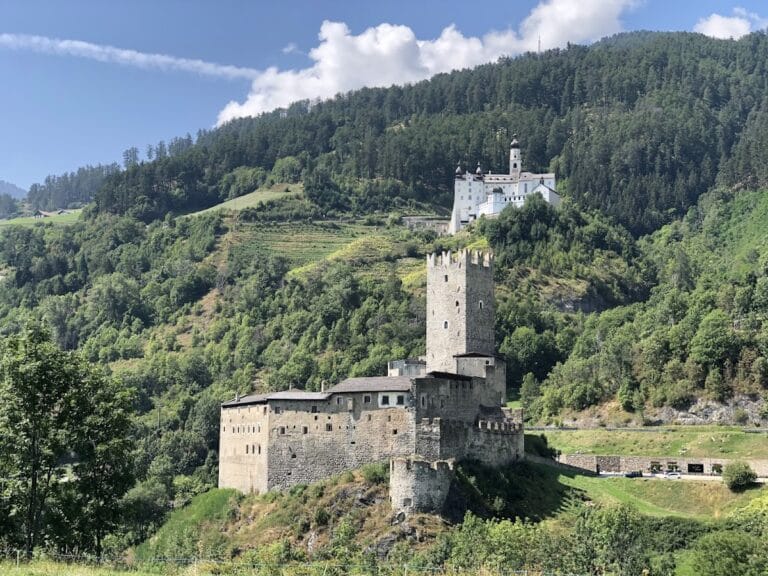
Marienberg Abbey, also known as Monte Maria, is an exempt Benedictine abbey in Italy, above Burgeis in the Upper Vinschgau of South Tyrol. Founded by the Tarasp noble family, it took shape at its present site in 1149 or 1150 in the Romanesque period and remains part of the Roman Catholic tradition and the Swiss Benedictine Congregation. At approximately 1,340 metres above sea level, it is regarded as Europe’s highest Benedictine abbey and holds the honorary status of a minor basilica.
From Schuls to the present site
The monastery began as a Tarasp family foundation intended to stand near Tarasp Castle. Between 1087 and 1095, Eberhard of Tarasp and his brother Ulrich II, bishop of Chur, established the first monastery at Schuls in the Engadine and endowed it with substantial property. Hostility from the local population and a fire made conditions difficult, leading the family to seek another location.
Ulrich III of Tarasp and Abbot Albert I of Ronsberg obtained papal permission to move the community to St Stephan above Burgeis, on Tarasp property. The monks arrived there in 1146, but the dry, windy ridge was far from springs and watercourses. A further papal authorization allowed the monastery to move north to its current location in 1149 or 1150. A chapel dedicated to the Virgin Mary already stood beside the Almeina stream, and its dedication became that of the monastery.
Much of the building stone came from nearby Kastellatz Castle, a Tarasp possession demolished for the project. The monks who formed the new community came from Ottobeuren, the family monastery of the related Ursin-Ronsberg family. This connection continued for centuries. Marienberg served as the Tarasp family’s house monastery and memorial foundation, where liturgical commemoration joined the religious life of the living with remembrance of the dead.
Medieval authority and conflict
Albert I of Ronsberg was the first abbot, leading the community from 1146 to 1152. The first crypt was consecrated in 1160, the choir side chapels in 1180, and the church in 1201. Ulrich III transferred relics from Cologne to Marienberg, including those associated with Saint Sebastian, Saint Climaria, and Saint Panafreta. Relics of Saint Emerentiana were also kept there, and from 1630 she was venerated as a second patron of the collegiate church.
When Ulrich IV, the only son of the founding couple, entered the monastery, the Tarasp family transferred its advocacy rights in 1160 to their cousin Egino I of Matsch. Advocacy was the secular responsibility for protecting an ecclesiastical institution, but the Matscher advocates alternated between defending Marienberg and exploiting it financially. A conflict between the Matscher and Reichenberg families resulted in the monastery’s plunder by Schweighard of Reichenberg in 1274. During later disputes with the advocates, Abbot Hermann of Schönstein was reportedly beheaded near the Prälatenstein at Schlinig in 1304.
The dukes of Austria acquired the advocacy rights in 1313, although the Matscher family regained them as a subfeudal holding. After a thirty-year struggle with the bishops of Chur, the Matscher lost all advocacy rights to the territorial ruler of Tyrol in 1421. The bishops of Chur also challenged Marienberg’s ecclesiastical position, especially after Bishop Konrad built Fürstenburg below the abbey between 1272 and 1281. The question of whether the monastery was subject to the bishop or exempt from ordinary episcopal authority and directly subject to the pope was settled in 1659.
Fire, reform, and suppression
Marienberg experienced repeated fires, religious conflicts, economic decline, and periods of physical deterioration. A devastating fire in 1418 required much of the monastery to be rebuilt. During the Engadine War of 1499, the Bündner recognized Marienberg as an Engadine foundation, so the abbey escaped burning. It was nevertheless heavily plundered during the peasant uprising led by Michael Gaismair in 1525, when archival material was lost. Another fire struck the monastery in 1656.
Abbot Matthias Lang of Weingarten, who governed from 1615 to 1640, began an internal renewal and a programme of renovation. He is regarded as a second founder of Marienberg. Monks who sought refuge there during the Thirty Years’ War helped resolve the community’s personnel difficulties. Under Abbot Jakob Grafinger, the Romanesque church was reshaped in Baroque forms between 1642 and 1647.
The monks had provided pastoral and educational services since the Middle Ages, teaching Latin and music. In 1724 the abbey founded a humanist secondary school at Meran, where male students studied Latin and Greek and received moral instruction. Marienberg narrowly escaped suppression under Emperor Joseph II, partly because of this educational work, but the Bavarian government dissolved the monastery in 1807. The monks were sent to Fiecht Abbey at Schwaz, the inventory was dispersed, and the school at Meran closed.
Restoration and continuing life
Emperor Francis I of Austria ordered the restoration of Marienberg in 1816 on the condition that teaching at Meran resume. Abbot Karl Mayr, who led the community from 1816 to 1855, re-established both the monastic community and the school under difficult conditions. Fascist political pressure brought the school to an end in 1928. After the Second World War, a five-year private secondary school operated at the monastery until the 1985–1986 school year.
The abbey’s medieval history was preserved in part by Goswin of Marienberg, its principal chronicler in the second half of the fourteenth century. His Registrum monasterii Montis sancte Marie described the foundation, relocations, abbots, rights, and possessions of the monastery through 1393. His copied charters and registers safeguarded legal claims and historical information, while his writings also described conditions in Tyrol and the Grisons, including the effects of the plague of the mid-fourteenth century.
Since 2007, the former economic buildings have housed the ora et labora museum, devoted to the abbey’s historical, cultural, and religious heritage. The monks continue pastoral work in surrounding parishes, care for pilgrimages, and conduct spiritual courses. In February 2025, the community consisted of seven members, including an abbot, five priests, and one brother.
Remains
Church and subterranean spaces
Romanesque crypt
The crypt is the oldest part of the complex. A crypt is a chapel or burial space beneath or partly beneath a church, and Marienberg’s example is Romanesque-Byzantine in character. Bishop Adalgott of Chur consecrated it in 1160 as the monastery’s first place of worship. Its western section was divided by a wall in 1643 and used for monk burials. The wall was removed in 1980, revealing frescoes that had remained concealed behind the later burial structures.
The fresco cycle dates approximately from 1175 to 1180. Parts of it were rediscovered in 1887, while the complete cycle became visible after the 1980 work. The paintings display Byzantine influence, are of exceptionally high quality, and survive in good condition. Their style also affected the decoration of many churches in the Vinschgau and adjoining areas, leading scholars to identify a painting tradition associated with Marienberg.
Church of Our Lady
The Church of Our Lady is a Romanesque building with three twelfth-century naves, altered in the seventeenth century during the Baroque transformation under Jakob Grafinger. The church originally had five naves. Its two eastern naves were separated to create room for the choir, sacristy, and a chapel. The Romanesque windows were enlarged to admit more light, and Renaissance stucco decoration is attributed to Florian Nuth of Innsbruck and the Jesuit Paul Bock.
The church also received wall paintings with strong Byzantine influence at the beginning of the thirteenth century, although only fragments survive. The building preserves a long organ tradition. Goswin mentioned an organum around 1360 near the Saint Michael altar, in the former southern apse, which is now the abbot’s oratory. A portrait of Abbot Johannes III Harter from 1464–1472 in the cloister also depicts an organ.
Abbey organ
Hans Schwarzenbach of Füssen began a large organ in 1595, but it was dismantled around 1646 during the Baroque alterations. Carlo Prati built a nine-stop organ around 1662, and its pipework was incorporated into a larger instrument made around 1677–1678. After the suppression, that organ was sold to the incorporated parish of Burgeis and survives there in altered form.
An eight-stop choir organ made in 1668 was transferred to Tartsch during secularization and was still recorded there in 1864. Following the restoration of the community, Franz Josef Holzhay installed a used organ in 1818–1820. Repeated modifications eventually gave it 28 stops on two manuals and a pedal. Joseph Aigner of Schwaz built the present organ in 1865–1866. It has 32 stops on three manuals and a pedal, was restored by Martin Vier in 2001, and has a case modeled on the Prati organ with an Italianate façade.
Monastic enclosure and later buildings
Cloister and chapel
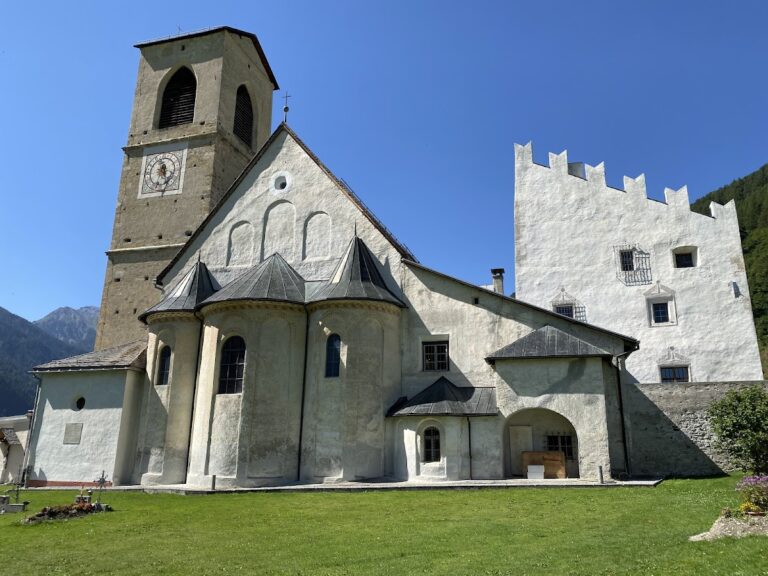
The whitewashed complex occupies a hollow on the right-hand slope of the Upper Vinschgau above Burgeis. Its fortress-like buildings include the former abbey church, a cloister, rooms of the monastic enclosure, a garden, and the Saint Giles Chapel. A cloister is a covered passage around an open courtyard that connects the principal monastic rooms. The Saint Giles Chapel stands on the site of the earlier chapel dedicated to the Virgin Mary.
Former economic wing and museum
The former economic wing was adapted as a museum in 2007. Its old masonry was cleaned, consolidated, and largely retained in its original state, while a contemporary second level was inserted. The intervention leaves visible building changes from the late thirteenth century to the present and made the museum accessible to wheelchair users. The exhibition rooms are climate-controlled, and the displays include historical objects and some artworks from the foundation period. A film presents the crypt frescoes and aspects of monastic life.
Library and associated buildings
The complex includes a library, with a new library established in 2020, as well as the Abbot Hermann House guesthouse, a monastery shop, and the Invito café. Together with the church, cloister, garden, chapel, and former economic buildings, these structures form the surviving abbey complex on its mountainside site.
Nearby sites