Saint Nicholas Church, Drama: An Ottoman Mosque Transformed into an Orthodox Church


Site at a Glance
- Rating
- 4.7
- Popularity
- Very Low
- Country
- Greece
- Primary era
- Medieval
- External website
- Open
- Eras represented
- Medieval, Early Modern
- Civilizations
- Ottoman
- Site type
- Religious
- Remains
- Church
On this page7 sections
History
Saint Nicholas Church, Drama, in Greece, is a functioning Orthodox church whose building began as an Ottoman mosque and now belongs to the Metropolis of Drama under the Ecumenical Patriarchate. Its date and attribution remain uncertain: it has been described as a fourteenth-century building, associated with Ottoman Sultan Bayezid II, and placed by another historical estimate in the late seventeenth century. The mosque was known as Eski Camii, or “Old Mosque,” and Çarşı Camii, or “Market Mosque.”
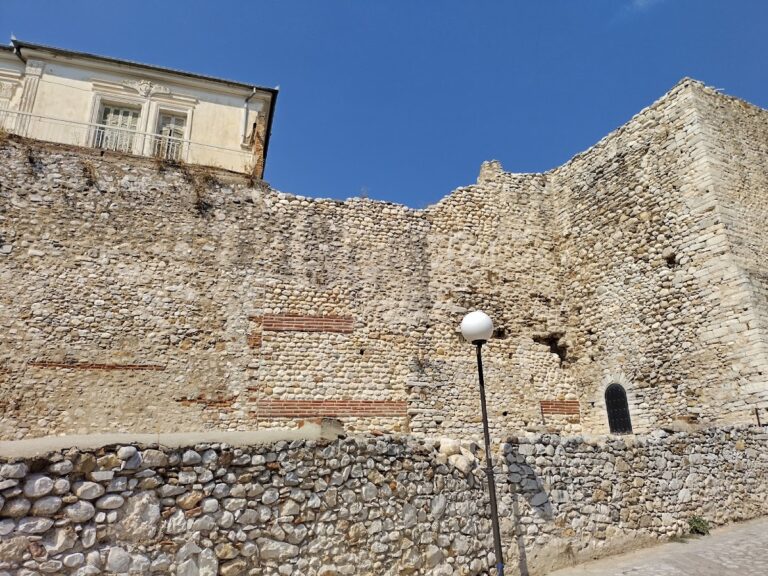
The mosque beside the Byzantine walls
The building stood in Drama’s market area, outside but immediately adjoining the Byzantine walls. The market was associated with the protection that the nearby castle offered merchants during dangerous periods, while the surrounding district appears to have had a predominantly Muslim population. The attribution to Bayezid II, who ruled the Ottoman Empire from 1481 to 1512, does not correspond neatly with either the fourteenth-century description or the estimate placing construction in the late seventeenth century.
Conversion into an Orthodox church
During the second Bulgarian occupation of Drama from 1916 to 1918, the mosque’s minaret was demolished and the building was converted into a church dedicated to Saint George. After the population exchange and the arrival of refugees, the Russian refugee priest Efstathios Kyriakidis removed the crescent from the dome, replaced it with a cross, installed a bell, and celebrated the Orthodox morning service inside. He secured the building’s continued use as a church and dedicated it to Saint Nicholas.
Drama’s mayor, Theofilos Athanasiadis, opposed this use because he sought to turn the former mosque into a covered market. The dispute went before the Holy Synod, the governing body of the Orthodox Church, but Metropolitan of Drama Lavrentios II Papadopoulos, who held office from 1922 to 1928, ultimately consecrated the church. In 1926, the building passed to the DAP, the state administration responsible for property transferred after the population exchange. It was transferred to the Metropolis of Drama in 1956. In 1958, a 528-square-metre plot formerly belonging to a Muslim waqf, an Islamic charitable endowment, was granted to the church through the DAP.
Alterations and present status
Alterations begun in 1960 aimed to remove features associated with the building’s Muslim architectural character. The church was renovated and frescoed in 1991, giving it its present form. A ceremonial hall and shops were added in 1995 and substantially reduced the usable space around the monument. Saint Nicholas Church remains a functioning Orthodox church and is a listed building in Greece.
Remains
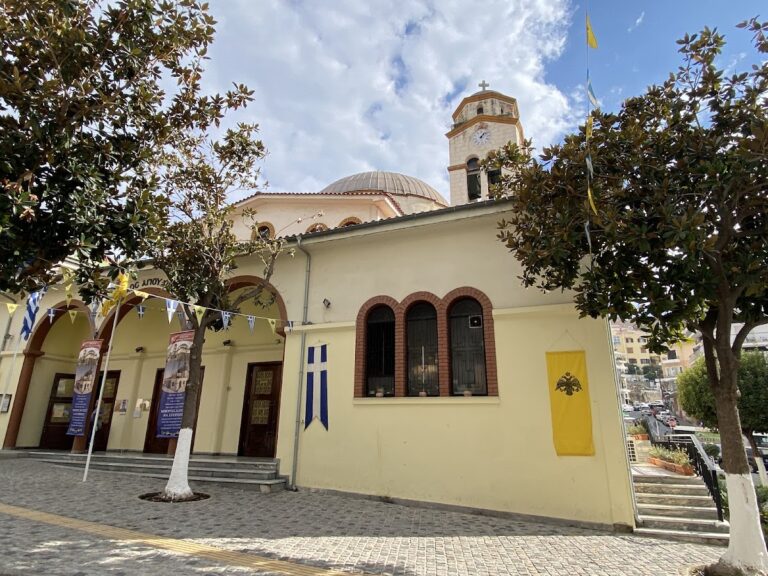
The church stands in central Drama at the southwest corner of Eleftheria Square. Its roof is organized around a central dome and nine hemispherical cupolas, all covered with lead sheets. This clustered roof form remains the principal feature of the building’s surviving exterior composition.
Roof and altered openings
The former mosque’s dome now carries a cross, while a bell forms part of the church’s later religious arrangement. The pointed window arches belonged to the building’s Muslim architectural design and were altered from 1960 onward. These changes form part of the building’s present fabric, alongside the 1991 renovation and fresco painting that established its current architectural and decorative appearance.
Bell towers and surrounding additions
Two bell towers were added in 1967, and the sanctuary apse, the rounded end containing the altar area, was added in 1970. A ceremonial hall and shops were constructed beside the church in 1995, encroaching substantially on the surrounding space. Together with the later frescoes and altered windows, these additions show how the former mosque was physically adapted for Orthodox worship and continued community use.