San Giovanni Battista: A Romanesque-Gothic Church in Serravalle
Site at a Glance
- Popularity
- Low
- Country
- Italy
- Primary era
- Medieval
- Eras represented
- Medieval, Early Modern, Modern
- Civilizations
- Italian, Venetian
- Site type
- Religious
- Remains
- Church
On this page18 sections
History
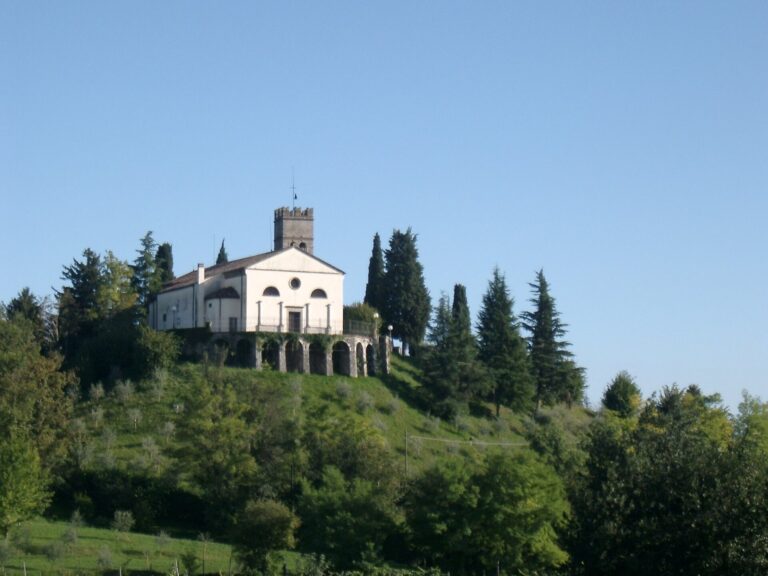
The Church of San Giovanni Battista is a Romanesque-Gothic Catholic church in Serravalle, within Vittorio Veneto, Italy. Built in 1367 north of Serravalle’s fortress, it became a house of the Conventual Friars Minor, a branch of the Franciscan order. Dedicated to John the Baptist, the biblical prophet who baptized Jesus, it belongs to the Diocese of Vittorio Veneto, a Catholic district overseen by a bishop.
Foundation and medieval expansion
In the second half of the fifteenth century, the church was enlarged and decorated with frescoes, paintings made on wet plaster. Local noble families, the Galletti and the Sanfiori, commissioned two chapels on its right side.
Religious communities and later changes
During a plague in the seventeenth century, the frescoes were covered with limewash, a white coating made from lime. The religious order was suppressed in 1769. Barnabite Fathers, members of a Catholic congregation founded in sixteenth-century Milan, took over in 1895 and remained until 1912. The Carmelites, a Catholic order with origins on Mount Carmel, succeeded them in 1920 and left the convent in 2004.
Twentieth-century changes and reuse
Frescoes in the left chapels were uncovered in 1944, restored in 1949–50, and restored again in the 1990s. After the Carmelites’ departure, their former convent, which they had purchased, became the seat of the CEIS Center of Solidarity and the Progetto Uomo Foundation.
Remains
The church’s Romanesque façade fronts an interior arranged around a central nave, the main part of the church, with two chapels on each side and a choir, the area associated with the main altar. A bell tower stands behind the church, while the former convent adjoins its right side.
Exterior and adjoining convent
Façade
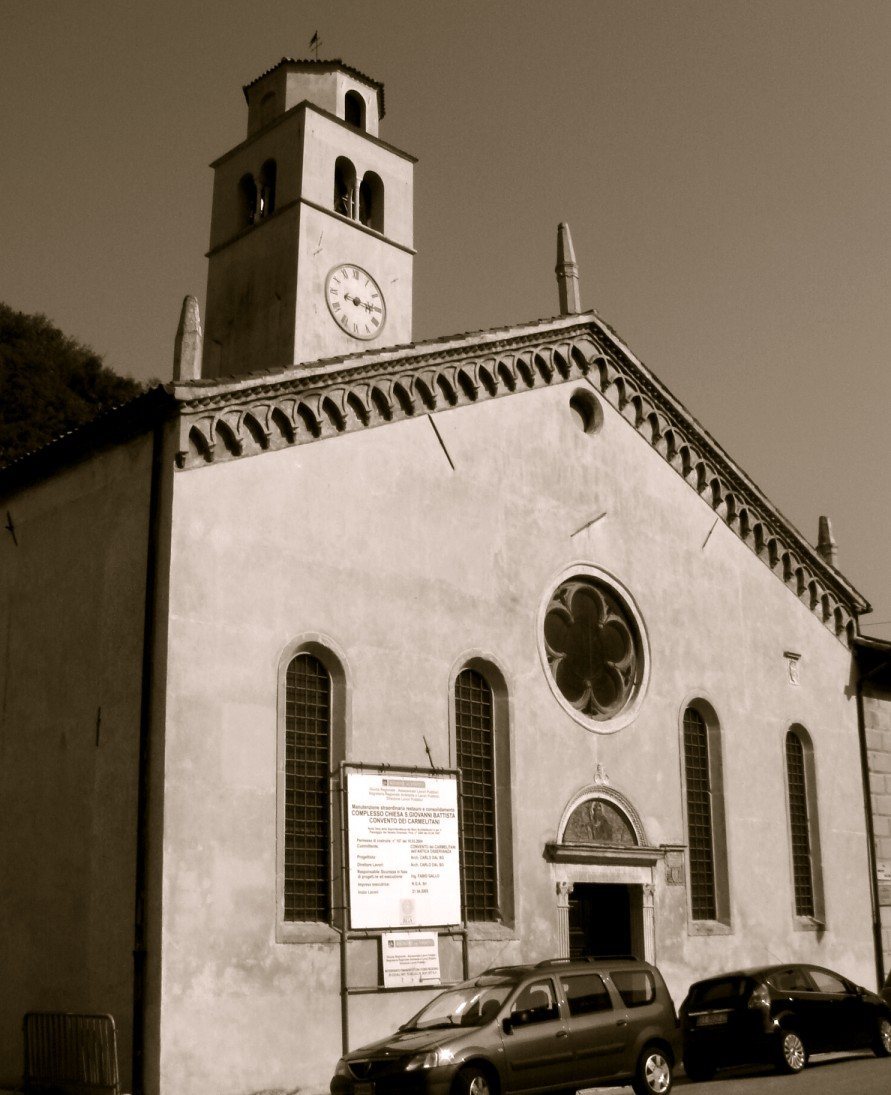
The Romanesque front rises to a central peak. Its fifteenth-century rose window, a large circular window, has five lobes, and a rectangular doorway from the same period sits below it. The semicircular field above the doorway, called a lunette, contains a twentieth-century mosaic of Saint John the Baptist. Two tall windows with single openings flank the entrance on each side. A horizontal molding runs along the top, surmounted by three small pointed ornaments. Stained glass installed in the second half of the twentieth century fills the rose window and other windows.
Bell tower
The Romanesque bell tower behind the church dates to 1427. Its bell chamber has paired openings and is capped by a small, eight-sided dome from the seventeenth century. Rounded single-opening windows pierce four sides of the dome.
Carmelite convent
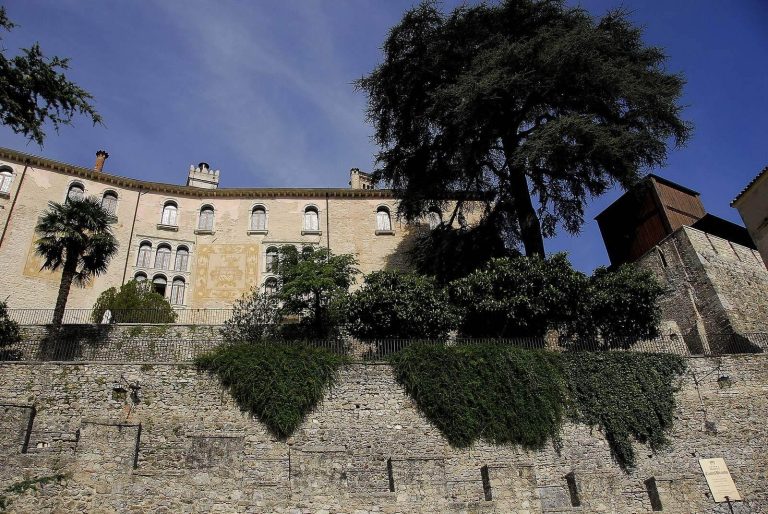
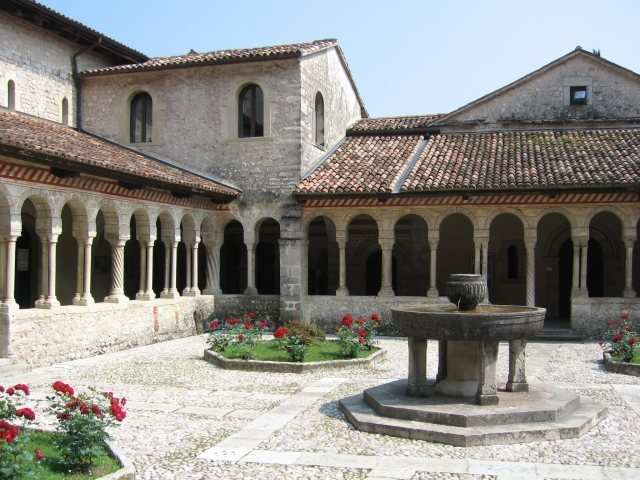
The convent adjoins the church to the south, along its right side. The building dates to the second half of the fourteenth century and has a façade of rough-faced masonry, with fourteen painted coats of arms high on the wall, dated 1922. Inside, a cloister, or covered walkway around an open courtyard, dates in origin to the fifteenth century. It has eight-sided columns with Corinthian capitals decorated with leaf forms.
Interior and artworks
Entrance artworks
To the left of the entrance is a late-fifteenth-century fresco of the Virgin Mary and Child by Matteo Cesa. Beside it hangs a late-seventeenth-century canvas by Gaspare Fiorentino depicting the Adoration of the Magi.
First chapel on the left
The altar in the first chapel on the left holds a 1502 altarpiece, an artwork placed behind or above an altar, by Jacopo da Valenza. It depicts the Virgin Mary and Child with Saints Joseph, John the Baptist, Joachim, and Anne.
Second chapel on the left
The walls of the second left chapel hold several paintings. An anonymous sixteenth-century fresco depicts the Stigmata of Saint Francis. A 1607 painting by Frigimelica shows Saint Roch and Our Lady of Health. Another work depicts Saint Bernardino of Siena among Saints Jerome Emiliani, Cajetan of Thiene, Peter of Alcantara, and Leonard of Limoges. A nearby altar has a painting of Saint Anthony of Padua by Frigimelica.
Nave and organ paintings
Three painted organ shutters, hinged panels associated with an organ, hang on the central nave’s left wall. By Francesco Frigimelica, they depict Saint Anthony of Padua, Saint John the Baptist, and Saint Francis of Assisi. A fourth shutter, on the opposite wall beside the organ, shows Saint Nicholas of Bari.
High altar and choir
The seventeenth-century high altar is made of Carrara marble and follows the Baroque style. Large canvases by Agostino Ridolfi cover the side walls: The Last Judgment, painted in 1688, is on the right, and The Universal Flood, from 1689, is on the left. Brustolon made their wooden frames. Behind the altar, the sanctuary ends in a seven-sided space. There, an oil-on-panel altarpiece by Francesco da Milano, dated 1529, depicts the Baptism of Christ with Saints John the Baptist, Francis of Assisi, and Anthony of Padua.
Right-side chapels
Galletti Chapel
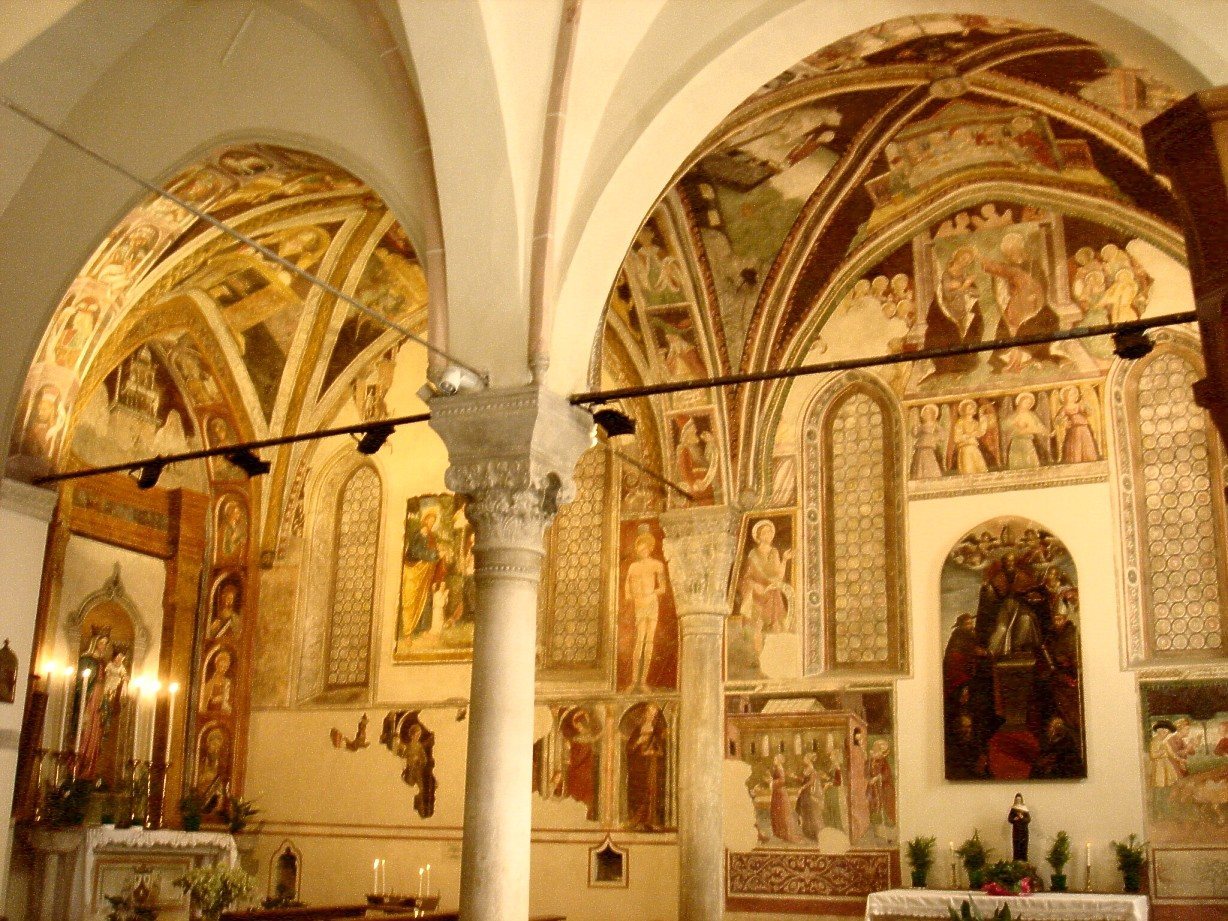
The Galletti Chapel contains anonymous frescoes of episodes from the life of Saint Nicholas, painted between 1460 and 1470. A 1607 canvas by Francesco Frigimelica shows Saint Nicholas of Bari with Saints Bonaventure and Louis of Toulouse, alongside the donor Manenti da Gabbiano.
Sanfiori Chapel
The Sanfiori Chapel’s frescoes depict groups of Church Fathers, influential early Christian theologians and writers, together with prophets and the twelve apostles. The paintings are attributed to Antonio Zago, active in the area between 1482 and 1507. Among these fifteenth-century works is a sixteenth-century fresco of the Holy Family by Francesco da Milano, brought from the adjoining cloister.