Mausoleum of Lucius Munatius Plancus: A Roman Funerary Monument in Gaeta


Site at a Glance
- Rating
- 4.3
- Popularity
- Very Low
- Country
- Italy
- Primary era
- Classical
- Eras represented
- Classical
- Civilizations
- Roman
- Site type
- Burial
- Remains
- Tomb
On this page6 sections
History
Roman Republican Foundation
The Mausoleum of Lucius Munatius Plancus is a Roman funerary monument in Italy, built on Monte Orlando above Gaeta around 22 BC during the late Roman Republic. It was commissioned by Lucius Munatius Plancus, a Roman military figure and politician from the period before the establishment of the empire.
Plancus belonged to Rome’s late Republican political and military elite. His commemorative inscription identifies him as the son, grandson, and great-grandson of Lucius, as well as a consul, a senior chief magistrate of the Republic, and a censor, the official chiefly responsible for the census and related matters. It also calls him twice acclaimed imperator, a member of the seven-man college of the Epulones, who organized important public religious banquets, and a triumphator over the Rhaetians.
The inscription further records several of Plancus’s public achievements. It states that he built the Temple of Saturn using spoils, distributed land in Italy at Benevento, and founded the colonies of Lugdunum and Raurica in Gaul. Through these claims, the monument presents both his political offices and his military, religious, and colonial activities.
Remains
Circular Tomb Structure
The mausoleum is perfectly circular, measuring 29.54 metres across, with an external circumference of 93.10 metres and a height of 9 metres. It originally carried a tumulus, a roof formed as a burial mound, but that upper feature no longer survives. The monument itself remains in an excellent state of preservation.
Burial Chambers and Interior
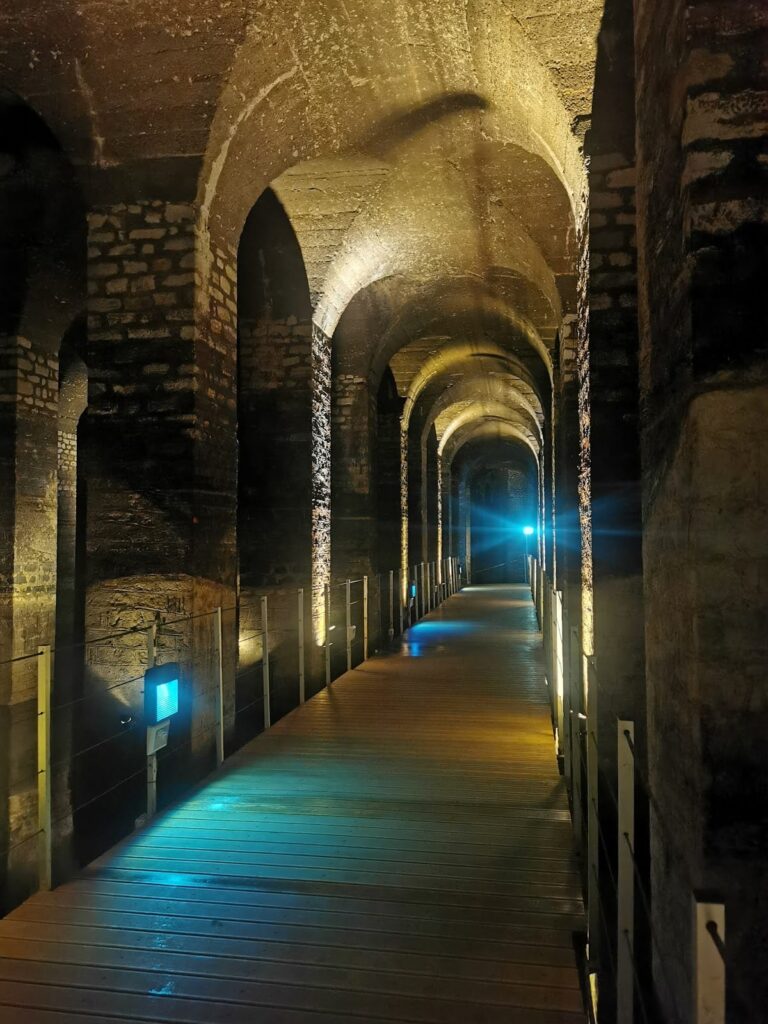
Inside, four burial chambers are arranged toward the four cardinal directions. Each chamber has a barrel vault, a continuous curved ceiling formed by extending an arch along its length. The chambers open onto a circular corridor known as an ambulatory. The principal chamber lies directly opposite the entrance and contains a copy of the original statue of Lucius Munatius Plancus, which is now in Rome.
Inscription and Antiquarium
Above the doorway, a dedicatory inscription remains almost perfectly preserved within a surrounding frame. The internal cells now contain an antiquarium, an exhibition space for archaeological and historical antiquities, with finds from different historical periods.