San Giorgio Martire vecchio: A Lombard Church in Costabissara


Site at a Glance
- Rating
- 4.3
- Popularity
- Very Low
- Country
- Italy
- Primary era
- Medieval
- External website
- Open
- Eras represented
- Medieval, Early Modern, Modern
- Civilizations
- Habsburg, Italian, Lombard, Venetian
- Site type
- Religious
- Remains
- Church
On this page16 sections
History
San Giorgio Martire vecchio is a Catholic church in Costabissara, Italy, associated with the Lombards and shaped by a Romanesque rebuilding around 1456, later Gothic alterations, and a major reconstruction in 1859. Its origins remain uncertain, although one interpretation places its foundation around 688–700, after the Lombard king Cunipert defeated the rival claimant Alachis. The dedication to Saint George, a Christian martyr and soldier-saint, has been linked with the religious and political realignment of that Lombard period.
Early Parish History
The church is also known as the Lombard Church of San Giorgio, the parish church, or the small church of San Giorgio. The earliest surviving written reference dates from 1186, when the parish church of Costa Fabrica, the former name of Costabissara, appeared in Pope Urban III’s confirmation of the Privilege of Pistore. Further references occur in documents dated 1 July 1277 and 4 June 1288.
The absence of a document establishing the original construction date has left the early history open to interpretation. One hypothesis places the church before the year 1000. Another connects its foundation with Lombard architectural fragments found at the nearby church of San Zeno and assigns it to the period around 688–700, during the reign of Cunipert.
Romanesque Rebuilding and Baroque Alteration
A substantial rebuilding took place around 1456 in the Romanesque style, a medieval form known for strong masonry and simple, robust structural forms. This work added a pronaos, or entrance porch, an apse, and a gabled roof. In 1600, a new Baroque ceiling concealed the earlier Romanesque roof framing, although traces of that earlier structure remain.
The church’s devotional arrangements also changed over time. The high altar was dedicated to Saint George from the earliest period and displayed the painting Saint George the Knight. A second altar, dedicated to Saint George in 1580, had been reassigned to Saint John the Baptist by 1633. A bequest dated 12 May 1501 had ordered 100 ducats for a chapel dedicated to Saint John the Baptist in a more suitable position within the church.
In 1580, a third altar was dedicated to Saint Bernardino. It was rebuilt in 1686, decorated with fifteen metal panels representing the Mysteries of the Rosary, and consecrated to Our Lady of the Rosary. The fourth altar, positioned to the left of the entrance above what is thought to be the tomb of the parish priests, was first dedicated to the Archangel Michael and soon afterward to Saint Fermo, an early Christian martyr.
Nineteenth-Century Reconstruction
The largest transformation occurred in 1859. The sacristy was rebuilt, the earlier brick apse was demolished and replaced in stone, and the floor was renewed. The pronaos was removed, while imitation-Gothic portals, rose windows, and pinnacles gave the building much of its present pointed-arch character. The baptismal font was transferred from the north wall to a room adjoining the sacristy, and three funerary slabs were covered by the new floor.
The bell tower was demolished in 1868 and replaced by the present tower, whose appearance contrasts with the church. The former tower had ended in a traditional brick finial shaped like a pine cone, a feature shown on older maps. The semicircular stairway behind the apse also appears to belong to the nineteenth century, since it is not shown on the Austro-Hungarian cadastral plans, which were land and property survey maps.
Changing Parish Use
San Giorgio Martire vecchio remained the parish church until 1920, when construction of the new parish church was completed. Its use then became occasional because of its inconvenient location and limited size. Successive rebuilding and the removal of materials further obscured its Lombard elements, particularly during the early twentieth century, when materials were taken for the embellishment of the new parish church and the church of Madonna delle Grazie.
During work at Madonna delle Grazie in 1923, the Rosary altar was moved there. The processional statue of Our Lady of Mount Carmel is now kept in the sacristy of the new parish church. Since 11 March 2012, the old church has also been made available to the Romanian Orthodox Diocese of Vicenza.
Remains
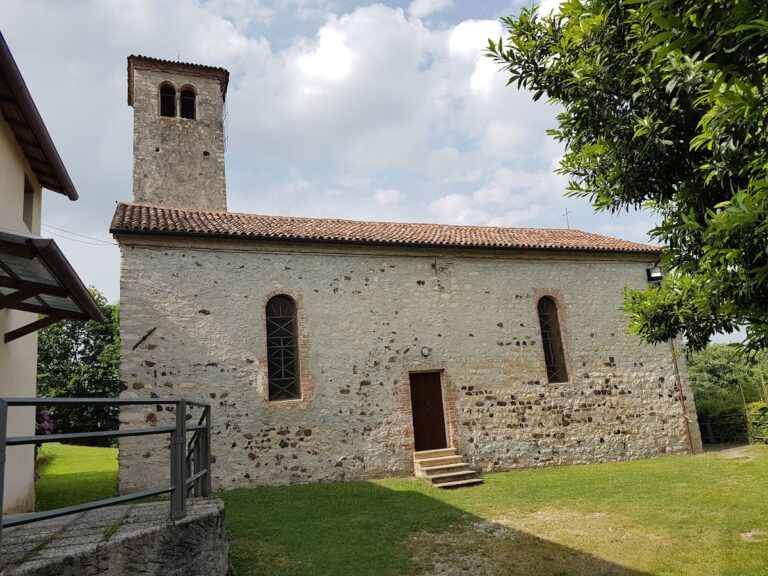
The church stands on the hill of San Giorgio, also called Mount Pignare and formerly Mount of the Church, beside the cemetery and near Villa San Carlo and Castle Sforza-Colleoni. Its façade faces west and its apse faces east. The walls meet at an angle of 82 degrees, a feature associated with the symbolism of early Christian churches. The precise form of the earliest building is unknown, while the present structure largely reflects the fifteenth-century rebuilding and the reconstruction of 1859.
Exterior
Principal Entrance
The main entrance has a pointed arch with finely worked jambs and small pinnacles at their ends. Above it, a gable crowned by a cross contains a fresco by Pietro Zappella. The painting shows Our Lady of Mount Carmel offering the traditional scapular, a devotional cloth emblem associated with the Carmelite tradition, to the faithful.
South Doorway
A smaller doorway of similar workmanship opens on the south side. Its gable contains another fresco by Zappella, depicting Saint Fermo with the palm of martyrdom. Together, the two doorways and their pointed forms contribute to the building’s predominantly Gothic appearance, although that appearance results largely from later alterations rather than from a single medieval construction phase.
Apse and Stairway
The 1456 rebuilding introduced an apse, the usually semicircular termination of the sanctuary. The earlier apse was built of brick and was replaced in stone during the 1859 reconstruction. Behind it, a semicircular stairway leads toward the cobbled path. Its nineteenth-century date is suggested by its absence from the Austro-Hungarian cadastral plans.
Interior Arrangement
Altars and Devotional Features
The former interior contained four altars. The high altar stood at the eastern end and was dedicated to Saint George. The other three occupied positions beside the entrance arch leading toward the high altar, except for the altar to the left of the entrance, which stood above the feature thought to be the parish priests’ tomb. The secondary altars were removed during the 1859 works and replaced by two altars on the north wall.
One of the later altars was dedicated to Our Lady of Mount Carmel and was erected where the Saint Fermo altar had stood. The other, dedicated to Our Lady of the Rosary, was placed near the organ. Their wooden statues were carried in annual processions on 16 July and on the first Sunday of October. The earlier Rosary altar, rebuilt in 1686 with fifteen metal panels showing the Mysteries of the Rosary, was transferred to Madonna delle Grazie in 1923.
Choir Loft and Organ
The former choir loft occupied the space above the entrance and held the organ pipes. Traces of those pipes remain, as do the bases of the loft’s supporting columns on the floor. The gallery is thought to have been removed during the nineteenth-century reconstruction.
Funerary Slabs and Holy-Water Stoup
Three funerary slabs associated with the Mazzocchetto and Caldognetto families were covered when the floor was renewed in 1859. One had been placed at the centre of the church, while the other two lay beneath the balustrade at the foot of the altar.
A white Carrara-marble holy-water stoup, a basin for water used in Catholic devotional practice, formerly stood at the entrance. It is now preserved in the new parish church, where it has been painted red with oil paint.
Paintings and Surviving Objects
Saint George the Knight
The painting Saint George the Knight, once displayed on the high altar, is now preserved in the parish church. It was long attributed incorrectly to the Vicentine painter Maganza. During restoration in 1983, with the assistance of Vittorio Sgarbi, it was identified as an early work by Francesco Maffei, a seventeenth-century painter from Vicenza.