St. Nicholas Church, Vilnius: A Medieval Catholic Parish Church


Site at a Glance
- Rating
- 4.7
- Popularity
- Low
- Country
- Lithuania
- Primary era
- Medieval
- External website
- Open
- Eras represented
- Medieval, Early Modern, Modern
- Civilizations
- Grand Duchy of Lithuania, Polish–Lithuanian Commonwealth, Russian
- Site type
- Religious
- Remains
- Church
On this page12 sections
History
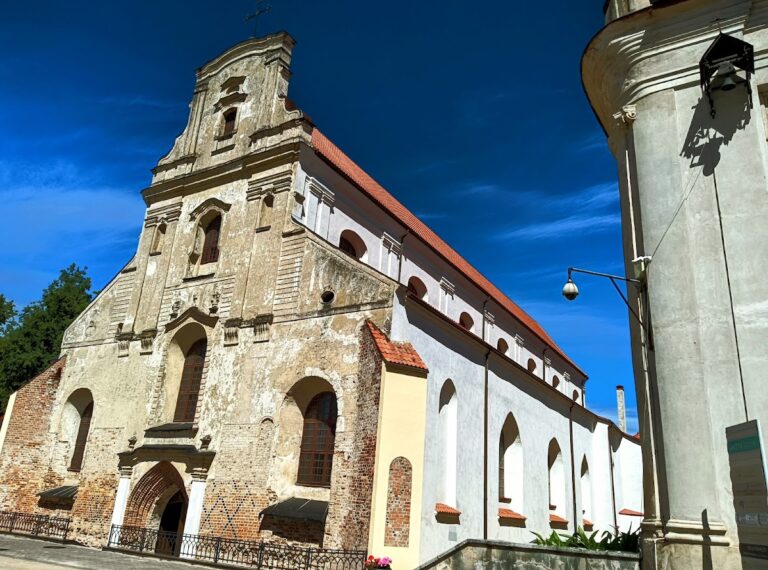
St. Nicholas Church, Vilnius, is a Roman Catholic parish church in Lithuania, built in the Gothic period as a place of worship for foreign, particularly German, merchants and craftsmen. Its foundation predates Lithuania’s official adoption of Christianity in 1387 and is traditionally associated with the rule of Grand Duke Gediminas, an early fourteenth-century ruler during the formation of the Lithuanian state. A stone church was constructed between 1382 and 1387 near German Street, and the building is regarded as the oldest surviving Catholic church in Lithuania.
Medieval Foundation and Reconstruction
The church first appears in written records from 1387 to 1397. Archaeological interpretation holds that the Roman Catholic church founded at this time has survived into the present. Its medieval form belonged to Brick Gothic, a Gothic tradition using exposed brick as a principal architectural material. The building’s clear and restrained composition later influenced other Gothic churches in Lithuania.
The church underwent repeated reconstruction and restoration. A consecration document from 1514 survives, while new vaults were built around 1525. These changes formed part of the building’s continuing development as a parish church rather than marking the creation of a separate institution.
Fire, Alteration, and Nineteenth-Century Additions
A fire in 1749 led to substantial architectural changes around 1750 and afterward. The work introduced Baroque elements to the main facade, enlarged the side windows, and added a Rococo choir loft. The Gothic character of the building remained visible within the altered exterior.
French soldiers seriously damaged the church in 1812 during the French-Russian War, the conflict between Napoleonic France and Russia. During the first half of the nineteenth century, a belfry with Classical features and a stone enclosure were added. The church had no original tower, so these additions changed the character of its approach and outer boundary.
Lithuanian and Belarusian Religious Life
Lithuanian-language services began in 1901. Between the First and Second World Wars, St. Nicholas Church was the only church in Vilnius where Mass and sermons were conducted in Lithuanian. It consequently became a center of Lithuanian religious, social, and cultural life. The courtyard hall hosted meetings, lectures, theatrical performances, and children’s Christmas events.
Several Lithuanian clergy served the parish during this period and afterward, including Juozapas Kukta from 1901 to 1906, Antanas Viskantas from 1906 to 1909, Jurgis Januševičius from 1909 to 1911, Petras Kraujalis from 1911 to 1912 and again from 1912 to 1924, Kristupas Čibiras from 1924 to 1942, Česlovas Krivaitis from 1950 to 1961, and Kazimieras Vasiliauskas from 1997 to 2001.
The church also served Belarusian religious and cultural life. Adam Stankievič, a prominent figure in the Belarusian movement who was also a literary scholar, publicist, and publisher, served there from 1919 to 1938. During the 1920s through the 1940s, Belarusian-language sermons were given by Adam Stankievič, Vincent Hadleŭski, Jazep Hiermanovič, and Kazimir Svajak.
War, Soviet Rule, and Continuing Use
Kristupas Čibiras, dean from 1924 to 1942, was killed during the bombing of Vilnius in 1942. A memorial plaque commemorating him was installed in the church after the Second World War. When Vilnius Cathedral was closed after the war, the Curia of the Vilnius Archdiocese moved into the St. Nicholas parish buildings, and the church effectively performed cathedral functions.
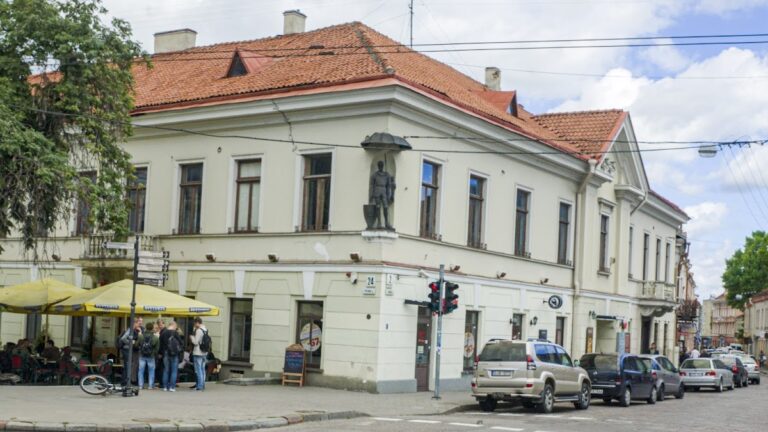
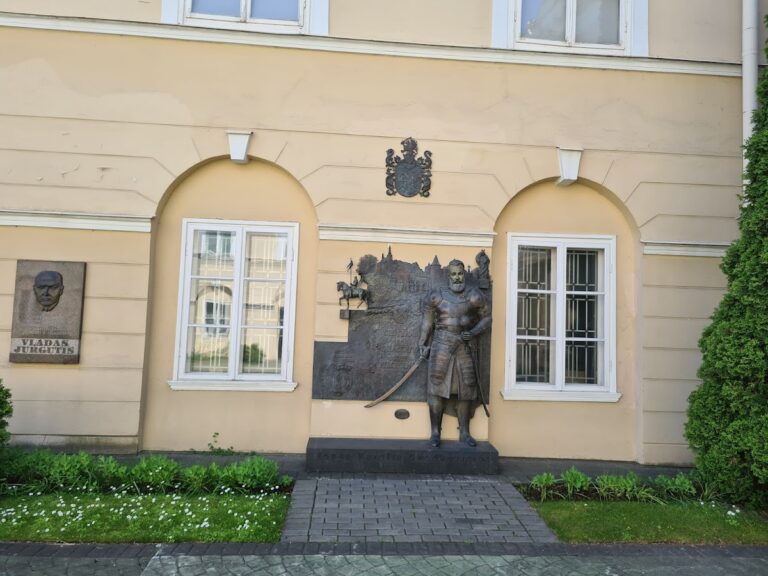
The church was restored in 1972 under the direction of architect Jonas Zibolis. During the Soviet occupation, a statue of St. Christopher was installed in the courtyard. Because the city’s coat of arms, which depicted the saint, had been banned, the statue served as an act of resistance. St. Christopher is traditionally regarded as a protector of travelers and is the patron saint of Vilnius.
The church and its enclosure are protected by the Lithuanian state as a site of national significance and are listed in the Register of Cultural Values of the Republic of Lithuania under code 749. St. Nicholas remains an active Lithuanian-language place of worship and a traditional center of Lithuanian religious and public life.
Remains
St. Nicholas Church is a comparatively small, almost square red-brick building measuring approximately 13.0 by 15.75 meters. Its massive walls enclose three aisles of nearly equal height, making it a hall church, a type in which the nave and aisles rise to approximately the same level. The exterior combines Brick Gothic construction with semicircular arches that introduce Romanesque elements.
Exterior and Medieval Structure
The short apse, the terminal part of the church framing the sanctuary, has three sides, narrow wall niches, and diagonal buttresses at its corners. Two sturdy buttresses with truncated tops also flank the facade. The restrained portal is framed by two rows of molded brick, while three groups of niches at different heights animate the triangular pediment through their changing rhythm and contrasts of light and shadow.
The pediment has been renovated while retaining its Gothic character. The 1749 fire and its aftermath left further marks on the facade, including a curved lintel above the central window and other Baroque alterations. A later belfry with Classical features stands apart from the church’s original medieval composition, and the surrounding stone enclosure belongs to the additions made during the first half of the nineteenth century.
Interior Vaults and Supports
The interior contrasts with the severe outer walls. Webbed rib vaults rest on two pairs of elegant octagonal piers whose faces are formed from shaped bricks. Web and star vaults extend through the interior, while a keel-shaped arch separates the presbytery, the area around the main altar traditionally reserved for clergy, from the aisles.
Altars and Sculptures
High Altar
The high altar contains a cross and statues of St. Christopher, St. Teresa, St. Clare, and St. Joseph with the Christ Child, arranged between columns. Sculptor Rapolas Jakimavičius made the four statues. The altar also holds a sixteenth-century painting of St. Nicholas in a silver setting. St. Nicholas is traditionally associated with generosity and with the protection of travelers, merchants, and children.
Side Altars
The left altar displays an image of St. Nicholas, with statues of St. Casimir and St. George between its columns. The right altar contains a relief of Our Lady of Sorrows. Together, the three altars form the principal devotional furnishings of the church’s interior.
Other Sculptures and Memorials
A polychrome statue of St. Louis from the Gothic period is among the church’s sculptures. A statue of St. Anthony stands in the central niche on the right. The church also contains a monument commemorating the five-hundredth anniversary of the death of Grand Duke Vytautas the Great, one of medieval Lithuania’s most important rulers. Vilnius Lithuanians arranged its installation in 1930, and Rapolas Jakimavičius created it from bronze and marble.
In 1936, a fence was added around the monument incorporating two swords. They symbolize the swords that the Crusaders presented to Jogaila before the Battle of Grunwald in 1410, when Polish-Lithuanian forces fought the Teutonic Order. The courtyard holds a further politically charged sculpture, a statue of St. Christopher carrying the Christ Child installed in 1957. Sculptor Antanas Kmieliauskas created it at the request of Prelate Česlovas Krivaitis, and its Lithuanian inscription asks the saint to protect the city.