San Giacomo dei Militari: A Historic Church in Palermo’s Military Quarter


Site at a Glance
- Rating
- 4.4
- Popularity
- Very Low
- Country
- Italy
- Primary era
- Medieval
- Eras represented
- Medieval, Early Modern
- Civilizations
- Crown of Aragon, Habsburg, Kingdom of Sicily, Spanish
- Site type
- Religious
- Remains
- Church
On this page14 sections
History
San Giacomo dei Militari is a Roman Catholic church in Palermo, Italy, built in 1482 within the city’s military quarter. Promoted by the Palermo Senate, it was dedicated to the Virgin Mary and Saint Sebastian, a Christian martyr traditionally invoked for protection against plague, during the epidemic that affected Palermo that year. The church formed part of the fortified complex known as the Galka, Alga, or Yalica, an enclosure whose name derived from a term meaning “enclosure” and which concentrated royal, ecclesiastical, and military institutions around the Norman Palace.
The Galka and the original church
The Galka enclosed the Norman Palace, the palace of the Curia, and the military quarter. Its boundaries consisted of walls, which in many places followed the earlier Punic circuit, together with tall towers. This citadel-like area brought together the principal authorities of medieval and early modern Palermo, placing San Giacomo dei Militari within a tightly controlled royal and military environment.
In 1505, the Scarpari confraternity established itself in the church. This religious and charitable association represented shoemakers and promoted devotion to Saints Crispin and Crispinian, the guild’s patron saints. Its chapel was completed in 1546. The church also became connected with the Spanish community in Palermo, which needed a hospital for sick soldiers. Permission was sought from the canons of San Giorgio in Alga to use the possessions of San Giacomo la Mazzara in return for an annual rent, and the hospital institution received approval in 1560 with the assent of Pope Pius IV.
The military hospital
Hospital construction began in 1586 on the side of the quarter facing the Norman Palace, under the viceroy Diego Enriquez de Guzman. After an interruption, work resumed in 1622 under the viceroy Francisco Ruiz de Castro and was completed during his administration. For this reason, Ruiz de Castro was regarded as the hospital’s founder rather than simply the official who continued an earlier project.
The San Giacomo quarter and its new hospital developed around military buildings and three churches: the Norman-period Santa Maria Maddalena, San Giacomo dei Militari, and San Paolo d’Alga, dated to 1312. In 1623, the abandoned church and adjoining properties passed to the Ospedale Grande e Nuovo, associated with the hospital at Palazzo Sclafani. The buildings then served troops stationed in the fortified quarter, while the church was rededicated to Saint James the Greater, one of the apostles and the patron saint of the Iberian nation. Its formal titular dedication remains to Saint James the Apostle within the Roman rite and the Archdiocese of Palermo.
Fortification, secular use, and restoration
In 1650, the viceroy Juan de Austria further enclosed the defensive complex protecting the Norman Palace and the buildings of Palermo’s ancient urban core. Two entrances led to the parade ground, one opening onto the Cassaro opposite the palace bastions and the other facing east. During this fortification, the canons of San Giorgio in Alga moved to Santa Maria Maggiore. The Confraternity of San Giacomo la Mazzara had already transferred in 1652 to the church of San Giovanni at Porta Carini, which has since disappeared.
In 1663, San Giacomo dei Militari, together with Santa Maria la Mazzara, was put to secular use and incorporated into a small palace. At the beginning of the nineteenth century, the architect Salvatore Maria Marvuglia substantially altered the building by raising its floor level and installing a reed-supported vault that concealed the timber roof. Religious services ended after 1874, and the premises were used for laboratories and workshops serving the barracks.
The hospital remained active until 1824, when its departments moved to the former Jesuit establishments of San Francesco Saverio in Albergheria. A restoration campaign in 1970 removed Marvuglia’s coverings and later additions. Further recovery work followed in 2003 and 2008, helping reveal the building’s earlier fabric and its place within the monumental complex of the San Giacomo degli Spagnoli military quarter.
Remains
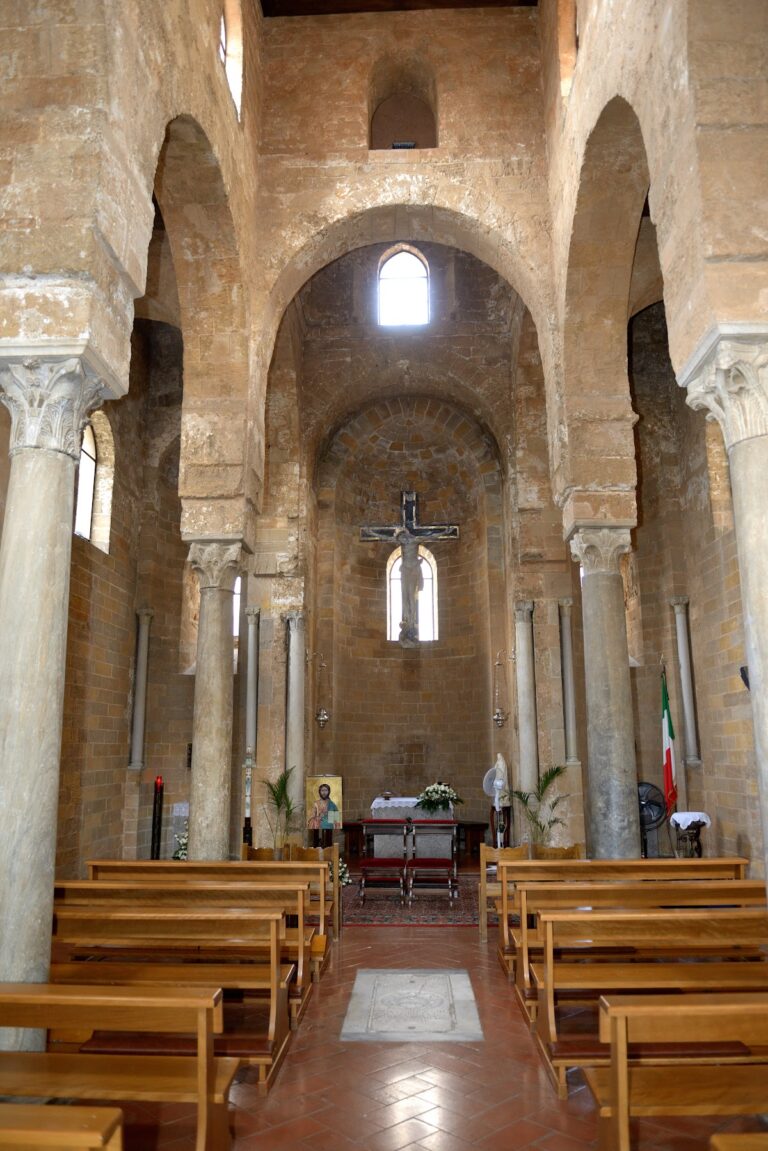
San Giacomo dei Militari retains a three-aisled interior divided by columns and an exposed timber roof with visibly decorated beams. Its facade combines a pointed-arch entrance made from squared tuff blocks with a circular oculus and a curving, mixed-line gable. The surviving structure brings together late medieval elements, later chapels, and features revealed by modern restoration.
Church structure and roof
Facade and interior
The pointed arch of the portal is formed from squared tuff blocks and is surmounted by an oculus, a circular opening in the facade. Above it, the gable follows a curving mixed-line profile. Inside, columns divide the church into three aisles. The timber roof remains visible, with decorated beams that preserve inscriptions naming the church’s dedication, title, and date, together with the arms of the House of Aragon and the Palermo Senate. The heraldry identifies the political setting of the church’s foundation in 1482.
Roof inscriptions
The roof beams carry written records connected with the church’s original identity. Alongside the dedication, title, and date, they display the arms of the House of Aragon, the dynasty ruling Sicily when the church was built, and those of the Palermo Senate. These elements form part of the surviving architectural evidence for the building’s foundation and civic sponsorship.
Side chapels and artworks
Chapel of Saint John Nepomuk
On the epistle side, the side traditionally associated with the Epistle reading, is the Chapel of Saint John Nepomuk. German worshippers sponsored it in 1727 and supplied a marble statue of the fourteenth-century Bohemian Christian martyr, who was associated with confession. Restoration during the 1970s uncovered wall paintings showing episodes from his life and identified the space with the chapel described in Gaspare Palermo’s guide.
The original statue was transferred in 1877 to the Church of the Holy Sepulchre in Bagheria. The church now has a similar statue made in 1722 by Tommaso Maria Napoli. Before reaching San Giacomo dei Militari, this sculpture had adorned the square of Castello a Mare and had later been kept in Santa Maria degli Angeli, known as the Gancia.
Chapel of the Madonna of the Rosary
On the gospel side, the side traditionally associated with the Gospel reading, is the Chapel of the Madonna of the Rosary. Its altar bears a painting of the Madonna of the Rosary by Filippo Paladini. The church is also associated with Simone de Wobreck’s Madonna of the Rosary among Saints, a panel painting dated 1580–1581 that is now held in the Torre Room of the Diocesan Museum of Palermo on temporary display.
Paintings connected with the church
A seventeenth-century painting of Saints Cosmas and Damian by an unknown artist of the Caravaggesque school is held by the Diocesan Museum of Palermo. Caravaggesque painting was influenced by Caravaggio’s strong contrasts of light and shadow and naturalistic treatment of figures. The former church spaces are currently used for exhibitions and contain works other than those historically associated with the building.
Santa Maria la Mazzara
Ruined church
The nearby former church of Santa Maria la Mazzara survives as ruins consisting of columns and pointed arches. It once contained a Greek-derived image of the Madonna of Consolation, donated by Roger I, the Norman count of Sicily. The image was later acquired by Santa Maria Maggiore, while the remaining columns and arches preserve part of the architectural setting associated with the former church.