Palazzo d’Orleans: Historic Palace and Seat of Sicily’s Regional Presidency


Site at a Glance
- Rating
- 4.4
- Popularity
- Medium
- Country
- Italy
- Primary era
- Modern
- External website
- Open
- Eras represented
- Early Modern, Modern
- Civilizations
- Kingdom of Sicily, Kingdom of the Two Sicilies
- Site type
- Civic
- Remains
- Palace
On this page8 sections
History
Palazzo d’Orleans is an eighteenth-century palace in Palermo, Italy, built opposite the Palazzo dei Normanni, Palermo’s historic royal palace and medieval seat of government in Sicily. Its first nucleus was constructed in 1775 for the abbé Gianfrancesco Monroy, the second son of Alonso Monroy, Prince of Pandolfina and vicar general of Val di Mazara.
Creation and enlargement
After the property was confiscated and offered at auction, the merchant Antonino Oliveri bought it in 1784. Between 1784 and 1806, he greatly expanded the building on both sides and added a third storey. The palace therefore grew from a relatively small residence into a larger urban complex, with its construction and subsequent development extending from 1775 to 1856.
The property grew again during the Orléans period. The family acquired the adjoining Gerardi and Bentivegna palaces, as well as the Greco and Vitale houses. Further works included a columned room, a chapel, and cellars. The columned room initially served as the bedroom of Louis Philippe d’Orléans and Marie-Amélie of Bourbon-Sicily, and later became the chamber of the Sicilian Regional Council, which used it from 1947 to 1967.
The Orléans residence
Louis Philippe d’Orléans occupied the palace from 1808 to 1814 while living in Sicily away from France, and purchased it in 1810. He married Marie-Amélie in Palermo in 1809, and their first three children, Ferdinand-Philippe, Louise, and Marie, were born at the palace.
The family returned to France in 1814 but retained the Palermo property, which was later neglected. After Louis Philippe died in 1850, Marie-Amélie inherited the Palermo holdings and transferred the palace and its surrounding 63-hectare estate to her son Henri, Duke of Aumale, in the mid-1850s. Henri added a second reception room in 1857 and supported activities connected with the Risorgimento, the nineteenth-century movement that led to the political unification of Italy.
The property subsequently passed to Henri’s grandson Philippe d’Orléans, who enlarged the palace further and died there in 1926. His sister, Amélie, Queen of Portugal, transferred it in 1928 to their cousin Jean, Duke of Guise. The palace hosted the marriage of Princess Françoise d’Orléans and Prince Christophe of Greece and Denmark on 10 February 1929. It also hosted the wedding celebrations of Henri d’Orléans, Count of Paris, and Isabelle d’Orléans-Braganza. A ball took place on 7 April 1931, followed the next day by the religious blessing, a luncheon for 1,000 guests, and the newlyweds’ appearance on the balcony.
War and regional government
The Italian government requisitioned Palazzo d’Orleans in 1940. After the Allied landing in Sicily, the palace housed Allied offices from August 1943, including AMGOT, the Allied Military Government of Occupied Territories. It later became the office of the High Commissioner for Sicily. During this period, furniture, works of art, tableware, and silverware disappeared.
On 29 August 1947, the palace became the seat of the presidency and council of the Sicilian Region. A 1950 ruling by the Italian-French Conciliation Commission required its return to the former Orléans owners. President Giuseppe Alessi then decreed its purchase by the region on 14 May 1953 for 210 million lire. It again served as the seat of the regional presidency from 1955 and remains the official residence and institutional seat of the President of the Sicilian Region.
The adjacent Bentivegna building was demolished in 1956 to make way for a seven-storey structure housing the offices of the presidency’s General Secretariat. The palace and its estate had belonged to the Orléans family from the early nineteenth century until the 1940 requisition, were returned to the former owners during the postwar settlement, and entered the property of the Sicilian Region through the 1953 purchase.
Remains
Palace complex and grounds
Main palace
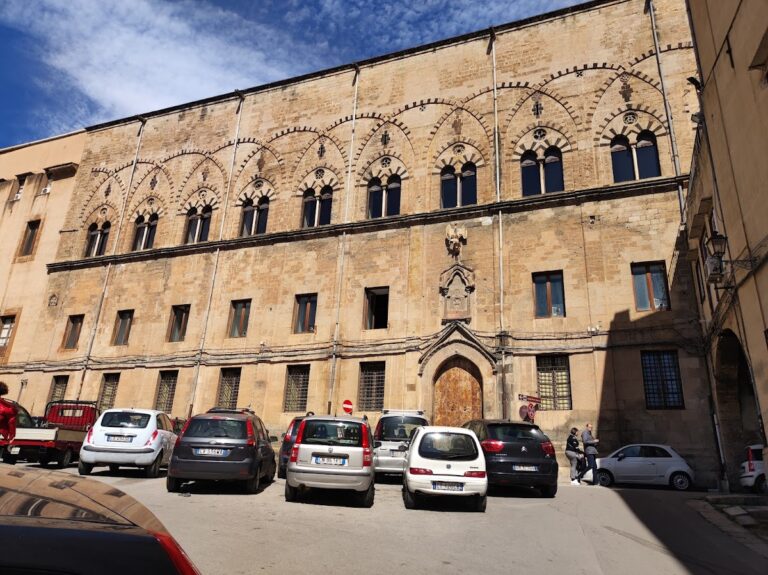
The main entrance opens onto Piazza Indipendenza, directly opposite the Palazzo dei Normanni. The present palace developed through successive lateral additions, the construction of a third storey, and later Orléans-period enlargement. The complex incorporated the Gerardi and Bentivegna buildings together with the Greco and Vitale houses. Its Orléans additions included the columned room, chapel, and cellars, while the former Bentivegna building was replaced in 1956 by the seven-storey administrative building for the regional presidency.
Parco d’Orléans
The palace estate included land known as the Fossa della Garofala. Following earlier planting associated with the Prince of Aci, the grounds were enlarged into the former palace garden, now called Parco d’Orléans. The extensive garden adjoining the palace contains Ficus magnolioides with aerial roots, exotic animals, and an ornithological zoo. It was opened to the public on 5 November 1955 during the presidential visit of Giovanni Gronchi.