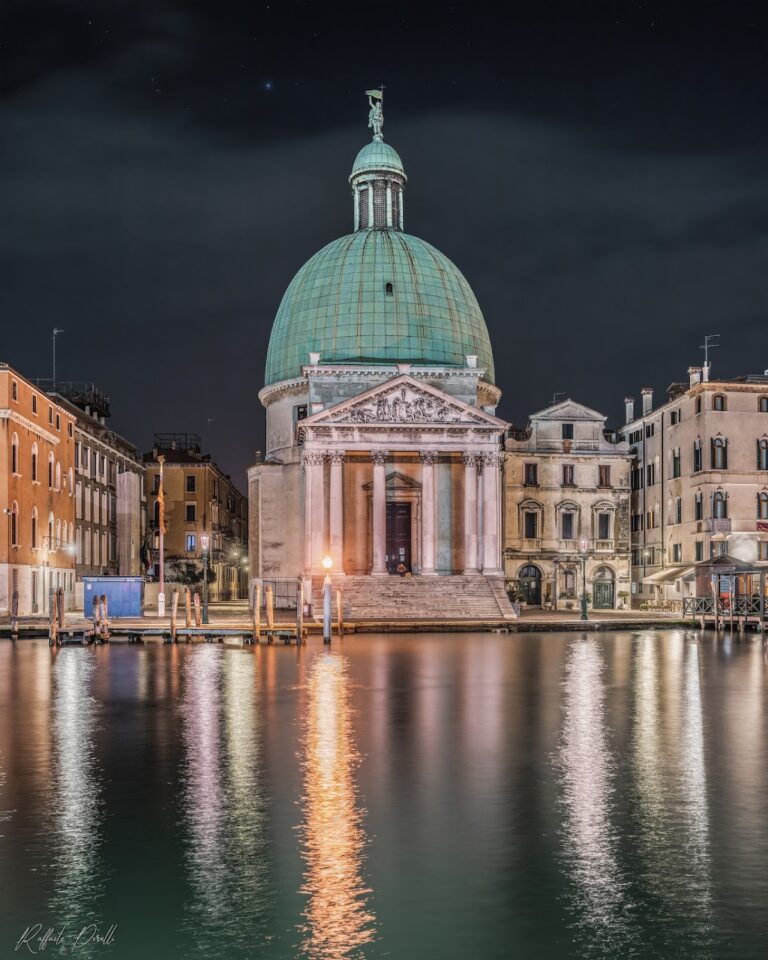
Chiesa di San Simeone profeta: A Historic Parish Church in Venice


Site at a Glance
- Rating
- 3.7
- Popularity
- Very Low
- Country
- Italy
- Primary era
- Early Modern
- Eras represented
- Medieval, Early Modern, Modern
- Civilizations
- Italian, Venetian
- Site type
- Religious
- Remains
- Church
On this page11 sections
History
Chiesa di San Simeone profeta, also known as San Simeone Grande, is a Roman Catholic parish church in Venice, Italy, dedicated to Saint Simeon the God-Receiver, the elderly figure in Christian Gospel tradition who recognized the infant Jesus at the Temple in Jerusalem. Probably founded in 967 with the support of the Ghisi, Adoldi, and Briosi families, it began as a modest wooden-and-thatch building for local fishermen, vegetable growers, and other residents.
Foundation and medieval rebuilding
The first documented reference to the church dates from 1073. A destructive fire in 1150 led to its reconstruction in stone, and it probably became a parish church during the same period. Further rebuilding took place in the thirteenth century. In 1301, the original thatched roof was replaced by a tiled one, marking another stage in the building’s early development.
Until 1807, San Simeone Profeta also held collegiate status. Its administration was entrusted to a chapter made up of two titular priests, a deacon, a subdeacon, and two acolytes. This arrangement gave the church an institutional role beyond the ordinary organization of a parish.
Alterations from the seventeenth to the eighteenth century
The church’s floor was probably raised after a victim of the 1630 plague was buried inside the building. City authorities ordered a new floor to be laid over the earlier one. During restoration work in the nineteenth century, the older floor was uncovered and found intact beneath the later surface.
In the early eighteenth century, a restoration directed by Domenico Margutti developed into a substantial reconstruction. The work altered the church’s earlier appearance but retained much ancient material, including the columns in the nave. Further interior restoration followed between 1750 and 1755. In 1755, Giorgio Massari designed and built a chapel, then received a commission to continue the modernization and provide a new facade.
Parish changes and modern restoration
Napoleonic legislation suppressed the parish in 1807, turning the church into a filial church of nearby San Simeone Piccolo. A filial church functions under the authority of another parish. In 1810, the arrangement was reversed: San Simeone Profeta recovered its parish status and former parish district, while San Simeone Piccolo became its filial church. From 1807 onward, the church was administered by a parish priest appointed by the patriarch.
Extensive alterations in 1861 remodeled both the facade and the interior so thoroughly that the church practically lost its historical value. Further restoration took place in 2015 and 2016. San Simeone Profeta remains an active parish church.
Remains
Plan and exterior
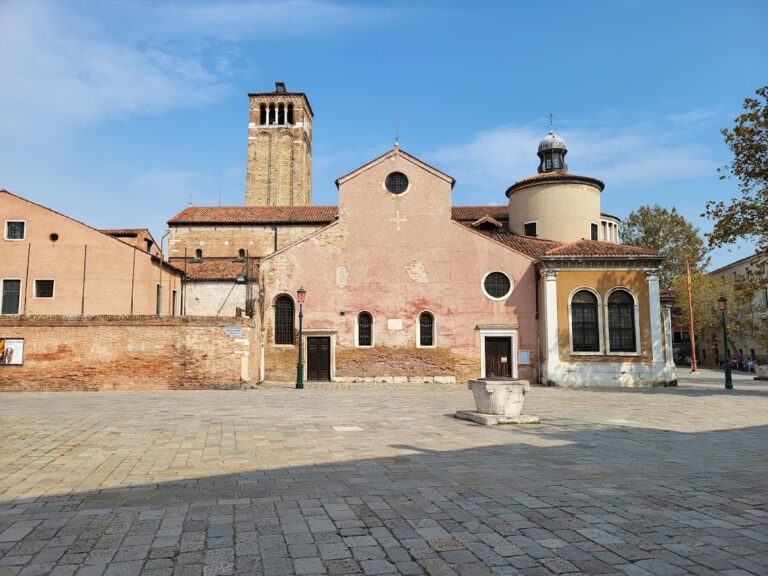
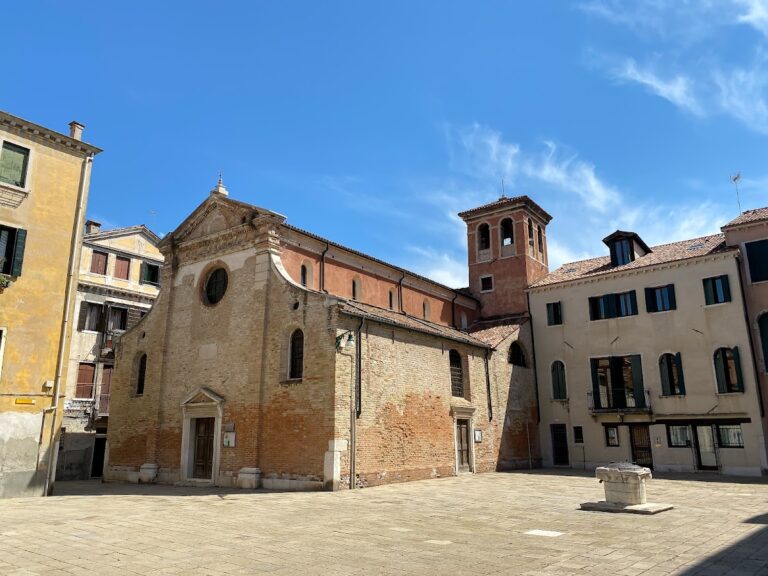
The church is built of stone and follows a basilican plan, an elongated arrangement with a central nave flanked by lower side aisles. The right nave was widened in the eighteenth century, while the central and left naves retain their original proportions. Buildings surround the church except around the facade, the apses, and the south side, which faces an interior garden.
North portico
A long portico extends along the north, or left, side of the church, with houses rising above it. The portico has preserved its original appearance over the centuries. Its widely spaced stone columns and architraves, the horizontal elements carried by the columns, remain well preserved.
Facade and campanile
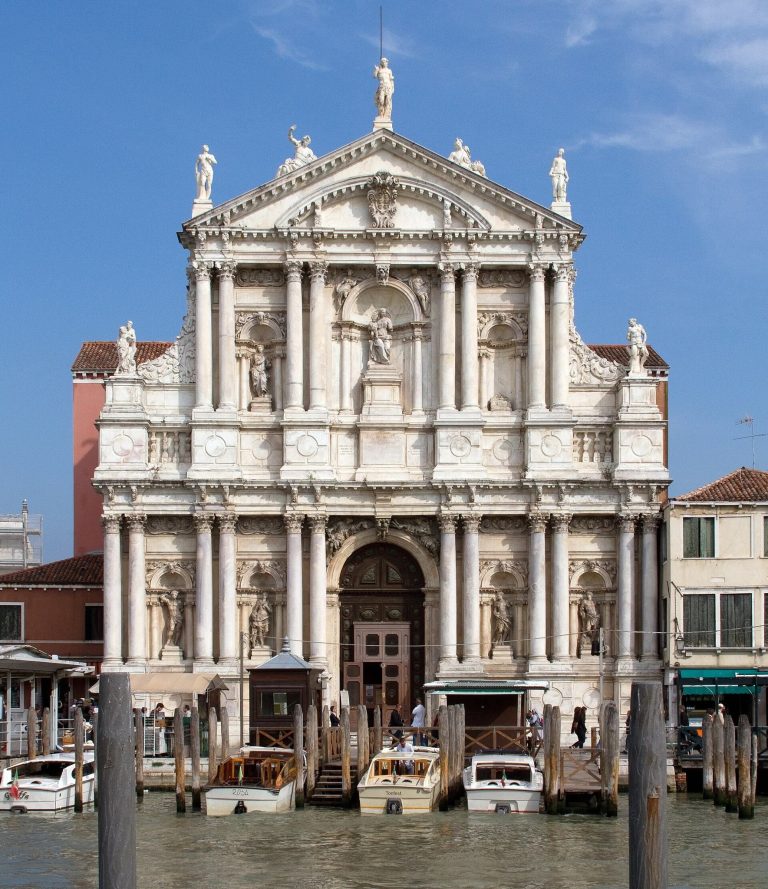
The present facade dates from the 1861 rebuilding and is Neoclassical. Two Corinthian half-columns on high plinths divide it into three vertical sections, while a triangular pediment crowns the composition. The central section contains a tall portal framed by two slabs of Istrian stone, with two arched windows above.
The sixteenth-century apses end in flat walls pierced by large thermal windows, meaning large windows with semicircular heads. To the left of the facade stands the eighteenth-century campanile, or bell tower. It is 23 metres high and has manually operated bells. A plan made in 1500 by Jacopo de Barbari, a Venetian Renaissance painter and mapmaker, shows an earlier campanile that was larger and taller.
De Barbari’s plan depicts a rectangular building with a simple pointed gable roof and the same orientation as the present church. The drawing may suggest that the earlier structure had a single nave. The current three-nave arrangement, together with the survival of ancient columns reused in later rebuilding, instead suggests that the original church was probably basilican.
Interior and furnishings
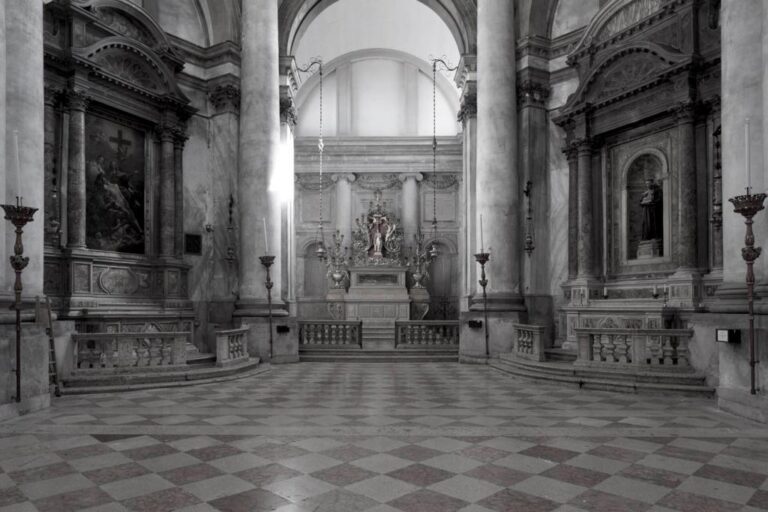
Inside, ancient columns with Byzantine capitals separate the three naves. Eighteenth-century stucco decoration, cornices, and statues give the irregular interior a unified appearance. The central nave is covered by a cross vault. The main altar is a simple altar table with a marble antependium, the decorative facing on the front of an altar.
Sculpture and chapel decoration
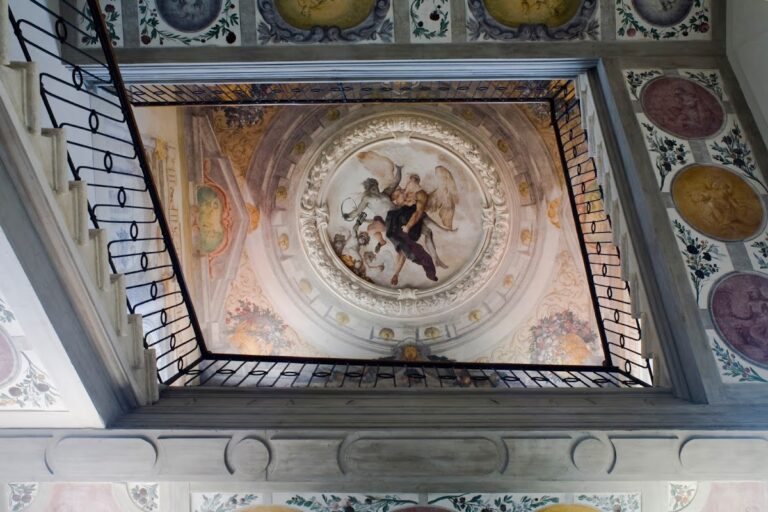
Statues of the Twelve Apostles stand above the nave columns. Dating from the early seventeenth century, they are works by Francesco Terilli. Behind the main altar is a polychrome, gilded stucco statue of the Madonna and Child, attributed to a fifteenth-century Tuscan school. The vault of the chapel to the right of the presbytery retains part of a fresco probably painted in the eighteenth century.
Paintings and tomb sculpture
On the wall of the right nave, beside the entrance, is Jacopo Palma the Younger’s Presentation at the Temple with Donors. The second altar of the left nave contains Jacopo Tintoretto’s Last Supper, dated 1560. These paintings remain among the principal works associated with the church’s interior.
An effigy attributed to Marco Romano stands above the tomb of Blessed Simeon in the right aisle. The identification is based on an inscription dated 1317. The sacristy contains a Holy Trinity attributed to Giovanni Mansueti. An Annunciation once attributed to Palma the Younger is now recognized as a work by the painter Blanc.