Capuchin Catacombs of Palermo: An Underground Burial Complex
Site at a Glance
- Popularity
- Very High
- Country
- Italy
- Primary era
- Early Modern
- Eras represented
- Early Modern, Modern
- Civilizations
- Italian, Kingdom of Sicily, Spanish
- Site type
- Burial
- Remains
- Catacomb
On this page18 sections
History
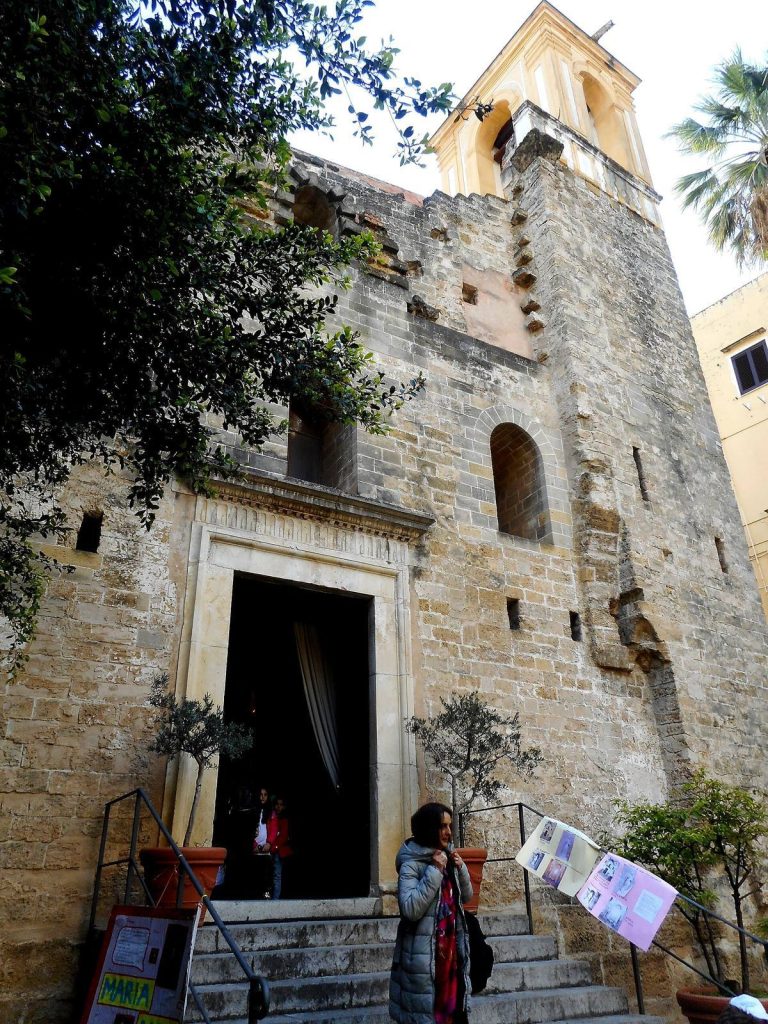
The Capuchin Catacombs of Palermo are an underground burial complex beneath the Capuchin monastery in Palermo, Italy. Capuchin friars, a branch of the Franciscan order, began the crypts in the late sixteenth century, and the first burial took place in 1599. The complex grew into a burial place for monks, clergy, benefactors, and lay families, and later inspired similar underground Capuchin burial crypts in Sicilian towns.
Origins and expansion
The monastery’s original cemetery could no longer accommodate its dead, so the monks excavated burial chambers beneath the church. Brother Silvestro of Gubbio was buried there in 1599. The remains of several monks who had died earlier were subsequently transferred to the crypts. As the burial space filled, the Capuchins extended it with more passages and chambers. The monks’ corridor continued in use from 1599 to 1871, when Brother Riccardo became the last friar buried there.
A wider burial community
The catacombs later received the monastery’s benefactors and other lay people. Until 1739, permission for burial was given by the archbishops of Palermo or Capuchin leaders; after that, the monastery’s abbots granted it. Burial there became prestigious among the city’s clergy, aristocratic families, and bourgeoisie during the eighteenth and nineteenth centuries.
Burial arrangements could reflect both status and personal wishes. Families might choose the clothing in which a person was buried, and some changed a relative’s clothes over time. Relatives came to pray and tend to the appearance of the remains. Their donations helped maintain the catacombs. A body could be moved from a temporary resting place to a permanent one, or set aside if payments stopped.
Preservation and burial rules
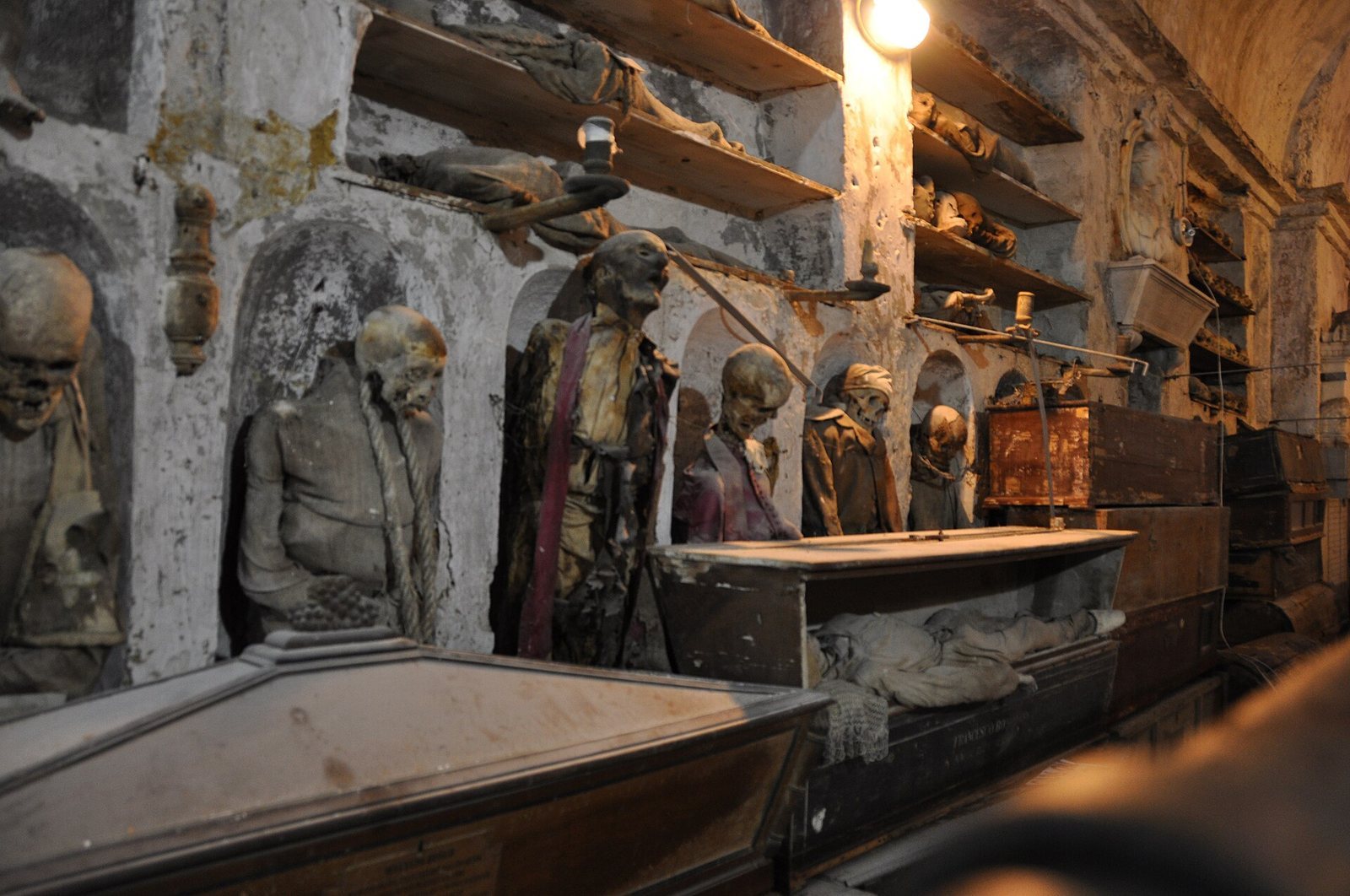
The soil and air in the catacombs slowed decomposition. One principal method of preservation was to dry bodies in special chambers for about eight months, then wash them with vinegar and dress them. Some bodies were embalmed. During epidemics, people also used diluted lime or solutions containing arsenic to treat the remains.
In 1837, open display of bodies was prohibited. The rule was sometimes evaded by removing a side of a coffin or leaving a viewing window. The catacombs officially closed to new burials in 1880, though exceptional interments continued. The last was Giovanni Licata di Baucina, Count of Isnello, in 1939.
Those buried there included spiritual writer Alessio Narbone; Filippo d’Austria, a Christian convert formerly known as Ayala and a son of the ruler of Tunis; and Vincenzo Agati, who died in 1731. Giuseppe Grimau, who held the office of president of the kingdom, was buried in 1755, followed by judge Vincenzo Natoli in 1770. Later interments included painter Giuseppe Velasco, in 1827.
Rosalia Lombardo was among the later burials. She died on 6 December 1920, aged two. Alfredo Salafia, an embalmer, preserved her body with an injected solution containing formalin, alcohol, glycerin, salicylic acid, and zinc salts. Salafia’s diary gives the proportions as equal parts glycerin, formalin saturated with zinc salts, and alcohol solution saturated with salicylic acid. He injected the mixture under pressure into an artery. When further deterioration became a concern, Rosalia’s remains were moved to a drier part of the catacombs and placed in a sealed glass case containing nitrogen.
Literary responses
The Italian poet Ippolito Pindemonte visited the catacombs on 2 November 1777. His poem Sepulchres treated them as a meditation on life’s triumph over death and belief in resurrection. The French writer Guy de Maupassant described the remains in very different, horrified terms in his 1890 travel writing.
Damage and modern study
Allied bombing in 1943 damaged remains in the women’s corridor and destroyed protective barriers there. The bombing of 11 March also destroyed many coffins in the New Corridor. A fire in 1966 destroyed further coffins in that corridor.
The Sicily Mummy Project began in 2007 to study the preserved people and build profiles of them. Led by anthropologist Dario Piombino-Mascali, the project has used X-rays, CT scans, and anthropological analysis, with recent work focused on identifying children. Forensic biologist Mark Benecke identified insects that help explain the mummification process.
Remains
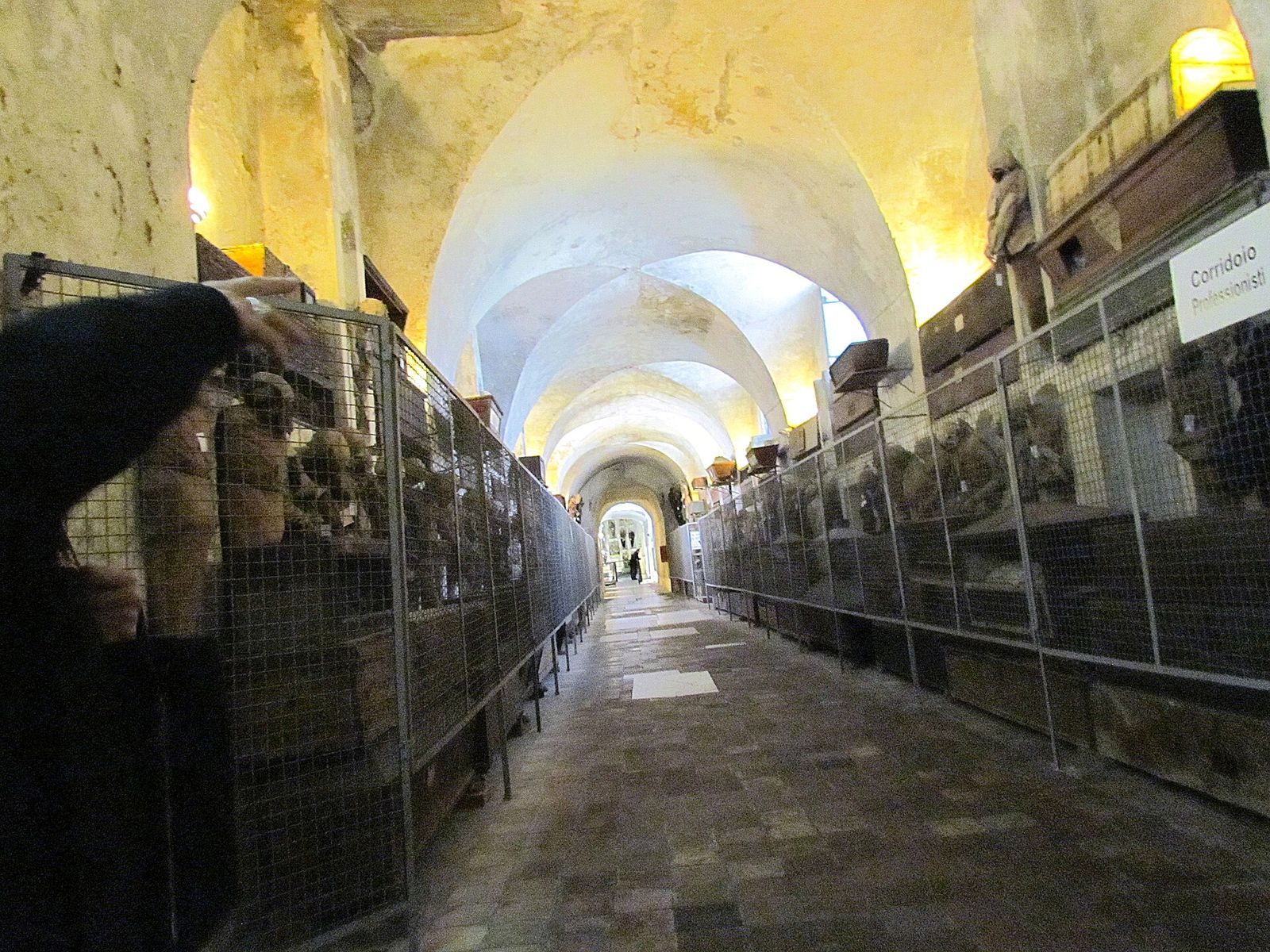
The catacombs lie beneath the monastery, outside Palermo’s historic centre. Their plan forms a rectangle with an additional priests’ corridor running parallel to one of its shorter sides. The four principal corridors are those of the monks, men, women, and professionals. Small chambers occupy points where corridors meet, and another chamber is associated with Rosalia Lombardo. The original entrance was from the monastery church above; an entrance directly from Piazza Cappuccini opened in 1944. Grilles close off dead-end passages and chambers.
Corridors
Monks’ corridor
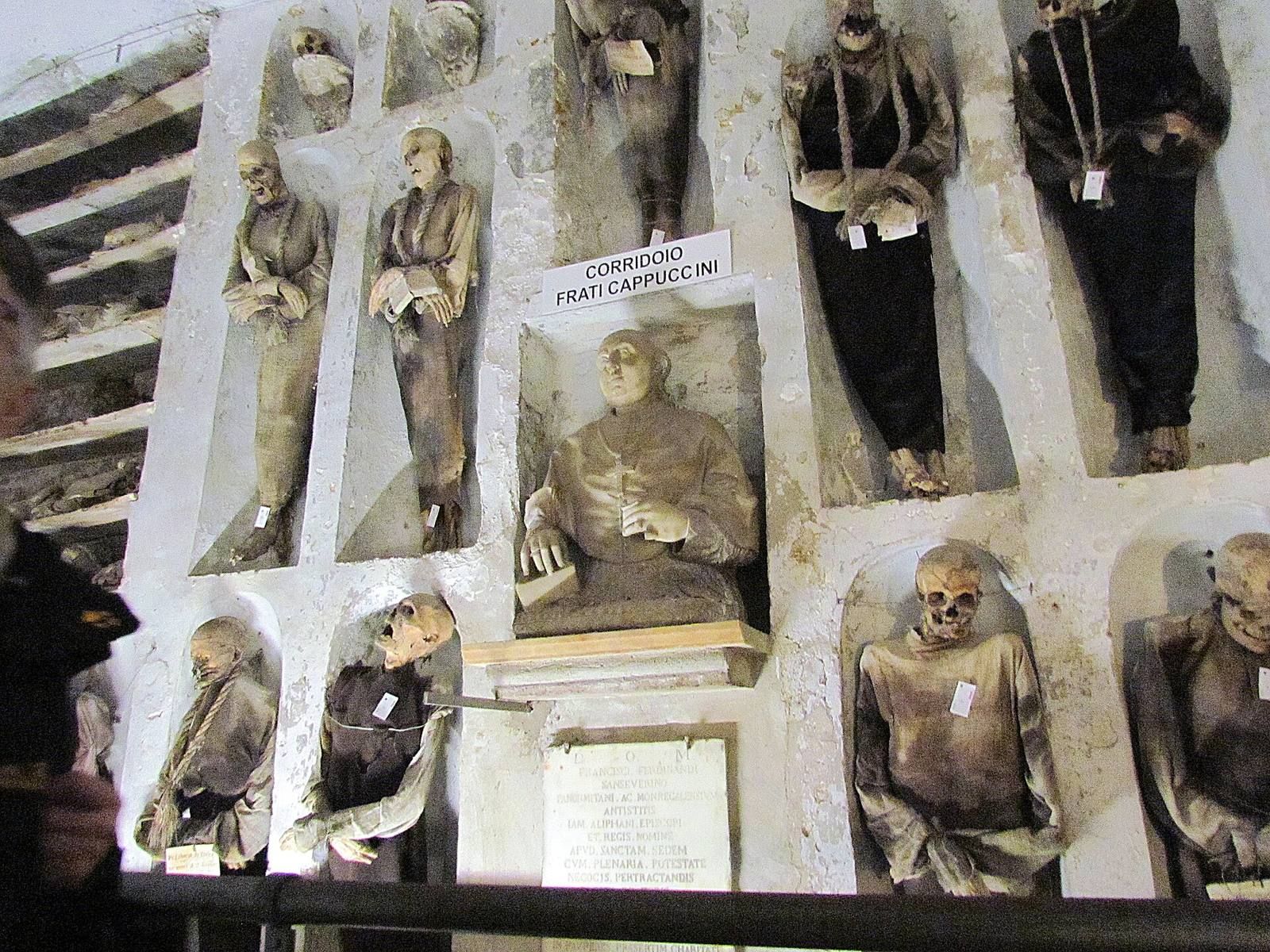
The monks’ corridor is the oldest part of the complex. Its section to the right of the present entrance contains the remains of 40 especially revered monks. On the left are Silvestro of Gubbio, the first person buried in the catacombs, and Riccardo of Palermo, the last Capuchin friar interred there. The monks wear the order’s coarse hooded robe and a cord around the neck.
Men’s corridor
Running along one of the rectangle’s longer sides, the men’s corridor holds male lay benefactors buried during the eighteenth and nineteenth centuries. Their clothing ranges from simple shrouds to formal suits, shirts, neckwear, and other garments.
Women’s corridor
The women’s corridor forms one of the shorter sides of the plan. Most of the remains lie in separate horizontal wall niches, while a smaller number of better-preserved bodies are displayed upright. Their clothing includes eighteenth- and nineteenth-century silk dresses with lace and flounces, as well as hats and caps. Wooden grilles and glass panels once protected the niches. The surviving remains and protective barriers show the damage sustained in this part of the catacombs.
Professionals’ corridor
This corridor runs parallel to the men’s and holds professors, lawyers, artists, sculptors, and professional soldiers. Among those identified are sculptors Filippo Pennino and Lorenzo Marabitti, surgeon Salvatore Manzella, and Colonel Giulio Ascanio Enea, whose military uniform remains exceptionally well preserved. Alexandre Michaud de Beauretour, a Piedmontese general and military adviser who died in 1841, has a tomb in the floor. A local tradition identifies a body in this corridor as the Spanish painter Diego Velázquez, an identification that some researchers accept and others reject.
Priests’ corridor
The priests’ corridor contains clergy from the Diocese of Palermo, the area administered by the local bishop. They wear liturgical vestments, garments used by clergy during worship, in a range of colours. A separate niche holds Bishop Agostino Franco, the only prelate, or senior church official, buried in the catacombs.
New Corridor
Used after the 1837 prohibition on displaying bodies openly, the New Corridor has no wall niches. Coffins were added gradually between 1837 and 1882. Many were lost, while the surviving coffins are arranged in rows along the walls, leaving the majolica floor visible through the centre. Majolica is decorated, glazed earthenware. Some coffins form family groupings, with parents displayed alongside their adolescent children.
Junction chambers and chapel
Children’s chamber
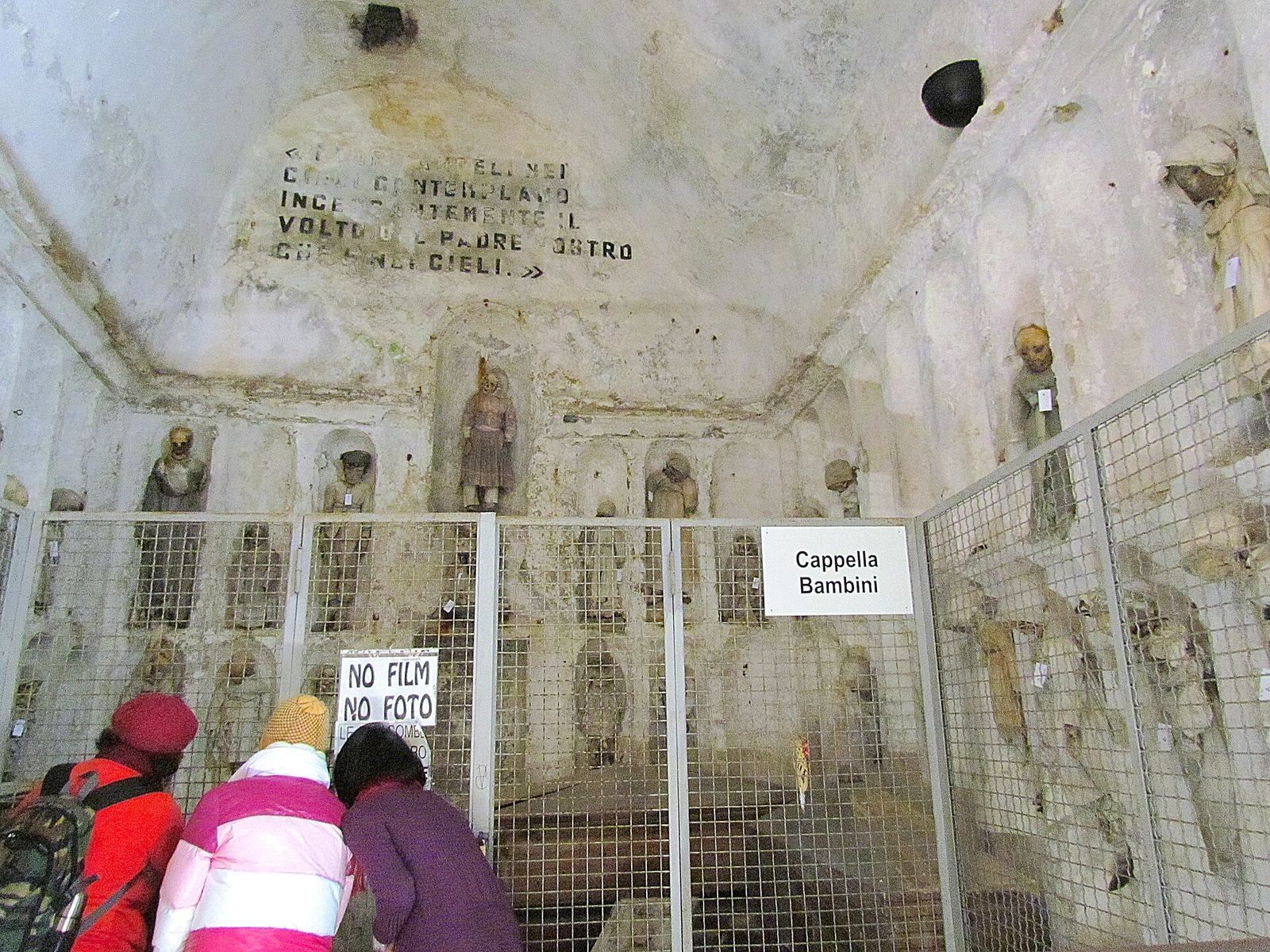
The children’s chamber lies at the meeting of the men’s and priests’ corridors. It holds the remains of several dozen children in coffins or wall niches. In the central niche, a boy sits in a child’s rocking chair holding his younger sister.
Girls’ and unmarried women’s chamber
A small chamber where the women’s and professionals’ corridors meet was reserved for girls and unmarried women. Around ten bodies lie or stand beside a wooden cross bearing an inscription from Revelation 14:4. Metal circlets on the girls’ heads represent virginity.
Rosalia Lombardo’s chapel
The chapel associated with Rosalia Lombardo was dedicated to Our Lady of Sorrows until 1866. This title for Mary recalls her grief at the suffering and death of Jesus. Rosalia’s body lies in a glass coffin at the centre of the chapel. An adjoining chamber contains other well-preserved bodies, including a young man with bright red hair, priests, and Giovanni Paterniti. Paterniti, buried in 1911, was a United States vice-consul and the only U.S. citizen buried in the catacombs.