San Gaetano Church: A Late Renaissance and Baroque Church in Padua


Site at a Glance
- Rating
- 4.8
- Popularity
- Low
- Country
- Italy
- Primary era
- Early Modern
- External website
- Open
- Eras represented
- Early Modern
- Civilizations
- Venetian
- Site type
- Religious
- Remains
- Church
On this page19 sections
History
San Gaetano Church is a Roman Catholic church in Padua, Italy, rebuilt in the late Renaissance and Mannerist period by the Theatines after originating as a twelfth-century church of the Umiliati order. Formally dedicated to the Apostles Simon and Jude, it became closely associated with Saint Cajetan of Thiene, the sixteenth-century religious reformer and co-founder of the Theatine order.
From the Umiliati to the Theatines
The medieval church served an Umiliati convent and was also known as San Francesco Piccolo. In 1571, Pope Pius V suppressed the Umiliati order. Bishop Nicolò Ormaneto then transferred the church and convent buildings to the Theatines, a Catholic order of regular clerics founded by Saint Cajetan and Bishop Gian Pietro Carafa, later Pope Paul IV.
Between 1578 and 1581, the Theatines acquired adjoining properties and began rebuilding the complex. Through the mediation of Bishop Federico Cornaro, they commissioned Vincenzo Scamozzi, a major late Renaissance architect and architectural theorist, to design a new church and convent organized around a square module and a cloister. Much of the earlier complex, possibly Gothic in character, was demolished. The foundations of the new church were begun in 1582 despite persistent Roman ruins and difficult ground conditions, with financial support from the prelate Alvise Cornaro.
The building was completed in 1585, formally delivered in 1586, and consecrated on 23 October 1588 by Antonio Gianotti, Bishop of Urbino. It retained its official dedication to Saints Simon and Jude, although the name of Saint Cajetan was already dominant in popular usage. The church and convent subsequently received substantial bequests from the Venetian patriciate, helping to transform the building’s appearance and furnishings.
Expansion and Baroque enrichment
Following the beatification of the Theatine father Andrea Avellino in 1629, the complex was enlarged. A large sacristy was built to the west, and the Oratory of the Crucifix was added beside the facade and connected to the nave by a stairway. The number of altars rose from three to five, while the later additions partly obscured Scamozzi’s original facade design.
Raffaele Savonarola, provost of the convent from 1692 to 1730, directed an extensive campaign of Baroque enrichment influenced by the Theatine church of San Gaetano in Munich, whose construction he had personally observed. Marble and painted decoration were added throughout the Mannerist interior. The work included a new main altar and floors, three altars in the Crucifix chapel, and improvements to the sacristy, including furnishings, an altar, and two choir galleries. Guy Louis II Vernansal completed the great Paradise fresco in 1729.
After 1739, construction produced a new Rococo bell tower, while work continued on the convent and cloister. These building campaigns also provided economic assistance to residents of Padua. The convent hosted notable guests, including the Theatine theologian, physicist, and astronomer Giuseppe Ballo.
Parish church and later changes
Napoleonic ecclesiastical legislation removed the church and convent from Theatine control in 1810. The church became a parish church in 1816, taking over the parish from San Bartolomeo, and later came under the parish of Santa Sofia. The former convent became the Imperial Royal Court of Justice after 1844, replacing the Palazzo della Ragione. A proposal to close the church and convert it into a courtroom for the Court of Assizes was not carried out.
The choir vaults were restored in 1825 at the expense of Duke Silvestro Camerini. A severe fire on 12 February 1929 badly damaged the former convent but caused only slight damage to the church. Later repairs included work on the roofs, and Bishop Carlo Agostini consecrated the main altar on 18 April 1942. Further intermittent repairs followed, particularly after the church became a rectory dependent on Santa Sofia.
The former convent has since been restored and converted into the Altinate/San Gaetano Cultural Center. A major restoration campaign addressed the church facade, side elevations, bell tower, dome, and interior vault, while cleaning of the marble and restoration of the statues and paintings remained planned or incomplete. The church is an Italian cultural property and remains a rectory dependent on Santa Sofia.
Several burials connect the church with Padua’s ecclesiastical history. Marco Antonio Martinengo, Bishop of Torcello, and Giovanni Dotto, archpriest of the cathedral, who died on 12 August 1797, were buried there. Martinengo also donated six paintings to the church in 1628.
Remains
Facade and principal interior
Facade and exterior
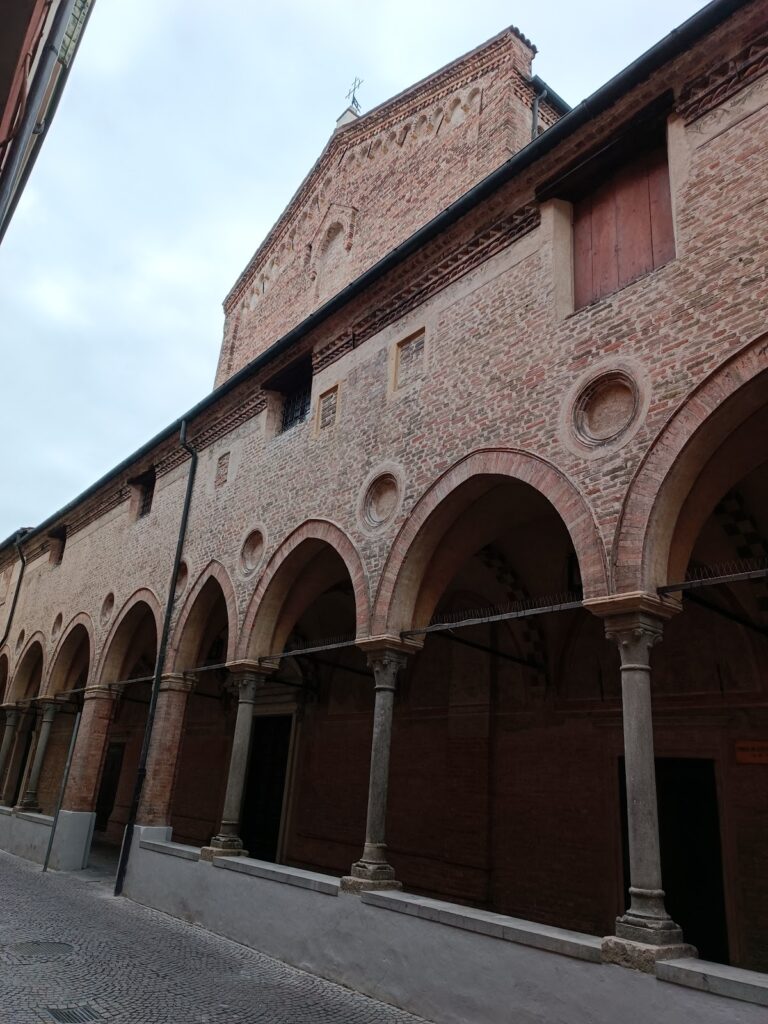
The church faces south toward Via Altinate and stands on the approach to the former Altinate gate. Its facade combines late Renaissance and Mannerist design with later changes. Built in brick, stone, terracotta, and plaster, it rises on a three-step crepidoma, a stepped classical base. Six giant Corinthian pilasters, whose capitals are decorated with acanthus leaves, support the entablature, cornice, and tall attic.
The attic contains a Palladian-style window and a false clerestory. Its elaborate capitals are molded in terracotta. An inscription in the central bay refers to the restoration of the church from its foundations in 1586 and appears with the emblem of the Theatines. The main portal has a curved pediment supporting two representations of virtues. The two smaller portals have triangular pediments, and reliefs above them depict the martyrdoms of Saints Simon and Jude. Two tapered windows rise above the reliefs, while two superimposed niches at each end of the facade hold life-size statues of the titular saints, Saint Cajetan, and Andrea Avellino. The wooden doors date from the sixteenth century.
A small decorated structure extends along the right side of the facade and has been interpreted by some as the base of an unfinished bell tower. The side elevations display elaborate exposed brickwork, minor chapels with lanterns, and thermal windows. Gothic elements near the large sacristy may belong to the earlier medieval church and may have been incorporated into the later building.
Bell tower and dome
The Rococo bell tower stands to the west. It is plastered and decorated with Corinthian elements, then crowned by a balustrade. Four single-arched openings, one on each corresponding side, open into the bell chamber.
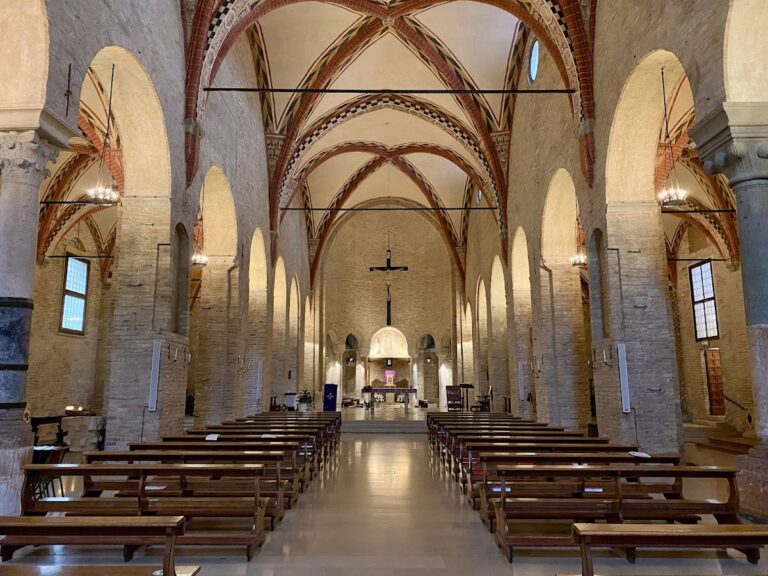
The church interior is organized around an octagonal hall continuous with the facade and articulated by the Corinthian order. Its umbrella dome, a dome with ribs radiating from the center, rises above the entablature. The ribs converge on a central oculus and divide the painted surface into groups of saints. The present roof scheme includes metal sheeting over the dome.
Polychrome marble covers the hall’s pilasters. Eight pilasters are treated with elegant interruptions and end in gilded capitals. Niches on the four shorter sides contain seven hard-stucco statues by Ruggero Bescapè, representing Saints Paul, John the Baptist, Andrew, John, Thomas, James the Greater, and Matthew. Bescapè also created the stucco decoration and allegorical figures above the arches.
Paintings and sculpture in the hall
Four large canvases beneath the entablature depict episodes from the life of Christ. They include Jacopo Palma the Younger’s Annunciation of 1610, Jesus Saving Peter and the Apostles, attributed to Alessandro Maganza, a Nativity from the school of Annibale da Bassano, and Dario Varotari’s Deposition.
Six canvases in curved marble frames were donated by Marcantonio Martinengo, Bishop of Torcello, in 1628. They depict Saint Cajetan, Andrea Avellino, and Padua’s patron saints Anthony, Prosdocimus, Daniel, and Justina. Sixteen additional canvases between the pilasters represent Saint Jude Thaddeus, Saint Simon, Frances of Rome, Clare, Augustine, Michael the Archangel, Catherine of Siena, Francis of Assisi, Louis of France, Apollonia, Agatha, Francis of Paola, Nicholas of Tolentino, Mary Magdalene, Lucy, and Scholastica.
Near the left side of the main chapel is a three-dimensional Madonna and Child carved in the soft stone of Nanto by Andrea Briosco. The sculpture originally came from the Umiliati church.
Paradise fresco
The entire vault of the dome is covered by Guy Louis II Vernansal’s Paradise, completed in 1729. Designed as a monumental trompe-l’oeil, an illusion that makes painted forms appear three-dimensional, the fresco presents a cloud-filled heaven populated by saints ascending toward the Trinity in the central oculus.
The dome ribs divide the composition into groups that include Old Testament figures, martyr saints, Padua’s patron saints, female martyrs, prophets, apostles, preachers of charity, Saints Simon and Jude, popes, bishops, confessors, Evangelists, penitents, the ecclesiastical hierarchy, confessors of the faith, Doctors of the Church, and saints associated with charity.
Main chapel and choir
Main chapel
The main chapel is a relatively small, vertically developed square space. Four arches support its dome and lantern, a small structure that crowns a dome. The presbytery, the area around the main altar traditionally reserved for the clergy, is raised above the nave by steps and enclosed by a marble balustrade.
The main arch rests on ornate brackets and carries the elaborate Cornaro coat of arms, surmounted by a gilded mitre decorated with hard stones. The Gospel and Epistle arches contain two lower choir galleries and two upper loggias. Hard-stucco high reliefs of the four Evangelists by Ruggero Bescapè occupy the pendentives, the curved triangular surfaces supporting the dome. Carlo Scapin painted the dome’s Martyrdoms of the Titular Saints. Beneath the arch separating the chapel from the choir stands the eighteenth-century main altar, made with contrasting marbles.
Choir
The rectangular choir ends in a wall articulated by three arches. Federico Zuccari’s Transfiguration occupies the central arch, while statues of Saints Jude and Simon stand in the two smaller arches. Sixteenth-century choir stalls are surmounted by four portraits of leading Theatines by Giovan Battista Pellizzari and by Zuccari’s Saints Simon and Jude Led to Martyrdom. Giovanni Battista Cromer painted the vaulted ceiling canvas Saint Andrea Avellino in Glory.
Minor chapels and Crucifix chapel
Chapel of the Madonna
The Chapel of the Madonna opens from the nave. Dario Varotari painted the Doctors of the Church, Ambrose, Augustine, Gregory the Great, and Jerome, in its pendentives. Its 1610 altarpiece, Jacopo Palma the Younger’s Presentation of Jesus in the Temple, is accompanied by Alessandro Maganza’s Adoration of the Magi and Dispute with the Doctors.
Chapel of Saint Cajetan
The Chapel of Saint Cajetan contains four virtues by Dario Varotari in its pendentives. Pietro Damini’s altarpiece depicts the Transfiguration with Saints Cajetan, Andrea Avellino, and Charles Borromeo. Giovanni Battista Bissoni’s 1622 canvas Saint Charles Borromeo Meets Clement VIII and Damini’s Saint Charles Borromeo Saving a Drowning Girl in the Ticino complete the chapel’s principal painted decoration.
Chapel of the Crucifix
The Chapel of the Crucifix, also called the Chapel of the Holy Sepulchre, is reached from the nave. Its floor lies below the church level because of its seventeenth-century enlargement. The original approximately rectangular vaulted space was expanded with three chapels containing altars and extensive marble decoration. The walls carry a long wooden bench beneath more than twenty canvases of varied sizes and shapes concerning the history of Christ. Works by Pietro Ricchi, Francesco Zanella, Carlo Scapin, and Matteo Ghidoni are particularly prominent. A small Flemish Crucifixion hangs above a blocked doorway.
The central altar bears Agostino Vannini’s strongly physical wooden Crucifix. A small tabernacle holds a relic of the True Cross, the cross traditionally identified with the crucifixion of Jesus. Its door is decorated with a late seventeenth-century Christ Carrying the Cross, above which appears a God the Father among Angels attributed to Giovanni Bonagrazia.
The right-hand altar of the Flagellation has marble representations of the instruments of Christ’s Passion. Its altarpiece, delivered around 1715, is Vernansal’s Flagellation of Christ, with a seventeenth-century Agonizing Christ above the arch. Another part of the chapel contains two successive altars. The end wall bears Giulio Cirello’s Deposition, while three lower canvases include Andrea Mantova’s Angels with the Shroud. Beneath the altar slab of the first altar is Bartolomeo Bellano’s wooden statue Christ Deposed.
The large chapel largely reflects the interventions promoted by Raffaele Savonarola between the seventeenth and eighteenth centuries. Its floor was replaced during the twentieth century, when the fresco Exaltation of the Cross was also completed. At the rear stands a monumental altar with a large pedimented retable, an ornamental structure behind an altar, supported by eight marble columns. A crowd of marble angels by the Bonazza family decorates it, while Michele Fabris’s wooden high-relief altarpiece depicts The Prayer in the Garden.
Niches beside the altar contain statues. Bartolomeo Bellano is represented by a marble low-relief Pietà and a polychrome terracotta Dolorous Virgin. Other works include an anonymous seventeenth-century Christ Risen and Marco Liberi’s Angels Holding Chains.
Paintings and furnishings of the Crucifix chapel
The east wall, toward the choir, contains two canvases by Pietro Damini dating to around 1625 and depicting the martyrdoms of Saints Simon and Jude. They formerly decorated the presbytery and were moved when the choir galleries were opened during Savonarola’s alterations. The same wall displays a Martyrdom of Saint Bartholomew attributed to Alessandro Zanchi, portraits of Theatines by Giovan Battista Pellizzari including the Blessed Giovanni Marinoni, and an eighteenth-century Immaculate Conception in an elaborate gilded Baroque frame.
The south wall contains a monumental Venetian cabinetmaker’s work whose internal architectural mechanism allowed the clergy to store personal liturgical linen. It also displays an Ecce Homo copied by Pietro Damini from Titian, Alessandro Maganza’s Pietà, and a Sorrowful Virgin attributed by some to Titian. The west wall has a large vestment cabinet above which hang an anonymous seventeenth-century Adoration of the Magi, Alessandro Zanchi’s Martyrdom of Saint Daniel, and Maganza’s Saint Catherine, shown among reliquary busts.
Sacristy and former organ
The large sacristy was added to the west during the seventeenth-century expansion. Its later improvements included furnishings, an altar, and two choir galleries. The church also contained a one-manual mechanical organ made by Francesco Dacci in 1750. Until 1975, it remained in San Gaetano; after adaptations, it was transferred to the parish church of Primolano, where it remains functional.