San Francesco: Baroque Church and Franciscan Convent in Biancavilla, Italy
Site at a Glance
- Popularity
- Very Low
- Country
- Italy
- Primary era
- Early Modern
- Eras represented
- Early Modern, Modern
- Civilizations
- Italian, Kingdom of Sicily, Spanish
- Site type
- Religious
- Remains
- Monastery
On this page12 sections
History
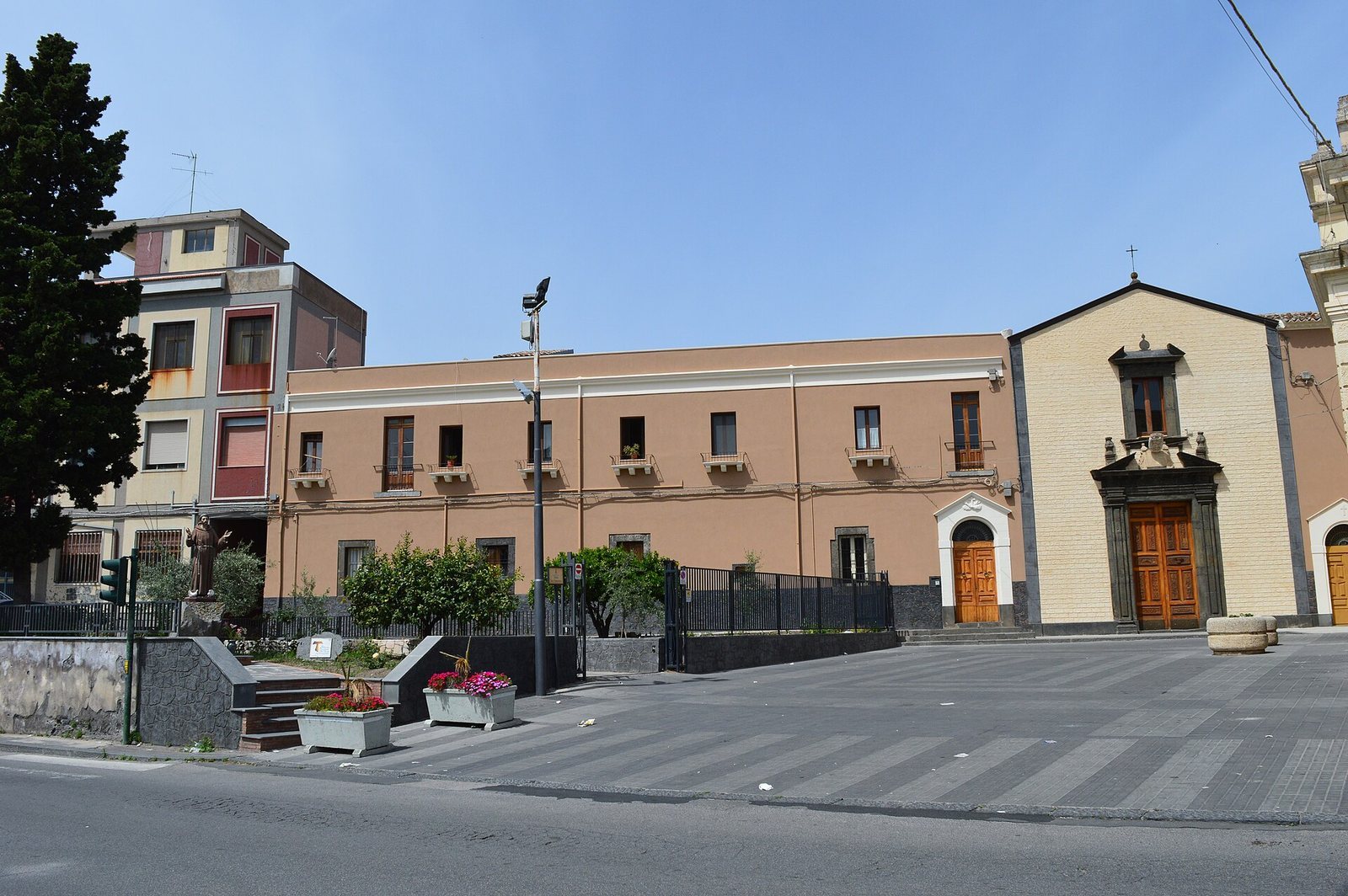
San Francesco is a Catholic church and Franciscan convent in Biancavilla, Italy, dedicated to Francis of Assisi, an Italian friar whose life and teaching inspired the Franciscan movement. The Baroque church and convent were built in 1686, with some work completed in 1692. The church is also dated to around 1700, was consecrated in 1699, and is recorded as complete in 1700. It is the only convent in Biancavilla and the only convent in the Sicilian Province of the Most Holy Name of Jesus dedicated to St Francis. The church belongs to the Archdiocese of Catania, a major territorial jurisdiction of the Catholic Church.
Suppression and return
In the years after Italian unification, the nineteenth-century process that established a unified Italian state, the convent was suppressed and used as a military barracks. In 1891, after about twenty years, it was returned to the friars under an emphyteutic lease, a long-term lease with continuing obligations. These included caring for the cemetery and providing its chaplaincy.
Franciscan community and observances
At different times, the convent has served as a formation house for novices, people undergoing religious training, and postulants preparing to enter an order. It has also hosted a regional center of the Secular Franciscan Order, an order for laypeople and secular clergy, and Franciscan Youth, a youth fraternity in the Franciscan tradition. Local fraternities of both organizations continue to share the convent with the Franciscan friars.
The community marks the Transitus, which commemorates the death of St Francis, and celebrates his feast. Its other observances include the Forty Hours devotion, a period of prayer and Eucharistic adoration, and feasts honoring St Paschal Baylon and St Anthony of Padua. St Paschal’s feast is preceded by a novena, nine days of prayer, and includes a Eucharistic procession in his honor.
Remains
Church
The Baroque church is arranged around a single main worship space, with three side altars along each wall and a high altar at the front. Its wooden entrance portal was crafted by Giuseppe Salamone at the commission of Friar Alessandro Bartolotta.
Nave and side altars
On the right, the altars hold an eighteenth-century marble statue of the Immaculate Virgin Mary, a wooden statue of St Francis dated 1929, and a late-eighteenth-century wooden statue of St Paschal Baylon, a Spanish Franciscan lay brother known for his devotion to the Eucharist. A painting of St Peter of Alcantara, a Spanish Franciscan friar and reformer, hangs on the same wall.
The left-hand altars hold a crucifix from the late seventeenth century, a painting of the Madonna of Carmel with Saints Ludovico, Agatha, Bonaventure, and Bernardino of Siena, and a twentieth-century statue of St Anthony of Padua. Olivio Sozzi painted the Madonna of Carmel work in 1759. It identifies Ludovico as a bishop; Agatha was an early Christian martyr, Bonaventure a Franciscan theologian and cardinal, and Bernardino a Franciscan preacher.
Presbytery and painted decoration
The presbytery, the area around the main altar, contains a marble high altar and a wooden tabernacle for the Eucharist. A marble ambo, or reading stand, made in 2015 bears a lion of Judah, an eight-pointed star, a cross, and a paschal lamb. It replaced Salamone’s wooden altar table, which remained in place until January 2015. Above the presbytery, a large canvas framed by four pillars depicts the Madonna of the Angels with Saints Francis, Clare, and Anthony of Padua. Clare was an early follower of Francis and founded the Poor Clares.
Sozzi’s 1759 ceiling fresco depicts the Assumption of the Virgin Mary with the Holy Trinity. Above the presbytery, Sebastiano Lo Monaco painted the Apotheosis of St Francis. An anonymous fresco on the vault above the entrance evokes the church’s consecration.
Convent and associated buildings
Sacristy
The sacristy, a room for clergy and church furnishings, adjoins the church and is reached through a finely made wooden door dated to around 1700. An old washing basin just inside is topped by a statue and bears an inscription meaning “Work in silence.” Windows on the right wall face the internal garden; that wall also has a recently built vestment cabinet. A built-in wardrobe on the left stores priests’ garments, while a large wooden wardrobe stands against the central wall.
The central wardrobe holds finely worked gold chasubles, embroidered albs, gold altar cloths, ciboria, patens, chalices, copes, older vestments, and altar linens. Some of the cloths and linens were made by women involved in the Secular Franciscan Order and by Franciscan tertiaries, lay members of the Franciscan Third Order.
Enclosed quarters and library
Stairs near the sacristy and the courtyard entrance lead to the convent’s enclosed quarters. They include rooms for friars and guests, a modern library with recent books, and an older library or archive with valuable books. Paintings along the corridors incorporate canopies, stoles, the narrow vestments worn by clergy, and framed altar cards bearing liturgical texts.
Cloister
The cloister is a covered walk around an enclosed courtyard. Frescoes by Giuseppe Tamo da Brescia fill its semicircular panels beneath arches, depicting episodes from the life of St Francis, Franciscan saints, and events associated with the order. Several rooms are used for catechesis and activities of the Secular Franciscan Order and Franciscan Youth. A statue of St Clare was placed in a disused basin at the courtyard’s center on 8 December 2019.
The church façade was renewed in 2015. The cloister frescoes were restored in 2017, followed by a comprehensive renovation of the cloister in 2018–19. The crucifix in the church was restored in 2018.
Adjoining building
An adjoining building constructed in the 1960s first served as a Franciscan seminary. It later housed an institute for industry and handicrafts until 2014; its rooms are now used for children’s catechesis and other activities. A large basement hall called La Corrida has a stage and formerly functioned as a theater, with performances held on Sundays from December to April.