Castello Normanno: A Norman Donjon and Archaeological Museum in Adrano


Site at a Glance
- Rating
- 4.5
- Popularity
- Low
- Country
- Italy
- Primary era
- Medieval
- External website
- Open
- Eras represented
- Medieval, Early Modern
- Civilizations
- Crown of Aragon, Kingdom of Sicily, Norman
- Site type
- Military
- Remains
- Castle
On this page12 sections
History
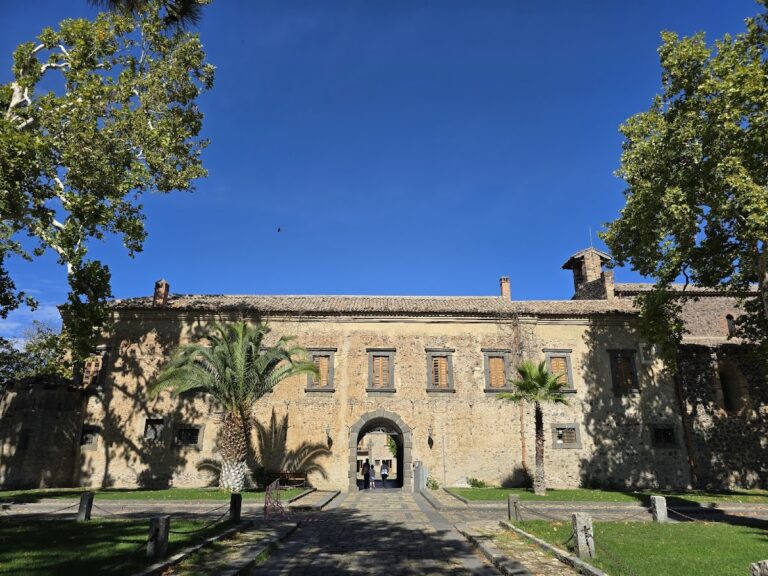
Castello Normanno is an eleventh-century medieval donjon in Adrano, Italy, built by the Normans in the tradition of Anglo-Norman keep architecture. Roger I of Sicily commissioned its construction after 1073. Along with comparable castles at Paternò and Motta Sant’Anastasia, it belonged to a defensive system that controlled the Simeto Valley, approaches to Troina, Regalbuto, and Randazzo, and access toward Catania. Its position was also connected with the nearby Ponte dei Saraceni, in a valley along the southern flank of Mount Etna.
Norman foundation and strategic role
Roger I was a Norman ruler from the Hauteville dynasty, whose members conquered and governed territories in southern Italy and Sicily during the late eleventh century. The castle’s donjon, the principal fortified tower of a medieval castle, combined defensive and residential purposes. Its position gave the Norman authorities a strong point from which to oversee movement through the valley and the routes leading toward important inland settlements and Catania.
Aragonese expansion
The castle was altered under Aragonese rule, the period when the Crown of Aragon controlled the Kingdom of Sicily. Giovanni Tommaso Moncada, a fifteenth-century nobleman of the Moncada family, is credited with expanding the original donjon into its later form. The enlarged complex was enclosed by a bastion, a projecting defensive structure, with four angular lookout towers.
The Moncada family held Adrano and occupied the castle for approximately a century, when the building also provided a setting for court life. Ownership later passed among several Sicilian dynasties, including the Moncada, Peralta, and Sclafani families. From 1754 to 1797 the castle belonged to the counts Alvarez of Toledo. In 1797 Luigi Moncada Ventimiglia Aragona, ninth prince of Paternò and a Grandee of Spain, took possession. The Moncada Ventimiglia family retained ownership until 1920.
Damage, reuse, and museum history
The upper floors fell into disrepair from the seventeenth century. The earthquake of 1693 destroyed the internal walls and attached structures, leaving the exterior walls standing. After repairs, the ground floor was again used as a prison during the eighteenth century, but the castle later lost that function.
Since 1959, Castello Normanno has housed the Saro Franco Regional Archaeological Museum. Administered by the Sicilian Region, the museum has been part of the regional hub known since 2019 as the Archaeological and Landscape Park of Catania and the Aci Valley. The castle is recognized as Italian national heritage. Its collections extend from the Neolithic period, approximately 6500–3500 BC, to the medieval period, including the eleventh century AD.
The museum also preserves material from the ancient cities of Mendolito and Adranon. Adranon was founded by Dionysius of Syracuse, ruler of Syracuse in the late fifth and early fourth centuries BC, around 400 BC. The ancient city stood on the remains of which modern Adrano developed. The complex additionally contains the Sangiorgio Gualtieri art gallery, a picture gallery, an archive, an historical archive, an ethnographic and anthropological collection, library holdings including the Imbarrato collection, and numismatic collections.
Remains
Tower and defensive complex
The surviving principal tower is rectangular, measuring 20 metres along its long side and 16.70 metres along its short side. It rises 34 metres and is arranged over six levels. The ground floor contains two rooms, each divided into three bays. A longitudinal wall separates them and incorporates the staircase to the first floor. Two large halls occupy the first floor, where a pointed arch opens onto the stairway leading upward. The second and third floors are each divided into two areas by internal walls.
Second-floor chapel
Around 1500, the southern room on the second floor was divided to form a rectangular chapel. Its apse, the rounded termination of the room, and its double ribbed cross vault, a vaulted ceiling supported by intersecting ribs, were inserted into the wall thickness. The chapel now houses numismatic collections arranged in eight coin cabinets, marble heads including a male portrait from the Imperial Roman period, and other objects dating from the Roman period to the Late Middle Ages.
Entrance sculptures
Two lava-stone lions stand at the entrance. Each bears the coat of arms of the Sclafani–Moncada house, linking the surviving entrance features with the families that held the castle in its later history.
Archaeological museum displays
Prehistoric collections
The ground-floor halls contain Neolithic and early Metal Age pottery, together with stone and bone tools. They also display Early Bronze Age ceramic urns recovered from lava-flow caves in Etna Park between Adrano and Biancavilla. The first-floor hall continues the prehistoric sequence with objects from the Early, Middle, and Final Bronze Age found in the territory of Adrano.
Mendolito and Sicel material
Historical-period finds are displayed on the second floor. One room contains material from Mendolito, including imposing lava-stone columns with Ionic capitals, the volute-bearing capitals associated with the Ionic order, and a Chalcidian helmet from the city’s southern necropolis. The same room displays a Sicel deity from the Ponte Primosole area, dated to the first half of the fifth century BC. The Sicels were an ancient people of eastern Sicily.
Adranon objects
Another second-floor room presents objects from Adranon, including vessels, terracotta statuettes representing deities, and everyday utensils. Among its notable pieces is a terracotta bust of a female deity attributed to the fifth century BC. Together, these objects form part of the museum’s presentation of the ancient communities associated with the area before the medieval castle was built.