San Francesco: A Franciscan Church in Treviso


Site at a Glance
- Rating
- 4.7
- Popularity
- Low
- Country
- Italy
- Primary era
- Medieval
- External website
- Open
- Eras represented
- Medieval
- Civilizations
- Holy Roman Empire
- Site type
- Religious
- Remains
- Church
On this page20 sections
History
San Francesco is a Catholic church in Treviso, Italy, founded by the Friars Minor in the thirteenth century and built in a transitional Romanesque–Early Gothic style. Dedicated to Francis of Assisi, founder of the order, it developed as part of a Franciscan convent established northeast of the city center, beyond the Cagnan Grande.
Franciscan foundation
Treviso’s statutes allowed mendicant orders to settle within the city walls during the early thirteenth century. Friars Minor sent by Francis of Assisi reached Treviso in 1216 and established a community outside the central area. Tradition preserves the role of the Da Camino family in granting them the site, while the early community is associated with a simple convent and a chapel dedicated to the Virgin Mary.
As the community expanded, work on the present church and convent began in 1231. The municipality contributed 1,000 lire, and construction was completed in 1270. The church’s development was also connected with Gherardo da Camino, who played an important part in endowing the convent. This support may have been an act of reparation for the killing in 1298 of Giacomo Casale, Bishop of Feltre and a Friar Minor.
Patronage and medieval burials
Several prominent Trevisan families established chapels in San Francesco. The Da Camino family had a grand funerary monument in the church, while the Bonaparte, Brandolini, Coderta, Rovèr, Rinaldi, Sugana, and Calandri families also had tombs there. The church later became the burial place of members of two major medieval Italian literary families, the Alighieri and the Petrarch family.
Pietro Alighieri, Dante Alighieri’s son, was a judge, poet, and commentator on the Commedia. He lived in Verona and died in Treviso during a stay in the city in 1364. Francesca Petrarca, daughter of the poet Francesco Petrarch, died in childbirth in Treviso in 1384. Her Latin tomb inscription was composed by her husband, Francesco da Brossano, an official serving Francesco da Carrara.
Suppression and restoration
French forces occupied San Francesco in 1797 and expelled the Conventual Friars Minor. The convent was suppressed under the laws of the Kingdom of Italy in 1806. The church was subsequently used for military purposes and as a stable, and its two large cloisters were demolished.
After restoration, San Francesco reopened in 1928. The Municipality of Treviso owns the church, which was again entrusted to the pastoral care of the Conventual Franciscans. It is not a parish church and lies within the territory of Santa Maria Maddalena. The design has traditionally been attributed to the Franciscan friar Benvenuto delle Celle, who is also traditionally associated with San Nicolò.
Remains
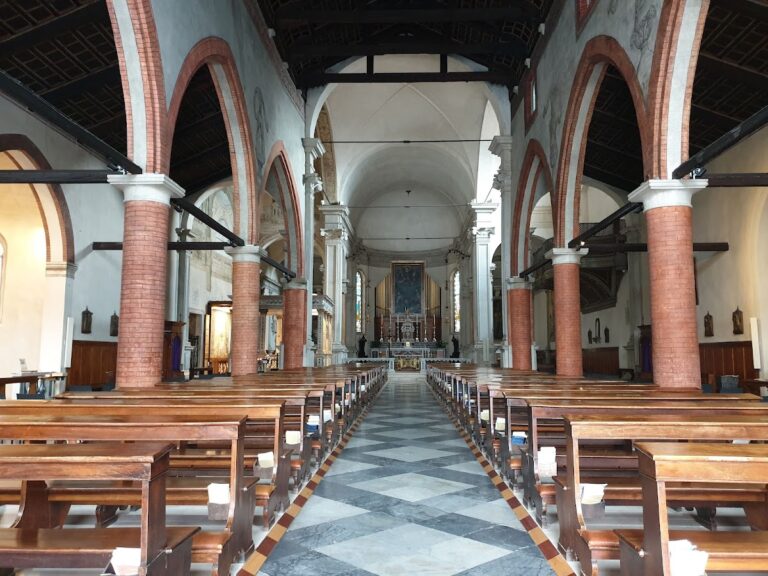
San Francesco survives as a late-Romanesque church with transitional Early Gothic elements. Its simple, severe exterior encloses a Latin-cross plan with a large nave, a right-hand sequence of chapels, painted medieval interiors, funerary monuments, and later furnishings. The building combines orderly Romanesque forms with emerging Gothic features, including more complex vaulting.
Exterior and interior plan
Facade and portal
The gabled facade and the two side walls are articulated by pilasters crowned with small arches. Above the portal, a lunette, or semicircular area over a doorway, contains a Byzantine-influenced fresco attributed to Marco Veneziano. The painting dates to the fourth decade of the fourteenth century.
Nave and chapels
The church follows a Latin-cross plan and has one broad nave covered by a wooden ceiling shaped like the inverted hull of a ship. On the right, five adjoining side chapels form a narrow aisle. Their masonry cross-vaults divide this area into five bays.
Apse chapel
The main apse chapel, the rounded sanctuary end of the church, has paintings in the webs of its vault. They show the Four Evangelists, the Stigmata of Saint Francis, the Madonna and Child, and Adam. These works belong to the fourteenth-century Veneto-Emilian school and were probably painted by a pupil of Tommaso da Modena, a fourteenth-century painter active in Treviso and known for refined Gothic works.
Frescoes and chapels
Saint Christopher
A monumental fresco of Saint Christopher occupies the left wall. It dates from the late thirteenth century and combines Romanesque and Byzantine features.
Giacomelli Chapel
The first chapel on the left is the Giacomelli Chapel. Its principal work is Tommaso da Modena’s 1350 fresco of the Madonna and Child with seven saints. Three of the saints were added later by pupils of the painter.
Madonna and Four Saints
The second chapel on the left contains a 1351 fresco of the Madonna and Four Saints. The painting is attributed to a pupil of Tommaso da Modena known by the conventional name Master of Feltre, an otherwise unidentified artist associated with Tommaso’s circle.
Tombs and transferred artworks
Pietro Alighieri’s tomb
The church contains Pietro Alighieri’s tomb. His funerary chest was sculpted by Filiberto de Sanctis and originally stood in the cloister of the church of Santa Margherita of the Hermits. Frescoes attributed to Andrea di Bartolo, depicting Saint Francis and musical angels, surmount the monument.
Francesca Petrarca’s tombstone
Francesca Petrarca’s tombstone is also preserved in San Francesco. Its Latin inscription recalls her death in Treviso in 1384 and was written by her husband, Francesco da Brossano.
Paintings now in Venice
Several important paintings formerly came from San Francesco and are now in the Gallerie dell’Accademia in Venice. They include Alvise Vivarini’s 1480 Madonna and Child Enthroned with Saints Louis of Toulouse, Anthony of Padua, Anne, Joachim, Francis, and Bernardino of Siena; Giovanni Mansueti’s 1500 Saint Sebastian among Saints Liberale, Gregory, Francis, and Roch; and Vittore Carpaccio’s 1515 Meeting of Joachim and Anne with Saint Louis IX and Saint Libera.
Later furnishings
Statue of Saint Francis
A statue of Saint Francis by the contemporary sculptor Roberto Cremesini stands outside the church.
Mascioni organ
The right arm of the transept, the cross passage intersecting the nave, contains the Mascioni pipe organ, opus 798. Built in 1960, it has electric transmission, two keyboards, and a pedalboard. Its console is positioned on the floor of the nave.