Chiesa di Santa Fosca in Santa Maria Maggiore: A Parish Church and Minor Basilica in Treviso


Site at a Glance
- Rating
- 4.5
- Popularity
- Low
- Country
- Italy
- Primary era
- Early Modern
- External website
- Open
- Eras represented
- Early Modern
- Civilizations
- Venetian
- Site type
- Religious
- Remains
- Basilica
On this page7 sections
History
Chiesa di Santa Fosca in Santa Maria Maggiore is a Roman Catholic parish church and minor basilica in Treviso, Italy. Commonly called Santa Maria Maggiore or Madonna Grande, it stands in the city’s historic center and belongs to the urban vicariate of the Diocese of Treviso. The present building was rebuilt from 1473 in the late Venetian Gothic period, with construction continuing into the sixteenth century.
Early origins and medieval rebuilding
Tradition places the church’s beginnings during the earliest evangelization of the Treviso area by Saint Prosdocimus, regarded as the first bishop of Padua and a disciple of Saint Peter. On this basis, the earliest nucleus is dated broadly between the late first and third centuries. A debated hypothesis proposes that the Marian sanctuary was built over, and in opposition to, an ancient pagan temple dedicated to the Egyptian goddess Isis.
The sanctuary grew through successive enlargements before it was probably destroyed during the Hungarian sack of Treviso in 899. It was rebuilt in the eleventh century. The current church followed a much later rebuilding campaign begun in 1473 by the Lateran Canons Regular, with the work completed during the sixteenth century.
Fortifications and the preservation of the sanctuary
In 1509, during the War of the League of Cambrai, a major European alliance formed against the Republic of Venice, the Venetian government commissioned the Veronese architect Fra Giocondo to plan defensive systems around cities on the Venetian mainland. The proposed fortifications at Treviso required the sanctuary to be demolished because it stood close to the new bastions.
Demolition began at the apse, but the work stopped when it reached a fourteenth-century fresco of the Madonna and Child attributed to Tommaso da Modena. The people of Treviso held the image in particular veneration, so the part of the church between the fresco and the facade was preserved. Treviso resisted a siege by French and German troops in 1511. After the war, the Venetian Senate gave the church a defensive tower standing to the left of Madonna Grande, and it was adapted as a bell tower in 1516.
Dedication, religious associations, and wartime damage
The cult of Saint Fosca, a Libyan virgin and martyr, spread during the Middle Ages through territories under Venetian rule but reached the Madonna Grande sanctuary only toward the end of the eighteenth century. The church received its present dedication when the parish of Santa Fosca was transferred from its demolished church on Via Bonifacio. The former church’s choir loft was moved to the right side of Santa Maria Maggiore’s transept.
The sanctuary is associated with the conversion of Saint Jerome Emiliani, a sixteenth-century religious reformer who founded the Somascan Clerics Regular. This Catholic order, devoted to religious and charitable work, made Madonna Grande one of its principal places of worship and established its seat in Treviso there.
Allied bombing during the Second World War heavily damaged the church. An air raid on 13 March 1945 gutted the central nave and destroyed much of the principal facade. The sanctuary now continues to serve as a parish church and as the seat of the Somascan Fathers.
Remains
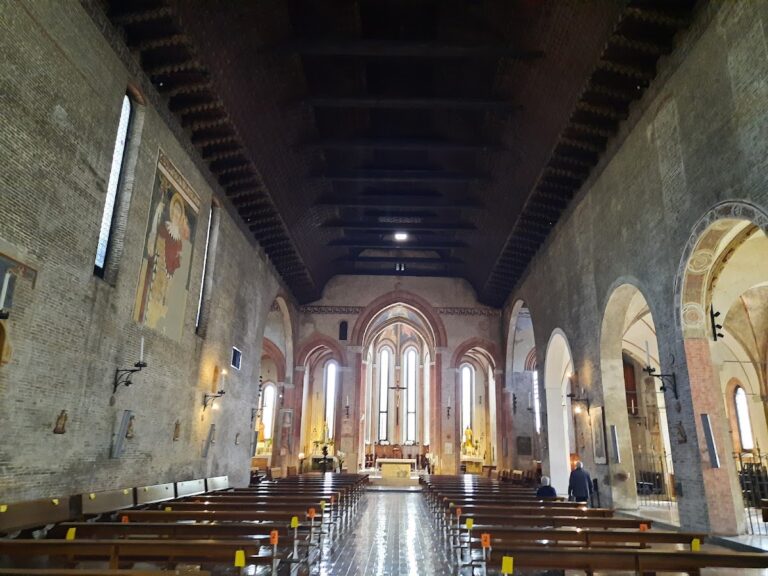
The surviving church has a longitudinal plan divided into three naves. Its exterior combines a brick-faced late Venetian Gothic facade with vaguely Orientalizing lines, while the former defensive tower used as the bell tower stands immediately to the left of Madonna Grande. The principal interior features include the apse organ and the transferred choir loft in the transept.
Facade and bell tower
The principal facade is entirely faced with brick and ends above in a mixed profile, combining straight and curved lines. Five Gothic aedicules, or small shrine-like architectural frames, crown it in Istrian stone; their columns support trefoil arches with three-lobed profiles. Four evenly spaced pilasters organize the facade and strengthen its vertical emphasis.
A large central doorway and two lateral doors open through the facade, each framed in Istrian stone. Above them are three rose windows, large circular Gothic windows with radiating tracery. The central rose window is the largest, while two tall, narrow pointed-arch windows flank it. The former defensive tower beside the church serves as the bell tower, although it was partially rebuilt toward the end of the nineteenth century in an unsuccessful effort to increase its height.
Apse and transept furnishings
The apse contains the Mascioni pipe organ, opus 716, built in 1955. A pipe organ produces sound through tuned pipes, and this instrument uses electric transmission to connect its console with the mechanisms and pipes. The console stands in the nave and has two keyboards and a pedalboard.
On the right side of the transept is the choir loft transferred from the demolished church of Santa Fosca. Its presence preserves a physical element from the earlier parish church whose dedication was later assumed by Santa Maria Maggiore.