San Francesco: A Franciscan Church in Pisa


Site at a Glance
- Rating
- 4.2
- Popularity
- Low
- Country
- Italy
- Primary era
- Medieval
- External website
- Open
- Eras represented
- Medieval, Early Modern, Modern
- Civilizations
- Grand Duchy of Tuscany, Italian, Republic of Florence, Republic of Pisa
- Site type
- Religious
- Remains
- Monastery
On this page16 sections
History
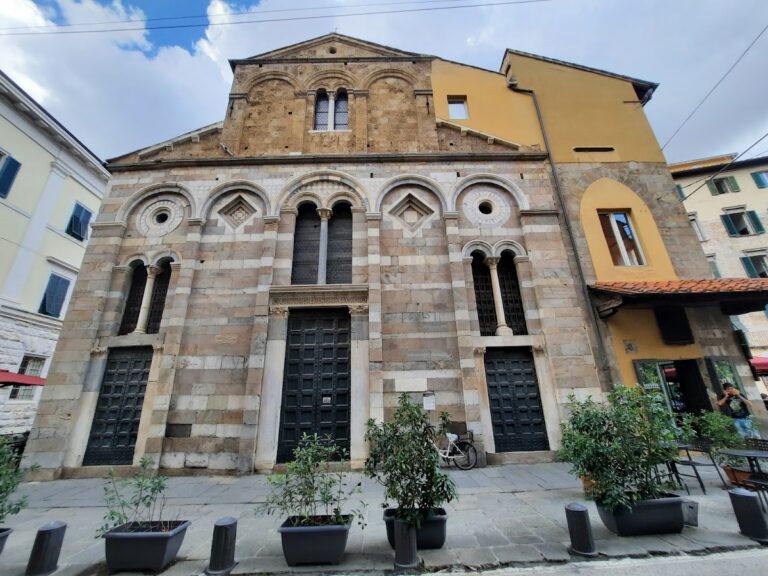
San Francesco, also known as San Francesco de’ Ferri, is a Roman Catholic Franciscan church in Pisa, Italy, first documented in 1233. Its principal medieval form belongs to the thirteenth century and represents the Umbrian-Tuscan tradition of Franciscan single-nave architecture. The church is attached to the Archdiocese of Pisa and became an important religious complex with an adjoining convent and cloisters.
Franciscan expansion in the thirteenth century
In 1261, Federico Visconti, the medieval archbishop of Pisa, ordered the church to be enlarged as the Franciscan order grew in importance. Giovanni di Simone, a Pisan architect and builder, directed the main works between 1265 and 1270. The Pisan noble families who held patronage over the church maintained private chapels for family burials, while the Franciscans were primarily responsible for administering worship.
Wartime events created financial difficulties and slowed the building campaign. The facade was still unfinished at the beginning of the fourteenth century and was completed only in 1603, during the period of Medici rule in Tuscany. Marble supplied by the Gualandi family was used for this later completion.
Later alterations and artistic changes
The church and convent were altered repeatedly. Two cloisters and the Chapel of San Bernardino were added in the fifteenth century. During the Counter-Reformation, the Catholic Church’s sixteenth- and seventeenth-century reform movement following the Protestant Reformation, new side altars and additional windows changed the nave. The windows damaged the fourteenth-century frescoes that had decorated the walls.
The Lorraine suppressions, secularization measures introduced in Tuscany under the Lorraine dynasty, and the later Napoleonic suppressions dispersed much of the church’s furnishings during the eighteenth and nineteenth centuries. Napoleonic seizures removed important paintings, including Cimabue’s Maestà, a devotional image of the enthroned Virgin Mary, Giotto’s Stigmata of Saint Francis, and Benozzo Gozzoli’s Saint Thomas Aquinas Among the Doctors of the Church. These works are now in the Louvre.
Deconsecration and return to worship
Following legislation enacted in 1861, the church and convent were deconsecrated in 1863 and converted into military barracks. Families with patronage rights removed objects, paintings, and ornaments, as listed in the inventory drawn up by the last prior. On 7 July 1866, the former church became a warehouse owned by the royal state.
On 4 March 1875, the Municipality of Pisa obtained the expropriation of the former church and other royal-state properties for public use. The action led to a prolonged legal dispute over compensation and procedure. On 22 May 1893, the former church and adjoining former convent were declared national monuments, and on 8 July they were transferred to the Municipality of Pisa for the conservation and use of the monument.
On 15 June 1899, the municipality granted the former church to the archiepiscopal curia for worship and for the conservation of artworks that might eventually be reinstalled. The interior had seriously deteriorated, but the church reopened for worship in 1901 after financial assistance from a citizens’ committee. The committee also reconstructed the stained-glass windows using designs and decorations by Galileo Chini and Francesco Mossmeyer, produced at the Quentin establishment.
San Francesco now forms a parish with the nearby Church of Santa Cecilia for an Italian-Romanian community. Restoration and reconstruction work began in 2019, and the church is closed while this work continues. The adjoining cloister, convent, and school are also in poor condition.
Remains
San Francesco stands in Piazza San Francesco and is the second-largest church in Pisa after the cathedral. The complex combines a Latin-cross plan, meaning a long central axis crossed by a shorter transverse arm, with a gabled marble facade, a single nave, a campanile or bell tower, a convent, two cloisters, and the Chapel of San Bernardino. Its surviving fabric brings together medieval construction, later chapels and altars, and sections of painted decoration preserved in different parts of the complex.
Main church
Facade and plan
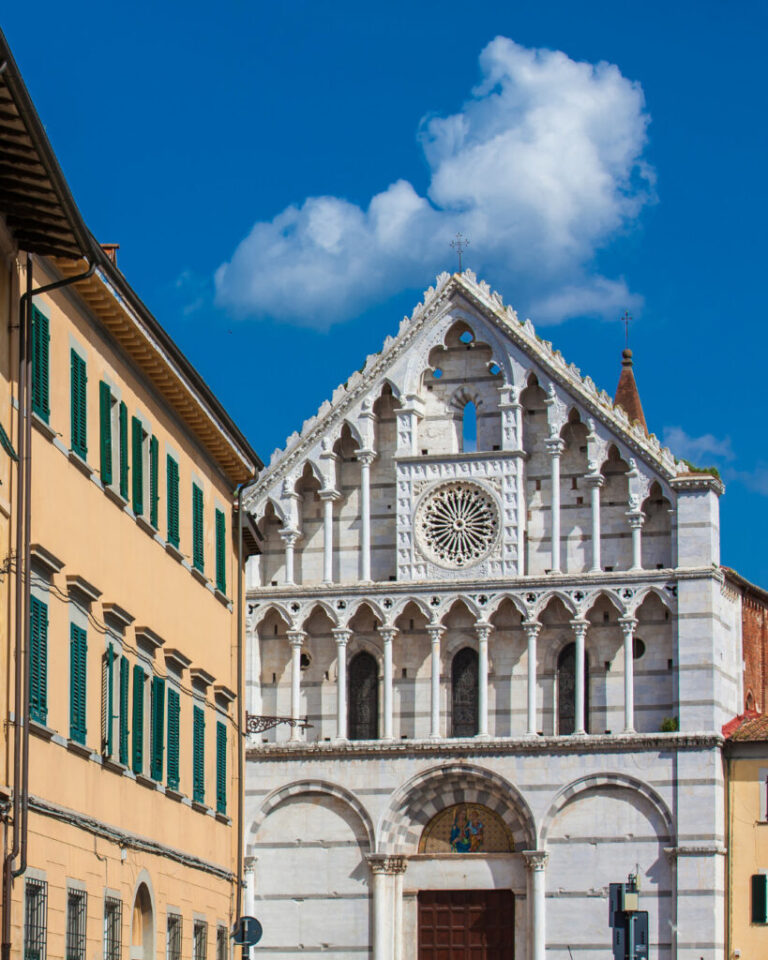
The facade is made from San Giuliano marble. Its lower register dates from the fourteenth century, while the upper section was completed in 1603. Inside, the broad nave follows the Umbrian-Tuscan Franciscan single-nave arrangement. It is 18 metres wide and expands to 22 metres near the transept. Exposed wooden roof trusses cover the nave.
Campanile
The slender campanile is a distinctive feature of the church. Two of its sides rest on corbels projecting into the interior, giving the bell tower an unusual structural relationship with the building.
Painted decoration and altars
The transept preserves frescoes by Taddeo Gaddi dated 1342 to 1345, together with later twentieth-century frescoes by Galileo Chini. Fragments and preparatory underdrawings, called sinopie, survive from the rich fourteenth-century wall decoration, including work associated with Spinello Aretino and Taddeo Gaddi. A sinopia is a preparatory drawing made on plaster beneath a fresco.
The Counter-Reformation side altars contain large paintings by Tuscan artists. They include Lodovico Cigoli’s Nativity of Jesus with the Adoration of the Shepherds, dated 1602, Ventura Salimbeni’s Assumption of the Virgin, D’Empoli’s Baptism of Christ, Santi di Tito’s Saint Francis Receiving the Stigmata, and Saint Francis Receiving the Indulgence, attributed to Francesco Vanni or Passignano.
The altar frontal, a decorative panel covering the front of an altar, is a late-fourteenth-century work by Tommaso Pisano, the son of Andrea Pisano.
Chapels and burials
Chapel of Santa Maria Maddalena
The first chapel to the left of the altar was formerly dedicated to Santa Maria Maddalena and was under the patronage of the Agostini Venerosi della Seta family. It contains a copy of Giunta Pisano’s Saint Francis and Six of His Miracles. The original is held by the National Museum of San Matteo.
Ugolino della Gherardesca chapel
The church contains burials associated with Count Ugolino della Gherardesca, a Pisan count and political figure whose imprisonment and death were recounted by Dante in the Divine Comedy, as well as with Ugolino’s children and grandchildren. Ugolino’s remains were originally placed in the cloister, while a monumental family tomb sculpted by Lupo di Francesco stood inside the church. After the monument was dismantled and moved to several locations, and after Ugolino’s reputation was later rehabilitated, the supposed remains of Ugolino and his descendants were transferred in the early twentieth century to the chapel where they are now kept.
Convent rooms and surviving frescoes
Sacristy
The sacristy contains Taddeo di Bartolo’s frescoes of Marian histories, dated 1397 and restored in the nineteenth century by Guglielmo Botti. A small Maestà attributed to the school of Cimabue was formerly recorded in the sacristy and is now in the National Gallery of Art in Washington.
Chapter house
The chapter house, the monastery’s meeting room, contains detached frescoes by Niccolò di Pietro Gerini depicting Christological histories, dated 1392, together with their preparatory underdrawings. Despite their less-than-optimal condition, the paintings, especially those in the chapter house, retain considerable expressive force and technical skill.
Cloisters and Chapel of San Bernardino
The convent complex includes two cloisters and the Chapel of San Bernardino, all added during the fifteenth century. They form part of the adjoining religious complex together with the convent and school, whose physical condition has deteriorated.