Palazzo Lanfranchi-Toscanelli: A Historic Palace and State Archive in Pisa
Site at a Glance
- Rating
- 4.7
- Popularity
- Very Low
- Country
- Italy
- Primary era
- Early Modern
- Eras represented
- Early Modern, Modern
- Civilizations
- Grand Duchy of Tuscany, Republic of Florence
- Site type
- Domestic
- Remains
- Elite Residence
On this page7 sections
History
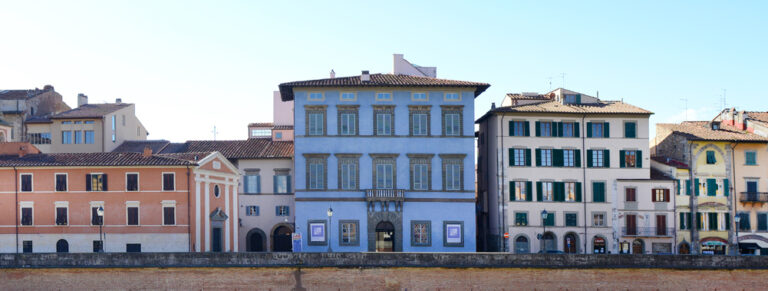
Palazzo Lanfranchi-Toscanelli is a historic palace in Pisa, Italy, on Lungarno Mediceo. Created during the first half of the sixteenth century in the Renaissance, it began as Palazzo Lanfranchi and later took the name Palazzo Toscanelli after its acquisition by the Toscanelli family. It predates the later Palazzo Lanfranchi on the opposite bank of the Arno and is now home to the Archivio di Stato di Pisa, the state institution responsible for preserving the historical records of the city and its territory.
The Lanfranchi palace
In 1505, Bartolomeo Lanfranchi purchased a five-storey riverside domus, a substantial urban residence, together with a loggia, an open-sided gallery, a well, and related premises. The building was developed into a palace during the first half of the sixteenth century. Its first recorded renovation took place in 1560 under the architect Giovan Battista Cervelliera.
Further change followed in 1576, when Albizzo and Giovanni Lanfranchi commissioned a new and more sumptuous front facing the river. The design was by Francesco Mosca, known as Meschino. This intervention gave the palace a more formal riverside presence and established the sixteenth-century character of its principal facade.
The Toscanelli residence
The Toscanelli family acquired the palace in 1827. It became the residence of Giovan Battista Toscanelli and his wife, Angiola Cipriani, who transformed it into a sumptuous nineteenth-century home. The renewal was undertaken on the initiative of the architect Alessandro Gherardesca and included substantial remodelling of the building and its interior structures.
The couple also assembled a large art collection in the palace. Its paintings and other works included pieces associated with Cornelis Bloemaert, Agnolo Bronzino, Pietro Ciafferi, Jacques Courtois, Carlo Dolci, Francesco Fidanza, Károly Markó the Younger, Cornelis van Poelenburgh, and Piero Zuccheri. The palace is also associated with the English Romantic poet Lord Byron, who stayed there around 1821 and 1822. He later moved to Albaro near Genoa and departed for Greece on 16 July 1823, where he died.
The state archive
The Archivio di Stato di Pisa has occupied Palazzo Lanfranchi-Toscanelli since 1913. The institution was established by the Provisional Tuscan Government on 22 February 1860. It was first housed in the palace above the Logge di Banchi, inaugurated for archival use on 4 June 1865; that building later became a subsidiary location.
The archive’s original holdings included records from the Republic of Pisa, the municipality during Florentine rule, and the grand-ducal period. They also included deposits from the United Hospitals, the Opera della Primaziale, the Pia Casa della Misericordia, and the Knights of Saint Stephen. Later additions brought in records from Pisan monasteries and donations from members of noble Tuscan families. The collections include documents dating from the eighth century and are arranged in more than 130 inventories.
Remains
The surviving palace combines a sixteenth-century riverfront composition with nineteenth-century alterations to its exterior and interiors. Its original facade used two lateral corner sections treated with rustication, masonry in which projecting blocks or pronounced joints give the surface a heavy, textured appearance. These sections extended through the full height of the river-facing elevation and contrasted with other types of stone used across the facade.
Facade and interior decoration
The nineteenth-century renewal replaced the earlier sandstone surrounds with marble elements in the Neoclassical style, which revived forms associated with ancient Greek and Roman architecture. Those marble surrounds are no longer visible. Inside, the palace retains ceiling frescoes by Nicola Cianfanelli, Gaspero Martellini, and Annibale Gatti. Their subjects include Byron and poetry, the Apotheosis of Galileo, and the Apotheosis of Michelangelo. An apotheosis represents the exaltation or glorification of a person, often with heavenly associations. Decorative work in the rooms during the 1830s also involved Giuseppe Bacchini, Luigi Venturini, and Benvenuto Brazzini.
Collection and fountain sculpture
The palace’s former art collection brought together works by artists including Cornelis Bloemaert, Agnolo Bronzino, Pietro Ciafferi, Jacques Courtois, Carlo Dolci, Francesco Fidanza, Károly Markó the Younger, Cornelis van Poelenburgh, and Piero Zuccheri. A Mannerist fountain sculpture, belonging to a later sixteenth-century style known for elaborate and fantastical forms, once stood among the palace’s furnishings. It depicts a winged female hybrid with fins for feet and a long tail, seated on a frog. The sculpture is now preserved in the collections of Palazzo Blu in Pisa.
The fountain has been attributed to Niccolò Tribolo, although that attribution remains uncertain. Michelangelo has also been credited with designing the palace, but the claim has no certain supporting evidence. The building’s surviving decoration, its documented alterations, and the movement of its collections together preserve the history of a riverside residence that became both an aristocratic cultural setting and an archive for Pisa’s long civic past.
Nearby sites