San Colombano: A Medieval Monastic Complex in Bologna


Site at a Glance
- Rating
- 5
- Popularity
- Very Low
- Country
- Italy
- Primary era
- Medieval
- External website
- Open
- Eras represented
- Classical, Medieval, Early Modern
- Civilizations
- Byzantine, Papal States, Roman
- Site type
- Religious
- Remains
- Monastery
On this page15 sections
History
San Colombano is an ancient monastic complex in Bologna, Italy, founded as a Christian religious site around AD 616 during the early medieval period. Pietro I, bishop of Bologna, established its original nucleus, the abbey church, on the remains of an earlier building that may have dated from the imperial or late antique period. The complex was dedicated to Saint Columbanus, an Irish monk and monastic founder whose religious legacy was associated with the early medieval monastery of Bobbio.
Benedictine and later religious communities
The first certain records of the monastery date to AD 1008, when Benedictine monks from the Abbey of Saint Gall arrived in Bologna. They controlled the church and monastery until 1144. Benedictine nuns then held the complex until the early thirteenth century, followed later by Carmelite and Poor Clare nuns.
Suppression and secular ownership
In April 1304, an internal division among the nuns led to the simultaneous election of two abbesses. The dispute developed into violent clashes, and the bishop suppressed the monastery while retaining the church as a place of worship.
After several changes of ownership, the complex was sold in 1679 to the Republic of Lucca. It established a residence there for young students from Lucca attending the University of Bologna. Further ownership changes followed from 1790, and the church was closed for worship and deconsecrated in 1798.
Devotion to the Madonna of Prayer
In 1547, an image known as the Madonna of Prayer was installed on the church’s exterior wall. Lippo di Dalmasio had painted the image in 1399. Its growing devotional importance encouraged prayer and pilgrimage, and the Confraternity of the Madonna of Prayer commissioned a chapel beside the church.
The chapel’s decoration was entrusted to pupils of the Carracci, a prominent family of Bolognese painters whose workshop influenced early Italian Baroque art. Around the Jubilee of 1600, pupils of Ludovico Carracci decorated the oratory above the chapel with scenes of the Passion and triumph of Christ. The exceptional quality of this pictorial cycle led the art historian Carlo Cesare Malvasia to call it “the glorious competition.”
Restoration and new cultural functions
In 2005, the Fondazione Cassa di Risparmio in Bologna acquired the complex and directed its restoration under the architects Roberto Scannavini and Francisco Giordano. Since 2010, San Colombano has housed the Tagliavini Collection of early musical instruments and the musical library of Oscar Mischiati. These uses followed the church’s deconsecration while preserving the complex as a place connected with art, music, and historical study.
Remains
San Colombano is organized around the church and the buildings added to it over time. The surviving complex includes the church, the adjoining Chapel of the Madonna of Prayer, the oratory above the chapel, and the archaeological remains beneath the church’s apsidal area. Its painted decoration ranges from a thirteenth-century Crucifixion fresco to the later Baroque cycles in the oratory.
Church and archaeological remains
Abbey church
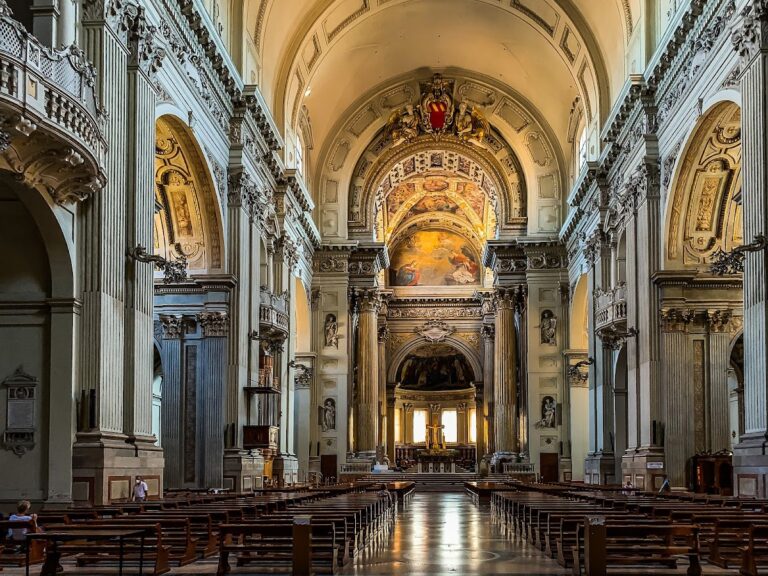
The church occupies the site of an earlier structure, possibly imperial or late antique, and formed the original nucleus of the complex. It retains an old painting of the Virgin with Saint Columbanus and other saints. Beneath its apsidal area are archaeological remains connected with earlier phases of the site.
Crypt and burial
Archaeological work during the 2007 restoration uncovered a late-Roman crypt beneath the church. The crypt was subsequently excavated, and a project was undertaken to make it accessible to the public. A twelfth-century burial was also found beneath the church’s apse, adding evidence of the complex’s medieval use.
Crucifixion fresco
The restoration campaign also revealed a thirteenth-century Crucifixion fresco attributed to Giunta Pisano, an Italian painter associated with the development of the monumental painted Crucifix in Italy. The discovery added an important medieval work to the surviving decoration of San Colombano.
Chapel and upper oratory
Chapel of the Madonna of Prayer
The Chapel of the Madonna of Prayer stands beside the church and was built in response to devotion to Lippo di Dalmasio’s image. From the late 1920s until 2005, it was used by the Association of War Disabled and War Invalids. Its creation and later reuse reflect the changing functions of the complex.
Upper oratory
The oratory is positioned above the chapel. Its fresco cycle presents episodes from the Passion and triumph of Christ and includes works by Francesco Albani, Francesco Brizio, Domenichino, Lorenzo Garbieri, Lucio Massari, Guido Reni, and Baldassare Aloisi. The upper oratory also contains Francesco Albani’s fresco of Saint Peter Leaving Pilate’s House Weeping.
Painted decoration
Other paintings in the oratory include Pietro Pancotto’s Last Judgement in the exterior portico and Antonio Caracci’s Saint Francis with angels above and demons below on the right wall. Leonello Spada painted the Virgin and Child with Joseph Gathering Dates, while Lorenzo Garbieri created a Sibyl and the Coronation of Saint Catherine. Lucio Massari painted Saint Martha Conversing with the Saviour, with Mary Magdalene Kneeling, in the vault, as well as a second Sibyl and an Angel Bearing the Palm of Martyrdom to Saint Ursula. Paolo Caracci contributed the Infant Jesus Playing with Saint John in the Presence of Little Angels.
Musical collections
The deconsecrated complex houses the Tagliavini Collection, named for and donated by Luigi Ferdinando Tagliavini. It contains nearly ninety early musical instruments, including harpsichords, spinets, pianofortes, clavichords, and other historical keyboard instruments. San Colombano also contains Oscar Mischiati’s musical library.