Nederlands Hervormde Kerk: A Protestant Church in Kerkwerve, Netherlands


Site at a Glance
- Rating
- 4.1
- Popularity
- Very Low
- Country
- Netherlands
- Primary era
- Modern
- External website
- Open
- Eras represented
- Early Modern, Modern
- Civilizations
- Dutch
- Site type
- Religious
- Remains
- Church
On this page10 sections
History
The Nederlands Hervormde Kerk is a Protestant church in Kerkwerve, Netherlands, built in 1900 and 1901 to replace a medieval church dedicated to Saint Pancras. Its history reflects the damage caused by the Siege of Zierikzee during the Dutch Revolt, the Reformation, and the difficult decisions surrounding the old building’s demolition.
Medieval foundation and Reformation
Kerkwerve developed around AD 1200 around a church dedicated to Saint Pancras, an early Christian martyr venerated as a saint. The building was severely damaged during the Siege of Zierikzee in 1575 and 1576, a military campaign in which Zierikzee and the surrounding region were contested. When the inhabitants joined the Reformation around 1576, the church passed into Protestant use. Part of the medieval structure was restored, while the remainder was demolished.
Decline of the medieval church
By the late nineteenth century, the surviving church had deteriorated severely. A restoration plan prepared in 1887 was rejected by the churchwardens, and early proposals for a replacement were abandoned because the cost was too high for the small congregation.
New-building plans were prepared in 1894. Mason W. Lemsom proposed a design priced at 6,000 guilders, but the proposal was rejected. In 1895, pastor H.J. Couvée suggested that his brother, architect Leonard Couvée, prepare a design without charge, on the condition that it would be followed in full.
A special building committee was formed, and engineers J. van Elzelingen and N.W. Hocke of Zierikzee examined the church’s structural condition. Their report led the mayor of Kerkwerve to close the building in December 1895. Services moved temporarily to a schoolroom, while plans were made for a temporary church using material salvaged from the old structure.
The General Synodal Commission of the Reformed Church initially prohibited demolition. J.A. Frederiks, a restoration specialist commissioned by the Ministry of the Interior, then concluded that repairs were possible. This created an impasse because the congregation could not finance restoration and could not obtain demolition material for the temporary church. C.J. Boogerd, a lay notable, and pastor Couvée offered to finance the temporary building themselves and lease it to the congregation, but official permission to demolish the old church was still required.
In 1896, architect L. Koole was commissioned to prepare an independent report. After extensive investigation, including partial excavation of the foundations, he concluded that restoration was impossible. The Synodal Commission accepted his conclusion and authorized demolition.
Construction of the present church
The tender for the replacement church was issued on 22 January 1900 with a budget of 12,000 guilders. Contractor P. Vink of Noordgouwe submitted the lowest bid, 13,250 guilders, but a calculation error affected the offer. The contract was therefore awarded to W. Lemsom of Kerkwerve for 13,320 guilders. Demolition began in February 1900, the first stone was laid on 21 April, and the building reached its highest point in July. The new church opened for use on 14 January 1901.
Music and protection
A harmonium, a keyboard instrument that produces sound by directing air through reeds, made by the L. Raar firm of Delft, was installed in 1919. After 1953 it was replaced by an electro-pneumatic organ from the Spiering firm of Dordrecht, which used electrical controls and compressed air to operate its pipes. That instrument proved inadequate, and a new organ by Fama and Raadgever of Utrecht entered service on 18 December 1987. The pulpit from the earlier church is protected as a national monument, a legally protected cultural heritage object, under monument number 29913.
Remains
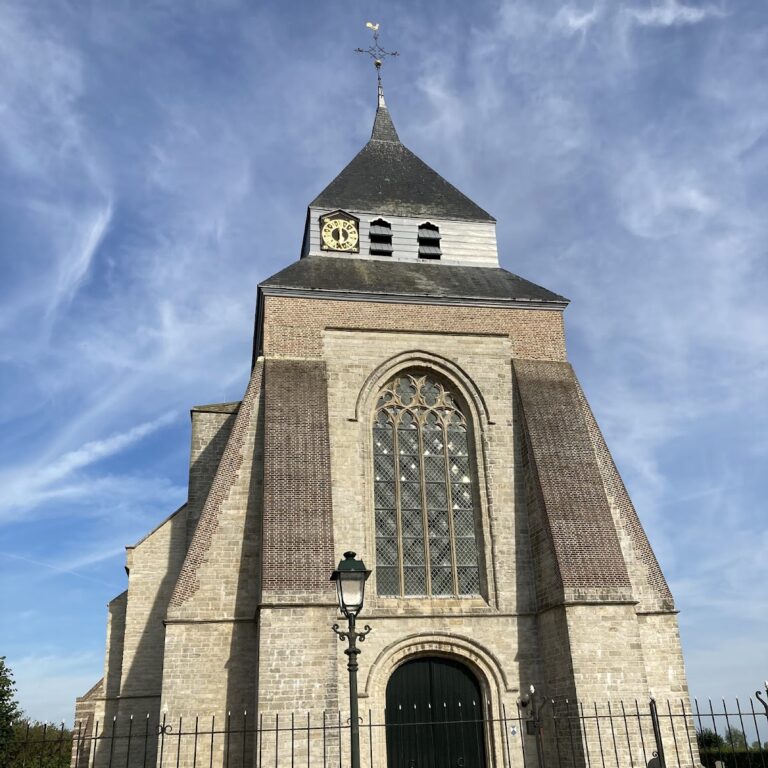
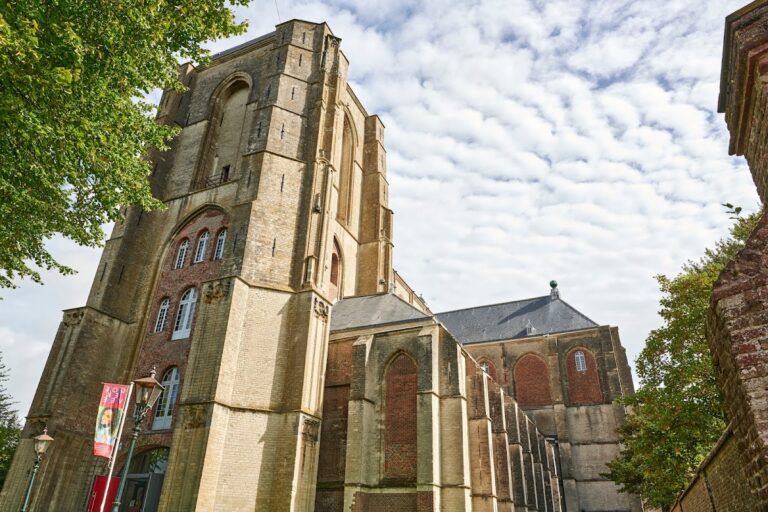
The present church stands at Weelweg 1 in Kerkwerve on the island of Schouwen-Duiveland in Zeeland. It is a relatively simple single-nave building, meaning that its interior is arranged as one main space, with five window bays and a tower incorporated into the façade.
Church building
The replacement church’s surviving form is defined by its single nave, five bays of windows, and façade tower. These elements give the building its straightforward architectural arrangement within Kerkwerve.
Retained furnishings and organs
Seventeenth-century pulpit
The present church contains a pulpit made around 1700. It survives from the earlier church and is the explicitly retained element of that building. The pulpit is protected as a national monument under monument number 29913.
Organs
The church contains the later instruments associated with its musical history. The 1919 harmonium was followed after 1953 by an electro-pneumatic organ made by Spiering of Dordrecht, and this was replaced by the Fama and Raadgever organ that entered service in 1987.