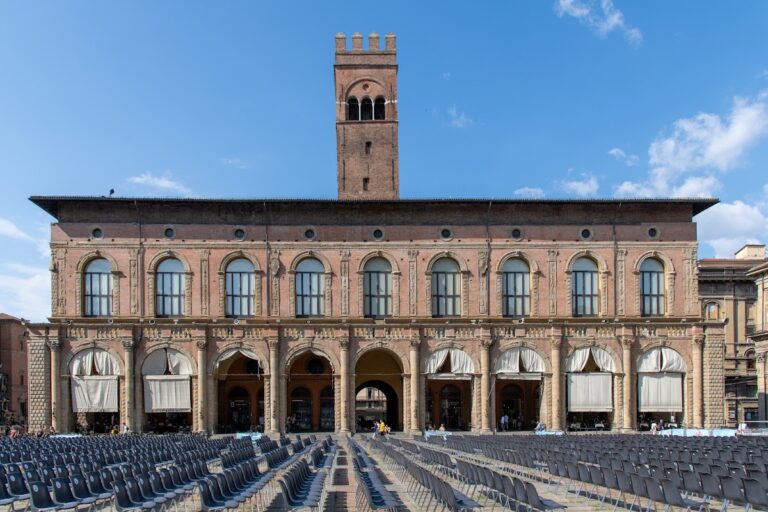
Palazzo Bonasoni: A Renaissance Palace in Bologna


Site at a Glance
- Rating
- 4.3
- Popularity
- Very Low
- Country
- Italy
- Primary era
- Early Modern
- Eras represented
- Medieval, Early Modern, Modern
- Civilizations
- Papal States
- Site type
- Domestic
- Remains
- Elite Residence
On this page10 sections
History
Palazzo Bonasoni is a sixteenth-century Renaissance palace in Bologna, Italy, reconstructed in the middle of the sixteenth century on the site of earlier residences. Its present form incorporates older building fabric and reflects the successive changes made by several prominent Bolognese families.
Medieval origins and Renaissance reconstruction
The site originally held a fourteenth-century residence belonging to the Caccianemici dall’Orso family, whose name survives in the adjacent street. Earlier fifteenth-century structures may also have formed part of the complex. By the middle of the sixteenth century, Galeazzo Bonasoni had acquired the buildings and initiated their reconstruction.
The Bonasoni family had originated in San Giovanni in Persiceto and Castello d’Argile before moving to Bologna by 1472. Galeazzo’s father taught canon law at the University of Bologna. In 1544, Galeazzo was made a knight and Count Palatine by Charles V, the Habsburg ruler who was Holy Roman Emperor and controlled a large European and overseas empire. A Count Palatine was a high-ranking title granted by the emperor.
In 1556, Galeazzo employed Antonio Morandi, known as Il Terribilia, a sixteenth-century architect active in Bologna. The palace’s reconstruction is probably attributable to Morandi, partly because its facade resembles that of Palazzo Orsi, completed in 1560. A groundbreaking date of 1566 is also associated with the building. Some of the palace’s decorative work has been attributed to different artists, reflecting the complexity of its development.
Changing ownership and later use
Ownership changed repeatedly after the Renaissance. The Tanari family held the palace from 1609 to 1615, followed by the Ranuzzi, who retained it until 1704. By 1739 it belonged to the Volta family, after which it passed to the Grati. In 1804, the marquis Francesco Scarani acquired the palace. The Zucchini and Bevilacqua families later owned it, and from 1931 its owners included the Zerbini, the Pellegrini-Quarantotti, and finally the Gamberini.
These changes of ownership brought further decorative alterations to the palace. In the early eighteenth century, the Ranuzzi commissioned Giuseppe Maria Mitelli to create a perspective decoration opposite the entrance loggia. Around 1739, the Volta commissioned Vittorio Maria Bigari to decorate an alcove with putti. The palace therefore preserved evidence of continued adaptation rather than a single, unchanged Renaissance scheme.
From 2004 to 2025, Palazzo Bonasoni housed the Cultural Heritage Sector of the Emilia-Romagna Region. Since 2025, it has housed the Bologna office of Banca Mediolanum.
Remains
The palace combines Renaissance architecture with surviving elements of earlier buildings. Its street facade includes a raised, asymmetrical arcade or portico, an irregular arrangement associated with the fifteenth-century structures incorporated into the complex. The building also retains the remains of the former fourteenth-century residence and possible fifteenth-century pre-existing fabric.
Facade and earlier fabric
The facade presents the palace’s Renaissance reconstruction while preserving traces of the site’s earlier development. The raised street portico is notably asymmetrical, linking the visible exterior to the irregular structures that preceded the sixteenth-century rebuilding. The combination of new Renaissance work and retained medieval and late medieval fabric gives the palace a layered architectural character.
Interior decoration
Trojan War fresco cycle
The piano nobile, the principal ceremonial floor of an Italian palace, preserves decoration from several periods of ownership. A fresco cycle depicting the Trojan War dates from the second half of the sixteenth century. It is concealed by a false ceiling, while a whitewashed and difficult-to-read frieze survives with allegories and landscapes associated more generally with the manner of Niccolò dell’Abate, a sixteenth-century Italian painter influential in decorative fresco painting.
Nineteenth-century rooms
The ceilings of the nineteenth-century rooms are decorated with Muses and putti framed by Neo-Rocaille ornamentation. Neo-Rocaille is a nineteenth-century revival style based on the asymmetrical, shell-like ornament of the Rococo. These ceilings are attributed to Girolamo Dal Pane and represent a later decorative phase within the Renaissance palace.
Courtyard Venus
A marble reclining Venus occupies an open niche in the courtyard. The sculpture dates to the eighth decade of the nineteenth century. Its classicist style and realistic treatment of details have led to an attribution to Carlo Monari, a nineteenth-century Italian sculptor.
Sixteenth-century sculpture
Some sculptural work in the palace is associated with Achille Bocchi and dated 1555. These works belong to the period immediately preceding or accompanying Galeazzo Bonasoni’s reconstruction and add to the building’s record of sixteenth-century artistic patronage.
Nearby sites