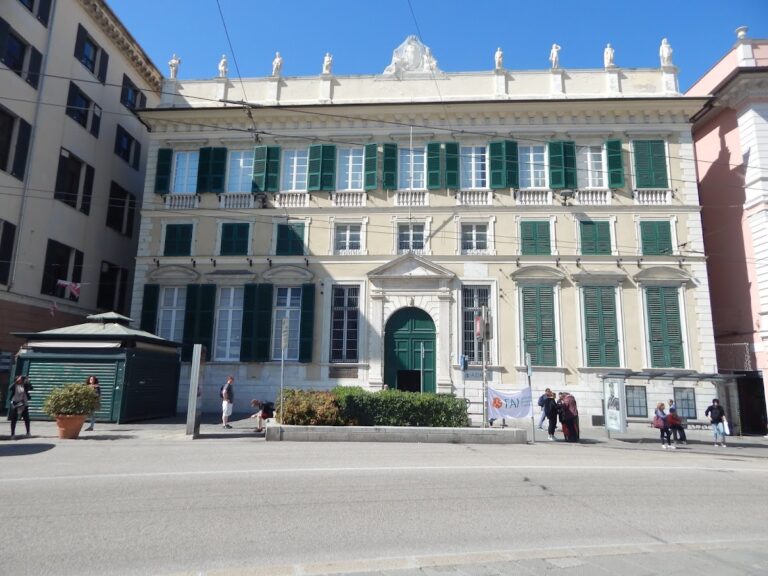
Santissima Annunziata di Portoria: Church and Sanctuary of Saint Catherine in Genoa


Site at a Glance
- Rating
- 4.6
- Popularity
- Very Low
- Country
- Italy
- Primary era
- Early Modern
- Eras represented
- Medieval, Early Modern
- Civilizations
- Genoese
- Site type
- Religious
- Remains
- Church
On this page24 sections
History
Santissima Annunziata di Portoria is a Roman Catholic church in Genoa, Italy, whose construction began in 1488 in the Gothic tradition and developed into a Mannerist complex. Formally dedicated to the Santissima Annunziata, the Catholic commemoration of the Annunciation, it is more commonly known as the Church of Saint Catherine. Since 1927 it has functioned as the Sanctuary of Saint Catherine, a church distinguished by its important devotional association and relics.
Foundation and connection with Pammatone Hospital
The church and adjoining convent were created in close connection with Pammatone Hospital, founded in 1422 by the lawyer Bartolomeo Bosco as a hospital for women. After Genoa suppressed its smaller hospitals in 1471, Pammatone became the largest hospital in the Republic of Genoa. The church and hospital were physically joined by an internal passage, and religious communities serving the patients also exercised responsibilities in the church.
Cardinal Paolo Fregoso, a Genoese archbishop and senior Catholic churchman, laid the foundation stone on 8 June 1488. Building continued until the end of the sixteenth century. Franciscan friars initially served the church and remained there until 1538. In 1498 it was recorded under the dedication Santa Maria Annunziata. The designation “di Portoria” identified its district and distinguished it from the later, larger Santissima Annunziata del Vastato. The names Annunziata Vecchia and Nunziatella were also used, while local custom associated the church with Saint Catherine because her remains were preserved there.
Saint Catherine and the hospital community
Caterina Fieschi Adorno, known as Saint Catherine of Genoa, assumed administration of Pammatone Hospital in 1489. Remembered for caring for the sick and for her writings on spiritual purification, she lived in the convent until her death in 1510. Her funeral took place in the church on 16 September 1510, after a life devoted to patients at Pammatone.
The hospital’s spiritual care changed hands several times. The Ordo Cruciferorum, a religious order whose members provided hospital care, served there before the arrival of other communities. Jesuits served from 1566 to 1578, while Camillians served from 1607 to 1719, from 1735 to 1777, and during shorter intervening periods alongside other clergy. The Capuchins, who had cared for patients at the nearby Chronici Hospital from 1538, took over spiritual responsibility for Pammatone from the Ordo Cruciferorum in 1719 and were allowed to live in the adjoining convent. They served at the hospital until 1735, again from 1777 to 1816, and definitively from 1838 until its closure.
The suppression of religious orders under Napoleon in 1810 and the renewed suppressions of 1866 altered the legal position of the friars. They were nevertheless permitted to remain at the church and hospital as secular priests. These successive communities maintained the connection between the sanctuary, the convent, and the medical institution.
Wall construction and rebuilding
In 1538 Genoa built a new section of city wall between Porta San Tommaso and Carignano. The work demolished the church apse, its original high altar, part of the cloister and convent, and the tomb of Giuliano Adorno, Saint Catherine’s husband.
In 1556 the government of the Republic of Genoa authorized Pammatone’s administrators to reoccupy part of the land that had been expropriated for strategic purposes. Reconstruction was allowed on the condition that the church remain at least twenty-six Genoese palms, approximately seven metres, from the city wall. Battista Grimaldi, a Genoese nobleman and patron, rebuilt the apse and planned a family crypt beneath it. He later commissioned the presbytery and high altar in 1563, intending to be buried there.
The church’s chapels were progressively decorated by Genoese families between the sixteenth and eighteenth centuries. Their commissions brought together works by major local artists, including Giovanni Battista Castello, Luca Cambiaso, the Semino and Calvi families, and other painters and sculptors. This concentration of paintings gave the church its reputation as a gallery of sixteenth-century Genoese painters and as a major centre of sixteenth-century Genoese artistic activity.
Relics, restoration, and twentieth-century changes
Saint Catherine’s body was transferred from the hospital chapel to the church in 1593 and placed on the gallery above the main entrance. After her canonization in 1737 by Pope Clement XII, Francesco Maria Schiaffino was commissioned to create a mausoleum. Pope Pius XII proclaimed Catherine patron saint of Italian hospitals in 1943, reinforcing the historical association between her devotion and the care of the sick.
Restoration took place between 1885 and 1894 and again in 1926. In 1927 the church was officially declared the Sanctuary of Saint Catherine while retaining its dedication to the Santissima Annunziata. Pammatone’s medical functions had gradually moved to the new hospital at San Martino d’Albaro, and Pammatone closed in 1942. Aerial bombardments in 1942 and 1943 seriously damaged the hospital buildings. The church was spared in the attack of 23 October 1942, although the urn containing Saint Catherine’s remains was temporarily moved to the Grimaldi family crypt.
After the war, the architect Eugenio Fuselli reconstructed Schiaffino’s mausoleum in a chapel on the church’s right. Saint Catherine’s body was solemnly placed there on 8 May 1960 in the presence of Cardinal Giuseppe Siri. The convent housed the Capuchin provincial curia from 1955 to 1967. Since 1977 it has contained the Capuchin Cultural Heritage Museum, the provincial library, the Capuchin provincial historical archive, and a ministry serving Latin American communities.
Between 1966 and 1974, the Palace of Justice was built on part of the convent property, incorporating the eighteenth-century Pammatone courtyard, colonnade, and monumental staircase. Ownership of the church passed from Genoa’s Civil Hospital to the Municipality of Genoa in 1980 and subsequently to the public agency ASL 3 Genovese. In 1999 the city council granted the Capuchins a ninety-year concession for the convent. The adjoining museum began in 1970 as the Museum of Capuchin Life, founded by Father Cassiano da Langasco, and was officially inaugurated under its later name in 2006. Its collections include art, sacred furnishings, and objects of Capuchin craftsmanship from Ligurian convents.
Remains
The surviving complex combines a three-aisled church with an adjoining convent arranged around a small fifteenth-century cloister. The church’s original Gothic character remains visible beneath its later Mannerist appearance. A central nave and two side aisles are supported by pillars formed from the original black-and-white marble columns, later covered in brick. Ten chapels open from the aisles. They began as aristocratic family burial chapels belonging to families that helped build and maintain the complex.
Entrances and nave
Portal and convent doorway
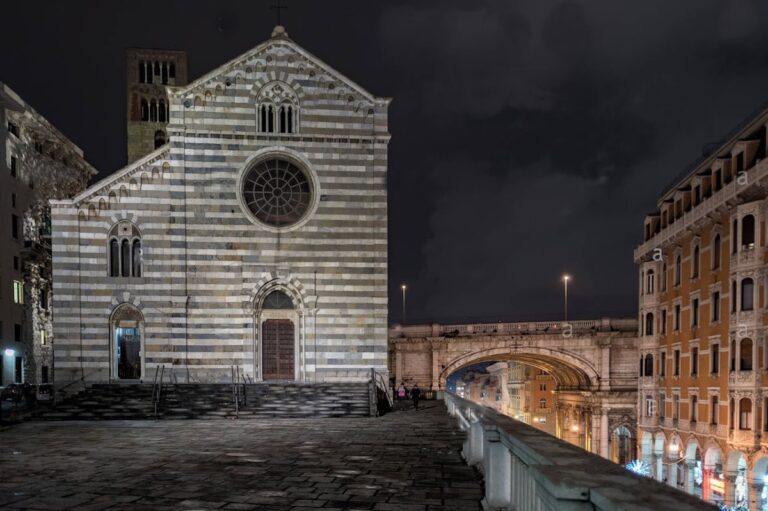
The church is approached from a small square reached by short stairs from Via Bartolomeo Bosco. Its original eighteenth-century forecourt was enclosed by a gate, and much of the space is now obscured by the Palace of Justice. A second entrance is reached from the Acquasola esplanade by an internal staircase.
The principal entrance has a double Renaissance marble portal made by Pier Antonio Piuma in 1521. Heads of friars decorate its pilasters, whose capitals carry acanthus leaves. Andrea Casaregis added Baroque plaster decoration in 1780, while an oval above the portal frames Francesco Maria Schiaffino’s stucco relief of the Annunciation, made in 1744. Above the convent door, a late-fifteenth-century stone lunette by Gaspare della Scala depicts the Stigmata of Saint Francis. It carries the foundation date of 8 June 1488 and shows the profile of the first church in the background.
Vault and organ
Giuseppe Passano’s 1837 fresco The Triumph of Saint Catherine fills the central vault. It shows the saint carried in glory among worshippers. Smaller frescoes portray saints, and Oldoino Multedo painted oval portraits of saints along the cornice. Two small medallions by F. Ballino depict The Death of Ettore Vernazza and the Venerable Battistina Vernazza Teaching Nuns.
The vault and pendentives, the curved triangular surfaces connecting a dome or vault to a square or polygonal bay, also contain works by Giovanni Battista Castello. These include Christ the Judge and the Evangelists, together with three paintings by Luca Cambiaso. Above the main entrance, the choir holds an organ made by the Bianchi firm of Novi Ligure in 1892. Its wooden case is open at the front and contains twenty-five tin pipes. Domenico Tagliafico, Bianchi’s pupil and heir, added a second manual in 1904. Giovanni Battista Buffa painted The Vision of Saint Francis and four small portraits of Capuchin friars on the vault in 1893. The organ was restored in 2016 by the Marin brothers’ workshop in Lumarzo.
Presbytery and apse
Battista Grimaldi commissioned the presbytery, the part of the church surrounding the main altar, and its high altar in 1563. The altar has a Baroque form and is made entirely of marble. Its wooden crucifix was made by Giambattista Gaggini da Bissone. The marble intarsia, an inlaid design made from pieces of differently coloured stone, on the presbytery floor displays the Grimaldi family coat of arms, accompanied by a large Grimaldi heraldic emblem.
Luca Cambiaso painted the apse Annunciation and the two large side scenes, The Calling of the Elect and The Expulsion of the Damned. Giovanni Battista Castello painted the apse-vault fresco Christ the Judge Surrounded by Angels Bearing the Instruments of the Passion, while the pendentives contain the Four Evangelists. Marble panels below the side paintings bear the Franciscan emblem and the symbol of Christ’s Five Wounds.
Right-hand chapels
Our Lady of Sorrows
The chapel nearest the main altar on the right was built in 1556. Originally dedicated to Our Lady of Mercy, it is now dedicated to Our Lady of Sorrows. A papier-mâché statue by Collina Graziani da Faenza, dated 1893, stands in the altar niche. Luca Cambiaso’s Christ in the Garden of Gethsemane and Lazzaro Calvi’s Pietà are displayed there, alongside frescoes by Pantaleo Calvi showing David, Isaiah, Jeremiah, and the Erythraean and Cumaean Sibyls. The chapel was formerly associated with the Cavanna family.
Nativity and Assumption
The second right-hand chapel, dedicated to the Nativity, was built in 1567 and decorated throughout by Andrea Semino. Its paintings include The Adoration of the Shepherds, Joseph’s Dream, The Angel Announcing the Birth to the Shepherds, and Angels in Flight. It was associated with the Pinelli family.
The chapel of the Assumption of the Virgin, also called Maria Santissima Assunta in Heaven, contains works attributed to Ottavio Semino. They include an altarpiece of the Assumption, a vault painting of the Coronation of Mary, wall paintings of the Annunciation and the Shepherds at the Manger, and lunettes showing the Presentation in the Temple and the Flight into Egypt. The chapel was formerly associated with the Giudice-Calvi family.
Saint Catherine’s mausoleum
The third right-hand chapel was founded by Francesco Pallavicino in 1490 and was formerly associated with the Rotolo-Pallavicino family. Pantaleo Calvi painted God the Father on the vault and prophets and Evangelists below it, while two anonymous paintings depict The Crossing of the Red Sea and The Adoration of the Magi. Since 1960 the chapel has housed Saint Catherine’s mausoleum.
The saint’s body rests in an eighteenth-century bronze and crystal-glass urn made by G. B. Dellepiane in 1738. The urn stands on a Carrara-marble base made by Francesco Maria Schiaffino in 1737 and 1738, with griffins and festoons added by I. Peschiera in 1838. Four statues represent Divine Love, Fortitude, Obedience, and Penance. R. Pareto made the tabernacle, decorative figures, and candelabra in 1860, and votive lamps hang from the chapel arch.
Saint Catherine chapel
The last chapel on the right is dedicated to Saint Catherine and was formerly associated with the De Franchi family. Four columns of black marble from Como frame its altar. The altar contains Pietro Raimondi’s eighteenth-century Apparition of Christ to Saint Catherine. Carlo Giuseppe Ratti painted The Translation of Saint Catherine, and Anton Raphael Mengs painted the saint’s face.
Left-hand chapels
Saint Anthony chapel
The first chapel on the left, counted from the main altar, is dedicated to Saint Anthony. It was formerly dedicated to Saint Felix of Cantalice and later to Saint Camillus de Lellis. Its marble altar contains the Holy Family. Giuseppe Palmieri painted Saint Anthony Preaching to the Fish and Saint Anthony with the Christ Child. Other works include Aurelio Lomi’s Visitation with Saints Augustine and Nicholas of Tolentino and Domenico Parodi’s Saint Camillus de Lellis. Pantaleo Calvi painted Prophets and Sibyls in the apse.
Baptismal chapel
The second left-hand chapel was formerly dedicated to the Pietà and now contains the baptismal font. It lies near the stairs leading to the upper exit toward Acquasola. Its paintings include Saint Frances of Rome, an anonymous Descent of the Holy Spirit, and Giovanni Carlone’s Jesus Comforted by an Angel in the Garden of Gethsemane. Oldoino Multedo painted nineteenth-century frescoes of Franciscan saints on the vault.
Our Lady of the Sacred Heart
The chapel of Our Lady of the Sacred Heart of Jesus was formerly associated with the Fabra and Costanzi families. It contains Mattia Traverso’s signed 1941 painting of the chapel’s patron. Ottavio Ghissoni painted frescoes there in 1606, depicting scenes from the life of the Virgin.
Three Kings chapel
The chapel of the Three Kings contains Luca Cambiaso’s Adoration of the Magi on the altar. Two biblical figures with cartouches occupy the side walls, while the vault bears a fresco of the Eternal Father among Angels. Giacomo Antonio Ponsonelli made the marble statue of Our Lady of Mercy. The chapel was associated with the Zoagli-Cicala family.
Saint Francis chapel
Near the main portal, the chapel of Saint Francis of Assisi was built by the Cambiaso family in 1723. Its altar has black-marble columns and contains Domenico Piola’s Holy Family with Saint Francis, transferred from the demolished church of Nostra Signora della Pace. Giuseppe Palmieri painted Saint Anthony Preaching to the Tyrant Ezzelino da Romano.
Convent and former hospital remains
Cloister and upper chapel
The convent is a composite group of buildings arranged around a small fifteenth-century cloister. Its covered passage retains original frescoes depicting biblical scenes and episodes from conventual life. The upper chapel, also called the Deposit Chapel, is reached through the convent by a broad staircase. Gaetano Cantoni arranged it in the eighteenth century, and Santo Tagliafichi painted its 1822 frescoes, including Saint Catherine in Glory on the vault and Visions and Miracles of Saint Catherine on the walls. The chapel formerly housed the saint’s urn.
Pammatone courtyard and museum
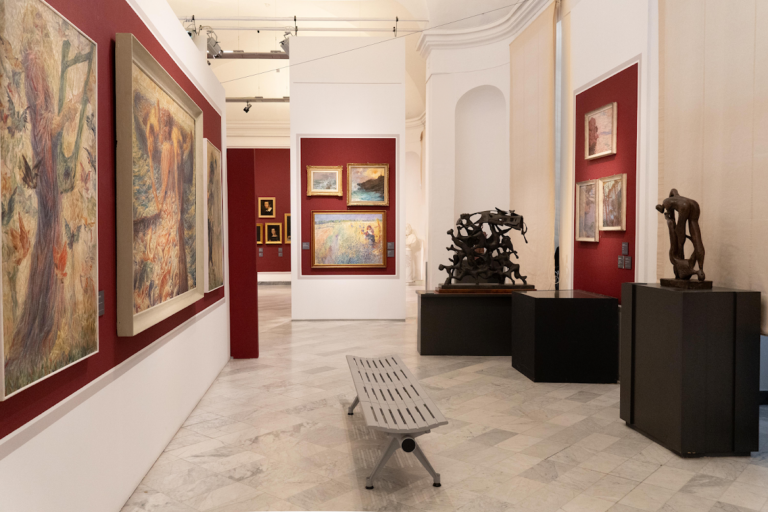
The eighteenth-century courtyard of the former Pammatone Hospital, together with its colonnade and monumental staircase, survives as part of the Palace of Justice complex. The museum attached to the church contains works by Genoese painters from the sixteenth to eighteenth centuries, sacred furnishings, and examples of Capuchin devotional and everyday craftsmanship.