San Barnaba apostolo: Marino’s Principal Catholic Church and Minor Basilica
Site at a Glance
- Rating
- 4.5
- Popularity
- Low
- Country
- Italy
- Primary era
- Early Modern
- External website
- Open
- Eras represented
- Early Modern, Modern
- Civilizations
- Italian, Papal States
- Site type
- Religious
- Remains
- Basilica
On this page22 sections
History
San Barnaba apostolo is the principal Catholic church of Marino, Italy, a Baroque basilica built in the seventeenth century under the patronage of the Colonna family, the feudal lords of the town. It belongs to the suburbicarian Diocese of Albano, one of the dioceses historically associated with the bishops holding titles linked to the suburbs of Rome. The church is also a distinguished collegiate church, served by a chapter of canons, and a parish church.
The foundation of the parish
Saint Barnabas, an early Christian missionary associated with the first Christian communities and traditionally regarded as an apostle and companion of Saint Paul, became Marino’s patron saint in 1618. Severe hailstorms had struck the town’s agricultural and wine-growing lands on his feast day, 11 June, in successive years. Cardinal Francesco Sforza of Santa Fiora, bishop of Albano, approved the choice on 4 June 1619. The saint was already venerated in Marino by at least 1620 in a chapel near the church of Saint John the Baptist.
At the end of the sixteenth century, Marino had two parish churches, Santa Lucia and Saint John the Baptist. On 28 October 1636, Monsignor Giovanni Battista Altieri suppressed both parishes and united their benefices and revenues to create the new parish of San Barnaba. The reorganization also sought to end long-running disputes between the two parish communities. Pope Urban VIII confirmed the suppression in the bull Exclesa merita Sanctorum, issued on 3 December 1643.
The new church received an important relic in 1630, when Duke Filippo II Colonna obtained a fragment of Saint Barnabas’s arm from Baron Girolamo di Piedivalle. The relic was placed in a reliquary made by Girolamo Zuccoli. The earliest known reference to the feast and fair of Saint Barnabas at Marino dates from 1638, reflecting the growing importance of the new cult in the town’s religious life.
Construction and collegiate status
The foundation stone was laid on 10 June 1640 in the presence of Cardinal Girolamo Colonna, who had recently succeeded his father Filippo as duke of Marino. Antonio Del Grande and Vincenzo della Greca designed the building, with Giovanni Maria Longhi and Paolo Andreotti also involved in its construction. By June 1642, the pillars and vaults of eight chapels had been completed. Girolamo Colonna spent at least 30,000 scudi on the church and formally undertook to complete it in 1644.
The church was intended to serve more than an ordinary parish. It became a distinguished collegiate church with abbey dignity, a chapter that eventually comprised twelve canons and six beneficed members, and an abbot-parish priest with special liturgical privileges. Later popes granted the church and its chapter further rights, including the use of the mitre by the abbot-parish priest and distinctive choir dress for the canons. In 1651, Girolamo Colonna also commissioned a funerary monument for himself, intending to be buried in the church, although he was ultimately buried in the Basilica of Saint John Lateran in Rome.
The church opened for worship on 22 October 1662 after a blessing by Monsignor Carlo Tarugi, vicar general of Albano. The first Mass was celebrated on 1 November by Abbot-Parish Priest Agostino Gagliardi, who transferred the Blessed Sacrament from the former church of Saint John the Baptist. On 10 December, the image of Our Lady of the Rosary, known as Our Lady of the People, was transferred from Santa Lucia. Construction was substantially complete by the middle of the century, but formal consecration took place on 14 May 1713, performed by Antonio Sanfelice, archbishop of Naples and bishop of Nardò. The adjoining Oratory of the Gonfalone, used by the Gonfalone confraternity, began construction in 1699.
Repairs, privileges, and nineteenth-century change
The church was repaired in 1737, 1742, and 1747, when one of its bells was recast. Its clock received a striking mechanism in 1743. Pope Benedict XIV visited the collegiate church in 1741 and on several later feast days of Saint Barnabas, while Pope Clement XIII visited repeatedly after 1759. Pope Pius IX elevated the church to a minor basilica through an apostolic brief dated 23 September 1851.
During the Napoleonic annexation of Lazio, Abbot-Parish Priest Antonio Galbani and six other priests refused the oath of loyalty required by the French emperor. They were imprisoned or exiled, and Galbani returned to his parish only in February 1814. Pope Leo XII confirmed the clergy’s privileges in 1828, and Pope Gregory XVI granted the abbot and canons the right to wear a purple silk collar in 1843.
The Colonna family retained its patronage over the church until 5 May 1917, when it renounced the right. This ended its authority to nominate canons and control ecclesiastical benefices. The church also suffered repeated thefts. The ornaments and votive offerings of Our Lady of the People were stolen in 1911 and 1914, and a major theft of artworks took place in 1984. Some stolen works, including the original Marian image and other sacred objects, remained untraced.
Earthquakes, war, and reconstruction
Major earthquakes around the turn of the twentieth century damaged the church and led to its temporary closure. Consolidation and restoration began in 1908 with support from Prince Marcantonio Colonna and a public subscription, and the basilica reopened on 30 September 1909. Further bomb attacks struck it in 1911 and 1912 during Marino’s intense anticlerical conflicts.
Abbot-Parish Priest Attilio Pandozi, who served from 1901 to 1907, was suspended a divinis over writings considered modernist and subsequently left the parish. Cardinal Antonio Agliardi appointed Guglielmo Grassi, who led the parish until his death in 1954. Grassi became titular bishop of Damiata in 1937 while continuing his pastoral work in Marino. He founded the congregation of the Little Disciples of Jesus, a parish oratory, and other educational, cultural, and charitable institutions. Giovanni Lovrovich became his perpetual coadjutor in 1950 and succeeded him as parish priest in 1954, remaining in office until 1989.
Allied bombardments in 1944 seriously damaged the basilica. The roofs were devastated, a supporting arch of the dome was broken, and interior paintings were damaged. From February until Allied forces arrived on 4 June, displaced civilians sheltered in the underground rooms and adjoining parish buildings. Municipal, postal, banking, and food-distribution services were also relocated there.
Emergency restoration was authorized in August 1944. The damaged dome arch was rebuilt, the paintings of the Martyrdom of Saint Barnabas and the Martyrdom of Saint Bartholomew were restored, and the image of Our Lady of the People was repaired and returned to its altar on 25 August 1948. The dome received further postwar restoration. In the same year, four travertine stelae commemorating 325 Marino residents who died in the Second World War were installed at the altar of the Crucifix and Our Lady of Sorrows. Marble plaques commemorating about three hundred victims of the 1944 air raids were added in 1951, followed by a votive lamp in 1964.
Later life of the basilica
The presbytery was adapted to the liturgical requirements of the Second Vatican Council in 1978. Important restoration of the facade took place during the 1990s, and the eastern exterior wall was replastered in 2006. Pope John XXIII visited unexpectedly on 31 August 1962 while staying at Castel Gandolfo. The basilica served as a Jubilee church in 2000.
The remains of Zaccaria Negroni were transferred to the basilica in 2014. In the same year, Guglielmo Grassi’s remains were moved from the underground crypt to the central nave. The diocesan inquiry into Grassi’s beatification closed at the basilica on 15 February 2025.
Remains
San Barnaba apostolo is a Baroque basilica with three naves and a basilical plan. The building measures 58.75 metres in length, reaches 24 metres across the transept, and rises 36 metres to the lantern of the dome. Its clear, solemn arrangement reflects the liturgical austerity associated with the Council of Trent, the sixteenth-century Catholic council whose reforms influenced worship, church administration, and ecclesiastical architecture. The design also appears to have been influenced by the Church of the Gesù in Rome.
Facade and central space
Facade
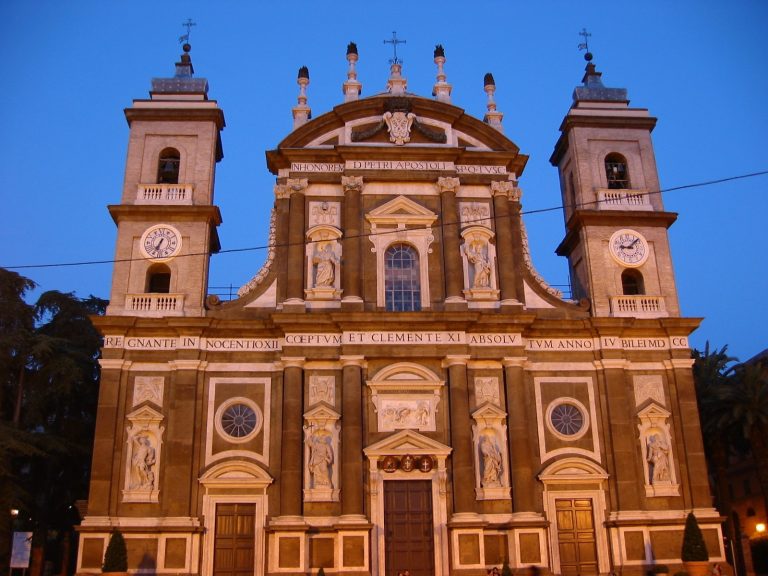
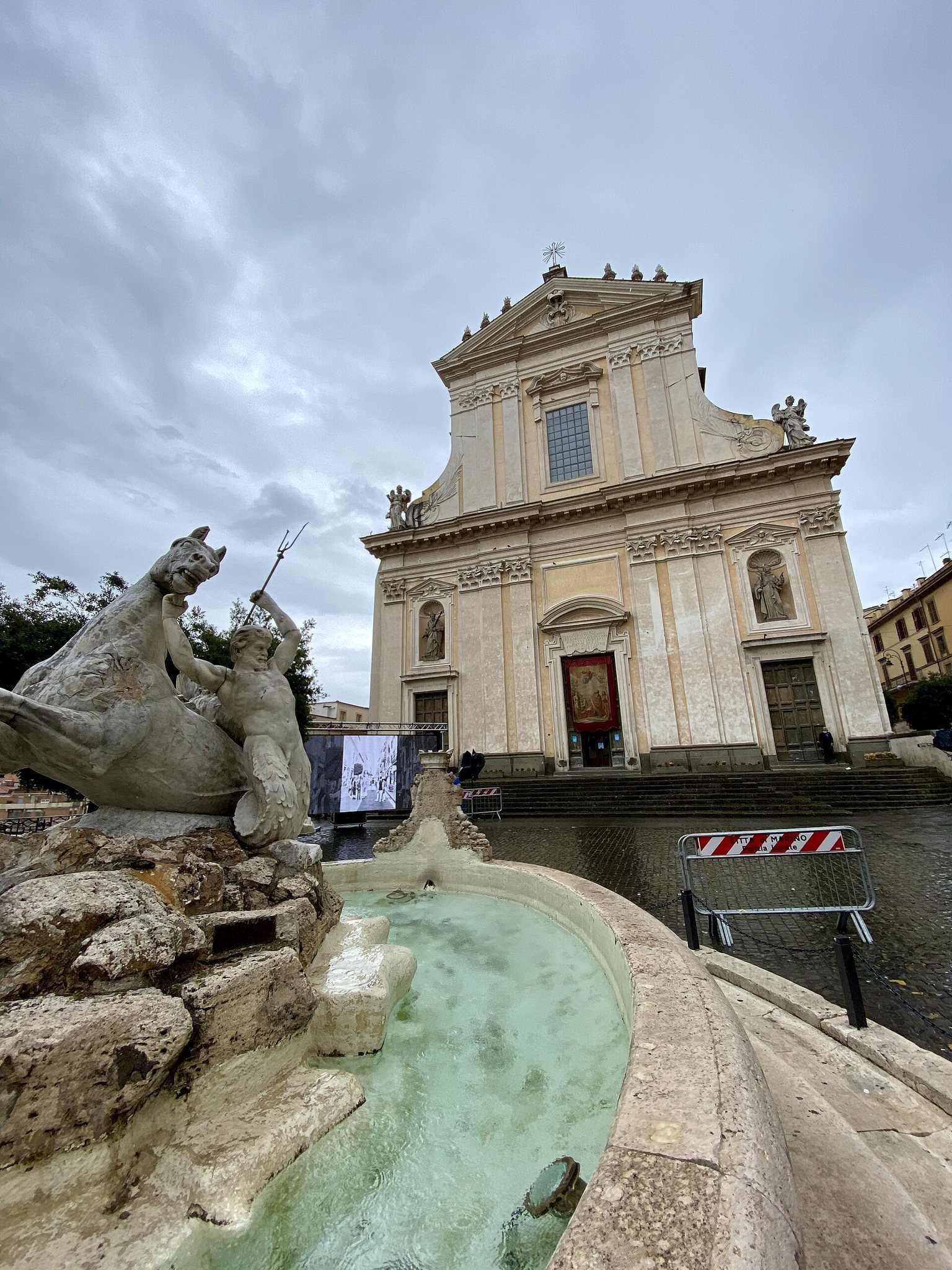
Built in 1652 and 1653, the facade was completed more than a decade after work on the church began. A cornice divides it horizontally, while six giant Corinthian pilasters of peperino, a volcanic stone widely used in the Alban Hills and Rome, divide it vertically into three sections. Later restoration gave the architectural members a faux-travertine finish and painted the recessed panels ochre yellow.
Three doors open into the basilica. Above the side doors are painted peperino statues, each about two metres high. Saint Barnabas holds the palm of martyrdom, while Saint Lucy holds a martyr’s palm and a dish containing her eyes. Two painted angels stand above the niches. The statues of the saints probably date from about 1690 to 1710, and the angels from the late seventeenth century. The tympanum bears Cardinal Girolamo Colonna’s arms, showing a column surmounted by a cardinal’s galero. An iron cross and six peperino torches stand above the pediment.
Nave and dome
The central nave is covered by a lunetted barrel vault, a vaulted ceiling interrupted by semicircular openings. The side spaces consist of communicating chapel bays with barrel vaults set across the direction of the main vault. Six lunettes, three on each side, admit natural light to the nave, while windows in the lantern illuminate the dome. The dome has an octagonal, pavilion-like exterior and a rounded interior calotte. Eight stucco ribs divide the interior into sections and meet at the lantern, which stands about 31 metres above the floor.
Crypt and entrance furnishings
The first bay of the right aisle no longer contains an altar, probably because a staircase to the underground crypt was installed there. It formerly belonged to the Ristretto of Saint Francis Xavier, a confraternity chapel. The former altar was represented by a monochrome painted illusion that disappeared during the 1909 plastering work. Its altarpiece, the Death of Saint Francis Xavier, was painted by Francesco Rosa around 1675 to 1680.
Above a white-marble holy-water stoup on the first right-hand pillar is a bronze cross from the Holy Door of the Basilica of Saint John Lateran in Rome. Cardinal Girolamo Colonna donated it after opening that door during the Jubilee of 1650.
The underground crypt was restored during the 1960s. It contains or formerly contained the burials of Guglielmo Grassi, Giovanni Battista Trovalusci, and Barbara Costantini, together with nineteenth-century funerary inscriptions, including those of four French and Belgian Papal Zouaves. Trovalusci’s granite-and-iron sarcophagus was designed by Sandro Benedetti. Grassi’s remains were transferred to the central nave in 2014.
Chapels of the right aisle
Saint Anthony the Abbot
The second bay contains the former chapel of the Confraternity of Charity, now dedicated to Saint Anthony the Abbot. Its altar front displays the confraternity’s red potent cross and the word charitas in gold. The marble statue of Saint Anthony has been attributed to Ercole Ferrata or Camillo Rusconi and dates from about 1685. Anna Maria Meucci painted the image of Saint Joseph with the Christ Child in 1871.
Our Lady of the People
The third bay contains the altar of Our Lady of the Most Holy Rosary, venerated as Our Lady of the People. The image was probably brought to Marino during the first half of the fifteenth century and transferred from Santa Lucia to the basilica in 1662. Its altar was consecrated in 1751 and incorporates ancient yellow-marble columns. The original image was stolen in 1984 and replaced by a copy.
Fifteen stucco panels around the altar contain anonymous paintings of the Mysteries of the Rosary, probably made in the mid-eighteenth century. A second painting of the Madonna of the Rosary, dated 1748 and attributed on documentary grounds to Sebastiano Ceccarini, was discovered in 2019 in a concealed space behind the Marian image’s frame. It had once been raised and lowered by a hand-operated pulley.
Lepanto shield
A shrine set into a pillar contains a shield associated with the Battle of Lepanto in 1571. Restoration presented in 2020 established that it was a pavise, a large shield used by infantry or missile troops, belonging to a soldier from Marino who took part in the battle and later donated it to the church. It was therefore not a shield captured from the Ottoman fleet, as tradition had held.
A bronze plaque by Nino Lodi commemorates the Lateran Pacts of 1929, the agreements that regulated relations between the Kingdom of Italy and the Holy See. The marble altar balustrade was made in 1946 by Tito Bellucci in memory of his wife Elena.
Chapels of the left aisle
Assumption of the Virgin
The first bay of the left aisle has no altar. Its rear wall carries a large canvas of the Assumption of the Virgin Mary, formerly kept in the Oratory of the Coroncina. The painting dates from the late seventeenth century and has been attributed either to a late Baroque follower of Carlo Maratta or, without currently established supporting evidence, to Pier Leone Ghezzi.
Crucifix and Our Lady of Sorrows
The second bay contains the altar of the Crucifix and Our Lady of Sorrows. Its large wooden crucifix came from the suppressed church of Santa Lucia and was installed here in 1706. The cross has features associated with a sixteenth-century Neapolitan school, while the figure of Christ has been linked to a southern Italian workshop of the fifteenth century. A small image of Our Lady of Sorrows at its foot is attributed to Carlo Maratta.
Four marble plaques in the chapel commemorate victims of the Allied bombardments of 1944. The third bay formerly contained the chapel of Saint Lucy. After restoration in 1952, its altarpiece was replaced in 1966 by Giuseppe Ciotti’s painting of suffering humanity turning toward the Sacred Heart of Jesus under the guidance of Guglielmo Grassi.
Transepts and presbytery
Altars of the transepts
The right transept contains the altar of the Blessed Sacrament, also called the altar of Our Lady of Mount Carmel. Giovanni Battista Mocchi built it from ancient colored marbles, including antique yellow, black, and serpentine marble. Its altarpiece shows Our Lady of Mount Carmel with the Christ Child, Saint Teresa of Avila, and Saint John of the Cross. The painting is attributed to Luigi Garzi, although it is also described as anonymous. The chapel formerly belonged to the Confraternity of the Blessed Sacrament, and an organ from the suppressed church of Saint John the Baptist stood there until at least 1870.
The left transept contains the altar of Saint Bartholomew, originally established as the Galantini family chapel. Giulio Galantini received permission to build it in 1677, and the work was nearly complete by 1679. Its altarpiece, the Martyrdom of Saint Bartholomew, is a contemporary copy by Giacinto Campana of a work by Giovanni Francesco Barbieri, known as Guercino, painted in 1635 and 1636 for San Martino in Siena.
Presbytery
The presbytery, the part of the church surrounding the high altar and traditionally reserved for the clergy, contains a circular, temple-shaped tabernacle of marble and red Verona marble, probably made during the first half of the eighteenth century. Its ciborium is a modern silver-plated metal work by Tommaso Merendoni. The baptismal font installed during the 1978 reordering consists of an eighteenth-century marble basin on a quatrefoil base and a circular, temple-shaped wooden structure.
The rear wall bears a large painting of the Martyrdom of Saint Barnabas, attributed to Bartolomeo Gennari, a pupil of Guercino’s workshop, or possibly to Guercino himself. Its frame carries the Latin inscription Divo Barnabae. The two marble wall niches were begun by Carlo Spagna in 1651 and completed by Gabriele Renzi between 1653 and 1655.
The right niche contains the cenotaph of Cardinal Girolamo Colonna, a commemorative monument for a person buried elsewhere. It shows him kneeling in prayer at a prie-dieu bearing the Colonna arms. The work has been attributed at different times to Alessandro Algardi or his school, Francesco Mochi, Gian Lorenzo Bernini, and more recently Orfeo Boselli. The left niche was intended for an urn containing sacred relics.
Choir and associated buildings
The winter choir chapel contains walnut choir stalls made in 1747. Giuseppe Aluisi painted the Glory of the Holy Spirit on its vault in 1873, and the work was restored in 1964. The chapel also contains a painting of Saint Francis of Assisi attributed to Girolamo Muziano, a Deposition or Humanity of Christ attributed to Cherubino Alberti, and a copy of a painting of Saint Roch. Two oval paintings of Saint Peter and Saint Paul, attributed to Guido Reni, were formerly kept there but were stolen in 1984.
The basilica’s associated fabric includes the Oratory of the Gonfalone and the former Oratory of the Coroncina. The latter served at different times as a refuge and community facility. It formerly housed the large painting of the Assumption that is now displayed in the basilica.