St. George’s Basilica: A Baroque Parish Church in Victoria, Gozo
Site at a Glance
- Rating
- 4.7
- Popularity
- Medium
- Country
- Malta
- Primary era
- Early Modern
- External website
- Open
- Eras represented
- Early Modern, Modern
- Civilizations
- Crusader, Knights Hospitaller
- Site type
- Religious
- Remains
- Basilica
On this page27 sections
History
St. George’s Basilica is a Roman Catholic parish and collegiate church in Victoria, Gozo, Malta, traditionally traced to a Christian foundation in the Byzantine period during the fourth century. A Roman pagan temple on the site was said to have been converted into a church dedicated to Saint George, the Christian martyr traditionally associated with the defeat of a dragon and the basilica’s patron saint. The present building is a Baroque church with a Neoclassical facade, rebuilt mainly in the late seventeenth century.
Early parish history
Manuscript records show St. George’s functioning as a parish church around 1250. It was also listed among Gozo’s parishes eligible for indulgences under Pope Nicholas V’s bull for the Holy Year of 1450. Until 1575, the parish followed the Byzantine rite, an Eastern Christian liturgical tradition associated with the Byzantine world. It was the last church on Gozo to use that rite before adopting the Roman rite, the principal Latin tradition of the Roman Catholic Church.
An apostolic decree issued in 1511 recognized St. George’s as Gozo’s parish church, with responsibility for the island’s entire population. During the Middle Ages, the church was rebuilt several times as Gozo’s population increased. Its history then took a destructive turn in 1551, when an Ottoman invasion led to the capture and deportation of most of Gozo’s inhabitants, including the parish priest Lorenzo de Apapis, who was taken to Constantinople.
After purchasing his freedom and returning to Gozo, De Apapis rebuilt the badly damaged church. Further rebuilding followed in 1583 and 1598. In 1630, Pier Francesco Pontremoli, vicar general of the Diocese of Malta, proposed joining the parishes of St. George and the Assumption in the Cittadella because of disputes and rivalry between their parish priests. Bishop Davide Cocco Palmieri carried out the union on 28 April 1688, after four new parishes had been established on Gozo. St. George’s was placed under the authority of the Assumption church.
Seventeenth-century rebuilding
In 1603, Grand Master Alof de Wignacourt commissioned Vittorio Cassar to rebuild the parish church and remove buildings that might shield an enemy attack on the Cittadella. Construction began in earnest only after Pope Clement X authorized the use of funds from the Holy See after 1670. The foundation stone of the present church was laid on 7 August 1672, and construction was completed in 1678.
The new building was consecrated on 21 September 1755 by Bishop Paul Alphéran de Bussan. It was then the largest Christian church on Gozo and the first on the island built on a Latin-cross plan. A 1678 inscription in the church commemorates Gozo’s deliverance from the plague of 1675, while another records the dedication and altar consecration of 1755.
The union with the Assumption parish lasted 266 years. Bishop Giuseppe Pace dissolved it on 1 August 1955 through the decree Cum hodiernis temporibus, restoring St. George’s independent pastoral administration. This returned the church to a separate parish role after more than two and a half centuries under the authority of the Cittadella parish.
Damage, enlargement, and artistic development
Earthquakes affected the church at several points. The earthquakes of 1693 and 1789 damaged the dome, while an earthquake on 1 February 1697 damaged the facade. Salvatore Bondi designed the replacement facade, completed in 1818. The dome was reconstructed in 1939 and 1940.
The church was enlarged during the 1930s through the addition of side naves and chapels. Its roof was reconstructed in 1938 and 1939, and Bishop Mikiel Gonzi inaugurated the enlarged building on 28 July 1940. A major interior campaign followed between 1945 and 1954. The dome was decorated from 1945 to 1949, work on the naves began in 1952, and the organ gallery was redecorated during the same period.
The church’s religious history also includes the foundation of the Franciscan Sisters of the Heart of Jesus. In 1880, the associate priest Joseph Diacono helped establish the congregation at St. George’s. Religious Virginia De Brincat opposed Diacono’s later wish to end the organization and became its superior general. She is now known as the Venerable Madre Margerita De Brincat.
Basilica and collegiate status
Pope Pius XII elevated the parish church to a minor basilica through the decree Merito dilaudatur templum, dated 6 September 1958. It was the first parish church on Gozo to receive that title. A basilica is a church granted special papal status and associated privileges. St. George’s received precedence over other churches, the right to use an umbraculum, a ceremonial umbrella, and a tintinnabulum, a ceremonial bell mounted on a staff. It could also display the papal crossed-keys emblem on its banners, furnishings, and seal.
On 8 December 1975, Bishop Nikol Joseph Cauchi established the first chapter of the Pontifical Collegiate Church of St. George. A collegiate church is served by a chapter of clergy known as canons. St. George’s was aggregated to the Papal Archbasilica of St. John Lateran in Rome, and its collegiate chapter remains the only pontifical collegiate chapter in the Diocese of Gozo. The current chapter has 13 members.
The basilica has also served the Anglican community of Gozo since the community dedicated to the Blessed Virgin and Saint George was established there on 23 April 2005. The community belongs to the Diocese of Europe, participates in ecumenical services, and celebrates important Anglican services in the basilica. The liturgical feast of Saint George falls on 23 April. The principal external patronal celebrations take place during the week before the third Sunday of July and include the public procession of the titular statue and religious ceremonies. The feast reflects Saint George’s role as protector of Gozo and patron of Victoria.
Recent cultural use
In February 2013, the basilica opened the Il-Hagar museum and cultural centre. The purpose-built museum made historical and artistic objects formerly inaccessible to the public available for display, while also providing space for temporary exhibitions and cultural events. The church is listed in the National Inventory of the Cultural Property of the Maltese Islands under number 00898 and is identified as a Grade 1 protected building.
Remains
Exterior and overall plan
Facade and bell towers
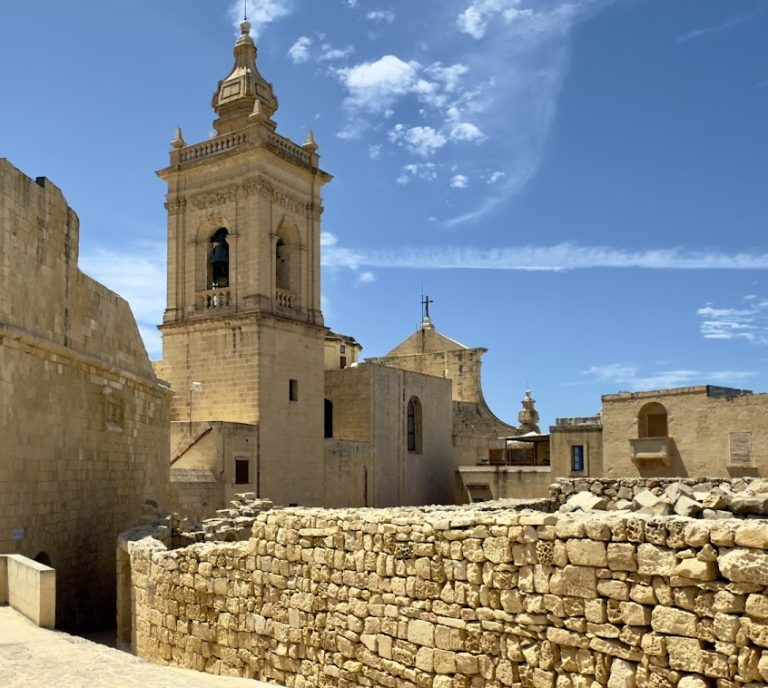
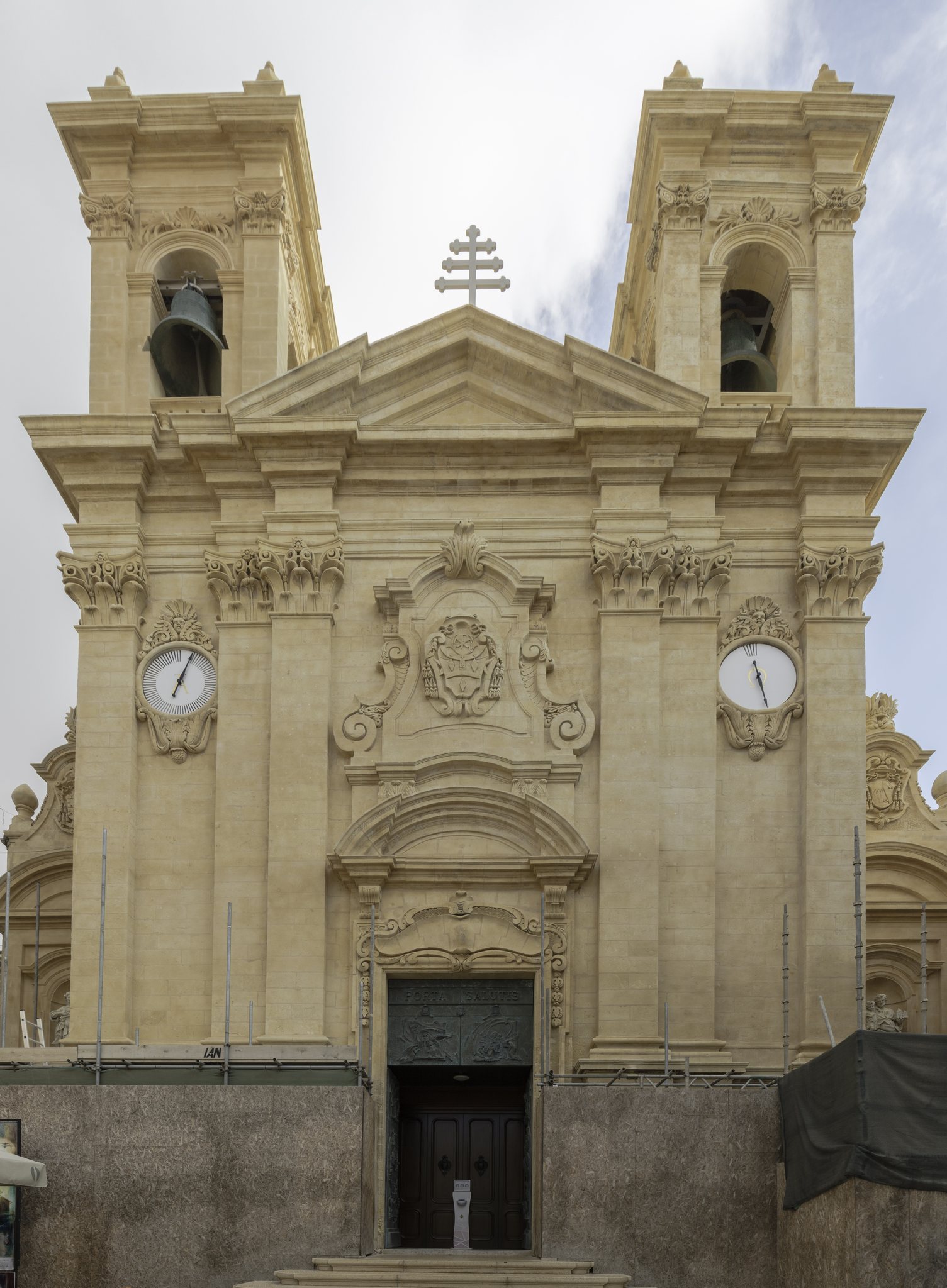
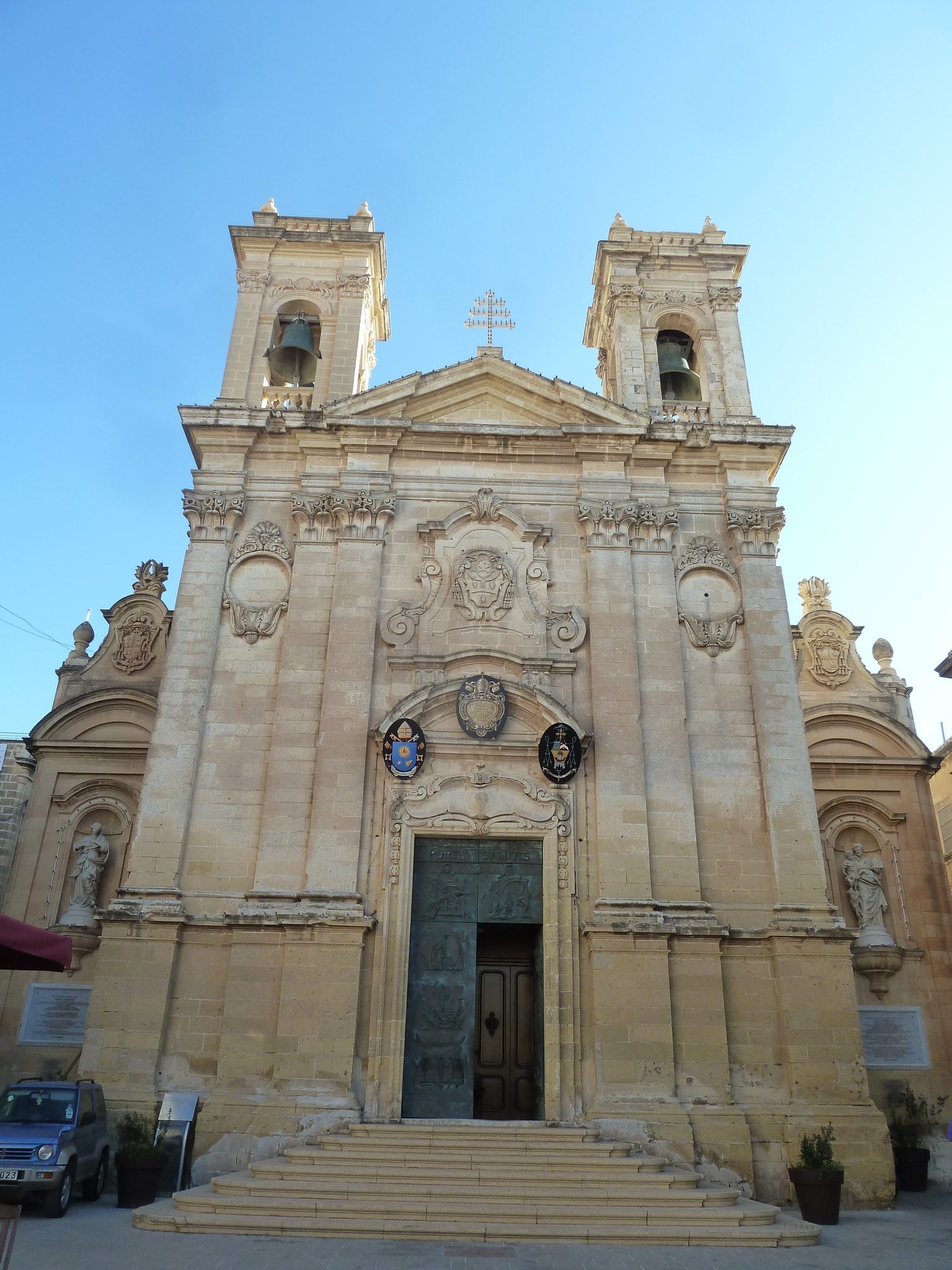
The basilica stands in central Victoria, the historic capital of Gozo, amid narrow streets and alleys. Built principally of limestone, it combines a Baroque body with a Neoclassical facade. Its essential plan is a Latin cross, and the building has three naves, two bell towers, a principal dome, and several subsidiary domes. One architectural inventory counts ten domes and nine altars, while the church contains eleven side chapels.
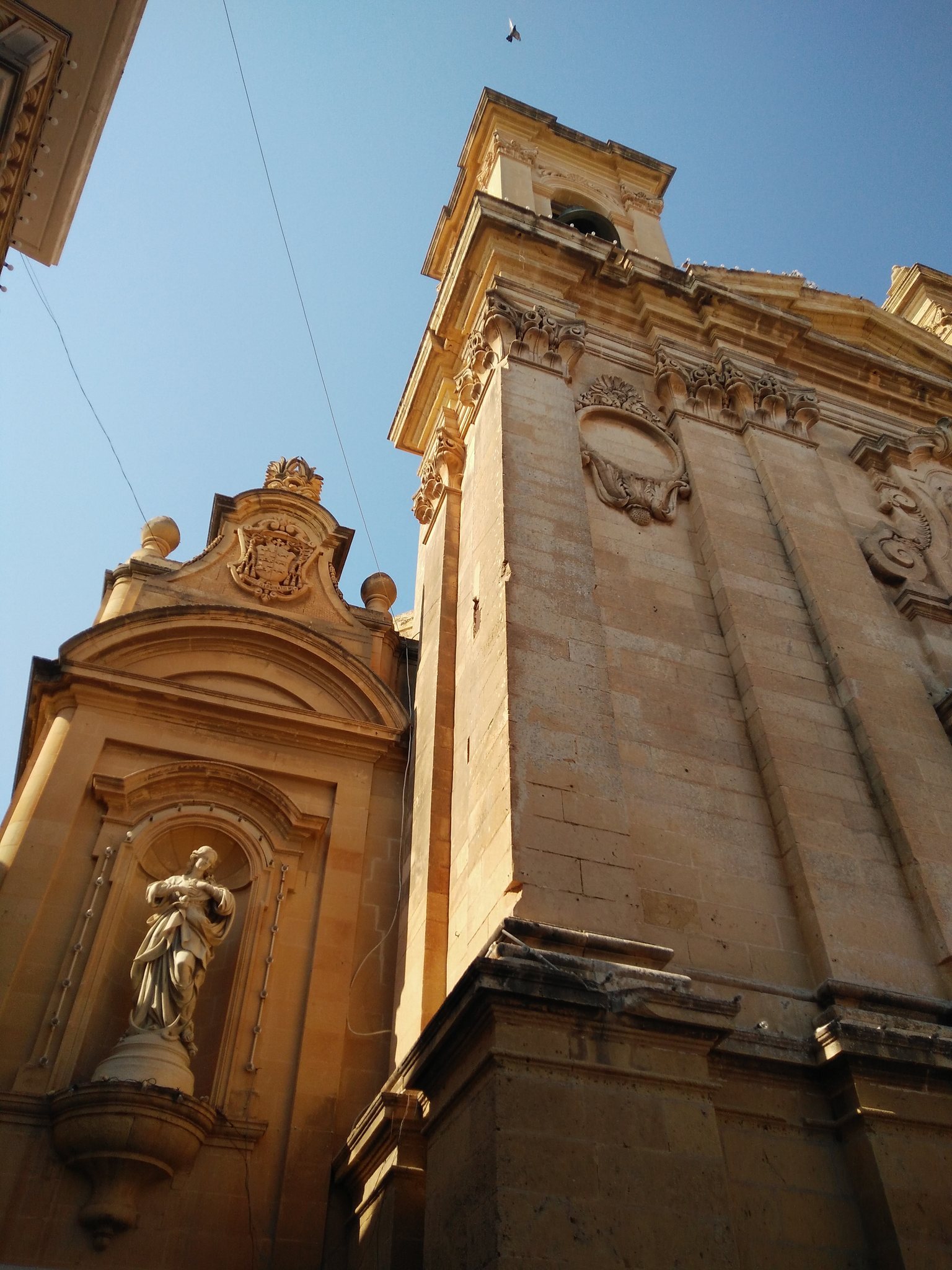
The facade rises on high plinths that occupy almost one-third of its height and is divided into three bays. The wider central bay is framed by two pairs of pilasters with acanthus-leaf capitals, together with another pilaster at each outer edge. The upper level rests on a broad cornice, with a triangular pediment between two square bell towers. Stone balustrades crown the towers, which contain five bronze bells cast in 1925 by Fonderia Barigozzi of Milan.
Entrance and side naves
The central entrance is occupied by the bronze door known as Porta Salutis. Designed by John Grima, manufactured by Fonderia Bonvicini in Verona, and installed in 2004, it contains eight designs and bears the coat of arms of Pope John Paul II. Its inscription reads Porta Salutis. The door is described as the only bronze door on Gozo. Above it, a rounded pediment carries three coats of arms, while a cornice and a scrollwork cartouche with another coat of arms occupy the area above the entrance. The two side bays contain blind circular windows with foliate decoration.
The side naves were added during the 1930s, and their front walls are recessed behind the front of the main nave. Niches in their fronts contain figures of the Immaculate Conception and Saint Joseph, sculpted by Alfred Camilleri Cauchi in 1992. The western entrance chapel occupies the position of the earlier church’s facade and main entrance, whose orientation differed from that of the present building.
Main dome
The principal dome rises from a tall octagonal drum and has a lantern. Reconstructed in 1939 and 1940, it received paintings by Gian Battista Conti, stucco work by Giuseppe Galea, and eight stained-glass windows designed by Conti during the decoration campaign of 1945 to 1949. Together with the ceiling and central dome, it carries oil paintings on canvas produced by Conti with Galea’s stucco work between 1945 and 1954. The dome paintings take their theme of victory from the Book of Revelation, the final book of the Christian New Testament.
Interior decoration and presbytery
Nave paintings and high altar
The interior is richly finished with marble, gold stucco, polychrome marble, mosaics, and paintings, giving the church its traditional description as Gozo’s golden church. The main nave and the two transepts contain six episodes from the life and martyrdom of Saint George. Near the twelve windows beneath the vault are representations of the Apostles and Evangelists, accompanied by 24 angels holding scrolls inscribed with virtues associated with Saint George. The conches of the apse, entrance or organ apse, and two transepts depict Saint George’s protection of the Maltese islands and other countries.
The present high altar replaced the Baroque altar in 1960. Designed by the Roman sculptor Carlo Pisi, it is made of white Carrara marble and shows four kneeling, vested archangels supporting the altar slab, which is conceived as Christ’s throne. A bronze and gilded canopy stands above it. Created in 1967 after the liturgical reforms of the Second Vatican Council, the canopy was inspired by Bernini’s canopy in St. Peter’s Basilica and was intended to give the church the character of a miniature basilica of Saint Peter.
Earlier high altar and presbytery paintings
The Baroque high altar installed in 1755 was made by Claudio Durante of Valletta to designs by Francesco Vincenzo Zahra and used six types of Sicilian marble. It was dismantled in 1960, and its components disappeared before being rediscovered in 1999. They were restored in 2011 and later exhibited in Valletta.
The enlarged apse and presbytery contain Mattia Preti’s Triumph of Saint George, painted in 1678 for Governor Francesco de Corduba. The work shows Saint George overcoming the dragon, with the donor’s coat of arms in the lower-left corner, and is regarded as one of Gozo’s important seventeenth-century paintings. Francesco Zahra’s Saint George before Diocletian and The Beheading of Saint George are also in the presbytery. Paintings of Saint Peter and Saint Paul by Attilio Palombi, made in 1906, flank Preti’s altarpiece. They replaced stone statues removed when the presbytery was enlarged in 1905.
Below Preti’s titular painting is Pierre Guillemin’s 1732 Virgin and Child with Saint John the Baptist, known as the May Madonna. It rests on a marble altar made in 1914 and has a carved, gilded frame.
Chapels of the left nave
Saint Paul and Saint Alphonsus Liguori
The Chapel of Saint Paul contains a Baroque altar and Stefano Erardi’s 1699 painting of the Immaculate Conception and Saint Paul, with a smaller painting of Saint Publius above it. The altar base bears the Maltese symbol of Saint Paul, a viper rising from a fire. The nave also contains a papier-mache statue of Our Lady of Sorrows, made by Michael Camilleri Cauchi in 1982 for the Good Friday procession, and a monument to Archpriest Alfons Maria Hili.
The entrance chapel of Saint Alphonsus Liguori has no altar. Its small 1925 oil painting of the saint was made by Ramiro Cali. Side doors lead towards the Il-Hagar museum.
Saint Michael and the Holy Souls
The Chapel of Saint Michael the Archangel was completed in 1936. It contains a mosaic made in Rome in 1963 after an older painting now preserved in the basilica museum.
The Chapel of the Holy Souls in Purgatory contains a Baroque altar designed by Francesco Zahra and made by Gian Antonio Durante between 1759 and 1761. Its principal painting is Mattia Preti’s Madonna with the Souls in Purgatory, commissioned by the Gourgion family, whose members appear as donors in the lower part of the work. The chapel also contains a wooden statue of Our Lady of Fatima brought from Portugal in 1950, a statue of Saint Anthony of Padua by Carlo Pisi from 1965, and a statue of Saint Maria Goretti in the corridor leading to the sacristy.
Jesus and Mary
The Chapel of Jesus and Mary contains Alessio Erardi’s painting of Christ and the Virgin with Saints Ignatius of Loyola and Francis Xavier, with Saint Francis Borgia in the upper panel. A wooden double statue of Jesus and Mary, carved by Sigismondo Dimech between 1802 and 1807, is also kept in the chapel.
Chapels of the right nave
Saint Catherine and Saint Thérèse
The right-side chapels occupy the former line of St. George’s Street, which remained in place until 1936. Excavation during their construction uncovered a cave containing approximately 4,000 Roman coins together with ceramic and marble objects.
The Chapel of Saint Catherine of Alexandria contains a mid-eighteenth-century Baroque altarpiece and Giuseppe D’Arena’s 1692 painting of the Mystic Marriage of Saint Catherine. The altarpiece also includes Saint Isidore of Seville, associated with the former Byzantine liturgical tradition. Its antependium, the decorated front panel of an altar, contains the relics of Saint Pacificus, identified as a Roman catacomb martyr. A bronze statue of Bishop Giuseppe Pace, made by Censu Apap in 1996, also stands in the chapel.
The entrance Chapel of Saint Therese of Lisieux has no altar. Above its doorway is a small oval oil painting of the saint, made by Ramiro Cali in 1925. The chapel occupies the position of the western facade and main entrance of the earlier church, which faced in a different direction from the present building.
Saint Joseph and Saint Lazarus
The Chapel of Saint Joseph contains a Baroque stone-and-gilt altarpiece and Giuseppe Cali’s 1899 painting The Holy Family. Before 1905, the chapel was dedicated to the Trinity and Saints Andrew, Basil, and Homobonus. Enrico Regnaud’s former painting of that subject is now displayed in the Il-Hagar museum.
The Chapel of Saint Lazarus occupies the location of an early Byzantine Christian sanctuary. Its 1923 altar replaced an earlier stone-and-wood altar, and its antependium contains the relics of Saint Clement. Giuseppe D’Arena’s Raising of Lazarus, dated either 1677 or 1689, replaced an earlier painting mentioned before 1621 and was restored in 1999.
Holy Cross
The Chapel of the Holy Cross formerly contained the altar of Saint Cajetan. It now contains Pietru Pawl Azzopardi’s wooden crucifix of 1848, Azzopardi’s wooden titular statue of Saint George made in 1839, and Alfred Camilleri Cauchi’s statue of the Resurrected Christ from 1996. The latter is carried in the Easter Sunday procession.
The 1839 statue of Saint George was the first titular statue acquired by a parish church on Gozo. Tradition identifies it as an ex-voto, an object offered in fulfillment of a vow or as thanks for divine assistance. It was restored in 1903 and 1996 and stands beside the Chapel of Saint Cajetan. The chapel also contains an anonymous Volto Santo, representing the face of Christ on Veronica’s cloth, and Raymond Pitre’s 2003 portrait of Saint George Preca, founder of the Society of Christian Doctrine.
Neo-Byzantine chapel and historic sacred objects
Chapel of the Holy Cross and Blessed Sacrament
A Neo-Byzantine chapel dedicated to the Holy Cross and the Blessed Sacrament was begun when its foundation stone was laid on 23 April 2002. Its dome was begun in 2004, and the chapel was blessed on 10 July 2005. Designed by Vince Centorrino, it has eight Byzantine-style windows, gold mosaic decoration, and a floor paved with porphyry slabs.
The chapel contains a solid silver tabernacle more than two metres high. Joseph Sagona designed it in the form of a medieval ciborium, a vessel or canopy associated with the reservation of the Eucharist. A medieval ciborium, probably dating from the twelfth century, was found concealed in the old facade during demolition and reconstruction in 1816. It is now preserved in the Gozo Cathedral Museum, while the silver tabernacle reproduces its historical form.
Organ gallery and ancillary rooms
Organs and inscriptions
The carved and gilded organ gallery above the main entrance took its present form in 1940 through the work of Emanuele Buhagiar and was completed in 1976 by Joseph Sagona. It contains a Baroque organ built in Sicily by the Santucci brothers in 1781. The instrument is described as the only surviving working Baroque organ on Gozo.
The organ fell silent in the mid-1960s and was temporarily replaced by portable electronic instruments. In the late 1990s, Piero Piccioni restored it in Italy. A new digital organ then replaced the electronic instrument, and the Baroque organ could again be played either from the gallery or from a console behind the high altar. In 2004, Dr Richard Vendome donated a nineteenth-century pipe organ formerly housed in a Methodist assembly hall in the United Kingdom. It was installed in St. Michael’s Hall and inaugurated in 2006.
A large cartouche beside the organ gallery commemorates the basilica’s association with the Lateran Archbasilica. The gallery area also preserves the inscriptions relating to the plague of 1675 and the dedication and altar consecration of 21 September 1755.
Sacristy and chapter rooms
The main sacristy is attached to the rear wall of the basilica. It preserves baptismal and marriage registers dating from 1628, gilded stucco surrounding three paintings made between 2000 and 2003 by Paulo Camilleri Cauchi, a 1924 papier-mache statue of Saint Joseph by Wistin Camilleri, and portraits by Maltese and Italian artists.
On the first floor, the Aula Capitularis is the official seat of the collegiate chapter and contains several valuable paintings, including former titular paintings removed from the basilica’s altars. St. Michael’s Hall houses the nineteenth-century British pipe organ and is used for organ concerts. The adjacent Aula of Father Giuseppe Farrugia accommodates parish meetings, recitals, symposia, conferences, receptions, and other cultural or private events.