Salos Manor: A Neoclassical Estate in Lithuania


Site at a Glance
- Rating
- 4.5
- Popularity
- Low
- Country
- Lithuania
- Primary era
- Early Modern
- External website
- Open
- Eras represented
- Early Modern
- Civilizations
- Grand Duchy of Lithuania, Polish–Lithuanian Commonwealth
- Site type
- Domestic
- Remains
- Manor House
On this page8 sections
History
Salos Manor is a former residential manor in Salos, Lithuania, whose present mansion was built in the late eighteenth century in the neoclassical style. The estate stands in an area that belonged in medieval times to the King of Poland and Grand Duke of Lithuania. Its history later connected the site with the Radziwiłł, Moriconi, Tyzenhauz, and Przeździecki families, as well as with education, political uprisings, and regional cultural life.
From royal land to the Radziwiłł estate
Sigismund the Old, who ruled as King of Poland and Grand Duke of Lithuania from 1506 to 1548, distributed parts of the surrounding territory among relatives and supporters. By the sixteenth century, Salos and its lands, forests, lakes, and swamps belonged to the Nesvizh branch of the Radziwiłłs, a powerful Lithuanian aristocratic family. The family apparently did not live at Salos permanently, using the area instead for hunting.
The estate later passed from the Radziwiłłs to the Moriconis, first as a pledge and eventually as permanent property. A deed from 1661 names a Moriconi as the owner, while Krzysztof Moriconi, mentioned in 1733, is the first historically confirmed owner. The Moriconis were of Italian origin and had entered the political and landholding elite of the Polish Crown through Queen Bona Maria Sforza in the 1530s. During the seventeenth century, members of the family moved to Lithuania, where marriages with influential Polish and Lithuanian families, including the Radziwiłłs, helped them acquire land and wealth.
The Moriconi period
Marcian Ignatius Moriconi (1720–1794), Treasurer of the Grand Duchy of Lithuania and elder of Ukmergė in 1771, received Salos and Taujėnai from his father. His son Ignacy Moriconi inherited Salos Estate, and his acquisition of the estate is dated to 1806. The Moriconi period brought institutions that served the surrounding community. Under Ignacy, the estate supported a school for peasants, a village hospital, and a small pharmacy. A pharmacy and a music school were also housed in the palace.
The family’s religious patronage extended beyond the estate. Ignacy financed the construction of Holy Cross Church in 1781 and took charge of building St. Francis Seraph Church in Aleksandravėlė in 1784. His will cancelled the debts owed to him by the estate’s peasants.
Ignacy and his brother Benedykt also became involved in the Kościuszko Uprising of 1794, an insurrection led by Tadeusz Kościuszko against the powers that had partitioned the Polish-Lithuanian Commonwealth. Benedykt became one of its leaders and commanders in Lithuania, gathering local rebels in Aukštaitija, a historical and ethnographic region of northeastern Lithuania. Some of the men dressed as horsemen in Hungarian Hussar uniforms.
Inheritance, revolt, and the Tyzenhauz era
After Ignacy’s death, Salos passed to Benedykt Moriconi, who died at Salos Manor on December 11, 1839. He was buried in the family grave at Troškūnai Manor, also known as Smėlynė Manor. Salos then passed to Hieronim Moriconi, who was married to Gertrude Sacken. Hieronim’s testamentary transfer of his property to two Moriconi sisters was challenged by Strutinsky, probably Hieronim Justyn Strutyński.
Hieronim’s son Liucijon Moriconi (1818–1893) inherited the estate. He took part in the January Uprising of 1863, a major Polish-Lithuanian revolt against Russian rule. Liucijon was detained and imprisoned in Vilnius for several months. After losing much of his property, he sold Salos to Count Rejnold Tyzenhauz. Liucijon later moved to Warsaw, worked as a teacher, and died there on February 14, 1893. He was buried in Vilnius’s Rasos Cemetery.
Under Rejnold Tyzenhauz, Salos became a cultural centre for the surrounding area. Celebrations at the estate attracted members of the elite from Kaunas Province and Vilnius. The park contained a summer theatre whose performers were invited from other provinces and from France. The manor also had one of Lithuania’s earliest music-school orchestras, led by Jurgelionis. Tyzenhauz had inherited Rokiškis Manor from his father in 1853 but had no children.
Later owners and twentieth-century uses
After Rejnold Tyzenhauz’s death, Salos passed to his sister Maria Przeździecka. This ended the estate’s period of cultural prominence. The new owners lived at Pastovys or Rokiškis Manor, while tenants occupied Salos. The last owner was Maria Przeździecka’s grandson, Konstanty Gabriel Kazimierz Przeździecki (1876–1966), a diplomat, writer, and former colonel in the Polish Army. He left for Sweden at the beginning of the Second World War and died there in 1966.
After the First World War, a girls’ school was established in the manor house. In 1924, the estate, comprising 94 hectares of land and 23 buildings, was transferred to A. Čeičas, head of the Antalieptė agricultural school. After the Second World War, the complex was used for agricultural engineering. Study of the estate began in 1969, and renovation work started in 1977. The manor house had suffered relatively little damage during the postwar period.
The building continued to function as a school until 2003. It now accommodates private celebrations and cultural events. A later legend also claimed that the dead Liucijon Moriconi returned as a ghost and haunted the palace rooms.
Remains
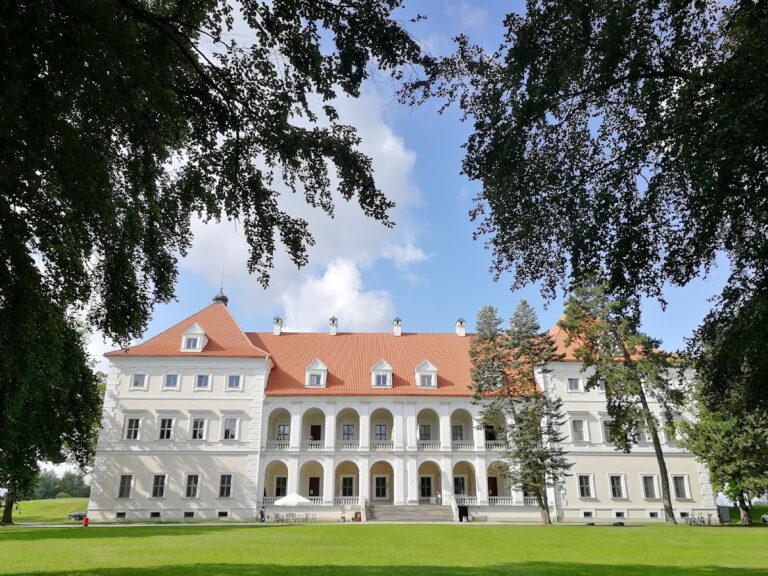
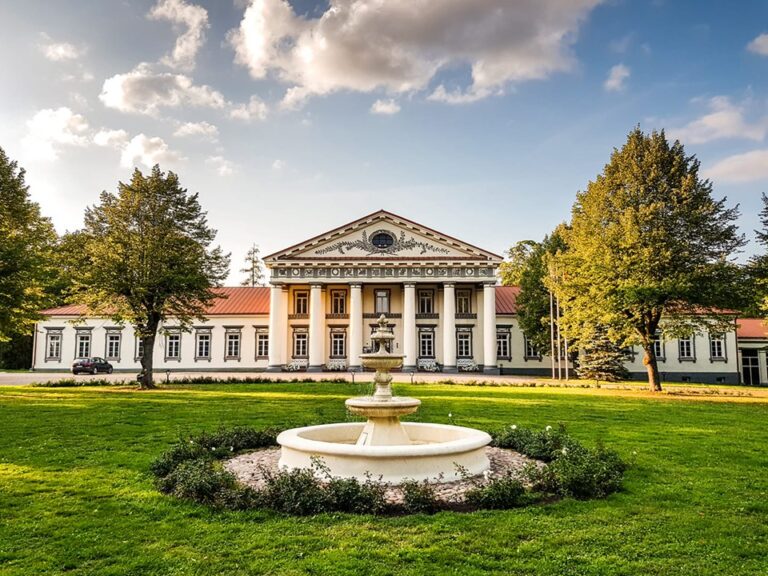
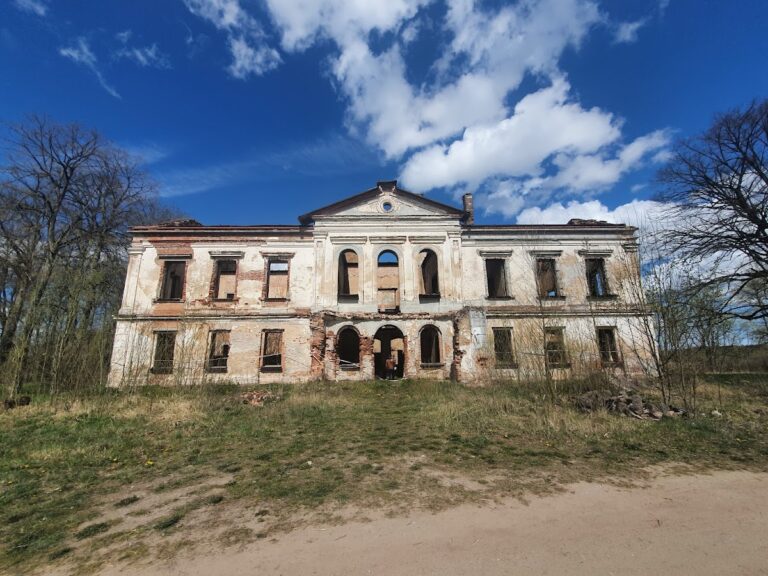
Salos Manor is a neoclassical palace and estate whose principal residence stands within grounds that included a garden in front of the building and a park with a summer theatre stage. The neoclassical design uses balanced proportions, restrained ornament, and classical forms associated with ancient Greek and Roman architecture. The estate’s recorded scale included 23 buildings across 94 hectares when it was transferred in 1924.
The manor house
The present mansion was built in the late eighteenth century, possibly to a design by Pietro de Rossi. It replaced an earlier wooden manor house that stood on a stone foundation. During the Tyzenhauz period, rooms in the palace were decorated with tapestries brought from England. The building also accommodated the estate pharmacy and music school during the Moriconi period.
Park and estate grounds
The grounds combined a formal garden in front of the palace with a park containing a summer theatre stage. These landscape features formed part of the estate’s cultural setting during the Tyzenhauz period, when performances were held for visitors from Kaunas Province, Vilnius, other provinces, and France. The manor complex underwent renovation beginning in 1977, after surviving the postwar period with relatively little damage.
Nearby sites