Gutenfels Castle: A Hohenstaufen Fortress above Kaub, Germany


Site at a Glance
- Rating
- 4.6
- Popularity
- Low
- Country
- Germany
- Primary era
- Medieval
- External website
- Open
- Eras represented
- Medieval, Early Modern
- Civilizations
- Electoral Palatinate, Holy Roman Empire
- Site type
- Military
- Remains
- Castle
On this page13 sections
History
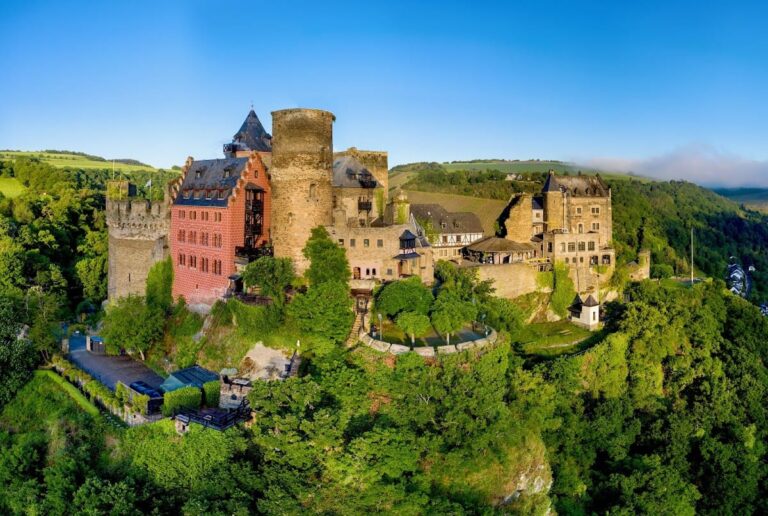
Gutenfels Castle is a medieval fortress above Kaub in Germany’s Upper Middle Rhine Valley, built as Castle Kaub around 1220–1230 in the Hohenstaufen period. Probably established as an imperial fortress, it was first mentioned in writing in 1237 and became part of a defensive network controlling the Rhine and the surrounding territory.
Hohenstaufen and Palatine rule
The fortress was administered by vassals of the Hohenstaufen dynasty, a medieval German ruling family whose rulers promoted fortified centers across the Holy Roman Empire. In 1252, an army led by William of Holland tried unsuccessfully to take the castle. The Falkenstein family transferred the castle and the town of Kaub to the Counts Palatine as a fief in 1277, and ownership of the castle and surrounding estates passed to Count Palatine Ludwig II by 1289.
During the fourteenth century, the site was greatly enlarged. A ring wall, an outer bailey, and additional defenses were added on the side most exposed to attack. The fortifications were also linked with Kaub and with Pfalzgrafenstein, the customs castle on an island in the Rhine. These connections made Gutenfels part of a wider system of territorial control along the river.
The siege of 1504
Gutenfels endured a 39-day siege in 1504 by Landgrave William of Hesse. After the successful defense, Elector Palatine Ludwig V ordered the castle to be renovated and expanded. He gave it the name Gutenfels, meaning “good” or “solid rock.” Further rebuilding and enlargement followed in 1508.
War, occupation, and destruction
The castle changed military possession several times during the Thirty Years’ War, the European conflict of 1618–1648 that combined religious, dynastic, and political struggles. Hessian-Kassel troops captured Gutenfels in 1647, the last recorded capture of the castle during that war.
French troops occupied the fortress without a fight in 1793. It served as a garrison for invalid soldiers until 1803 or 1804. Napoleon ordered the fortifications destroyed in 1806, after which the castle was transferred to the Duchy of Nassau and auctioned for demolition in 1807.
Preservation and later ownership
Friedrich Gustav Habel bought the ruins in 1833 and prevented further destruction. The Cologne architect Gustav Walter acquired the castle from Habel in 1888 and rebuilt and restored it between 1889 and 1892. The work retained much of the original masonry while preserving the character of the ruins.
Later owners included Duke Heinrich Borwin of Mecklenburg, who acquired the castle in 1909; the industrialist and private investor Josef Massenez, from 1911; the manufacturer Georg Edel of Schüttorf, from 1935; the mining official emeritus Werner Dubusque, from 1952; and Rei-Werke of Boppard, from 1959. Dubusque carried out further renovation. Gutenfels entered private ownership on 31 December 2006 and subsequently underwent extensive work on both the former residential buildings and the fortifications. The complex operated as a hotel until the end of 2006, and hotel use resumed in March 2022 without a change of ownership.
The long-abandoned vineyard terraces below the castle began to be restored and replanted with vines in 2008. They belong to the Middle Rhine wine-growing region. Gutenfels is part of the UNESCO World Heritage ensemble of the Upper Middle Rhine Valley, together with the historic townscape of Kaub and Pfalzgrafenstein. The designation recognizes the cultural and historical importance of the river landscape, settlements, vineyards, castles, and fortifications. The castle is also regarded as a particularly well-preserved example of Hohenstaufen fortification architecture.
Remains
Gutenfels occupies a rocky spur approximately 200 metres above sea level and about 110 metres above Kaub. The hilltop fortress is organized around an upper castle containing the residential core and square keep, with an irregular outer bailey extending down the slopes on two opposing sides. Ring walls, towers, several defensive levels, and restored external fortifications preserve the structure of this defensive complex.
Upper castle
Residential core
The upper castle’s residential core measures approximately 21.60 by 21.10 metres. Two four-storey rectangular wings are joined by curtain walls, forming a quadrilateral plan. Within the residential complex, a principal rectangular building measures about 22 by 8 metres and rises three storeys. The surviving arrangement reflects the residential and defensive organization of the medieval fortress.
Square keep
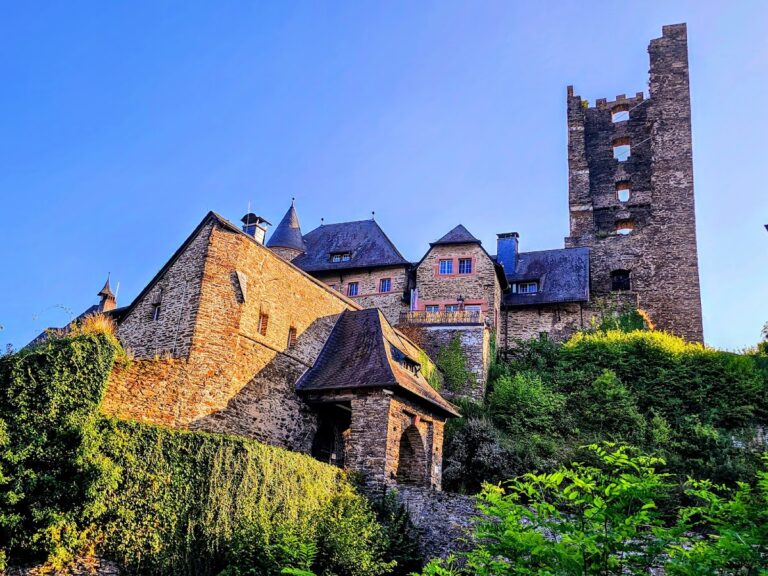
A square keep stands on the east side of the residential buildings. Known in German castle architecture as a principal defensive and refuge tower, it rises approximately 35 metres and was not designed as a permanent residence. Its massive walls contain small windows, and battlements crown the upper part.
Outer defenses
Bailey and defensive walls
The outer bailey occupies the slopes on two opposing sides of the upper castle and follows an irregular plan. Its defenses include several levels of walls, towers, a ring wall, and a fortified space between defensive lines that exposed attackers to fire from the defenders. The external fortifications, including the ring walls, have been restored, while nineteenth-century rebuilding preserved substantial original masonry and retained elements of the ruin character.
Later defensive structures
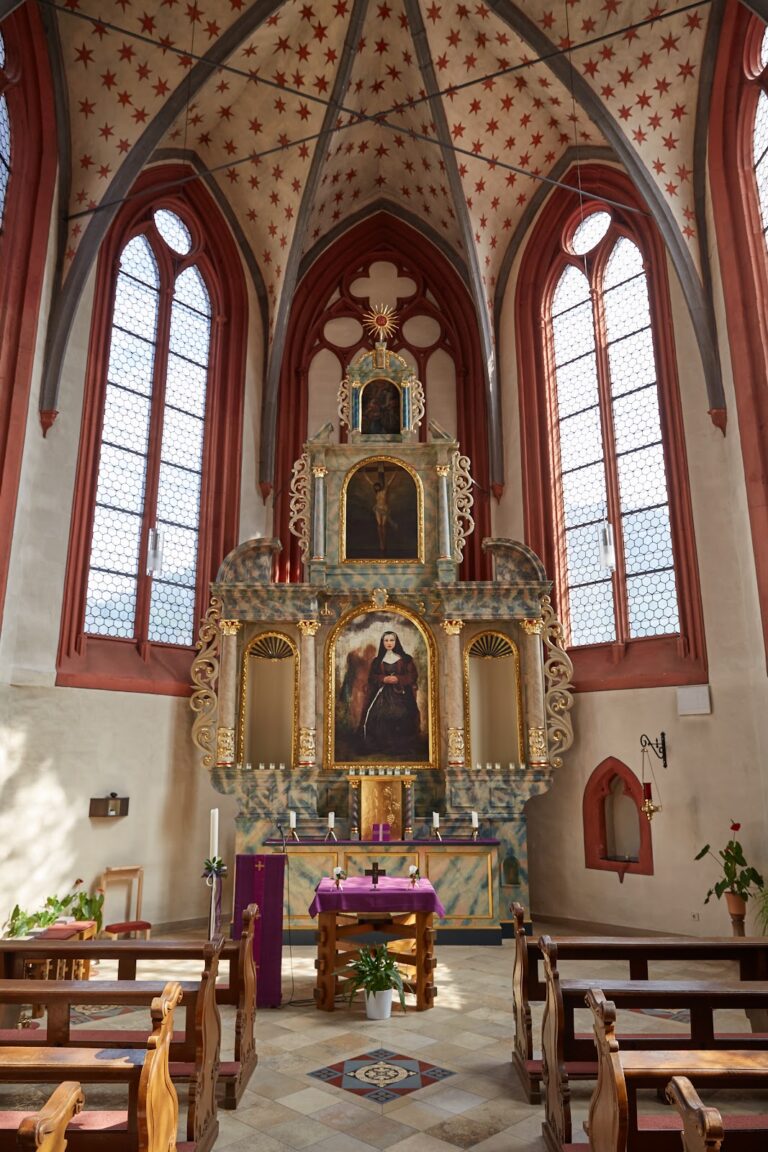
The western part of the outer bailey has a Renaissance character, although Gothic forms dominate the castle as a whole. Its paired windows have shapes influenced by Romanesque architecture. A chapel formerly stood on the northwestern side of the outer bailey. During the Thirty Years’ War, a rounded artillery fortification with a cellar was built west of the main castle to strengthen its defenses.
Vineyard terraces
Extensive vineyard terraces cover the slopes at the foot of the castle. After restoration began in 2008, the terraces were replanted with new vines, preserving their physical connection with the fortress and its setting in the Middle Rhine wine-growing region.
Nearby sites