Sallustian Obelisk: A Roman Imitation of an Egyptian Monument in Rome
Site at a Glance
- Rating
- 4.6
- Popularity
- Low
- Country
- Italy
- Primary era
- Classical
- External website
- Open
- Eras represented
- Classical, Early Modern
- Civilizations
- Papal States, Roman
- Site type
- Civic
- Remains
- Obelisk
On this page9 sections
History
The Sallustian obelisk is a Roman-period monument in Rome, Italy, modeled on ancient Egyptian obelisks and probably made in the second or third century. One hypothesis connects its quarrying at Aswan around AD 270 with Emperor Aurelian, who ruled from AD 270 to 275, but its precise date and original commissioning remain uncertain. The monument was brought to Rome after the reign of Augustus and later placed in the Gardens of Sallust on the Pincian Hill.
From the Gardens of Sallust to medieval ruins
Ammianus Marcellinus recorded that the obelisk arrived in Rome after Augustus, without giving a more exact date. It was probably erected on the spina, the long central barrier of a Roman circus or racetrack, in the Circus Sallustianus. This private circus formed part of the imperial gardens, which had originally belonged to the historian Sallust and later became associated with the Ludovisi family.
After the decline of the Roman Empire, the obelisk fell and eventually broke into several pieces. It remained among the ruins of the gardens for centuries. In the sixteenth century, Pope Sixtus V included it in a plan to move the monument to the front of Santa Maria degli Angeli e dei Martiri, but the proposal was never carried out. During the seventeenth century, Athanasius Kircher noticed that its inscription resembled that of the Flaminian obelisk and suggested restoring it to Pope Alexander VII.
Eighteenth-century relocation
The Ludovisi family recovered the monument in the eighteenth century and donated it to Pope Clement XII in 1734. Clement had it transported to the area of the Basilica of Saint John Lateran, where it lay horizontally and remained uninstalled for about fifty-five years. Negotiations also considered sending it to Paris for placement before Notre-Dame Cathedral.
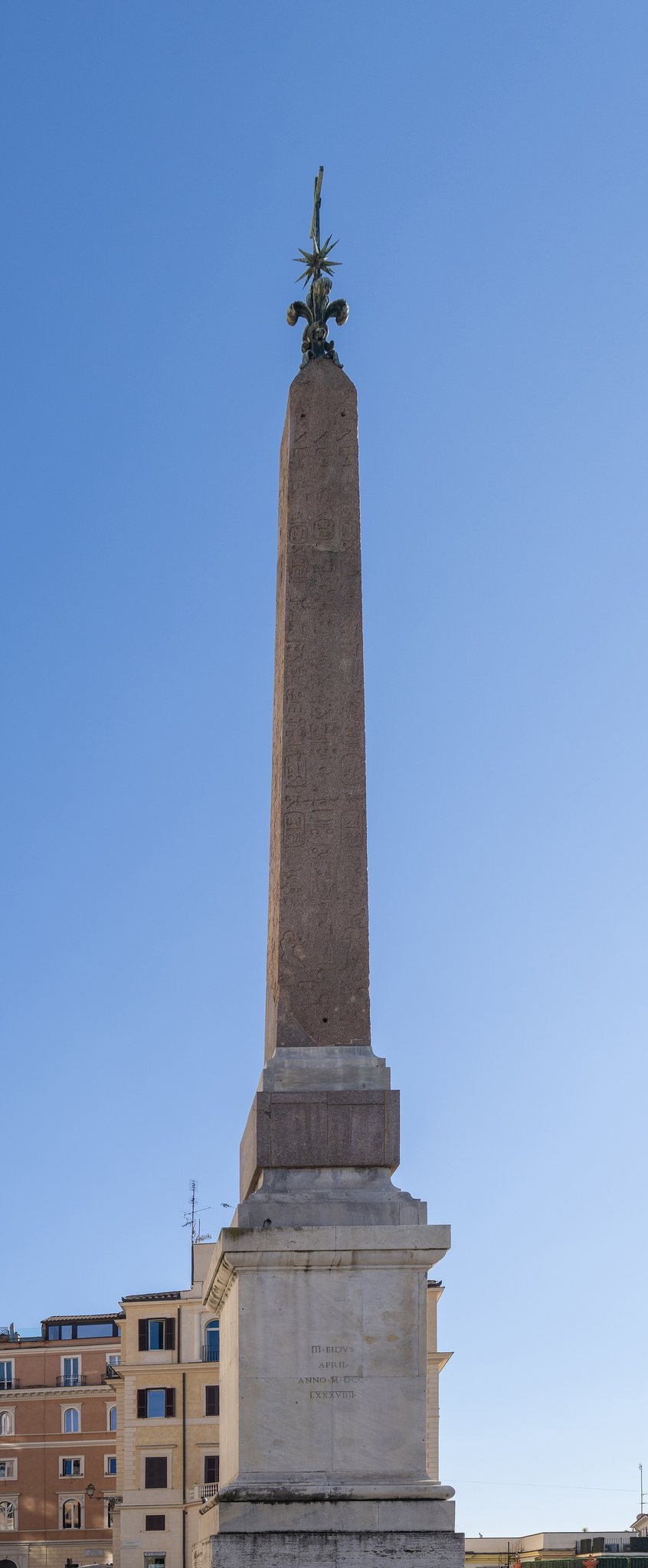
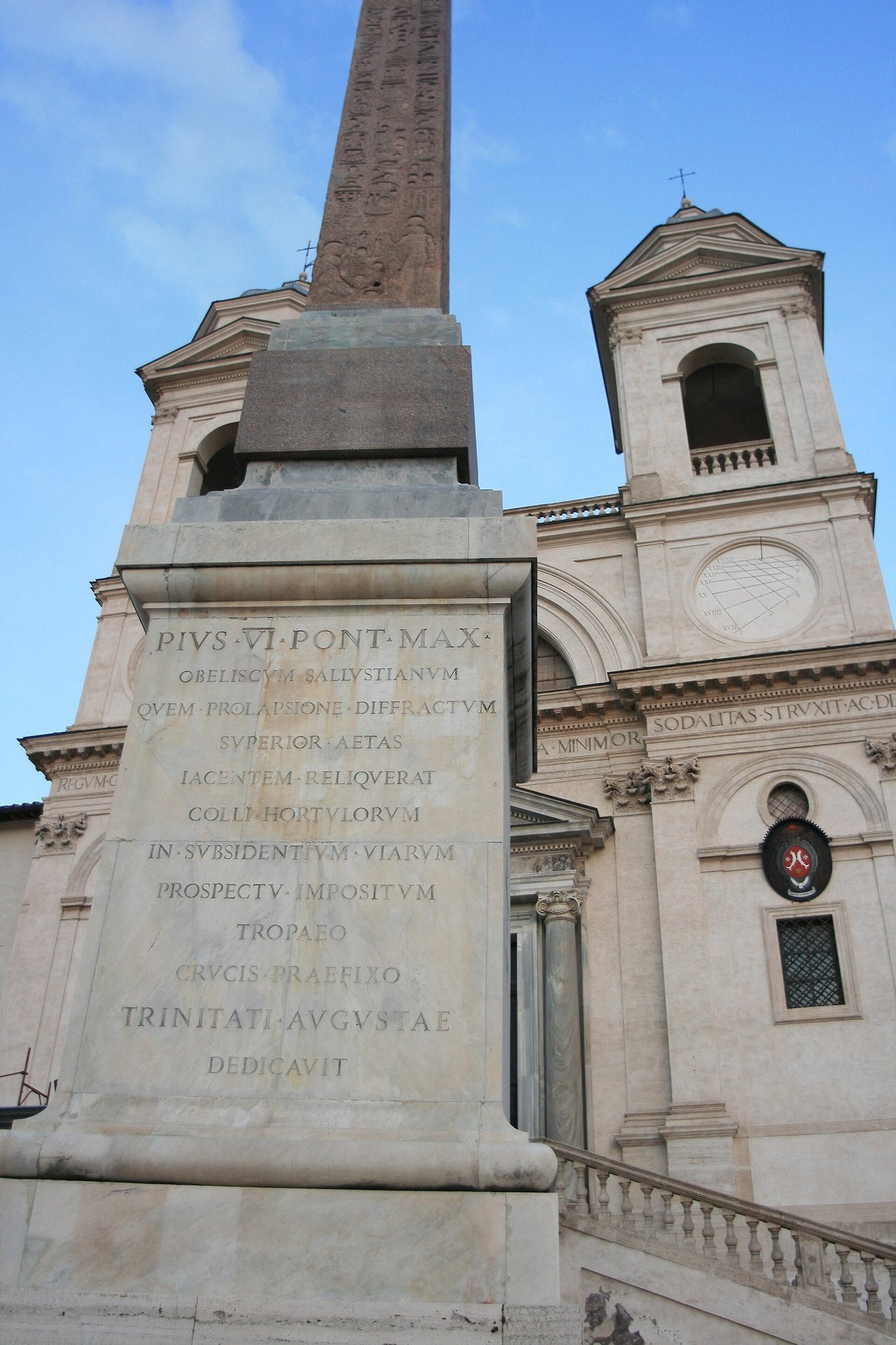
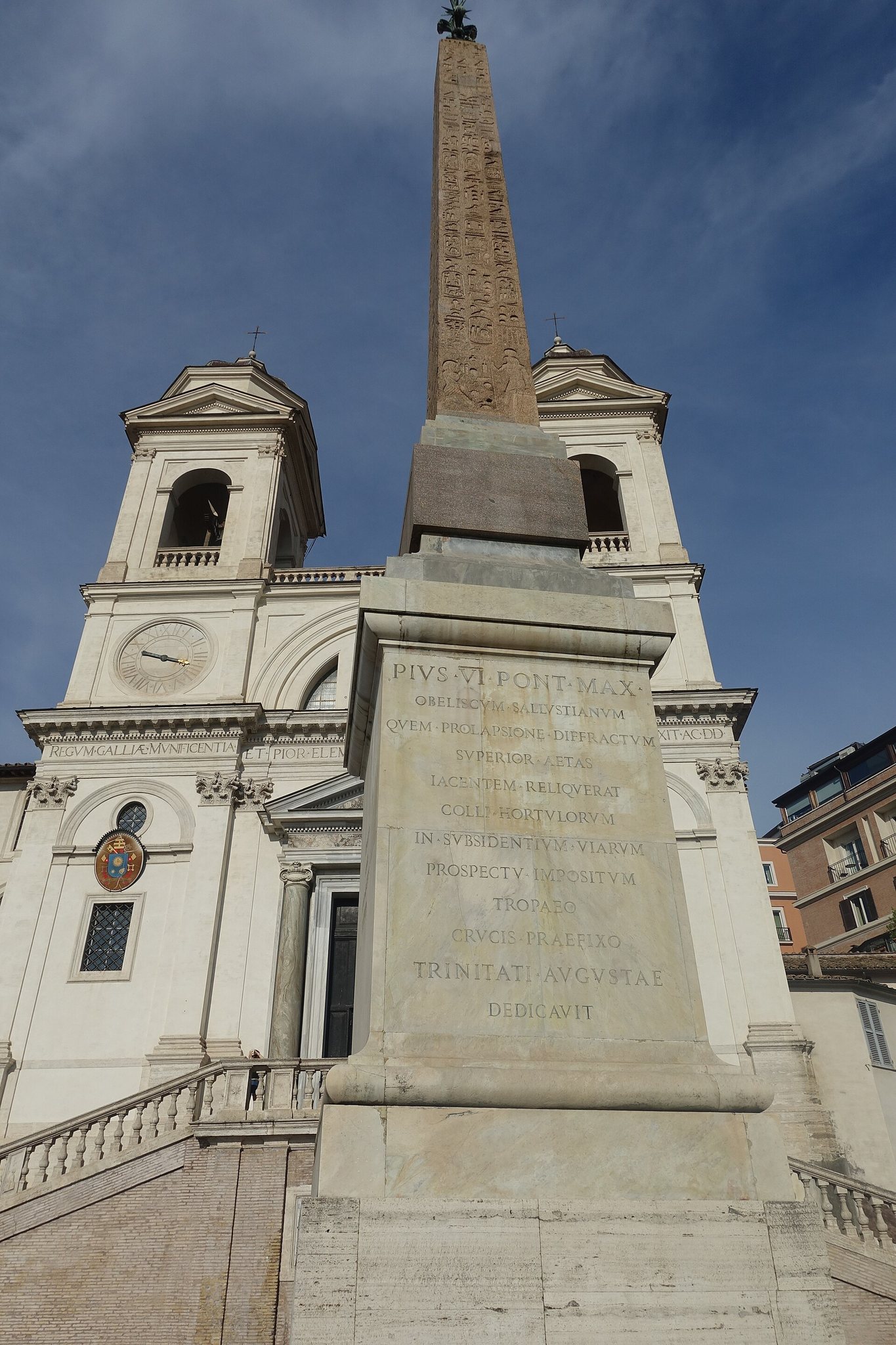
Pope Pius VI ultimately ordered its relocation and re-erection during works carried out from 1787 to 1789. Giovanni Antinori directed the installation, completed in 1789 at the summit of the Spanish Steps before the Church of the Trinità dei Monti. France had financed both the church and the Spanish Steps, so the obelisk’s position became part of a dispute over the symbolic prominence of the French monarchy and the papacy. Its upper decoration consequently incorporated the French royal fleur-de-lis, a stylized lily used as a heraldic emblem. Although the relocation was controversial, the quality of the completed work later won acceptance.
The monument is traditionally linked with lunar worship and is sometimes called the Lunar Obelisk. Its eighteenth-century re-erection was dedicated to the Holy Trinity. The original granite pedestal was found in the former Gardens of Sallust in 1843, separated from the shaft. It was moved to the Villa Ludovisi and later incorporated into a monument commissioned by Benito Mussolini in 1926 for those who had died during the March on Rome of 1922, the Fascist seizure of political power in Italy. The pedestal became the Ara dei Caduti Fascisti on the Capitoline Hill. After the Fascist regime fell, its marble decoration was removed, the block was inverted, and it was moved elsewhere within the Capitoline area, obscuring its earlier commemorative use.
Remains
The monument now stands at the summit of the Spanish Steps before the Trinità dei Monti. It consists of a tall red-granite shaft, a marble pedestal made for the eighteenth-century installation, and a bronze upper finial. The shaft is monolithic, although it was broken and later reconstructed, while the original granite pedestal remains separated from it.
The granite shaft
Roman imitation of an Egyptian form
The shaft measures 13.91 metres in height and was carved from red granite quarried at Aswan. It was brought from Egypt to Rome without inscriptions and was later carved in Rome. Its hieroglyphic texts imitate those on the Flaminian obelisk, particularly the inscriptions naming Seti I and Ramesses II, pharaohs of Egypt’s Nineteenth Dynasty during the late second millennium BC.
The copied signs were not reproduced accurately. Some are reversed, inverted, or otherwise incorrectly formed, showing that the Roman craftsmen were reproducing the appearance of the Egyptian texts without understanding the hieroglyphic writing. The shaft, pedestal, and upper finial together give the monument a height of 30.45 metres.
Pedestal and upper finial
Modern marble support
The current marble pedestal was created for the obelisk’s installation at the Spanish Steps. The original support was a single block of granite discovered buried in the former Gardens of Sallust in 1843. It was never reunited with the shaft and later acquired a separate commemorative history on the Capitoline Hill.
Bronze finial
The bronze finial at the top consists of a fleur-de-lis supporting a cross, together with a starburst and a small pine cone. The cross is said to contain a fragment of the True Cross and relics associated with Saint Joseph, Saint Francis of Paola, Saint Pius V, and the apostles Peter and Paul. Including this finial, the re-erected monument reaches its present height of 30.45 metres.